We’re wasting ourselves

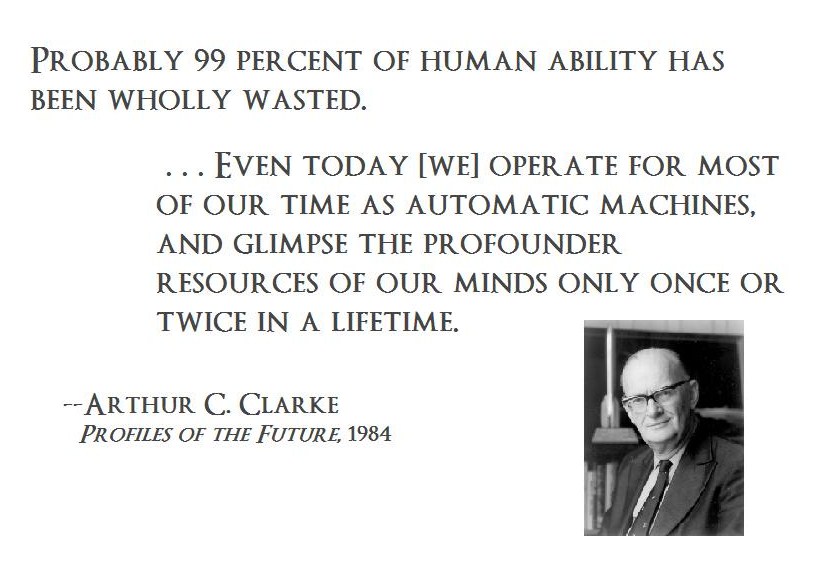
This morning while rereading Hugh Nibley’s essay “Zeal Without Knowledge,” I came across this quote from Arthur C. Clarke. While I don’t agree with everything Clark believed–he was a provocative philosopher in his own right–I do appreciate this:

arthur c clarke quote

In preface to this, Hugh Nibley wrote:

sin is waste

Drat.

Means I need to get off of Facebook again.

(And yes, I am working on Book 5, the title to be released soon.)

Why English as a major is dying

Some years ago I was hired on as an adjunct composition instructor at a public university in the Carolinas. (We’ll allow this English department to remain anonymous.) At the faculty meeting held a couple of weeks before school started, several agenda items had to be addressed. After the usual introductions, someone of importance stood up and announced, “First order of business: the censorship of the freshman reading selection!”

That caught my attention in what would normally be a dull meeting wherein I’d fill half a page of doodles.

Each year the university assigned a novel for incoming freshmen to read in hopes of having an “intellectual discussion” between students and faculty during orientation. (Nice idea in theory, but in reality it usually fails.)

Just days before our meeting, a few parents had objected to the book choice, citing its violence and a few questionable scenes. I’d never heard of the book before (again, we’ll let it remain anonymous) but according to Amazon it was a “coming of age” story about a college student who was hazed. Today I looked it up again to refresh my memory and saw that it never became a best seller since interest in it died off quickly. Its couple dozen reviews hovered around a “3” calling the book dull, unrealistic, and lacking substance.

Freshmen college students procrastinate reading this kind of stuff, especially in their last summer before college begins. 

Which likely explains why, just the week before they were to come to campus, freshmen students were finally picking up the book, not liking what they saw, and complaining to their parents.

Those parents then complained to the administrators, who, afraid of upsetting those parents who paid for their students’ tuition, agreed to pull the book as required reading.

Which in turn enraged the English department. “Censorship!” they cried.

It occurred to me that telling students they didn’t have to read a book (which most of them wouldn’t have read anyway) didn’t constitute “censorship.” No one was insisting that the books be destroyed, or planned to burn them in the commons area. They just didn’t want to read something that offended their sensibilities.

But no! insisted the English Department. This called for action! This called for a . . . for a  . . . STATEMENT!

I nearly guffawed at that, until I realized that the 60 or so faculty around me found that an entirely excellent way to Make a Stand.

Snickering quietly to myself, I then watched the most absurd display of bureaucracy. First, a committee had to be formed to write The Statement. That took half an hour, with several rounds of voting (my memory wants to say it was anonymous and with eyes closed, but maybe I’m just remembering “Heads Up, Seven Up” from elementary school), and finally a small committee was selected, and a chairman was decided, and times were set up for faculty to confer with them concerning The Statement.

(Not an actual self-portrait, but pretty darn close.)

I would have been bored silly—I was there only to pick up a copy of course policies and find out what text I was to use—had I not been so entertained by the seriousness of the process, the lengthy explanations tossed about, and the excessively self-righteous language used to tear down the self-righteous who didn’t like the book selection. (It was pretty clear which faculty helped choose it, and were personally offended.)

After that entire fiasco, which took the better part of an hour, was completed, the next item on the agenda was, How to get students interested in becoming English majors.

I know I snorted out loud then, but covered it with coughing or something, because just moments before I was thinking, “Why the heck am I here? Why did I ever once think becoming a full-time professor would be fulfilling? They’re accomplishing nothing of importance! And just look at my notes: I’ve written, ‘Get me out of here’ over and over! What 18-year-old, in his or her right mind, would watch these proceedings and think, ‘Hey, awesome! I want to be part of that!’?

The next excessively dull half hour was spent in another tidal wave of predictable “let’s have luncheons” (as if college students in this century do “luncheons”) and “let’s demonstrate how valuable an English degree is” (I was struggling to see how mine was useful) and “let’s have an open house” (seriously? An open house? To demonstrate what?).

At some point I probably blacked out from sheer boredom because I have no recollection of when or how that meeting ended. I just know that I wanted to leave, leave, leave.

Oh, and The Statement?

Five people spent two full days writing and rewriting it. And when they finished, they put a copy in each of our mailboxes.

Four pages, single spaced.

That’s no “statement.” That’s a constitution for a fascist country.

I tried to read it.

Really, I tried.

My master’s degree is in rhetoric, but I could NOT get through it. So full of jargon and big, scary words, and sentences that went on and on and on pointlessly . . . I couldn’t even understand the first paragraph.

The Statement Committee threw a new fit of fury the next day when the school newspaper wouldn’t print the statement in its entirety.
They wanted a “blurb.”
Hey, who didn’t?

The local newspaper wouldn’t even touch it. I’m sure they didn’t even know what it was about. I sure didn’t.

I stared at the monstrosity and knew, right then and there, that English as a study was committing suicide.

What happened to writing directly? Plainly? 

I wrote several versions of a statement in my head that day. One went something like this: The point of college is to expose ourselves to new ideas and experiences. We in the English department are disappointed that some of our incoming freshmen are choosing not to do so.

That’s a “statement.” Two or three sentences: something pithy, something tweetable.

Fortunately my husband was offered a job across the country, and just three weeks later I bailed out and moved far away from that stuffy soup.

Today Grammarly posted this cartoon below, which brought back those memories. I commented about my experience, and someone wrote back that he left an English site because it had become a “competition in obfuscation.” Amen! (By the way, “obfuscation” means “to confuse.”) 

Years ago I thought English was the pursuit of reading books and poetry, analyzing others’ perceptions of the meaning of life, and then sharing those ideas with others. The point, I thought, was to try to make life bearable.

 David Masciotra wrote in The Daily Beast,

“Any lover of literature . . . knows . . . it is the enchantment of experiencing life through the consciousness of another human being, albeit an invented one, and gaining unique access to the vantage point gained by entering the mind of its inventor.”

But that’s not what I’ve been seeing.

Instead, my (admittedly) very limited experience is that many professors in English departments try to prove their worth in ever-deepening holes of thought where no one really wants to go. I remember a student in my grad school classes who was unquestionably brilliant, and you could see our professors stiffen every time he opened his mouth and said, “I posit that . . .” What followed next would be a length of jargon and rhetoric that none of us in the class could follow.

In fact, I think that’s when I started doodling in the margins.

Verlyn Klinkenborg wrote this about college students in The New York Times:

“They can assemble strings of jargon and generate clots of ventriloquistic syntax. They can meta-metastasize any thematic or ideological notion they happen upon. And they get good grades for doing just that. But as for writing clearly, simply, with attention and openness to their own thoughts and emotions and the world around them — no.”

His point was to show that students can’t write directly, and even he struggles to state that directly.

This isn’t a new trend, either. In the 1990s, the late Denis Dutton hosted the Bad Writing Contest for professors, and many of the “winners” were English professors.

Steven Pinker believes academics communicate horribly for a number of reasons: trying to impress their readers, to prove they actually know something, and getting caught up in the language itself. But, mostly, he says,

“There are few incentives for writing well . . . In writing badly, we are wasting each other’s time, sowing confusion and error, and turning our profession into a laughingstock.”

Yep. So glad my daughter’s majoring in nursing.

It took Mahrree a couple of weeks, but at the “bottom” of it all was a list she made to elucidate and disambiguate—
Clarify  what the Administrators were advising. Whenever she got stuck or tired trying to decipher the intricately convoluted—
Needlessly complicated language, she asked Perrin for ideas, and also received a few more insights from Shem. She discovered that the changes in instruction were only an advisement—for now. In the nebulous “near future” it would all be compulsorily mandatory—
Unavoidable.

~Book 2, Soldier at the Door

We adults have ruined the world for our kids

Once again someone has sent me a trite old email about “How great things were in the past!” and “How awful things are today!”

Surely you’ve seen these before, the less-than-subtle comparison that when we were kids we knew how to be kids, unlike kids today who are pathetic pansies.

However, there are two major problems with such grossly inaccurate nostalgia trips: 

1) Life was never as good as we remember it, and;

2) If we don’t like the way life is for our kids, we—their parents and grandparents—are to blame.

First, let’s look objectively to some of the ridiculous claims about how we “survived” and are somehow inherently “better” than the younger generation.  Many pieces like this one detailed below float around, but since this is the most comprehensive, we’ll use it to demonstrate the selective memory problems so many in the older generations suffer from. This one is called:

TO ALL THE KIDS WHO SURVIVED
The 1930’s 40’s, 50’s, 60’s and 70’s

(From: http://www.corsinet.com/braincandy/hage5.html)

First, we survived being born to mothers who smoked and/or drank while they carried us. So there’s no problem with mothers smoking and drinking during pregnancy? Or are you willing to admit that no, not everyone emerged as “good” as you?

They took aspirin, ate blue cheese dressing, tuna from a can, and didn’t get tested for diabetes. And they also had a lot more problems during childbirth as a result. But you don’t remember your birth, so obviously this detail doesn’t matter.

Then after that trauma, our baby cribs were covered with bright colored lead-based paints. Lead-based paint causes problems in mental acuity, which the author of this piece of propaganda demonstrates all too well.

We had no childproof lids on medicine bottles, doors or cabinets and when we rode our bikes, we had no helmets, not to mention, the risks we took hitchhiking. And the author also doesn’t remember that children died from poisonings at higher rates than they do now, and that many children suffered from brain damage or worse when they crashed on their bikes. There were consequences. Although brain damage causes us to forget . . . 

As children, we would ride in cars with no seat belts or air bags. And the families who died in car accidents back then aren’t around to explain how seat belts and air bags would have saved their lives.  

Riding in the back of a pick up on a warm day was always a special treat. Stupid, but special. Again, loss of memory=brain damage. (Or marijuana use. Go ahead–ask Grandpa about the drug culture of the 60s and 70s.)

We drank water from the garden hose and NOT from a bottle. So why don’t you let your grandkids drink from the hose?

We shared one soft drink with four friends, from one bottle and NO ONE actually died from this. No one dies now, either. It’s usually kids’ parents and grandparents who freak out about them sharing. 

We ate cupcakes, white bread and real butter and drank soda pop with sugar in it, but we weren’t overweight because WE WERE ALWAYS OUTSIDE PLAYING! But an enormous amount of the adult population is overweight now, because you never outgrew drinking soda and eating sugar. Type 2 diabetes, anyone? Everyone?

We would leave home in the morning and play all day, as long as we were back when the streetlights came on. So why did you create a society where your kids and grandkids can’t have such freedom? Why do you call social services when you see kids walking by themselves to a nearby park?

No one was able to reach us all day. And we were O.K. It’s not kids who buy cell phones to carry around; it’s their parents.

We would spend hours building our go-carts out of scraps and then ride down the hill, only to find out we forgot the brakes. After running into the bushes a few times, we learned to solve the problem. But when your kids/grandkids ask to use supplies in the shed, you yell at them to not make a mess, not make any noise, and go to their rooms and be quiet. So they turn to their games . . .

We did not have Playstations, Nintendo’s, X-boxes, no video games at all, no 99 channels on cable, no video tape movies, no surround sound, no cell phones, no personal computers, no Internet or Internet chat rooms……….WE HAD FRIENDS and we went outside and found them! So why do you now yell at the neighbor kids when they’re outside running around and making noise? Why do you call their parents and threaten to sic the cops on them for accidentally running across your lawn?

We fell out of trees, got cut, broke bones and teeth and there were no lawsuits from these accidents. Kids don’t file lawsuits; their parents file lawsuits. Why are you doing this now?

We ate worms and mud pies made from dirt, and the worms did not live in us forever. So why do you not let your own kids/grandkids explore this way?

We were given BB guns for our 10th birthdays, made up games with sticks and tennis balls and although we were told it would happen, we did not put out very many eyes. Kids don’t call the cops on other kids with BB guns. Adults do that. Why did you change?

We rode bikes or walked to a friend’s house and knocked on the door or rang the bell, or just walked in and talked to them! So stop accompanying your children, or telling them to use a phone, or tell them that you don’t want them out on their own.  

Little League had tryouts and not everyone made the team. Those who didn’t had to learn to deal with disappointment. Imagine that!! So now that you’re coaching these teams and have put your kids in these sports, why have you changed the rules?  

The idea of a parent bailing us out if we broke the law was unheard of. They actually sided with the law! So why don’t you respect the law anymore, and defend your precious “innocent” babies instead?

This generation has produced some of the best risk-takers, problem solvers and inventors ever! And has also produced adults that over-parent their children and limit their development. Why is that?

The past 50 years have been an explosion of innovation and new ideas. Surely you don’t think YOU’VE accomplished all of that, do you? Millions take credit for the work of just a few thousand. 

We had freedom, failure, success and responsibility, and we learned HOW TO DEAL WITH IT ALL! And yet you’re afraid to let your children and grandchildren have that same experience?

You might want to share this with others who have had the luck to grow up as kids, before the lawyers and the government regulated our lives for our own good. Ah, I see! Individuals don’t have any responsibility—it’s all the lawyers government’s fault!? You just claimed earlier to have “responsibility,” but only when it’s convenient? No, I’m sorry. You can’t pin all of these changes on the government. And how many of you are lawyers? We all have to take responsibility for how our children turn out.

And while you are at it, forward it to your kids so they will know how brave their parents were. And just how dramatically they changed the world you now live in. Yes, your parents and grandparents destroyed everything when they became grownups. Remember that when you choose their nursing home.

How many of us have naively imagined Thanksgiving looking like this? How often have we actually achieved it? Everyone smiling? Yeah, me too.

The problem is the “good ole days” never really existed. Even in the 1950s—a classical age many of our older generations hark back to—we knew this.

Morris Wright in 1957, wrote this about the beloved Norman Rockwell paintings that I’ve used in this blog:

“We might say that Mr. Rockwell’s special triumph is in the conviction his countrymen share that the mythical world he evokes actually exists. This cloudland of nostalgia seems to loom higher and higher on the horizon . . . and disappears from view . . . leaving the drab world of common place facts and sensations behind.” [emphasis added] (Approaching Zion, Hugh Nibley (1989), page 523. )

Here’s another plug for “Those were the good ole days” that never were.  https://www.facebook.com/1035wimz/photos/a.180388971978038.49555.121975634486039/871131596237102/?type=1

And another that touts many poor decisions as “ok” and “Hey, we survived.” However, I appreciate that she prefaced her list with this:

Now, as a parent myself, my own parents like to tell me I’m too overprotective.
“Really?”
“Well, you survived,” they say.
“Yep, but it seems like the odds were against me.” http://thestir.cafemom.com/big_kid/165499/21_Things_80s_Kids_Did

Another “We had it so tough but we also had it so great, so we’ll just ignore all the other bits.” https://amyunjaded.files.wordpress.com/2012/03/70s-80s.jpg

This one’s more balanced, with an interesting comparison of a few decades ago with today. There are advantages and disadvantages to both times, and let’s remember that. http://preventdisease.com/news/15/020515_10-Differences-Child-Grew-Up-70s-Compared-To-Today.shtml

Check out this video by Nature Valley Granola, and ask yourself: who bought all the gadgets for their kids and grandkids? Who’s responsible for teaching them how to really play outside? It seems that some adults are realizing that hey—all of this is our fault. And we’re also the solution. https://www.youtube.com/watch?v=is5W6GxAI3c

The next time someone older than 30 (yes, don’t trust anyone over 30!) sends you a nostalgic turn of the belly via email or social media, challenge them with this: Prove that life really was better “back then.” And don’t let them use only their hazy and selective memories. Make them use real data. 

Don’t worry. They won’t. They can’t. They’re still not sure what “Google it” means.

In many ways our society is far better than it ever was. Yes, we have huge and glaring problems—I rant about those enough, so I won’t do so here—but we’ve also done a few things right. For example:

We’re far more compassionate.

  • Many decades ago a relative of mine committed suicide. His grieving family was shunned, and even a basic burial was denied him. Today, we’re far more helpful to those suffering from mental illness, and we open our arms to love those left behind when someone loses the fight.
  • To those of various religions. Only fifty years ago this was a very Protestant country. Catholics and Jews were commonly snubbed. Ask your grandma about the fear of a Catholic John F. Kennedy running for president. Although we still have far to go, we tolerate others’ beliefs far better than we ever have. Mormons like me haven’t been run out of a state since the 19th century.

We’re far more accepting. 

  • Of different races. Seriously, we are. Ask anyone who grew up in the south in the 1940s and 1950s. Ask them what they remember about where the blacks and whites lived, and where they got drinks of water, and where they worshipped. We’ve made HUGE strides. The problems we have now are frequently manufactured and piddly in comparison.
  • Of homosexuals. The closet door has been open for a long time now.
  • Of different lifestyles. Just a decade ago anyone who was a vegetarian was snickered at. Now, a lot more people are looking to eat healthier, smarter, cleaner. “Alternative” is becoming “mainstream.” We’re less worried about “fitting in,” which is marvelous progress.

We’re far better about acknowledging and fixing problems.

  • Not so long ago, alcoholism was ignored. It was a condition whispered about, but rarely helped. Just ignore it and the problems will go away, was the shallow hope.
  • Oh, and advertisements used to feature doctors, babies, and even Santa to sell cigarettes. Admirable, very admirable.
  • Abuse in the home was also another “Don’t talk about” issue. Kids would come to school bruised and battered, wives (or worse, husbands) would have black eyes from “accidents,” and it was very rare that anyone ever stepped in to help.
  • Same with sexual abuse. We tend to think that’s a recent problem, but it’s not. Kids who were sexually abused in the 1970s were told to just “forget about it,” and their parents would as well. Employ the trusty, “Ignore it, and it’ll go away,” like that giant elephant in the living room which grows bigger and stinks more horrendously every day.

We’re far better at talking. 

About all those issues above, and many, many more. Some senior citizens think we talk too much—they derisively call it “gossip”—but frankly, I wouldn’t want to live in any other generation. Yes, we’ve got problems far worse than many of our ancestors faced, but we also are tackling them in ways they never dared.

“But the older generation, with its propensity to remember everything far better than it ever was, will be a harder sell.”  ~Chairman Nicko Mal, Book 3, The Mansions of Idumea

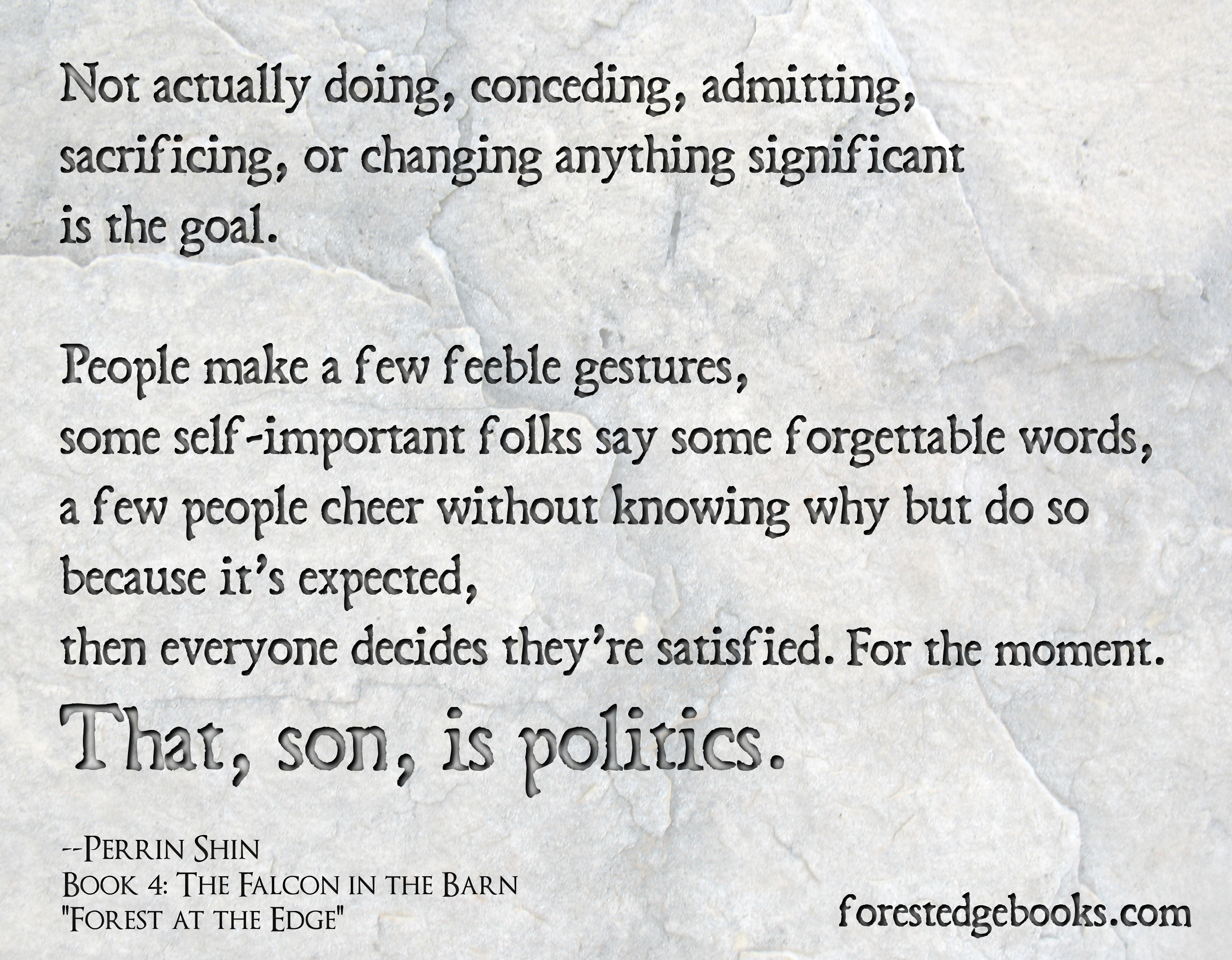
Please tell me Perrin and I aren’t the only ones skeptical about politics

I have to confess that with the election season already upon us, and with more than a full year to go, I’m already sharing Perrin’s skepticism about politics:

politics quote

I may go into hiding for the next 13 months. I’m still suffering from lingering trauma caused by the 2012, and I just can’t go through it all again. (See you all about mid-November, 2016.)

I nearly gave up because of half an ounce.

“Half an ounce?! No!!!”

I’m normally an up-beat person. My mantra over the past 15 years has been, “I will make this work!” It’s become a challenge to take whatever fragments I’ve been given and put them together into something I really didn’t think would function, but does.

But every once in a while too many of those fragments pile up. For some reason, it’s the little things that get me down, not the big ones.
etsy business card

My business card. Just print, cut out, stick in your wallet.

I have an Etsy shop, and because various websites have highlighted my Harry Potter clock and sock sign, and my Geek/Nerd clock, I’ve been successful enough to quit my part-time job. Now I stay home making products, devoting more time to homeschooling, cooking healthier, ghostwriting a biography on the side, and—oh, yes—editing book 5.

Several times a week I bring my labeled packages to my local post office, but last weekend the postal worker said, “Hold on a moment. We recently noticed a problem.” She put my package on the scale and it read one pound and barely half an ounce. “You’re just a tiny bit over. Anything over one pound puts your packages in the next price range.”

I was stunned. “But they’ve always weighed just under a pound!”

007

The digits of doom and despair . . .

She shrugged in sympathy. “Something’s changed, though. You’d be amazed how little things can add up.” She suggested I rework my shipping, and I went home worried and embarrassed. Had I been cheating the US postal service lately with packages suddenly too heavy?

And that’s when the spiral hit. Maybe you never do this, but a perfect storm of scenarios can make me sink rapidly. My despair spin looked like this:

  1. I’m done for.
  2. Because the packages are too heavy,
  3. my shipping charges will skyrocket, and,
  4. my profits will be cut dramatically, so
  5. I won’t make the money we need for the bills, and
  6. I’ll have to get another job again,
  7. because I’ll have to shut down my Etsy shop!

Those seven steps took me all of about 20 seconds.
It was just one of those days, when the weight of a tiny pebble hit me like a boulder.  By the time I got home four minutes later, I was utterly dejected. Having little hope, still I borrowed a scale from a neighbor (I have since bought my own) and, remembering my mantra, mumbled, “I’ll make this work.”

I came up with that phrase 15 years ago when we had our sixth baby and a foreclosure notice. Several months of little to no work meant we could no longer afford the house we thought we’d live in for the rest of our lives. No matter what we tried, we failed at. It felt like God didn’t want us to succeed, at least not there.

In desperation, I agreed to follow my husband who thought we should move to the other side of the country and try a different kind of life. We packed up whatever would fit in a U-haul truck, my little children said good-bye to their friends, we gave away some of our pets, said farewell to all of my family, and, with only a few dollars and a humble job awaiting us, we trekked to the east coast and moved in with his family who could offer us three bedrooms for our clan of eight.

Struggling with post-partum depression (my baby wasn’t yet two months old), financial disaster, and living in a state I didn’t know and with zero friends for our family, I miserably decided, “Somehow I have to make this work.”

And so for the next few months we tried. Because we were in a suburb of Washington DC, I took my kids as often as I could to the Mall and the museums, and tried to find ways to enjoy our new environment. But it was tough. Housing was impossibly expensive which meant we couldn’t find a place of our own, my husband’s commute was over an hour, and there wasn’t a mountain to be seen anywhere. But still I kept thinking, “I have to make this work. God sent us here for a reason, so I have to make this work.”

After a few months my husband was offered another job in a much cheaper area. He moved into the heart of Virginia, and five months later we were able to join him. That was possible because someone miraculously bought our former home the day before it was to be auctioned off. That same week an old house became available for us to rent, across the street from my husband’s work.

Commute time, one minute by foot.
virginia house

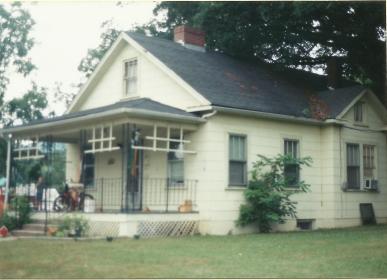
Our rental house in Buena Vista, VA. We were the last occupants of this magnificent home.

There were some catches, though. The house was officially condemned, to be torn down in a few months to make way for new construction. But until then, the owners agreed to let us live with mice in the attic, skunks in the crawl space, roaches in the kitchen, and vines growing through the siding into the house. When it rained, we set up buckets to catch the water. But, at $350/month, I knew we “had to make this work.”

And we did. I was so happy to be together as a family again, and in the dingiest house I’d ever lived in.

Miraculously, another five months later we moved into a brand new house which we loved for five years, and when we sold it we were miraculously able to pay off the debt we still carried from the old house we had lost.

Those were heavy weights to wield, but we made them work.

So why, several years later, did I freak out over less than an ounce of weight?

Sometimes the smallest things feel insurmountable, like the brick in my path which makes me fall to my knees and weep. But strangely, if someone were to throw a brick wall in front of me, I’d rub my hands together and say, “I’m gonna tear down that wall!”

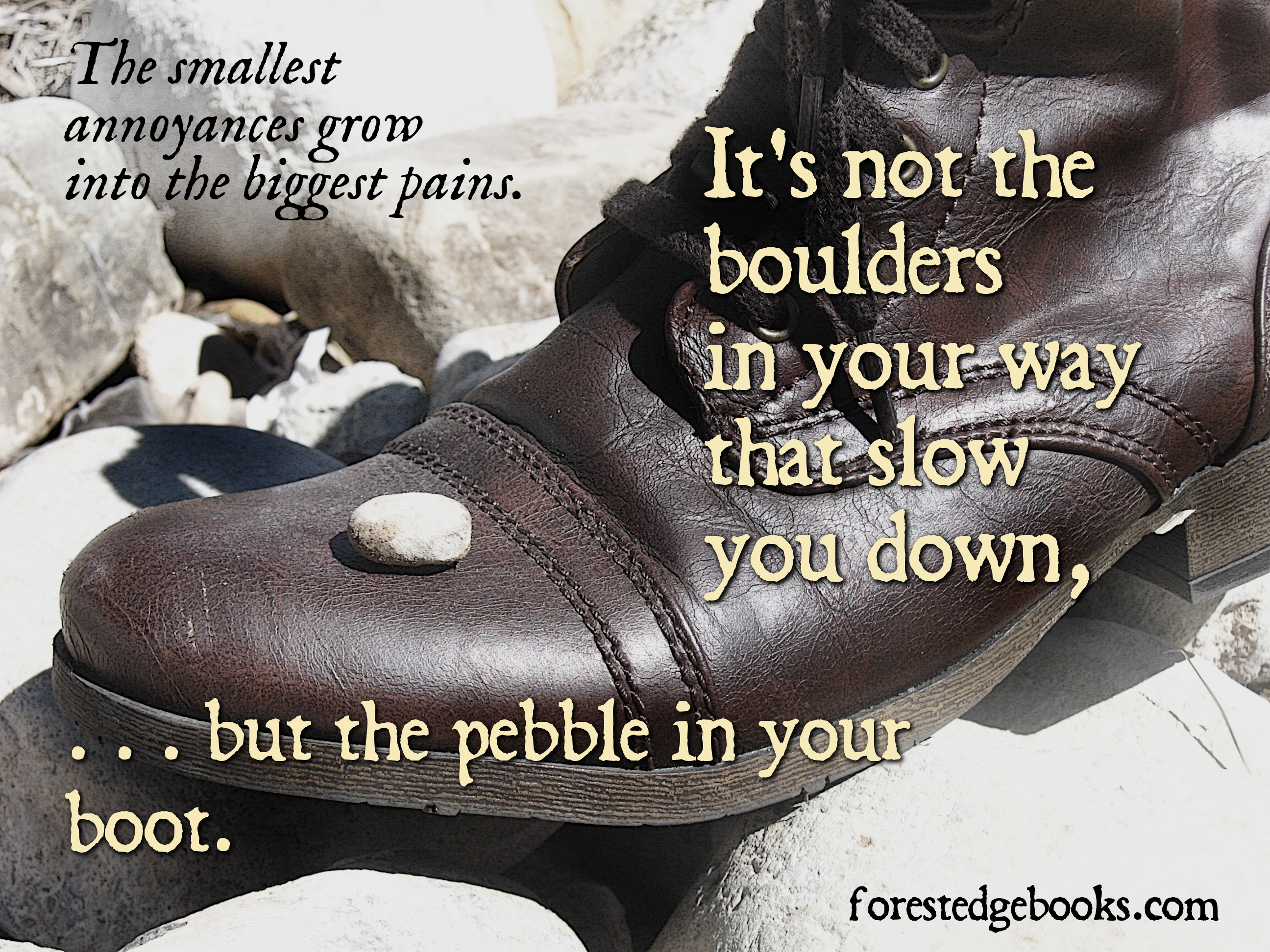
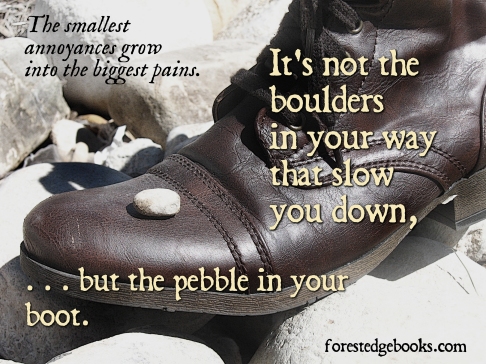
Maybe it’s the niggling smallness of it, the constant tiny bits that just wear us down. A pebble in a shoe bumping against the toes is much more annoying than a rock one has to climb over. Day after day after day, it’s the little things that just get to you. pebble and boot
I had a few dozen of those niggling issues last weekend, so hearing that I had “a weight problem” pushed me ridiculously to tears. “I don’t know how I’ll ever fix this! It’s all over!”

But still I worked it, because I just can’t bear to quit. I bought new packing supplies and weighed all of my products (identical items had different weights!) but still couldn’t find the problem. Aggravated, I thought, Fine! I quit! Which I really didn’t mean, but the words came clearly to my mind, “You’re going to quit over half an ounce? That’s not like you.”

No, it wasn’t like me, but I was being petty and indulging in a little pity party. I’d been working on major projects for other people, and hadn’t had time to spend on my own work. (Not regularly visiting Edge leaves me edgy.)

My next thought was, “You’re treating this like a ton, but you know it’s only half an ounce. You can beat half an ounce.”

Yes, losing our house and moving 2,000 miles away—that was a ton.

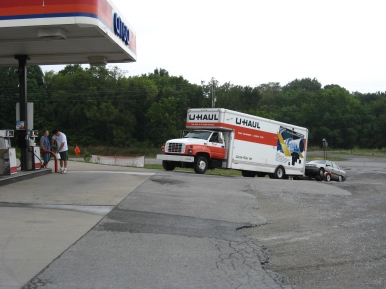
So was moving back west, which we did when our 8th baby was just four weeks old, and I drove our 15-passenger van all the way from South Carolina to Idaho in four days, and the U-haul my husband drove broke down every single day.
IMG_0728

The fuel gauge was also broken (along with the braking system), and this is where the truck stopped one day, out of fuel. Yes, just that close to the gas pump.

We’ve also again faced the crushing weight of under-employment, and the medium bone-breaking weight of medical bills, of debt, and of major appliances dying.

But here’s the weird thing: as I look back on those problems that fairly crushed or merely bruised me, I see that weight as only a few hundred pounds: difficult, but not impossible. We made it work! No big deal!

My perception has changed not just because of hindsight, but because we didn’t carry that weight alone.

Fifteen years ago I began to finally learn what Christ meant when he said “Take my yoke upon you, and learn of me; . . . For my yoke is easy, and my burden is light.” One day, about two months after we had moved to the east coast, I was so discouraged by our plight that I finally said out loud, “Dear Father, we moved, but we’re still in a mess. We can’t have a home of our own, my kids can’t find friends, and I really hate so many trees that make it impossible to see where I’m going! I give up. What do you want me to do?”

The moment that I said, “I give up,” something clicked. What I was “giving up” was having things my own way, and insisting upon my will.

That day I gave up all my expectations of what I thought my life should be, and I handed it all over to God.

Things began to change. I found myself praying for ways we could serve others, and a few problems quickly arose where all of us needed to help. While we were focused on helping others, we were much more satisfied with our situation.

Since that miserable-yet-important year, I’ve discovered that we can get by on much less than we expected. For example, our family of 10 once lived in another rental house for four months without a couch. We survived with three camp chairs in the living room and a few blankets on the throw rug which covered a wooden floor. It was far from comfortable, but we made it work.

I have to remember those days when the weight wasn’t as terrible as I thought. I especially needed to remember that last weekend when, after several hours of experimenting, I stared dumbfounded at my clocks and wondered how I could reduce packaging without increasing risk of breakage.

I kept reminding myself, “It’s only half an ounce. How dare I give up over half an ounce!” I felt like that scene in “Apollo 13” where they try various configurations to start-up part of the spacecraft without it going over a certain voltage, but they failed again and again.

Finally I headed into my bathroom to brush my teeth (somehow that always clears my mind) and as I did so I prayed, “Dear Father, this may sound silly, but I’m so frustrated. Why are my packages overweight now? How can I fix this?”

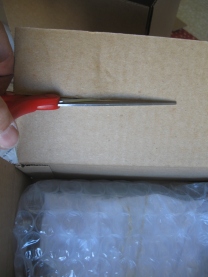
As I reached for my toothbrush the thought came clearly, “The boxes are overweight. They were made differently, and now they’re too heavy.” In my mind I saw myself cutting off part of one flap—enough to reduce the weight, but not too much as to compromise the structural integrity.
004

It’s embarrassing how many hours it took me to come up with this solution.

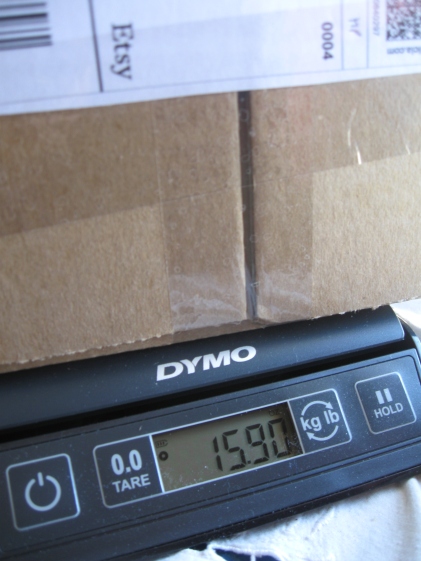
I ran back to the boxes (brushing teeth could wait), cut off half a flap, weighed it with my product and packaging and—yes! Removed all the weight I needed!
002

Magic numbers! Under 16 ounces!

“Really?! That was the problem? That’s the solution? We made it work!”
006

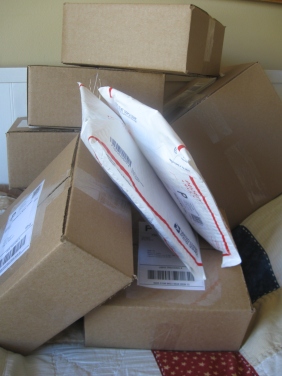
Ship ’em all out, Ethel–we’re good to go!

As I did a bizarre little dance celebrating that my business-which-was-never-out-of business was back in business again, I sent up a few prayers of gratitude as well.

I felt as if the heavens answered back, “You’re welcome, again. But you didn’t have to fret or despair. Why do you take upon you these burdens, then decide to heap on a few more just to make yourself fully miserable? No one’s asking you to do that. In fact, how many times have you read, Take my yoke upon you, and learn of me; . . . For my yoke is easy, and my burden is light?

Oh. Yeah.

Someday I just may remember that God can easily handle half an ounce, and also a full ton. And I’ll skip the part where I make myself miserable. Some day I’ll just instantly “ . . . drop my burden at his feet, and bear a song away.”

“Remember the saying, ‘The smallest annoyances—”

“—grow into the biggest pains.’” Perrin sighed and finished the familiar phrase. “‘It’s not the boulders in your way that slow you down, but the pebble in your boot.’”
~Book One, “The Forest at the Edge of the World”

Planned Parenthood and its Very Care-ful Language

[Warning: this post contains graphic–yet accurate–language. Discretion is advised.] You probably don’t want to know about any of this, and may have even avoided all discussion about the Planned Parenthood videos.

But you can’t.

You MUST to know what’s going on, and more importantly, why Planned Parenthood has gotten away with so much for so many years.

“It’s all in how you say it.”

That’s one of the many rules of rhetoric: the art of using language to manipulate your audience and hide what’s really going on. Ok, that’s not an “official” definition of rhetoric, but during my graduate coursework in rhetorical theory, that’s one of the conclusions I came to.

Words are not only great illuminators, but also great disguisers of the truth, shining light over here to hide in shadows something over there. Connotations are “the emotional impact” of a word, and Planned Parenthood chooses their words oh so carefully.

Look at “Planned” and “Parenthood.” Both are innocuous, even positive, words.  We’re taught at a young age to “plan for the future,” and “make a plan,” and “plan to succeed!” Planning is something thoughtful and deliberate. How could “planning” ever be negative?

Same for “Parenthood.” Throughout the centuries “parenthood” invoked notions of family, of responsibility, of maturity.

Stick them together, and the emotional feel of the name creates a sense of “thoughtful maturity.”

That, my friends, is the art of rhetoric. The phrase “Pro-Choice” is also deliberate. Logically, the opposite of “Pro-Life” would be “Pro-Death” (of the growing baby), but no one’s callous enough to claim they are “Pro-Death.” Instead, “Pro-Choice” becomes a harmless, yet highly deceitful, phrase. Because what Planned Parenthood does is destroy babies and potential parents.

While we could go into an extensive debate about the emotional effects of abortion on women (and even men), or the moral implications of abortion, for today we’re going to stick to the analysis of language used to describe the procedure itself.

I’ve watched all of the recently released videos concerning Planned Parenthood’s techniques and methods for selling body parts, and my first thought was, “This can’t be real.” Then later, to my horror, I realized that it was as I heard Planned Parenthood defending their actions in harvesting tissue (carefully chosen words).

As a mother of nine children (most not planned, but still happily welcomed) I was at first sickened by what I witnessed, but then the inner rhetorician in me was fascinated by the deliberate use of language by Planned Parenthood.

Planned Parenthood not only chooses their words based on connotations, but also employs many euphemisms. This is “softer language,” designed to lessen an impact.

For example, it’s rare to hear anyone say that a loved one “died.” Rather, we say that they “passed away,” or “are no longer suffering”; something gentle and careful, and maybe even a bit distracting or deceitful. Hospitals rarely have patients who die; instead, they may “code,” or “have coded,” meaning that a “code blue” had to be called for personnel to rush to resuscitate a patient because they . . . um . . . died.

We’re afraid to use the real and sharp words, because the emotional connotation can devastate those who hear and use them. Euphemisms are found everywhere—business, education, science, medicine (see an exhaustive list here http://www.euphemismlist.com/ ). Often euphemisms are needed to soften a blow and, sometimes, they’re even kind. But there’s always a component of misleading—subtle or obvious—and occasionally outright deceit.

Enter the “careful language” of Planned Parenthood. The hours that I’ve spent watching and analyzing the videos released to date were the most gruesome I’ve ever spent, and far more disturbing than any horror/slasher movie because all of this is real. (The only other time I’ve felt this appalled was when I studied the Holocaust in depth.) I have chosen only a few words and phrases to dissect—I mean, break down—for you to see Careful Language at work.

Phrases you may have seen/heard associated with the Planned Parenthood videos:

Words used by Planned Parenthood Connotation (emotional feel) Denotation (actual meaning, in terms of Planned Parenthood)
Procedure Very vague term: can be anything from open-heart surgery to save a life, to trimming one’s toenails Aborting a baby by forcing open a woman’s cervix, using forceps to grab the baby, then pulling it out to kill it and end the pregnancy.
Procurement Services Getting something for someone, perhaps even as a kindness (service) Giving (selling) dead babies for people to cut up and study
tissue Any random part of a body (or perhaps something you blow your nose into) Baby body parts
tissue donation Donation has a “charitable” feel, making anything that’s “donated” sound noble Giving (selling) dead babies to researchers
fetus (also specimen) Medical term for an undeveloped growth Very young baby, still growing, may even be able to survive if born as early as 22 weeks
calvarium Most of us have never encountered this word before The baby’s head
evacuation Generally, an urgent sense of “need to leave! There’s danger! Get out!” Pulling the unborn baby out of the mother’s body in order to cause its death and end the pregnancy
vacuum aspiration (which “gently empties your uterus” according the Planned Parenthood website) Oh, so a vacuum had hopes of becoming a Dyson? The method of literally sucking the baby out from the womb
“change the presentation” Some approach to explaining information isn’t adequate, so changing the presentation means replacing slides, etc. Twisting the position of the baby so that it can be pulled out more fully intact for the benefit of those buying its body parts
“intact fetal cadavers” Well, cadavers are dead bodies, so something about whole dead bodies? Whole, dead babies
“changes in technique to increase your success” everyone “changes techniques,” to improve their jumpshot or their piano playing or their piece quilting . . . Changing the way the forceps crush and pull out the baby so that more of its parts are usable by researchers
“induce fetal demise” Cause something to happen? Deliberately kill the unborn baby
“heart is still beating on aborted fetus” Umm . . . that can’t mean what we think it might . . . Yes, it does.
The baby was “aborted” but was born alive.
Then it was killed.
Outside of the mother.
Otherwise known as murder.

One more example which I took directly from a video: “If you maintain enough dialogue with the person who’s actually doing the procedure, so they understand what the end-game is, there are little things, changes they can make in their technique to increase your success”

Now translate that slew of jargon, clichés, and euphemisms into the hard language of the truth: “Tell us what body parts you want, and the person killing and pulling out the baby can give you what you want.”

Planned parenthood language

You get the idea. I apologize for the graphic nature of this post—wait, no I don’t. If we don’t fully understand what’s happening, then we’ll continue to be complicit and willfully naïve.

I refuse to apply gentle terms to something truly horrific.

That’s exactly what employees of Planned Parenthood do: immerse themselves in euphemistic connotations, and surround themselves with ideologies of “helping women” with “Care. No matter what.”

Does anyone else find those squishy words of their slogan, “No matter what,” just as chilling as I do? Fascinatingly, it’s also deliberately vague. Who receives the “Care”? And in defiance of “what”?

planned parenthood logo

Seriously, it’s the worst slogan ever because it means nothing, yet it’s also the most devious because it can mean anything.

But soft words do not hide the sharp truth of, “No matter what.”

While I am Pro-Life, I agree that there are very, very rare instances when an abortion is needed to save the life of a mother, or in the instance of rape resulting in conception. The entire premise of legalizing abortion decades ago was that it would be “rare.” Yet the Planned Parenthood website says, I assume to assuage the potential guilt of those looking into one, that “Abortions are very common. In fact, 3 out of 10 women in the U.S. have an abortion by the time they are 45 years old.“

We’ve conceived some of our nine kids at astonishingly bad times: when we were in college and had literally no money; when we were jobless; when we were losing our house to foreclosure; and when had no insurance and were essentially homeless and living with family. I admit I wept at times to realize I was pregnant yet again. But the idea of aborting that child never once occurred to me. In fact, I frequently look back and say, “Thank God that He sent us that child in the middle of the trials.” Life gets better.

Perhaps what amazes me most of all is that the vast majority of Planned Parenthood employees are women. Potential—and maybe even actual—mothers. Their coldness as they chatted about body parts over lunch stunned me. Their callousness at throwing around monetary figures, or referring to “patients” and “donations,” was dumbfounding.

The words of the apostle Paul to the Romans as he describes those who have denied God reverberates in my mind:
“Without understanding , covenantbreakers, without natural affection, implacable, unmerciful:” (Romans 1:31) [emphasis added]

These women no long have “natural affection” for babies. They are also “without understanding” and “implacable” [ruthless] and “unmerciful.” Abortion is all of those.

At least Paul didn’t bother with “soft words.”

There are no “soft words” for preying upon the most innocent and helpless.

Mahrree kept mulling over Perrin’s reasons for the garbled language: to keep the wrong sets of eyes from fully understanding. ~ “Soldier at the Door” Book 2

Four Reasons Why I Hate/Love Camping

Having just returned from four nights of camping in the cold wilderness, I once again wonder why we bother (as I put in the eighth load of laundry, with about ten more to go).

We camp primarily because it’s the only way we can afford to take our entire family anywhere.  This last week we camped with twelve people; one son was missing because he’s on an LDS mission. It cost us around $200 for the campsite and showers. That amount would barely get us two rooms for one night at a motel.

While it’s certainly cheaper, camping is a logistics nightmare—all meals, bedding, and cooking/cleaning/living supplies must be planned and packed. (We rarely camp anywhere within close driving distance of a Walmart; the point is to “get away from it all,” especially Walmarts.) It takes me a full two days before we leave to get everything ready, then another two days after to wash and put it all away again.

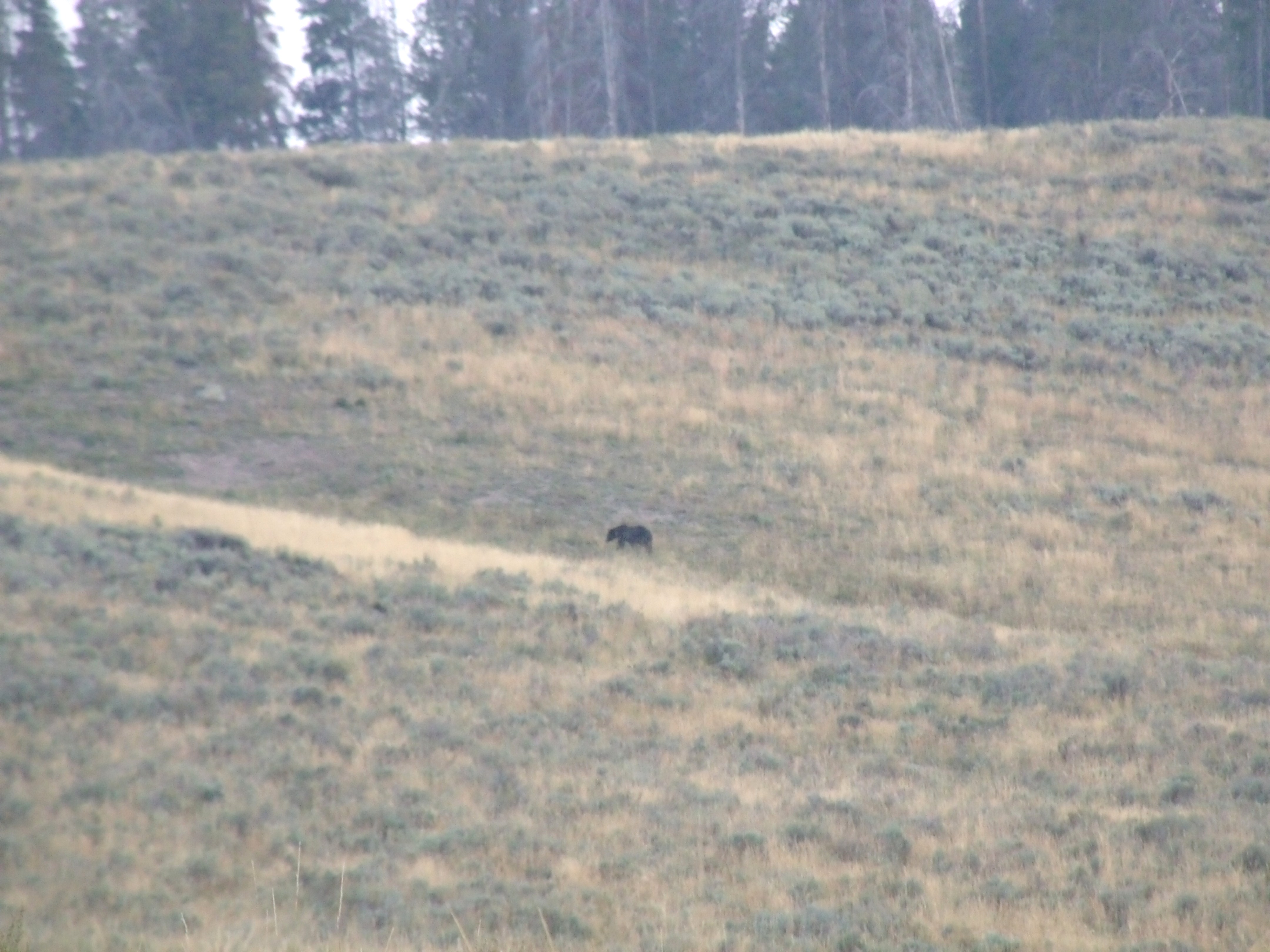
Every day I fret that I forgot something important: sunscreen or the phone charger or the string cheese. Each day there’s some minor disaster: a son contracting the stomach flu, or a baby starting to teeth, or two quarreling teenagers deciding they want to sacrifice each other to the nearest bear.

GEDSC DIGITAL CAMERA

(Fortunately this was the nearest bear, a grizzly still half a mile away.)

There is no such thing as a “relaxing camping trip.”

Camping is a physically, mentally, and even emotionally exhausting venture. (Did I mention there were twelve of us this trip? All trying to get along?)

So why bother?

Over the years of dreading camping, I’ve also discovered there are a few aspects that I love. It’s a fine line between “have to” and “get to,” and a slight shift in thinking keeps me willing to throw together yet another trip each summer. (Just never more than one, though.)

So here are my four reasons why I hate/love camping:

1–We have to/get experience nature.

  • We have to experience nature: It was bison mating season in Yellowstone last week, according to a park ranger.

Don’t worry–I turned off my camera when the action became a bit (ahem) active.

It was also squirrel mating season, according to the activity above our tents in the wee hours.

And also for the coyotes, who at 4am decided to call to each other for a romantic rendezvous about 100 feet away.

The great outdoors isn’t always so great. One night a massive thunderstorm hit, with lighting and thunder from 9pm to 11pm.

Yes, I timed it.

There was little else to do as I cradled our three-year-old son in our tent, he so terrified that he eventually fell asleep with his hands firmly over his ears. That’s when we discovered the tent was leaking, and the foam cushions we slept on were absorbing water like the spongers they were. Half of our family retreated to our vehicles, curled up on benches and bucket seats with their dry blankets, while the rest of us slept in ever-smaller sections of the cushions, looking for dry patches until dawn finally came.

When I woke up that morning, I was royally ticked off at Yellowstone. How dare it pour rain on me and my babies?! I took a walk to Yellowstone Lake to evaluate if the sky was clearing up, and was greeted by the most cheery and apologetic sunrise.

205

(I apologized to the geese for startling them, although they didn’t apologize for their ruckus at 5am.)

I had no choice but to forgive the park. The day was glorious, and by lunchtime we were completely dried out. That’s when I remembered that I actually enjoyed nature.

  • We get to experience nature: The little critters who scavenge our crumbs. 082

The bigger critters who wander placidly by. 148

The deep night sky punctured with more stars than we remember. The smell of trees, of earth, of water, of nature. You can’t get that rich scent from a candle, trust me. You have to sniff nature around the clock, and let it seep deep into your tissue. Everyone needs to suck up nature at least once a year, to find again our roots next to the roots of the pines. Last year we couldn’t afford to camp for even one night. My soul mourned that loss for an entire year.

  • Bonus: My standards of cleanliness are suspended for a few days, and my appreciation for vacuum cleaners skyrockets when we get home.
2–We have to/get to sleep outside.
  • We have to sleep outside. When I was a kid and we went to Yellowstone or the Tetons, we stayed in the lodges or cabins. Full working bathrooms were a must, as was a hot restaurant breakfast. “Roughing it” to my mother was a Motel 6.  One year I asked my dad to drive through the campground at Canyon to see what tenting was like. My mother shuddered in sympathy at the thin nylon tents, but I thought they were the most romantic things in the world!

Years later, when we took our four little kids camping for the first time in our new tent, I realized how silly my earlier notions had been.

The ground is HARD. The air gets COLD. Nature is NOT QUIET.

When we woke up —probably for the thirteenth time—after a miserable night to realize it was finally dawn, and I discovered that mosquitoes had thought my toddler’s forehead was tasty and had left over a dozen bites across his head, I wanted to burn that tent and all things associated with it. But my sisters and neighbors gave us suggestions (two-inch foam cushions are a MUST), and while I’ll never love sleeping outside, I do have a new perspective.

  • We get to sleep outside: There’s something very real and almost primal about being outside in the summer night. Some places we’ve camped the heat and humidity were nearly unbearable and we sweated all night. Other places, like Yellowstone last weekend, are shockingly cold (two nights were at 32 degrees at 6am). 212

But leaving my climate-controlled house for a few nights reminds me that the world heats and cools, rises and falls, inhales and exhales, and when I spend the night in it, I feel a sense of connection that I’ve lost being so sheltered. I forget that the earth is alive, and when I spend a full day and night in it, I remember it has a heartbeat.

  • BONUS:  The first night back, when I take a hot bath and slide into my cushioned bed, I feel like weeping for joy.
3–We have to/get to eat outside.
  • We have to eat outside. The first rule in camp food is, No matter how hot you cooked it, it’ll be cool and congealing in five seconds. There is no such thing as a warm meal outside, even if it’s 95 degrees. Nature abhors a hot dish.

Nature also likes to add protein to everything you eat. Just ignore the bugs that drop into your food, flail gamely for a few seconds, then give up and melt into the sauce (or create their own). It’s just easier to pretend the food was once hot enough to kill whatever germs they were carrying.

Outside in nature, things boil slower, burn faster, become charred on the outside while remaining pink and spongy in the middle . . . I’ve pretty much given up on camp cooking. Breakfast is cold cereal. Lunch is sandwiches. Dinner is canned beef/mosquito/dragonfly stew.

But sometimes it’s better than that.

  • We get to eat outside. People claim that camp food tastes better than regular food, but I think that’s only because you’re so desperate for sustenance that anything is good. But for me, food tastes blander in the wilderness (cold and congealing does that), yet still just about anything I cook is close to palatable.

Some things are just plain great, though. Tin-foil dinners, for one. Always our first night’s meal. I put them together at home the day before, and here’s the key: pre-boil the sliced potatoes and carrots until they’re half done. Then when you bake them in the fire with the hamburger patty, they’ll actually be fully cooked. Some of us like to toss in peas, or green beans, or spice it with Worcestershire sauce, or Montreal Steak seasoning.  I also bring shredded cheddar to toss over the potatoes, and ketchup to hide the congealing gray bits. It’s the easiest meal, with the easiest cleanup, and the only thing that tastes better are s’mores.

August 15, 2011 Crater Lake

Cleaning up after s’mores, well, that’s one of the trials of camping.

I have some kids who have perfected the roasting of the marshmallows. There should be badges awarded for that skill. Certainly it should be a criteria for marriage. Can she roast a perfect marshmallow?

Yep. She’s a keeper.

  • Bonus: After washing dishes in cold water in a small sink twice a day, loading a dishwasher at home feels like a luxurious indulgence.
4–We have to/get to live in interesting places.
  • We have to live in interesting places. Just as in real estate, the key to good camping is location, location, location. That’s the difference between becoming drunk on the beauties of nature versus becoming annoyed at your drunk neighbors.

A few times we have camped at private campgrounds, little more than grassy fields where tents and trailers were crammed together, and no one dared tell the boozers that belching contests past midnight were keeping awake the babies. We’ve even cut short some of our trips because the nature of the neighborhood felt downright dangerous. I’d rather face a hungry bear than a redneck who just discovered his buddy finished off the last six-pack.

Now we camp only in national or state parks. It seems that the more remote a place is, the more likely we are to find like-minded individuals who are there because they really love nature, not just a drinking party. If it were a formula, it may look like this: the correlation of quiet and respectful campers is proportional to the distance it takes to acquire more alcohol. I also unbiasedly believe that camping in the wild west is far better than the crowded east, where we encountered those private (and not-so-private) campgrounds.

Put it this way: if the pizza place will deliver to your campsite, you’re not yet “far enough away from it all.”

  • We get to live in interesting places.
103

Craters of the Moon. For some reason passers-by thought we were throwing lava rocks at each other instead of pine cones. I suppose the assumption is that all large families are weird. And trying to kill each other off.

On the flip side, camping in national and state parks—away from convenient pizza and beer—means that we sleep in fascinating areas. Besides Yellowstone, we’ve camped at Arches in Utah (where jackrabbits chewed through the electrical wires of our trailer), in Mesa Verde in Colorado (where we found pottery sherds in ancient midden piles which we turned in to astonished park rangers), in Craters of the Moon in Idaho (where we stacked lava rock into bunkers for a pinecone war) and in Nauvoo, Illinois (where we were startled the first evening to hear what sounded like distant angels singing . . . but it was a choir rehearsing outside for a later performance).

But the most magical place was Del Norte Coast State Park, California, in the heart of the redwoods. Our campsite consisted of mammoth ferns and massive tree stumps. For our Star Wars obsessed children, it was like living on the forest moon of Endor. You can’t get that kind of experience in any hotel.

August 18, 2011 Redwoods and Tidal Pool, CA

Now THAT’S a log to contend with! And to play “Ewoks Hiding” in.

August 18, 2011 Redwoods and Tidal Pool, CA

You can hardly see our campsite in the middle of the giant ferns and stumps.

  • Bonus: Our kids get an international experience without the international costs.
208

Don’t have to be in Europe to see European cars.

One more plug for Yellowstone: there’s nowhere in the world that feels as international as that massive park in Wyoming. I’d estimate that fully one-third of the tourists are from Asia, and of the remainder, less than half are American. That put us in the minority.

Our kids have contests trying to discern the languages we hear on the trails around us. Last week we heard Russian, German, Spanish, a few Slavic languages we couldn’t narrow down, a couple of Norse languages we weren’t too sure of, Chinese, Japanese, another Asian language that sounds like blue jays bickering with each other, and a multitude of accents: a man with a lilting French accent offered me the next use of the Laundromat dryer he was using for his wet sleeping bags, and the woman coming out of the outhouse in front of me commented on its condition in an Italian accent.

The Japanese tourist who was taking pictures of the sunrise right along next to me. (I’m betting that when my back was turned, he also took a picture of me taking pictures.)

As much as camping exhausts and stresses me, how can I deny such an adventure for my kids? In a way, it’s our civic duty to camp. In the sites around us were people from other countries experiencing “The American Vacation.” Certainly there needed to be at least one legitimately “American Family” demonstrating the proper way to tarp a tent or hang laundry lines for towels to dry, right?

Besides, there are additional bonuses for me: When I come home, I’m appreciate so much more hot water on demand, separate bedrooms, refrigerators that don’t require bags of ice, my wonky 75% operating stove, my old cracked microwave, my soft couches, my firm chairs, my washer and dryer that don’t require quarters, and a bathroom door that I can lock.

Maybe I camp to renew my gratitude for the luxuries I have, such as carpeting.

Maybe the entire point of embracing nature for a time is to come home and more fully embrace all that isn’t natural. You know, kind of a yin/yang thing? Good thing we camped next to Chinese. I’m feeling more well-rounded already.

Every neighborhood in Edge had the appearance of an adventurous fishing trip; people shared stories late into the night as they sat around fires roasting pieces of animals until the outsides were burned but the insides were still raw and chewy.

But Camp Edge included amenities most families weren’t accustomed to.  . . . Temperatures plummeted to near freezing. And, in the case of the Shin family, a long sofa appeared outside near the fire in the back garden.  ~The Mansions of Idumea, Book Three

Xeriscaping the Forest at the Edge of my Yard (a green and healthy obsession)

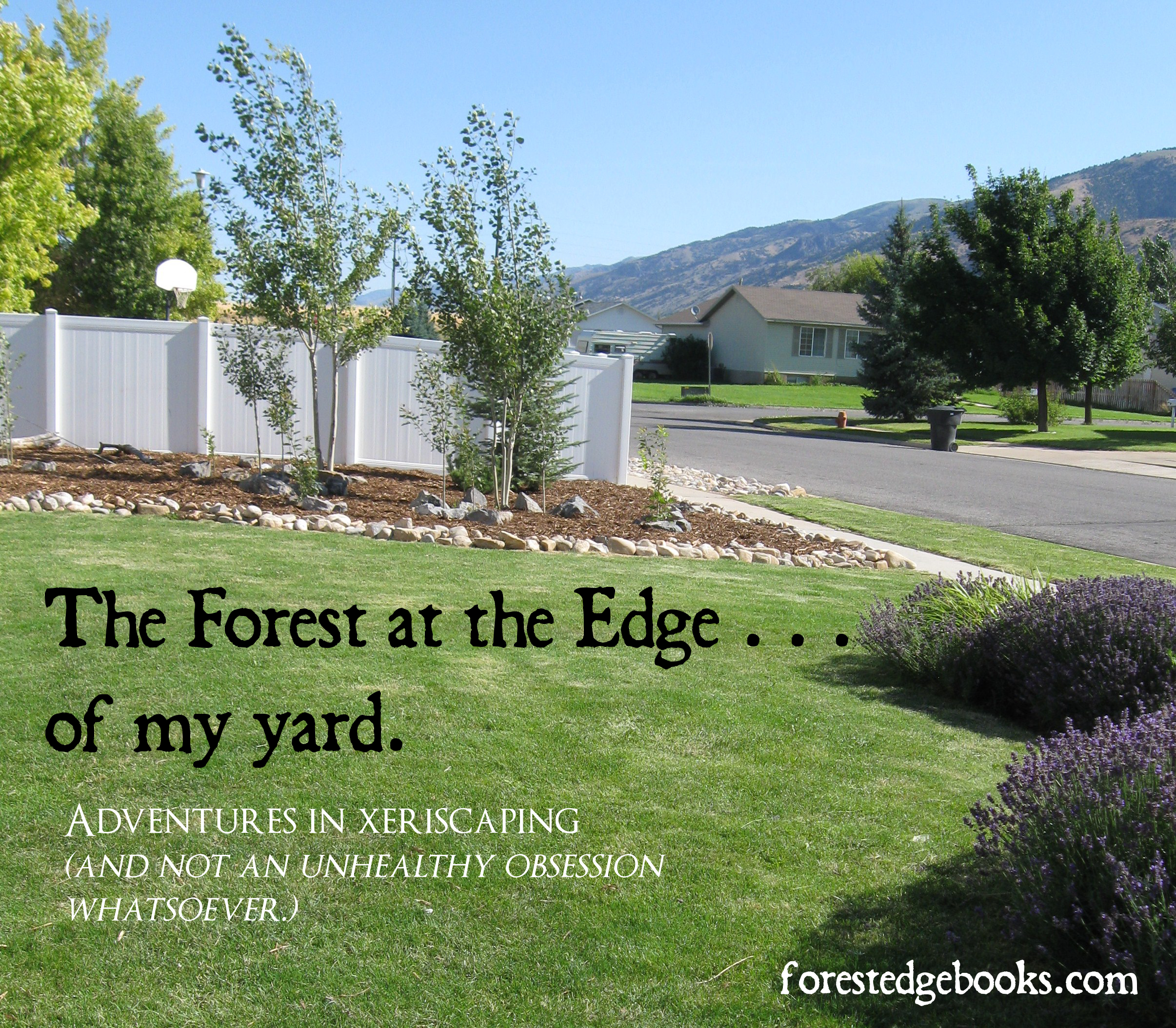
My neighbor stopped in front of my yard where we were moving rocks and mulch, and asked, “So where will the hotpots go? And the mud volcanoes?”

forest at the edge of my yard

I scratched my chin. “Haven’t figured that one out yet. But for Halloween I think I’ll put some dry ice and hot water out here.”

My husband stared at me, worried that the conversion of our front yard really isn’t about xeriscaping or conserving water, but that I really am so obsessed with “forests” and “edges” that I’m creating it in our very yard.

Only slightly. Maybe.

side view of forest

Our front yard used to be all grass with aspens, a couple pines, and rocks with fossils we picked up in the canyons. But my husband and I have always loved forests, so began the full transformation to creating a forest floor which requires no mowers.

yard in progress

For the several weeks that it took us to complete the project, neighbors would wonder what in the world we were up to. (“You’re killing your grass? On purpose?!”)

All in the name of xeriscaping, mind you. (Not “zeroscaping,” by the way.) We live in the second driest state of the country, after all, and watering so much grass is irresponsible, we thought. So we installed a drip feed system (not entirely xeriscaping, I realize, but certainly reducing the amount of water we use). The system feeds our trees and a few perennials such as shasta daisies, black-eyed susans, and vinca, which will look amazing next year.

003

(Look at the fossils in those rocks. And we just picked them up in the canyon behind our house. We live in an awesome area!)

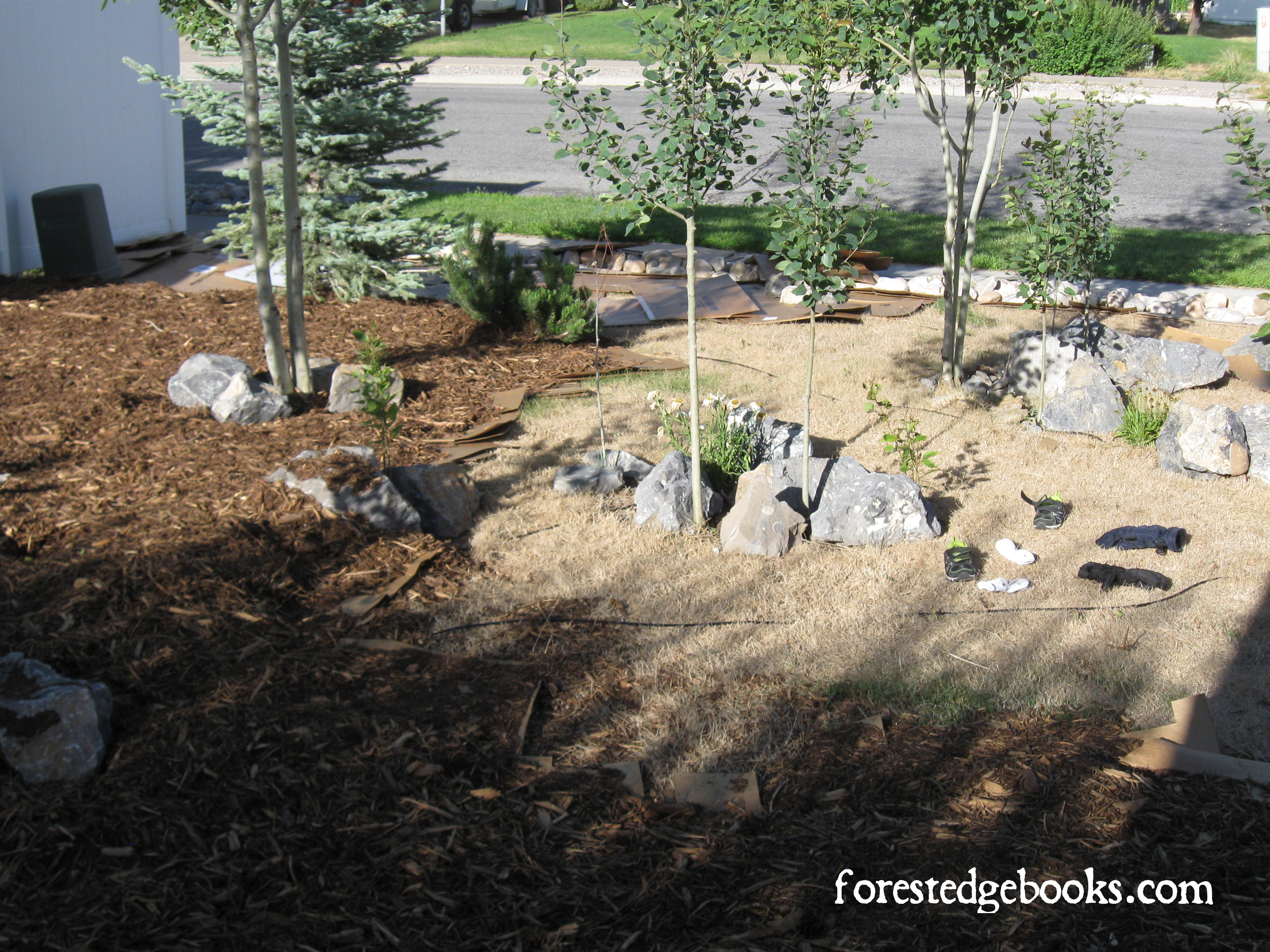
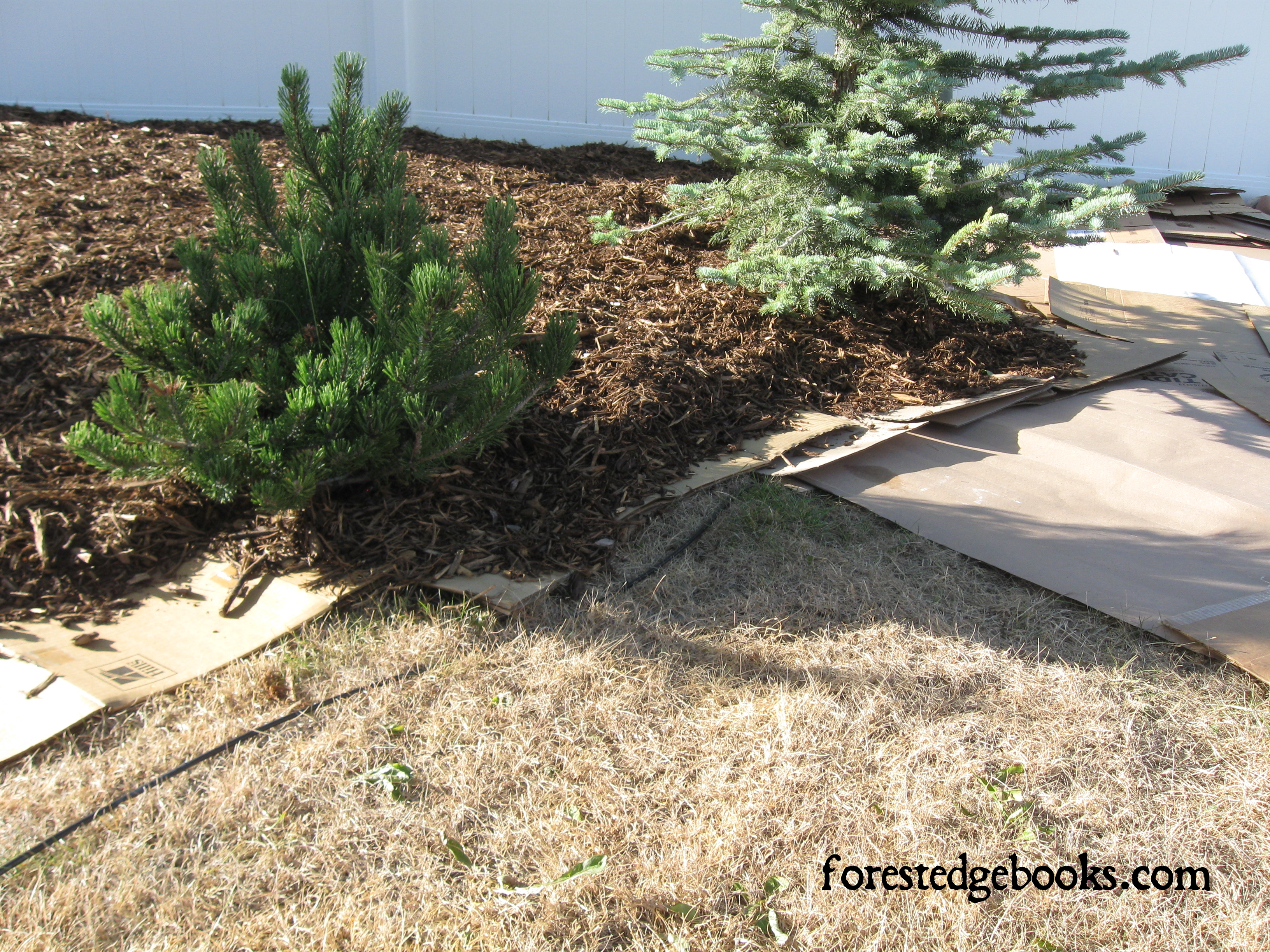
We let the rest of the grass die (yes, on purpose), and covered it with a couple layers of cardboard that my husband retrieved from his old workplace.

011

The cardboard keeps down the weeds and retains moisture. And makes people wonder if there are any cats buried under that Tidy Cats box. (No, that was at our last house.)

We live in a rocky area, so instead of fighting the rocks, we decided to incorporate them to help hold down the cardboard, set off the aspens and their little “volunteers,” and to keep the drip-feed system contained.

009

(At the correct angle, these look like house-size boulders, don’t they?)

Then we covered it all with several inches of mulch. Fortunately our dump provides a full yard of mulch for less than $10. Yep, that load below cost less than $10. We used about five of these for the whole front third of our yard.

3 year old and mulch

(Meet my three-year-old, Mr. Ham-and-Cheese.)

Our kids helped, albeit at times reluctantly, to shovel and rake out the mulch (taking an entire 20 minutes to empty each load). Whenever they quietly grumbled, we reminded them that they no longer had to mow around the trees, which was becoming quite the annoying endeavor each week.

grass cardboard mulch

The mulch is 4-6 inches thick, and has that lovely cushiony feel like a real forest floor.

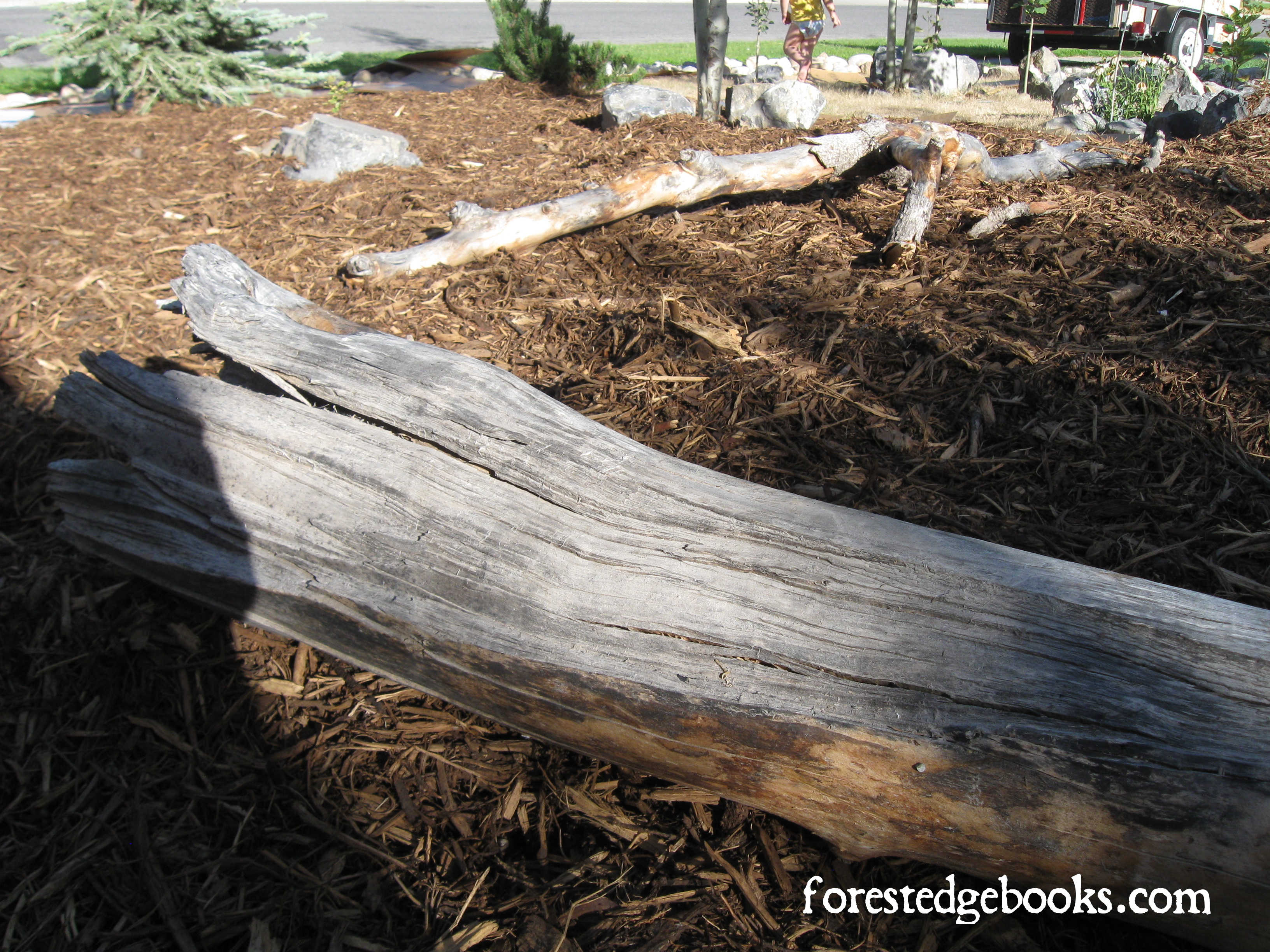
After a few weeks we finally finished. We plan to add a few more logs and another dwarf pine or two, but for now, I have my own little forest! (Yes, I’m fully aware a trickling river would be amazing through here, but that’s not in the budget this decade.)

logs in forest

(We need more logs. My husband’s planning next year’s vacation to the northern California coast primarily to pick up salt-treated driftwood.)

Another friend suggested I place a miniature wooden fort in the middle of this. (Her kids had actually made Fort Shin out of Lego bricks last year.)

And maybe a sign that says, “Welcome to Edge.” (Oh, yes–I want one!)

My husband keeps shaking his head at the suggestions. It’s all about xeriscaping, right? Right?!

hostas in mulch

No more weeding around the bishop’s weed and hostas.

Next year, we plan to do the parking strip. Dear Hubby was surprised to hear I was on board with converting a lot of it to rock and taking out the sprinkler system. I wonder what his reaction will be when he discovers I made some miniature buildings out of cement block, and put up a little sign that says, “Welcome to Idumea.”

forest in background

Thank you, 2 more recipes from Hycymum, and free magnets

Free downloads last weekend went great! Thank you for spreading the word. I’ve heard from a lot of new readers, and that’s always exciting.

Hycymum’s also been busy with me in the kitchen, and we’ve figured out Banana Bread (gluten free, dairy free, and fat free), and Chocolate Chip Cookies (gluten free, egg free, dairy free). Click on the recipes to go to the site.

banana bread sliced chocolate chip cookie

Why did I not know before that you can replace eggs with good old cornstarch and water?! I feel like the world has been keeping this a secret from me, but now I need to bake everything one more time with cornstarch/water and see how it goes. So far the cookies were a huge and happy surprise!

033Remember, if you want the magnets, I need you to PLEASE send me your address. I won’t use your address for anything else but the magnets, I promise. I’ve had a few requests but I don’t know where to send them.

In the form below, tell me you WANT MAGNETS and GIVE ME YOUR ADDRESS in the “comment” box. Thank you!

← Back

Thank you for your response. ✨