Leader-servants and presidential candidates

When someone requires service, it’s fascinating to see who steps up to provide it. Quite often, it’s not who you’d expect.

Some years ago my husband and I were in charge of setting up and serving Christmas dinner for our ward (church group, congregation). We anticipated a good turnout, about 150 people, both members and neighbors, because no one turns down a free dinner.

A few people had been assigned to help us, but on the evening of the dinner they were unable to come. So my husband and I, and our capable children, scrambled to set up the buffet as best we could.

Soon, some members of our ward noticed we were shorthanded, and volunteered to help. To this day I’m still impressed by those who chose to serve, rather than be served.

The first was our bishop (pastor, rector, preacher) and his wife who were supposed to be relaxing that night, instead of helping as they always did. In addition to being our bishop, this busy gentleman was also a college math instructor and basketball coach. He and his wife cheerfully positioned themselves in the kitchen where no one would see them laboring, to hand our children platters of turkey,  ham, and potatoes for the buffet, and to prepare backups.

The next couple who stepped were in their sixties, and busier than anyone I knew, so most deserving of a peaceful evening. He was the president of the liberal arts university where we worked, and his wife was behind the scenes of everything. Without a word they set to filling and putting out pitchers of water on the tables, and setting out salt and pepper shakers.

The third couple who joined us immediately rearranged the buffet tables, so that two groups could go down either side, servicing four lines most efficiently. Then again, the husband knew all about efficiency. He had recently retired as the CFO of a well-known, high-priced clothing company whose name I won’t drop here because it’d drop your jaw, and had come to our little university as a volunteer to help with finances.

In terms of importance, these three couples were probably the most important in our small community in Virginia. In terms of education, financial standing, prestige, and anything else the world ranks, no one compared.

In terms of service, no one could compare, either. Now that I think about it, none of them asked if they could help, or how. They just saw a need and filled it. I don’t know if any of them sat down to eat, but instead assisted us all evening in keeping the buffet table full.

My husband and I were both astonished by who came to our family’s aid that night. Even though it’s been many years, I’m still awed by their examples.

Did I mention that the wives and the bishop all stayed afterward to do dishes? And that the university president vacuumed up, while the retired CFO put away tables and chairs with our kids? And that none of those six left until they were sure all the work was done?

I doubt any of these three couples would remember that evening, because it wasn’t a once-in-a-lifetime expression of service; it was something they did every single day.

Recently we discussed this incident with our children who were too young to remember that dinner, or were not yet born, because it coincided with our scripture of the week, from Mark 10:43-44:

43 But so shall it not be among you: but whosoever will be great among you, shall be your minister:

 44 And whosoever of you will be the chiefest, shall be servant of all.

The school where these six people served with us, Southern Virginia University, has as part of its motto to turn students into Leader-Servants. None of us are working there anymore, but that mission statement has stayed with me.

Neal A. Maxwell once wrote, “The leader-servant is perfectly epitomized by Jesus,” and,

No leader can be fully effective without love, and those who try to serve without it will not be properly motivated, and may even feel resentment and a sense of slavery. (The Neal A. Maxwell Quote Book, pg. 194; emphasis added)

It’s an election year. We’re choosing new leadership. When I read about candidates, I’m not looking for evidence of financial success, or business acumen, or charisma, or moxie, or guts.

I’m certainly not looking for someone to voice my anger, to shout or disparage or drag down or accuse.

I’m looking for someone who knows how to serve, who feels genuine love and concern, who desires to help this country, not merely be known as the leader of it.

But so far, I’ve mostly heard young Perrin’s attitude toward leadership. His response is something I was taught years ago in a business leaders course I was forced to endure, but I rephrased it for book 3 in less exalted verbiage:

“No leader is truly great who doesn’t know how to serve,” Hogal told him. “Service first, leadership later. First rule of leadership.”

“No it’s not,” Perrin retorted. “First rule of leadership is to identify the rival and eliminate it through defeat or feigned friendship.”

Hogal sighed. “A true product of the king’s educational system. Learned your lessons well, I see. . . .Trust me; to be a great leader, you need to be a great servant.”

~Book 3, The Mansions of Idumea

leader servant

I still have hope that a great leader-servant to show him or herself this year; for another George Washington or Abraham Lincoln or Thomas Jefferson–a true statesman who’s greatest concern is to help the country, not exploit it or use it for self-promotion. The kind of leaders who won’t lock up at night until they’re sure everyone who’s serving under them are taken care of first.

It’s time to make serving an honorable tradition again.

Book 5 Teaser–Sneaky Creator

I realized long ago that God is the ultimate plot developer.

One of my favorite quotes is an old Jewish saying: “Tell G-d your plans, because He needs a good laugh.” I think this is why so many of us experience plot twists in our lives. And while I’d grumble about those twists, always–always–I’d thank my Heavenly Father later that He didn’t pay any attention to my plans. His are always better.

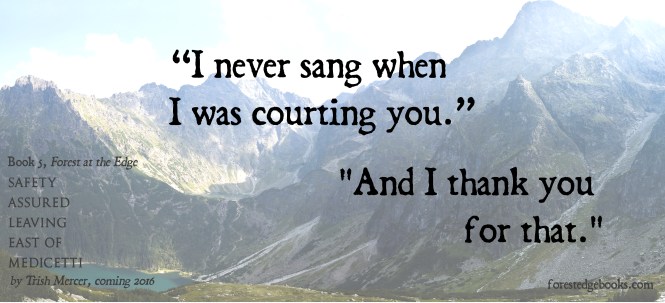
High Polish Tatra mountains

Not a midlife crisis–just black licorice on quinoa

No, I wasn’t having a midlife crisis.

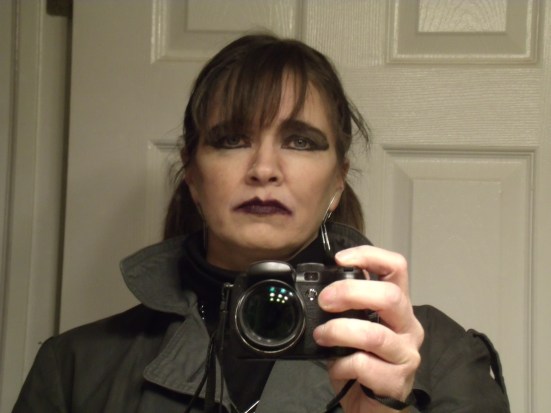
GEDSC DIGITAL CAMERA

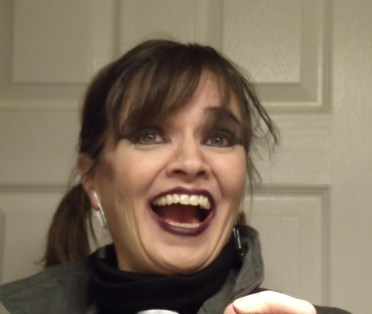
Someone in my church asked me to do this. Really. Ok, not dress exactly like this, but as something “unrecognizable.”

It’s a group activity called “Where’s Waldo,” and ten adults from our church group (called a ward) were asked to dress up and hang out in the local Walmart while groups of our youth, ages 12-18, with their leaders, found us. I was instructed to “really get into the part,” so I dressed up as best as I could, put on make-up I’d never used before, and since I don’t own jewelry, made up my own goth look with paperclips. (I’ve seen safety pins used in piercing, so I wasn’t that far off, right?)

Then I drove to Walmart, and as I pulled in to the parking lot, I laughed out loud. “Wait—I have to WALK into the store like this! Someone’s going to take my picture and put it up on that website that makes fun of Walmart shoppers.” At least no one would know who I was, because I kept my glasses off. (Worked for Clark Kent, too.)

But my 17-year-old daughter had said, while I was preparing for my big acting scene, “You have to change your walk, too. You have a ‘Trish Mercer’ walk that’s kind of distinctive.”

“It’s because my mom used to make me practice walking with books on my head when I was your age. Victorian England, but in 1980s Utah.”

So as I parked my minivan, I practiced my scowl. As I headed into the store I traipsed, slouched, then finally sauntered in, moving like a sophisticated zombie as I got into my part.

0209161829Grabbing a cart, I headed to the back of the store and loaded it up with Coca Cola Zero, because it was in dramatic black boxes, which matched my dramatic black clothing, and my son’s dramatic dark gray trench coat. I also picked up a tribute magazine to David Bowie, then ‘hung out’ in the bakery department to read it.
And waited.

An adult from my ward was to come by with slips of paper that I’d give to the teams of teens. The kids had to ask me, “Are you a Waldo?” then I’d give them a ticket as proof they’d found me. After they had ten tickets, they were to race back to the church (adult leaders were driving, thank goodness) to see who got their first.

But no one came by, and the stray thought went through my head, What if this was just a set-up to get me to dress up bizarrely and make the rest of the shoppers nervous?

Because by this point, I’d noticed—even without my glasses—that carts would approach, hesitate, then turn or take a circuitous route around me. I felt badly about that, because I’m usually a cheerful shopper, smiling at others and saying “excuse me.”

But not last night. I could feel the darkness of my clothing, the drama of my makeup, and the pinching of the paperclips on my earlobes. Altogether, that meant I wore a perpetual scowl.

I felt terrible that the way I dressed and presented myself made others feel uncomfortable, and maybe even threatened. (But not terrible enough to quit.)

So I tried to ignore everyone else as I thumbed through the tribute to David Bowie, reading about his wild early years which I felt I was living right then. That’s when my cell phone rang. It was my neighbor Elise, also in the store dressed up (whew—wasn’t a set-up) asking if I was there yet. “Yep, hanging out in the bakery department, like I’m supposed to.”

She chuckled. “Well, Cindy’s been looking for you. I’ll send her over again.” A few minutes later Cindy approached me nervously, until her eyes lit up. “Holy cow, that is you! I walked past you twice but didn’t dare talk to you.”

“Sorry,” I said. “Without my glasses, I can’t recognize faces until they’re right in front of me.”

“Very convincing,” she said, handing me the tickets I was supposed to give the teens. “And the Bowie magazine is appropriate.” She took one last look at me, shuddered briefly, and left, and then I waited.

And eventually . . . the fun began.

I kept my head down as I read, but I could see feet approaching from different directions as the sweet and innocent youth of my church approached the strange gothy woman in the store. You see, we live in a quiet valley where nothing too exciting ever happens, and where people are pretty much white bread and baked potatoes.

I was black licorice over quinoa. No one knew what to do with me.

Waldows in Walmart Feb, 2016

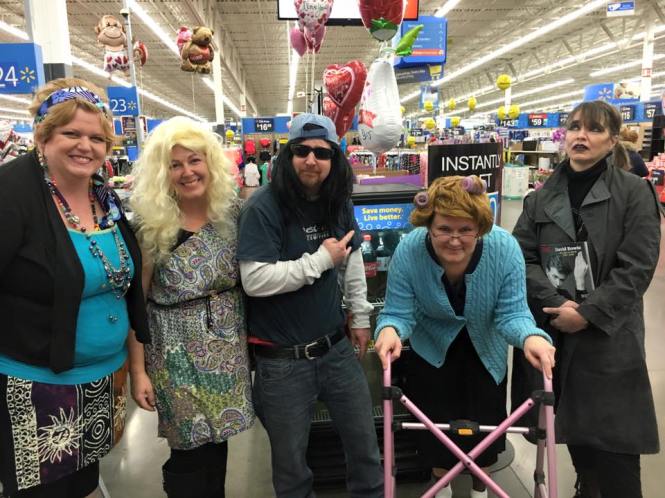
Our collection of “Waldos.” I’m in the middle, looking as disinterested as possible.

As I saw the feet tentatively congregate around my cart, I’d slowly look up, with as much snarling apathy as I could muster. “Like . . . what do you want? I’m reading my Bowie, here. Can’t you tell?

Then their eyes would bug out, they’d take a step backwards in alarm, and someone would mutter, “Isn’t that Mrs. Mercer?”

“I don’t know . . . I think so. Whoa.”

“Are you . . . are you Waldo?”

I’d roll my eyes dramatically (yes, I practiced that too) and fished in my trench coat pocket for a ticket. “Oh my gosh, look—can we get this over with already? I’m late for a Walking Dead party, you know.”

That’s when they’d start smiling and laughing, but still they stayed back a few feet.

One of the leaders, a lovely woman in her 60s, stared at me in shock. “Trish? Oh my gosh . . . Trish?!”

Only for her did I break out of character, because she really did seem disturbed. “Cindy didn’t recognize me either,” I consoled her as her group of five girls hustled off after the next clue.

But for the other groups, I just glared menacingly and went back to flipping pages of my magazine after I handed them their tickets. I think a few of the younger girls were worried by my appearance, and I nearly lost it when a fifteen-year-old boy exclaimed, “Wait—she’s my Sunday School teacher!”

I may have lost all credibility with him.

But all of the effort was worth it when one high school girl said, “Wow—I thought you were a teenager.” I’ll hold on to that one for a long, long time.

GEDSC DIGITAL CAMERA

I’ve lost 30 years! And my mind!

After a while the groups of kids slowed down, and I finished reading, waiting for the call that we were done. At the end of the Bowie magazine, looking at pictures of him in his 60s with his spikey gray hair and dazzling smile, I couldn’t help but think, “He was a great looking senior citizen.”

Image result for david bowieI flipped to the earlier pages and felt as uncomfortable as I had when I first walked into the store, dressed up as something I really wasn’t. Bowie—actually, David Jones—seemed a lot happier and more handsome in his later years. The gray hair suited him.

By the time the call came for “All Waldos to come to the front of the store,” I was relieved. While it had been fun to dress up and freak out the youth of my neighborhood—especially since it wasn’t Halloween—I was anxious to become me again. While I had a small shopping list in my pocket, I couldn’t bring myself to actually buy anything in my present get-up.

As I approached the other Waldos at the front of the store, everyone’s jaws dropped. I have to admit I rather enjoyed the attention—I’ve never been a jaw-dropping woman—but I also was glad it wasn’t going to last more than a few minutes.

Waldos in Walmart Feb 2016

“Like, totally . . . I’ve got a Walking Dead marathon to get to.”

At home, my husband took one look at me and said, “Are you going to need a shower to get all of that off?” I had even gone so far to buy a gray hair touch-up kit to darken my bangs and color my streaks of gray. “You really don’t want to keep using that stuff, do you?” he hinted.

I’m blessed to have a husband with the same attitude of my dad, who once said, “I don’t like a lot of makeup on my wife. I want to be able to recognize her in the morning, not wonder how some stranger got into my bed.”

“No,” I assured my husband, “this it was just for the night, and yes—I need a long shower.”

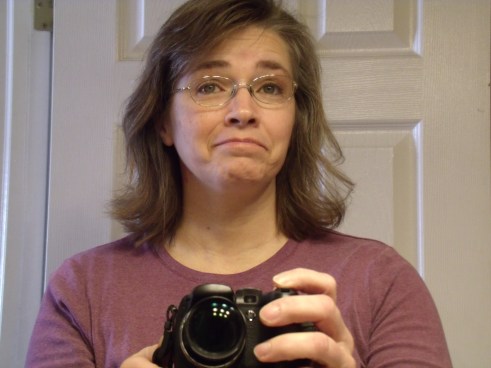
I took a couple of selfies in the bathroom, because that’s what you’re supposed to do after you spend an hour putting on makeup, and then I tried to wipe it all off. Half a jar of Vaseline later, I took a shower to scrub out the rest of the dyes and gunk.

GEDSC DIGITAL CAMERA

Never let middle-aged women take selfies.

This morning as I looked at myself in the mirror to get ready for the day—gray streaks highlighting my hair again, and pale, dull eyes looking back without any ringing makeup—I knew that was a much better look: the clean, basic, unmade me. Kind of like Bowie in his later years, looking genuinely happy in his rawness.

GEDSC DIGITAL CAMERA

What, you’re supposed to use a cell phone for a selfie? Have you seen my cell phone?

I’ve discovered that with the right makeup and the right clothing, I can look like just about anyone, as skilled make-up artists have demonstrated. Even untalented me turned myself unrecognizable.

And I don’t like that.

I’ve always been averse to lots of makeup, and I think it started way back in the 1980s, when coincidentally I first fell in love with David Bowie’s music.  I also noticed a Robert Plant video where the same makeup and clothing turned a variety of different young women into creamy, rubber copies of each other. It struck me as strange, and as sad.

I never wanted to be an imitation of someone else.

So I’ll go out today as usual, “au natural” (but dressed, so don’t panic). (Ok, I’m wearing a tiny bit of eye shadow and mascara, so people can find my eyes.) No one will mistake me today for something I’m not. Because even if I had an identical twin, no one can copy my look.

(Not that anyone would want to, but that’s a rambling topic for another day.)


Book 5 teaser–victims of history

Winston Churchill famously said that, “History is written by the victors.”

I’ve always wanted to hear the other side of the stories. One side’s “glorious leader” is the other side’s “maniacal tyrant.”

High Polish Tatra mountains

There should always be at least two versions of history, if not hundreds.

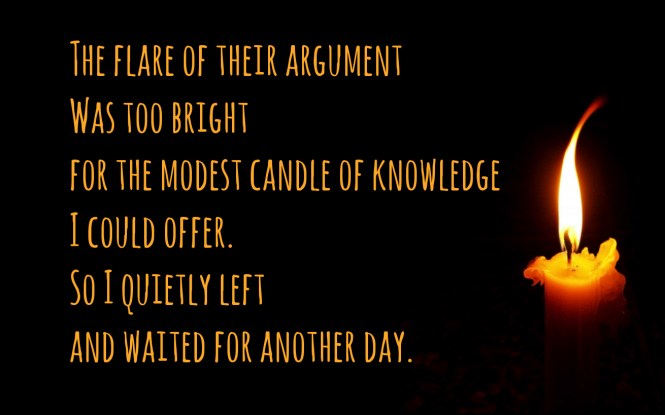
Because I have yet to walk away from an argument feeling better about things

I need this tattooed to the inside of my eyelids, to remember. (Especially during this political season, which is drawn out to many very long, very ugly seasons . . .)

flare of argument

“I’ve known more people to die in the last two years than have been born”

Late last spring I was contacted by an old friend to do some contract work. His company had a client who was donating a large sum so they could create a tribute book for Vietnam veterans. As a thank you, they wanted to help him create a book about his own life as a Top Gun pilot during the war, real estate mogul, and philanthropist. They interviewed him for hours, had the beginnings of an autobiography he’d already written, and turned it all over to me to compile and ghost write.

I spent much of June working on it. Mashing together three different accounts, looking up dates and place names, and turning conversation into a narrative was a lot more work than I anticipated. I had just quit my part-time job, otherwise I wouldn’t have been able to pull it all together in a month’s time.

In July I met with the man, a fit and trim 84-year-old who still went jogging each day and rode his zip line that he installed on his property in Hawaii. We spent hours going over my questions, and he gave me more stories. He told me that he’d never been ill in his life, except for in March, when a case of pneumonia sidelined him for several weeks. He was still shaken by the experience, and was impressed that he needed to get his story done now, the sooner the better.

We met again in September, this time spending eight hours poring over nearly a thousand photos, choosing which ones to use, creating captions, and adding even more stories.

The goal was to have his life story edited and ready to print by Thanksgiving, so that he could give it to his family for Christmas. We didn’t meet that goal. Revisions, additions, reorganizations, and lost photos pushed it back a week, then another week. Every time my phone rang, I cringed in worry to see his name there, and more often than not, he was calling to say something was missing, or that something needed to be rearranged.

When a man has adventures from bear hunting in Russia, to finding a gold mine in Nicaragua, to driving a team of mules for hundreds of miles as part of the 1997 pioneer trek reenactment to Utah, then multiple trips to China, the Holy Land, and to his place in Hawaii where he donated extensively to BYU-Hawaii, there tends to be a lot of stories.

But we covered it all, going back and forth with emails and scans and texts and phone calls, and finalizing this, and then that. It needed to be right, and I offered many prayers that I wouldn’t disappoint him.

He wrote me once, after I fine-tuned something that he struggled to write, that I knew him so well. By then, I really did.

Finally, December 14th, it was finished and went to press. He received the hard-bound books, 250 pages worth of stories and photos, just in time to hand them out to his children, grandchildren, and great-grandchildren for Christmas. He sent me a crate of oranges for Christmas from his orchards.

Three weeks ago he called me, looking for someone’s phone number. I found it, gave it to him, and as I hung up I thought, “That’ll be the last time I speak to him.”

Today, Al Gardner of Mesa, Arizona, passed away from a heart attack.

IMG_0063

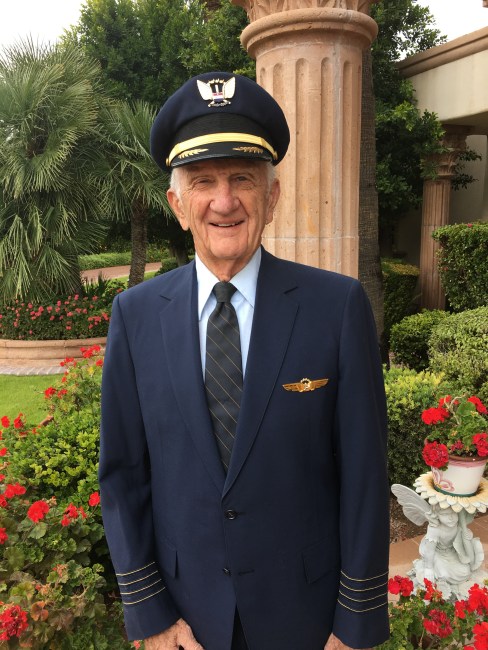
Among a hundred other things, he was also a pilot for United Airlines for many years. Early one morning in December he called to ask me to search through the hundreds of photos we didn’t use to find one of him in his United uniform for the book. The book was to be printed that afternoon. After an hour of searching I couldn’t find one, and I called him with the bad news. But later that day he sent me an email with this photo. His wife Kathleen had found his old uniform, he put it on, and they took the picture. Got it in, just in time.

Today I also got news that another man whom I deeply respected, a religious leader when I was growing up, also passed away, Harry McSwain.

And I feel today like Jaytsy did in Book Three, that in the last two years I’ve known more people to die than to be born.

I don’t have any clever or insightful endings today. Just this ending.


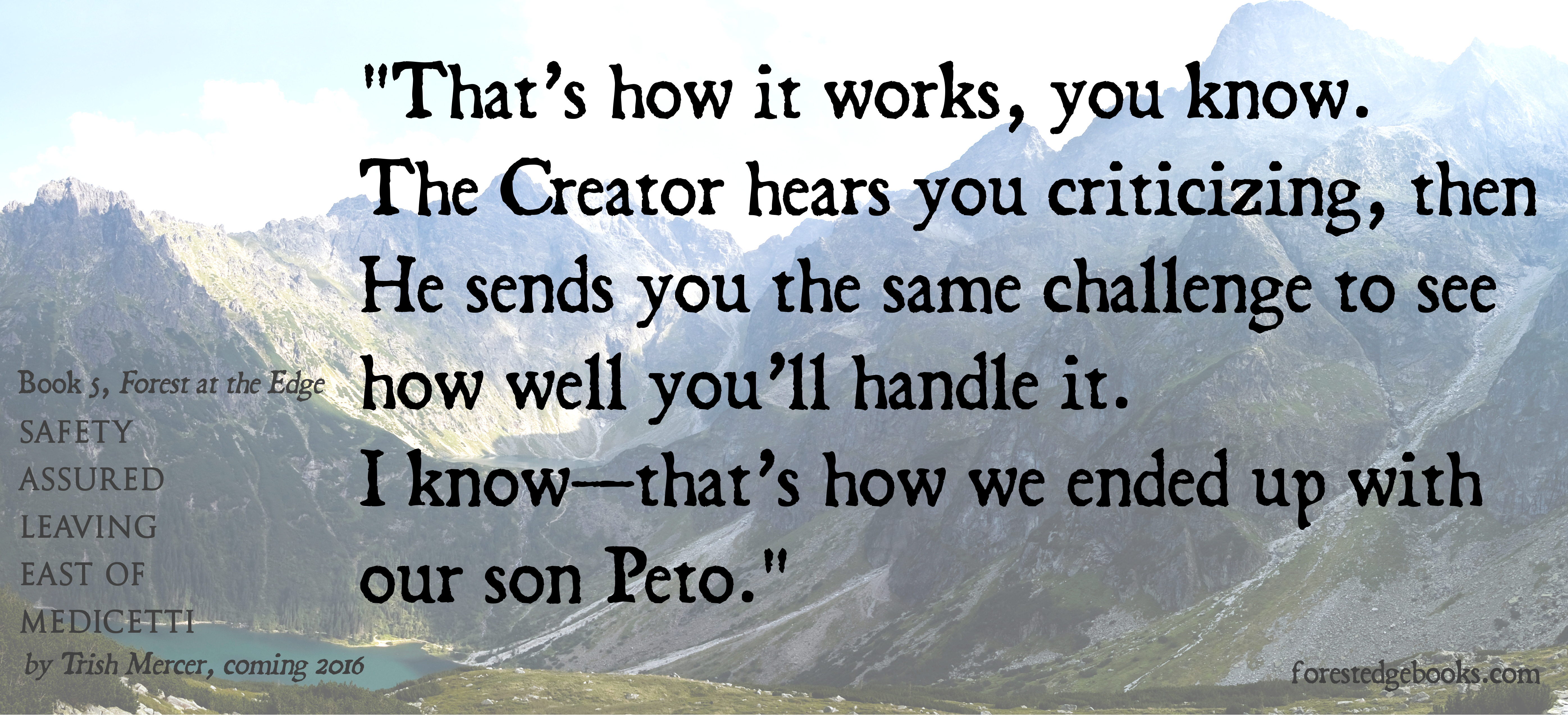
Book 5 teaser–The Creator, criticism, and thinking twice

I’ve had several readers ask about Book 5, Safety Assured Leaving East of Medicetti and I’m pleased to report that yes–it’s coming along well. I can’t devote as many hours to it as I wished each day, because I have five kids at home–half of whom I homeschool (work out that math)–and a side business I run on Etsy, so I have to try to strike a balance. If I could just learn to not sleep, progress would be much faster.

But because I’m so excited about this book, I’ve decided to give you a teaser each week in the form of a line or two from the story. Here’s the first, which I’ve learned from personal experience:

High Polish Tatra mountains

(At least half my trials come to me this way. I’m slowly catching on to keep my mouth shut.)

Farewell to a beta reader: my life preserver and sinking anchor

Writers need beta readers because they are a mixture of life preservers and anchors; on the one hand they point out the little things we can do to fix the draft, and their enthusiasm keeps us buoyant. But on the other hand they drop anchors on us, comments that can sink us into editing despair, such as, “I really hated what you did to so-and-so. Are you sure that’s the direction you want to go?”

Well, seeing as how the next three books depend on that plot development . . . no?

Drat.

Writers value their beta readers because they do an enormous task for literally nothing: they read through our drafts which we think are near to perfection, point out how far from perfection they really are, then we thank them for their hours of work only by mentioning them in the back of the book and sending them a bookmark and a magnet or two.

But we couldn’t do it without them. I’ve burned through a few beta readers in the past years because it’s a demanding task “grading” someone’s 180,000-word essay. I understand when they say they can’t help this time around. But I’ve never lost one completely before, until last week.

Debbie Beier was an unusual beta reader because she could see things sideways, and I’d been looking for someone like that. I feel that’s how I’ve always seen the world—from odd angles. This was particularly frustrating in English classes where everyone would read a story/poem, begin to discuss it, and I’d be completely confused as to what they thought was “important.” While they were discussing the meaning of ‘walking in the wilderness,’ I’d wonder why the author kept referring to his yellow cat. In every class I’d search for that other sideways thinker who thought the reading was potentially absurd, while everyone else fixated on its deliberateness. (Seriously, I didn’t understand half the jargon I encountered in college. Still I graduated. That should give every college freshman hope.) 

But Debbie was the sideways thinker who also saw the proverbial yellow cat, and would notice that its whiskers were burnt off, and would then speculate as to what kind of mischief the animal got into. Maybe it was because she was a scientist—a geologist who loved rocks and observing nature. She liked to turn things on their sides, figuratively and literally, to see what was really going on.

I first met Debbie in Virginia about 14 years ago, where we were neighbors and I was her visiting teacher, assigned by our ward (church) to check up on her each month. That’s when she first developed breast cancer, and I brought her meals. But I don’t remember that. She did, however, and a few years ago when I put out the request for beta readers, she eagerly volunteered in order to pay me back for those meals I totally forgot about. Talk about a lopsided investment. I was returned far more than I put in.

Debbie was diligent and incredibly thorough. She commented, she corrected, she caught my proofing errors, and she gave feedback that both buoyed me up and dragged me down, in necessary ways.

Cancer came back to her with a vengeance two years ago, but still she carried on reading and editing for me. But by last autumn, it was getting to be too much. “Send me book 5,” she wrote me. “Even though its unpolished. I need a distraction from the pain and boredom of cancer. Plus, I want to know what happens.” So I did. Even in her exhaustion and pain, she took the time to royally roast me. In particular, she was upset with what the future of a minor character. “Don’t do it,” she begged. “It’s all wrong!”

In defense, I wrote up a synopsis of books 6, 7, and 8 so she could see how the series would end, and how that minor character played a significant role. But she wrote back that while she could see where I was going, and thanks for the entire series in a nutshell, still I was wrong. Fix it.

To be honest, I was a bit surprised at that. The poor woman was literally dying of cancer, and here I thought she’d write me back a “That was so wonderful, thank you for sharing” message. Something pleasant as an exit.

Nope, not Debbie. She was too pragmatic and honest for cloying niceties. I never knew her to be conventional in anything. Dying from cancer only meant that she had to be more diligent, and, if need be, even harsher.

In November she posted on Facebook that her end was coming, and in typical Debbie fashion she wrote, that “I’ll be dying sometime or other” and that she didn’t want to be hit with faith promoting rumors or wild ideas of going to foreign countries to be healed. She accepted her fate, and accepted our prayers.

I wrote to her the following:

Debbie, I hate to see you go, but you’re going on to a marvelous adventure. You’ve done great things here, and your graduation from this life to the next will be astonishing and wonderful, I have no doubt. I’ll pray that you’ll not feel pain, but that you and your family will feel peace.

And when you’re on the other side, I hope one of the first things you find out about is dinosaurs. Exactly when did they live? For how long? What, really, went on with them and the fossil records?!

Oh, the mysteries you’ll get to re-learn! The questions that will be answered! So many people you’ll get to re-meet and re-remember! I’m so sorry this is a physically painful experience, but when it’s over–ah, it will be amazing for you.

I’ll miss you–you’ve been a wonderful help and so supportive of my writing. Friends like you are rare. But I’m also just a bit jealous of what you’ll get to see next. If at all possible, come by some time and whisper just how amazing it is, and what I’m missing.

Thank you for your friendship. Until we meet again . . .

She passed away last Monday, in Oregon. Her funeral was here in Utah last Saturday, 100 miles away from my home. As I drove down to it, I thought, “Debbie, now that you’re not in pain anymore, about that ending for book 5. You’ve had some time to think about it . . . do I really need to redo everything with that character?”

I could picture her shrugging and saying, “I said what I said. It’s your book, but that’s what I think.”

Drat. Major rewrite coming.

1008151701

Debbie’s ever kind and perennial cheerful husband Mike drove her down from Oregon to Utah to visit some friends last fall, after she learned she wasn’t going to beat cancer this time. We met at a Wendy’s, shared Frostys, talked about Virginia, and family, and dying, and shared a few laughs and tears. I took this picture from my car as they slowly walked back to theirs. But first, Debbie inspected the gravel at the bottom of this photo, found a rock that looked like a heart, and picked it up for her granddaughter. I was a bit disappointed there wasn’t a pile of rocks on her coffin. Maybe they were inside, with her books.

Thank you, Debbie, for never pulling your punches, and for being utterly true and honest to the end. I’ll not only miss you as a beta reader, but also as a friend.

And if at all possible, come by and whisper what you found out about the fossil record. But don’t use your geologist words—dumb it down for me a bit. You know how I think.

The “Thank you for Being a Grown-up” campaign

Enough of hearing about people who act like children. Let’s start recognizing people who act like grown-ups!

Recently I wrote about being a better Grown-up (yes, with a capital G), and that got me thinking: there are people who I look up to and admire, and it’s time that they know that.

These are folks who take responsibility for their lives—no excuses; they do the right thing, especially when it’s hard; they make their corner of the world better for everyone in it.

These are the people I want my children to emulate, and who I hope to be like when I fully Grow up.

So I’m instituting a campaign, and you’re welcome to participate. Each week identify someone who displays Grown-upness, and show them gratitude by copying and pasting the sign below on their Facebook or Twitter feed. 
Thank you for being a grownup

(Suitable for printing out and taping onto a refrigerator.)

This could be for:

  • the friend who tried to right a wrong, or admitted they had made a mistake;
  • an acquaintance who defended a belief with with kindness and civility;
  • the teacher/coach/tutor who goes the extra mile with your child;
  • the teenager/neighbor who shoveled your walk without being asked, and without being paid;
  • the relative who’s always been a source of strength for you;
  • a coworker, mentor, or former teacher who inspires you.

You get the idea.

Maybe you want to tell this person what they did to earn your appreciation, or maybe you want to keep their deeds a secret. It’s up to you.

We need to draw attention to positive behavior, for the sake of our rising generation.  Our kids need to know who they can look up to: REAL people. (Not famous twits.)

There are lots of real Grown-ups out there, but they don’t get enough attention.

(Hint–real Grown-ups don’t take offense at every little thing, they don’t complain endlessly, they don’t expect others to rescue them from their poor choices, and don’t need someone else to police their every action.)

So let’s give them the attention they deserve! Let’s emphasize positive behavior, give others hope, and show our kids how real Grown-ups behave. (No, you don’t have to have kids to participate.)

It doesn’t cost you a thing, but may reward everyone in ways we can never count.

Thank you for being a grownup

(Go ahead–copy and paste wherever you wish. I’ve got millions of these.)