She shamed my copper bottom pots, and now I see how everything can be so much better

It took Zelda at my church inadvertently shaming my copper bottom pots to help me realize that often we live lower than we should.

It started when we were cleaning up after a meal at our church. In the corner had sat a copper-bottom pot, unclaimed for months. Zelda picked it up and frowned. “Disgraceful! Look at the bottom of this. I’ve had my Revere Ware for 50 years and it still looks as good as the day I got it.”

I swallowed. It wasn’t my pot, but my bottom was even more tarnished. (My pot, that is.)

“That’s not how it’s supposed to look?” I meekly asked.

Zelda turned on me as if I’d just confessed to eating baby monkeys. “Good gravy, no! A little elbow grease, a little maintenance, and it should stay shiny for a century. This could be much better!”

I didn’t know that.

I went home and looked at my pots—three of them—that I’ve owned for 30 years. Not shiny.

20181027_103742

I didn’t realize this wasn’t normal.

Her words hung above me for days. This could be much better.

So one Saturday morning, I went to work on my bottoms. (The pots, that is.) After half an hour of scrubbing, Comet, vinegar, baking soda, and steel wool I was astonished to realize that, daggum, my pot could be much better.

20181027_123950

In my sink, with baking soda and vinegar and only about 10 minutes of work.

I did the next two pots, and a relatively short time I had wiped out decades of neglect.

In the month since I’ve cleaned my pots, I’ve been much more diligent about keeping them clean. It takes all of 30 seconds each time I wash them.

20181027_115819

So THAT color is copper! I’d forgotten.

That got me thinking of how many other tasks we let get away from us, then decide in quiet despair that there simply isn’t a better way, that life is always this tarnished, or dirty, or hopeless.

It’s not.

What if we spent an hour trying to make something better? Just one hour? Instead of going online to complain how someone shamed us (Zelda didn’t mean to, she’s a lovely lady whom I love dearly), what if we get to work fixing things instead?

Over the years I’ve discovered how much can be done in an hour–a filthy garage swept, a disorganized storage room straightened, an overgrown flowerbed weeded, a moldy shower scrubbed—and always after I think, Why didn’t I do this earlier? Why did I put this off for weeks, months, years? (It was a REALLY awful shower.)

I’ve been applying this idea to bigger things: the books I’ve put off writing, the education I neglected to finish, other issues that I don’t feel like confessing here . . . I spend a little time here and there, step away from the TV or the social media and instead do something productive, and every time—every stinking time!—I think, “Everything is so much better now when I do this! Why don’t I do this every day?”

Brigham Young once said that, “we live far beneath our privileges.” I think this partly means we often forget that we can improve many situations we think are unchangeable, that we frequently forget that we’re Children of God who are destined to far greater things than fiddling with mere trifles and wasting precious time.

The interesting thing is, as we fix something small–like a copper bottom pot–we see what great improvements to our mental and emotional health small measures can make, and we start to look for more ways to begin to live up to our privileges. It’s addicting, a natural high. (My kids can tell when I’m really depressed because I’ll get on my hands and knees and scrub a floor. An hour later, it sparkles and my brain is flooded with natural dopamine. Unfortunately for my floors, I’m not frequently that depressed.)

School’s canceled today because of snow. That means I have time to tackle problems that yesterday I thought were unfixable. At the end of the day–at the end of an hour!– everything will seem a little brighter.

Leave for a better life

Defensiveness arises when we suspect we may be wrong

In my experience, those who become defensive and angry in a discussion are those who aren’t sure their position is correct.

They respond with anger when they’re afraid of being found out, when they’re afraid they might be wrong.

That’s always been a good reminder for me when I find my ire raising: something’s not right with my thinking, and it’s up to me to fix it; it’s not up to me to attack someone else.

When in the history of the world has attacking someone with an opposite point of view brought them around to agreement?

disrespectful to tell the truth

“The sky is blue.” We’ve been giving our kids fake news since kindergarten, and why that’s a growing problem

“You’re sophomores now,” I told my new batch of high school students last week, “which means you’re realizing that there’s more going on than you used to think. For example, you’ve been lied to since kindergarten. Answer me this: what color is the sky?”

I’ve written about this debate in my first books, and carry the thread throughout the series, but I had never before asked it of my students. I watched to see what they did with this simple yet odd question. I was not disappointed.

A few shouted, “It’s blue!” because on the second day of school you’re still trying to impress the teacher.

A few squinted, dubious as to what the right answer was, seeing as how I’d spent the last five minutes explaining how we’d be learning to analyze and see “the bottom part of the iceberg.”

(I drew terrible pictures of icebergs on my board. The students asked, “Is that a potato floating in the ocean?” Yeah—see the “whole potato,” my friends.)

41429333_10212947688711179_2356401697774895104_o

(Imagine if icebergs were potatoes. “Titanic” would have been a very different movie.)

But in each class, a couple students glanced out the window before answering, “White and pale blue.” (It was a humid, muggy day because Maine has been thinking it’s Maryland all summer.)

I replied nothing for a few seconds, watching them process, think, and squirm in worry that I was just standing there, smiling slyly, until I finally I said, “That’s exactly what I was hoping you’d say!”

“What?” they exclaimed. “That it’s blue? Or white? Or . . .” And then more started looking out the window, as if I’d seen something they hadn’t noticed and maybe they should notice it, too.

I could barely contain my excitement—they were re-examining what they assumed was true. I love these moments when their neurons start firing!

Some kids had initially sniggered at those glancing out the window, likely thinking, So dumb—have to look out the window when everyone knows the sky is blue.

Some others had that twinkle in their eye that they were going to show me up by not giving me the standard, “Blue!” answer, which I pounced upon happily.

“So is the sky actually blue?” I pressed.

They glanced at their peers, now unsure.

“It’s only looks blue,” one 15-year-old remembered, albeit backwards, “because it’s reflecting the blue of the ocean.”

“Except,” I said, “I grew up in the deserts in the west, and the sky was very blue there.”

Rapid eye-blinking is a sign that new neurons are being created in students’ minds. That’s a fact I just made up, like the sky is blue.

Eventually I explained how the blue is merely an optical illusion and asked them what other colors the sky can be.

When they realized it can be every color, especially at night (black) and during sunsets (even green and purple) they looked simultaneously intrigued and disturbed by this “new old news”.

And when I told them the sky is different colors on other planets (and that the sun isn’t actually yellow but white, if they could steal a glance at it without hurting their eyes), a few students’ eyes bugged out (a sure sign that neurons are firing—it’s a scientific fact I also just made up).

mars skyMars, 1997, with no blue sky in sight.

Blue sky is fake news. Oh, we didn’t mean to set out feeding our kids lies when they’re little–we’re just trying to simplify their complex world, cover the essentials, and worry about the deeper details later. That’s not a problem.

Except if we neglect to later dig deeper, think harder; then we become lazy thinkers. We don’t want to analyze, to see if everything we’ve assumed is actually true, because it’s not fun or entertaining. (Ask high schoolers what makes a “good class” and they’ll answer with, “It’s fun,” “We don’t have to work hard,” “We play games and watch movies,” or “We can get away with anything.”)

We want entertainment, not enlightenment. 

That’s going to be a problem in the future, as it’s becoming a problem right now. It seems most adults won’t analyze the news, its sources, or its veracity. They’ll take whatever matches their present assumptions, rant on social media for a minute, feel they’ve done something good, then see what’s new on Netflix.

In the meantime, nothing improves, no one notices, and the sky continues to darken without anyone glancing at it to say, “I don’t think that’s a good sign . . .”

color of the sky

Rector Yung studied him. “Dormin, what color is the sky?”

“Blue,” he answered automatically. He didn’t even glance out the window at the blazing orange that leaked into the room, tingeing everything around them in a carroty hue. “Everyone knows that.”

~Book 1, The Forest at the Edge of the World


The Forest at the Edge of My Yard (or, whatever you’re asked to sacrifice will eventually be no sacrifice at all)

My past forests have been pathetic. In 2015 when we lived in Utah,  I wanted a real forest  even though we lived in a desert. I was in the middle of writing this series and it seemed wrong that I didn’t have a real Forest at the Edge of my yard.

side view of forest

This was it–our “huge” forest. (And the pine tree died the next year. Typical.)

So we created one that summer in the name of xeriscaping, and I documented it in a blog. I even slashed an aspen to see how the markings the Shins left in the forests might look, and I used that tree as the teaser for Book 6.

book 6 teaser front cover

See the lovely scars of black under the W?

Only two short years later I sold that house and mourned the loss of my little forest.

I didn’t realize that God would compensate my sacrifice, and in a grand manner. Now, this is the Forest at the Edge of My Yard in Maine:

IMG_0315

(Morning from the back porch.)

20180829_181104

(Sunset on aspens slightly larger than what I had in Utah.)

This compared to what I left behind last year? There’s no comparison.

We don’t own this land, but my husband’s job allows us to live here and wander in acres of old forests. I just need a geyser somewhere to make my life complete.

I write this as a witness to you that whatever God asks you to sacrifice, it will be only temporary. We’ve left homes we’ve built, we’ve said good-bye to friends and family, we’ve given up jobs and dreams.

Then we’ve been granted new homes, additional friends, ways to see our family, better jobs, and grander dreams.

In fact, if we hadn’t sacrificed what we thought was good, we never would have been granted what was far better. 

But first we had to be willing to give up what we didn’t want to, without knowing what might come later.

That’s immensely difficult: to have enough faith in a different future to walk away from a good present; to find enough hope to believe that what comes next will be worth the current loss. But as someone who has “given up” a few houses, a couple of careers, a lot of friends (but thanks to Facebook they’re not entirely gone), and some big dreams, I have seen–time and time again–that what I’m eventually given in return was well worth the sacrifice.

No real sacrifice HORIZONTAL

In fact, all of our sacrifices have turned out not to be sacrifices at all, but instead were the means to leading us to far richer lives.

“I won’t do it!” said another man in the crowd. “I won’t leave behind everything we’ve worked so hard to build. And not just for me, but for my congregation, my family, my neighbors—I can’t just abandon all that we have.”

“Why not?” Mahrree said.

A man in the middle shouted, “Why not? Do you have any idea how hard it is to start again?”

“As a matter of fact, I do!” Mahrree told him, and nearly grinned as she realized how perfectly the Creator had prepared her for this moment. “I know exactly what it’s like to leave a home I love, to leave books that I considered my closest friends, to say good-bye to memories, possessions, the graves of all those I loved, and to have nothing more than the clothing on my back to walk to a future that I knew nothing about.”

The crowd was silent as she continued. They’d heard her story before in her class, but not told quite like this. Today, it was more than just history.

“Twenty-seven years ago I came to Salem, nervous and at times terrified as to what I would find. All I knew was that the Creator told us to go, and in faith I went. Not blindly, because every previous time I followed His plan, He was right.

“I ran through the forest in the darkest night I’ve ever seen, with hazards on either side, the army right behind me, and a lightning storm before me. But I came out of it safely and my faith stronger than ever. And then I came to Salem, which was a far greater life than I could’ve ever imagined. Now, none of that would have happened if I had said to the Creator, ‘No thanks—I think I’ll just handle the army on my own.’ I realize you’re worried, but staying here and fighting is far more terrifying than trusting in the Creator!

“Soon I’ll be making that journey again,” Mahrree’s voice threatened to quaver but she held it strong. “But I know that whatever sacrifice the Creator asks of me, He will reward me again a hundred times over.

“So what if you lose your homes? Your flocks and property which you don’t even own? Isn’t the risk of losing your souls worse? There’s a saying in the world: It doesn’t matter how you begin the race but how you end it. How tragic it’d be if you’ve spent your entire lives living as the Creator wanted you to, then now, at the very end of the race, you jump off the path and ignore all that you’ve been taught? Why fail the Plan now?”

Mahrree knew she was saying the right things. Her chest burned and she felt such energy she could have flown right off the small tower. She watched their eyes as she spoke. So many were hardened and impenetrable, but others’ eyes were softening.

“How do you know this isn’t His plan?” one man demanded. “This can’t be it—”

“How can it NOT be it?” Mahrree shouted, throwing her hands in the air. “Have all of you missed the signs? Land tremors! Deceit awakened! Famine in the world! Now the army marching upon the Creator’s chosen? THIS IS IT, PEOPLE!”

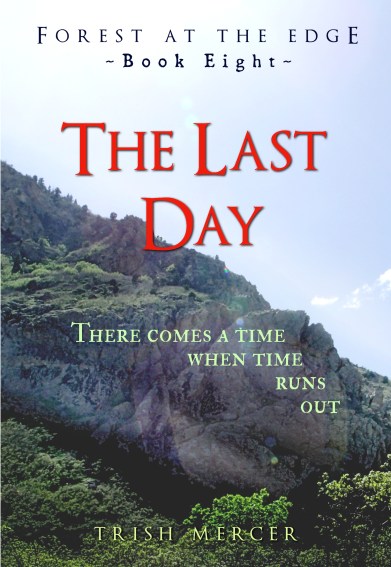
~Book 8, The Last Day, available HERE on Amazon, or HERE as a pdf. download, or HERE on Smashwords.

Book 8 FRONT COVER

The worth of battered books, and us (plus a sneak peek into Book 8)

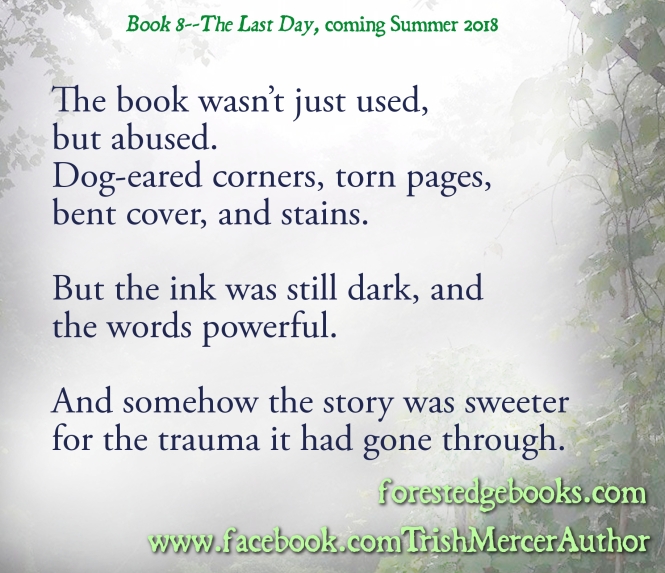
I woke up dreaming of a battered book. I’d been thumbing through it and wincing that poor-quality sticky notes had left yellow squares on pages, along with what I suspected was coffee or soda splotches. And that brown smear? Oh, I hoped it was chocolate.

I sighed in frustration. Not that long ago the book was brand new, but it had suffered from living in a student’s backpack for a few months.

The dream was so vivid probably because I recently went through my classroom novels and grumbled that books which I had purchased at the beginning of the year were now filthy and being held together by . . . sheer determination?

But the words that went through my mind as I woke from my dream were, “So what? The words are still readable, the story still wonderful. It’s worth isn’t lessened because the book’s been misused.

Abused text

I’ve met a lot of people who have been treated horribly, yet have beautiful stories to tell, maybe because of the mistreatment. They hold together through sheer determination, which makes them even more valuable.


Young Pere scoffed quietly. “I know what you’re suggesting, but who would want someone like me? After all I’ve done and been through?”

“No one’s perfect, Young Pere. Everyone has less-than-impressive moments. We all hope someone will forgive us of those moments and let us move on. Could you love someone who made mistakes in their past but feels about them now the way you feel about yours?

He pondered that. “I think . . . I think I could.”

~Book 8–The Last Day–coming Summer 2018

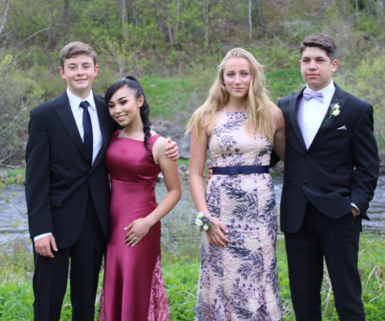
I used to think prom was a waste of time and money, but last weekend I realized why we need it (and a sneak peek to book 8)

My inner anthropologist compelled me on Saturday night to go to our high school and witness a cultural phenomenon called “walking out.” At proms in the west, this doesn’t occur. But here in Downeast Maine it’s the event of the year.

Before the prom begins, the juniors (even though all grades were invited) link arms with a friend or date and march out on a catwalk to pose for pictures. In the audience seated below, their family and friends whoop and cheer as the music plays.

It was fun to see my students all dressed up: the muck boots and hoodies swapped out for buttoned shirts and jackets. The stretchy pants and plaid tops traded for beaded gowns and updos.

prom WA taylor and kistin

And the beautifully decorated gym never smelled better—the combination of perfumes and colognes replaced the usual waves of B.O. (Then again, the dancing hadn’t yet started.)

prom picture carissa

But, according to the comments I heard around me before I left, it was all very painful.

“Seventy bobby pins! That’s what’s holding this hair up—seventy. My head’s killing me.”

“Are dresses supposed to feel like your [bahonkas] are going to fall out of them every five minutes?” (If I had my sewing machine with me, I would have taken her to my classroom and made her straps, if only to get her date to stop staring.)

“I already kicked off my shoes. I don’t care what my mom says, I know I should have worn my moccasins.” (Still the dancing hadn’t started.)

PRom pictures madelyn and andersen

“Dude, I spent an hour with a Youtube video trying to figure how to tie this tie.”
“Why didn’t you just order a clip-on from Amazon like the rest of us?”
“What’s a clip-on? Man, that would have been WAY easier.”

prommikaila and friends

“No, I can’t eat anything. My mom rented this tux from Bangor [a two-hour drive away]. She said she’d kill me if I got anything on it.”

(There was a lot of “killing me,” and my inner English teacher was chanting, Hyperbole, Hyperbole.)

Overall, the kids looked great. Girls squealed in delight at each other and their dresses and hair, boys guffawed at their friends, punched them in the shoulder, and told them they looked “sick.” (That’s a compliment, by the way. Took me only a few months to figure that out.)

Another teacher murmured to me on our way out before the dancing began, “They clean up pretty well, don’t they?”

They really did.

A few boys who barely seem awake in my class were bright-eyed and dashing. I almost didn’t recognize a few others without their trademark baseball hats (oh wait–there they are, proving anything can go with a baseball hat if you’re a Mainer boy).

Image may contain: 6 people, people smiling, people standing

Then there was the girls who usually wear torn jeans and apathetic expressions, but were instead smiling shyly with smoky eyes and in gorgeous gowns. There were a few girls I didn’t even recognize in their glamour gear and huge grins.
(And occasional winces, because of shoes. And because of hairdos. And because of dresses which threatened to pop out strategic parts of their anatomy.)

I always thought the school had a lot of pretty girls, but that night all of them had progressed to “stunning.” And the boys were so close to “debonair” it was jarring.

I was surprised at my pride in all of them, especially when I recognized a few of my students strutting on the catwalk. (But calling out “AP LIT POWER!” would have sounded ridiculous.)

prom karli

prom isaac

I have a terrible confession to make: for years I’ve thought prom was a waste of time and money. I seconded the griping of one of my students about his date. “Her mom’s taking her all the way to Bangor to get her hair done. It’s gonna cost $200. For what?”

Exactly. All this effort, expense, fanciness—for what? Some of my own children went to prom, and I made dresses (less than $100) and helped (sort of) with hair, and hoped the dates didn’t spend too much money.

But why bother at all?

Saturday night, I knew why: to let these newly-emerging adults see what they can become.

Image may contain: 1 person, smiling, standing, ocean and outdoor

No, not some glamorous model on a magazine (but pink mermaid above certainly could be). But that with some effort, care, and attention, they can shine and dazzle.

Sometimes I’m given insights into people—glimpses into who they were before they were born and who they can become later in life. And it’s a good thing those glimpses are rare, because they overwhelm me. C. S. Lewis was right in that we never talk to “mere mortals:”

“There are no ordinary people. It is immortals whom we joke with, work with, marry, snub and exploit—immortal horrors or everlasting splendors.”

Image may contain: 2 people, people smiling, people standing

I sometimes see who my students were, and who they can become. It’s staggering. So much strength. So much potential. So much power, wrapped up in these tense bodies of anxiety and worry and worldliness. It’s good for them to see themselves—and each other—at their “best” that none of them knew existed.

To feel, just for one night, the grandeur of what may be.

No wonder their parents were there, proudly taking pictures and cheering. They have glimpses, too, I’m sure. At least they have hope. They sigh and think, “Almost there . . . almost there . . .”

prom nevin

(Uh, Nevin? It’s not “hoodie optional.”)

And as their teacher, it was good for me to see them, too. These are the moments when I think, “There’s still hope for the future. Look at these kids. Don’t despair just yet. Give them a chance to shine like this all the time.”

(NOTE: I didn’t take any of these amazing photos, but gleaned them from Facebook and emails, and my students agreed I could use them.)

[Sneak peek to Book 8: The Last Day]

Cloud Man smiled as he wiped Young Pere’s face, as if he were washing up a toddler. “Chin up. Up, up. Too bad there’s no time for a shave. You grow the most ridiculously splotchy beard. Now, behind your ears . . . And over to your forehead . . .”

Sergeant Beaved, observing the cleaning up of his prisoner, rolled his eyes and turned around in embarrassment.

Young Pere struggled to keep his face from contorting. Cloud Man was the best.

“Now close your eyes. We need to get all that dust off. Why, you’re not as tan as I thought you were. Most of that coloring is dirt. Tsk, tsk. What would you mother say? Oh, I guess we’ll find out soon enough, won’t we?”

Young Pere snorted.

“Now your hair . . . hmm. I think I have a comb somewhere. Ah, here it is! I don’t think I’ve even used this. Let me comb through this . . . It’s as if you haven’t bathed in days, Young Pere.”

“Because I haven’t, Cloudy. None of us have. We’ve been invading Salem, remember?”

“Tsk, tsk. Your hair would be better if it was shorter. Guess there was no time for a decent cut after they released you from the dungeon. We’ll just comb it up and over your ears. Now, let me look at you. Hmm. Guess we need a woman’s opinion. Do they generally consider you handsome?’

“Generally.”

“You might pass for handsome. Ruggedly handsome, since you’re not cleaned up properly—”

“Are you about finished?” Sergeant Beaved interrupted hotly. “Because I’m supposed to bringing him at any moment!”

Cloud Man nodded and patted Young Pere’s hand which still held the unlocked chain together. “I think we’re almost ready.”

~Book 8, The Last Day, coming Summer 2018

How an invasion of ladybugs brought down this pacifist and is making her rethink her stance on guns.

See this photo of our latest snowstorm?

IMG_0126

Look closer—see all the spots on the image when I turn on my camera’s flash?

IMG_0127

Ladybugs.

No, no, no—don’t start saying, “Oh, how sweet!” because they aren’t. Not one bit.

They are everywhere. Hundreds, every single day, springing up in the oddest of places. Usually I find them my bedroom and in kitchen–literally IN the butter dish and in the refrigerator (under the veggie drawer, trying to get to my lime).


They don’t respect anything or care where they die. My curtains seem to be their favorite death spot. And our cat is useless against them.


Did you know that when you step on them with bare feet, they have the softest crunch? Not as bad as cockroaches, but still very unsettling when, in the middle of the night, you pad clumsily to the bathroom and feel tiny “crunch . . . crunch . . . crunch” under your feet.

This has been problematic for me because I’ve gone on the offensive, vacuuming up these creatures every day—hundreds a day–and every morning the window looks again like this:

IMG_0129

I like to believe I’m a pacifist. I don’t destroy spiders, but back away respectfully and let them have the room until they feel like leaving. I’ve caught mice in past houses and released them into the wild. I have a “live-and-let-live” philosophy: everything deserves life, as much as I do.

Except for hornets. Just the other day I followed a disoriented one who must have come out of hibernation early in my classroom. It landed on the floor and I whacked it repeatedly with a binder, to the cheers of my students. Hornets serve no purpose except to sting me and make my hands swell up.

And ants. They can do anything they want outside, but if they invade the house, they’ll meet my can of Raid and my cries of “DIE! DIE!”

Ok, so I’m a pretty bad pacifist, with a “live-but-not-in-my-house” philosophy.

Funny how circumstances can make you rethink your philosophies, how something hitting close to home—or invading your home—can shift everything.

For example, I hate guns. Always have. I recoil when I see one nearby, and the desire to run for cover overwhelms me.

Until recently, when I realized that as a “permanent substitute teacher” I have a responsibility beyond myself.

Our school has recently been discussing ways to improve safety. New measures began this week, and as I explained them to my students, we naturally joked about how to deal with real threats. (These are teenagers—the only way to deal with heavy issues is to make them lighter.) We talked about the door, and how I might be rearranging the classroom to put me nearest the door, in to open it first whenever someone knocks.

A student said, “So that means you get to die first? Mrs. Mercer, how’s THAT supposed to help us?”

Before I could answer with, “Gee, I really don’t know. I hadn’t considered that,” another student suggested, “Seeing her get shot gives us half a second to realize what’s happening so we can hide under our non-bulletproof desks.”

“But if Mrs. Mercer had a gun,” someone said, “she could take out the shooter and save us all!”

Shockingly, I found myself smiling at that.

Wait, what?!

No. No, no, no I hate guns. I don’t even like their shapes. But suddenly, looking at all of my students who daily test and try me, but who I love far more than I ever thought I would, I wavered.

Would I try to take out their shooter? I like to think I’d rush him, like a manic mama bear, screaming and flailing and maybe doing some good before I was cut down.

But if a gun appeared in my hands at that moment—and I knew what to do with it—would I use it in a situation where I thought my students were in danger?

Shockingly, I just might.

Oh, I know all of the arguments against guns—I’ve written them all in my head. Every time I read about an accidental shooting, or another child finding a loaded gun, or someone else being careless and causing injury or death, I point it out to my husband and say, “Again, THIS is why I insist you keep the ammo and guns separate.” He does. It took him years to convince me to let him have any weapons at all.

I’ve always maintained that I would rather lay down and die in front of a gunman, instead of risking taking someone else’s life. Especially if there was the possibility of my misreading the situation and using a weapon on an innocent bystander. Judging a life-or-death situation accurately in a moment’s notice is difficult for highly trained soldiers and police. They sometimes get it wrong, despite all their experience.

But someone like me? Untrained and emotional and terrified? I wouldn’t trust myself to make the right decision. That’s why I’d prefer to lay down and let happen whatever would happen. God will sort it all in the end.

But as a teacher—even a mere permanent substitute—it’s not just my life in that classroom. I’m a pseudo parent for every child in that room, and I have to consider, “What would each of those parents expect me to do for their child?” I still hate guns. I never want to hold one, but . . .

I’m wrestling with that idea as I vacuum up yet another batch of invading ladybugs.

Only a year ago, I would have carefully rescued the stray ladybug I found in the house and escorted it outside, not unceremoniously suck them up and throw them into 22 inches of new snow.

Circumstances have changed, and I’m changing too.

And I’m still debating if that’s a good thing or not.

Mrs. Yordin chased after Mahrree. “Don’t you dare interfere with my soldiers!”

Mahrree stopped. “Your soldiers? Eltana, no one in Salem owns anything, especially soldiers! But this is what it’s about for you, isn’t it? Revenge for Gari? You don’t care one bit for these people. You never really tried to live the Salem way. You harbored resentment and anger all this time, and now you’re using these gullible people to try to, what, kill Lemuel Thorne? Is that your goal?”

“Yes!” Mrs. Yordin declared. “For me AND for all these people, and even for you, Mahrree! We kill Thorne, we change the world.”

“Change it to what? Not all change is for the best, Eltana, I promise you. The kind of place where bitter old women like you get their way and peace-loving people suddenly want to know how to bleed a man to death is not a place I’d want to live in!”

Mrs. Yordin folded her arms. “You were always so self-righteous,” she announced smugly. “Always had to tell everyone else what they were doing wrong and why nothing was ever right. No wonder the world forced you from it. They were sick of listening to you. Everyone in Edge was. And now you’re breathing your sanctimonious ranting here.”

“Yes, I am.”

~Book 8, The Last Day, coming Summer 2018

FREE .pdf file of Book 7: The Soldier in the Middle of the World–available now!

Book 7 FRONT coverAs with my previous book, Book 7 is HERE now, for free, available as a .pdf. Click right here for the page that will give you the link. 

Why do I do this, give away my books for free? As I’ve written before when I published Book 5, Safety Assured Leaving East of Medicetti, I feel I was given this series, like a rough blueprint, along with a pile of supplies, and told to “Go for it.”

I’ll be the first to admit I’m a clumsy builder, but writing and rewriting has brought such joy, and I want to share it. I don’t want a few bucks to come in the way of someone accessing it, and while the paperbacks cost a bit, I literally do not make anything from them. The prices are set to the barest minimum I’m allowed to set them to.

Years ago the phrase, “Freely given, freely shared,” came to me, and this blueprint and supplies were “freely given” to me by our Creator. I feel He wants me to “freely share” these books with you.  If you’ve read Book 5, you know what I’m talking about. Yes, I’ve put in a ton of labor for about eight years, but I’ve been compensated in other ways, if not monetarily.

No, I’m not independently wealthy. My husband and I are both in education and we have nine kids. Do the math. It’s dismal.

But this series hasn’t been about making money–it’s about sharing an idea that can improve our world for everyone.  

So share freely and get the word out: “There’s this slightly mad woman giving away her books. Snatch them up, quick, before she comes to her senses!” (No worry there; I’ve never come to my senses. I have no idea where they are, and they aren’t too worried about looking for me, either.)

Book 7 Teaser: Why we’re so susceptible to fake news

Because we don’t want to think. That’s so like, boring. <insert eye-roll>

We don’t want to study, to research, to ponder, to analyze–we just want to be fed so that we can get back to playing and being entertained, as quickly as possible.

Give us easy information, sensational too, because we love to be entertained.


weekly meme dumb sheep

And we’ll follow whoever makes life the easiest and most entertaining for us.

Which is why we’re running headlong into big trouble.

Anyone remember ancient Rome, the bread and circuses?

That’s what I was afraid of.

(By the way, that book 7 I keep promising? It’s so close I can taste it when I lick my laptop. Um, maybe you didn’t need to know that detail . . . sorry.)

The semester in which Mahrree Shin suddenly became my mentor

I haven’t been too active on my blog since September, as I’ve mentioned before, because I was offered to teach 10th grade English at a local high school when a teacher suddenly had to leave.

The strange thing is, I’d forgotten that I’d given up on the idea of teaching a couple of years ago. Burned out by grading and freshman college students’ attitudes, (“Wait, college is hard?! No one told me college would be hard!”) I had pursued a small business and my writing.

Then why was I suddenly agreeing to teach high school in a matter of days?!

I still don’t know why, except that, strangely, I really, really wanted to.

The adjustment has been immense—working full-time, learning how to teach high schoolers, reading their novels rapidly to be two days’ ahead of them. I’ve never worked harder in my entire life. I’ve never been so drained and depleted and exhausted.

And, shockingly, I’ve loved it.

Well, most of it.

Because there’s 2nd period.

Everyone at this school of 400 students and teachers knows about my 2nd period. A senior that I have in 4th period stopped by last week to turn in something, glanced at the back row of boys I teach, and exclaimed, “Whoa—you’ve got ALL of the rotten ones!”

Yes, yes I do. Out of 20 students, 17 are boys. One-fourth are retaking the class because last year’s teacher failed them (and yes, I’ve heard all about THAT injustice from them repeatedly). A couple are retaking English 10 for the third time. They’re juniors who are feeling a bit panicked.

As you might imagine they have attitudes. Disrespectful, bitter, bratty, insolent—yep, I’ve got the full gamut. This has always been my biggest nightmare: a classroom where half of the students are the school’s known bullies.

And, for the strangest of reasons, I love each one of them.

No, it’s not a strange reason, really; it’s an absolute gift. The first day I faced them—and I had been warned about them by the assistant head of school, the head of the English department, and their current substitute teacher—I gazed over their scowls and cynicism, and I was filled inexplicably, wholly, with love for them.

Realize, this is NOT my nature. I can be rather nasty and cynical myself, as anyone whose read my books can attest. But not right then, and not since then. I was filled with pure love.

It wasn’t my love, but God’s love for them. I felt at that moment such a profound sense of, These are my children, and they need someone to care for them. This is your task, and here’s how I feel about them.

Staggering. Absolutely staggering.

I never before realized how immensely God loves each of His children–even the rotten ones. So much so that He’ll send anyone He can find to help them.

weekly meme Not too far gone

He’ll use anyone willing. Even me, as inadequate and unprepared as I am.

The head of the department had suggested that what these kids needed most was someone to “mom” them, and since I have nine kids she assumed I knew how to do that.

I didn’t, but God does. And daily He’s tutored me in what to do when someone acts up; when a student etches poorly drawn male anatomy into the desk; when another student wanders the classroom in search of the garbage can to toss his breakfast sandwich into from fifteen feet away (the sandwiches tend to fall apart in flight, just fyi); when a frequent-failure, who is failing yet again, lays down on the floor and announces that he’s no longer writing but is listening, so keep talking and don’t mind him when he starts snoring; when another student, smelling strongly of marijuana that he claims is his parents’, looks at me with his bloodshot eyes and hazy expression and says, “What was the assignment again?”  

And I’ve been tutored as to how to handle the other half of the class which is frustrated with the ding-dongs on the back row and yell, “She told us eight friggin’ [at least, I think he shouted friggin’] times what we’re doing! I counted! Shut up and listen for once!”

And I’ve been channeling Mahrree Shin, when she was teaching the delinquents of Edge. When I first drafted books 3 and 4 and described Mahrree’s experiences with her troubled students, I borrowed examples from friends who taught, and also my limited experience in once teaching English composition to the auto shop students at a local community college. They, too, were insolent and boorish. The college had thought that teaching them a humanities class might instill in them some humanity. That’s material for another post, but I’m happy to report I did have some success with them.

But that was long ago, and these are very different boys. And nearly every day I’ve thought, “What would Mahrree do?”

I’ve been taking her advice, which is also the Creator’s advice:

I never yell, although many of my front half of the class have told me to shout at the back half. “Just let them have it!”

But I never felt that was right; Mahrree never lost her temper. She’d stand in front of the class, smiling sweetly (sanctimoniously?) while waiting for the noise-makers to lose some steam. She’d stare at the worst ones intently until they squirmed and blurted, “What?! What do you want?!”

“To begin class. Are you now ready for me to talk?”

“Yeah, talk already! You’re creeping me out!”

Mahrree would never lose her cool, even when a handful of boys, upon hearing they could throw away their homework, crumpled the pages into balls and started hucking them, a dozen at a time, toward the garbage can. No, Mahrree would critique their terrible shots, exclaim loudly that she’s glad none of them are on the basketball team (while knowing that two of them were) because they couldn’t make a shot to save their lives. Then she’d pick up the balls of paper and chuck them back at the boys, demonstrating how to properly hit a target.

Mahrree wouldn’t insist on absolute silence or obedience, knowing that these boys trapped in her classroom were counting down the minutes until they could break free and run home to their four-wheelers, or their lobster boats, or their shotguns which beckoned them all day long. She’d play games in the class with vocabulary words, knowing that the teachers on either side of her classroom were forgiving of their volume because, “It’s 2nd period,” and even their students know about Mrs. Mercer’s 2nd period.

Mahrree would bring in the occasional treats, feeding them pomegranate seeds when they discussed Persephone and Hades, giving them “bird poop” cereal mix when we discussed Poe’s “The Raven,” and tossing Smarties to the students who won the last round of vocabulary Bingo.

Mahrree would worry about the students’ need to be heard, to be engaged, to feel like their 80 minutes in the classroom wasn’t an exercise in frustration.

Mahrree wouldn’t care about her ego, or her students’ lack of respect, because she knows she’s there for them, not for herself. It’s about the kids; it’s never about her.

Mahrree, by the way, is NOT like me in the least bit.

But she’s been tutoring me; God has been teaching me–daily, hourly, and every minute–how to cope.

And I’ve never learned more about teaching, about myself, and about God’s love for every one of his children—EVERY last one of them.

Mahrree would, however, count down the days until the semester was over. That, we have in common.

Eight days. Eight.

And I suspect that right after I do my Happy Dance on January 12th, I’ll shed a few tears as well, because this mom will have lost a lot of her children who she learned to love.

Because God showed me how much He loves them.

(By the way, Book 7, The Soldier in the Middle of the World? I’ve nearly finished proofing it. It’s coming, friends–it really is!)