We’re wasting ourselves

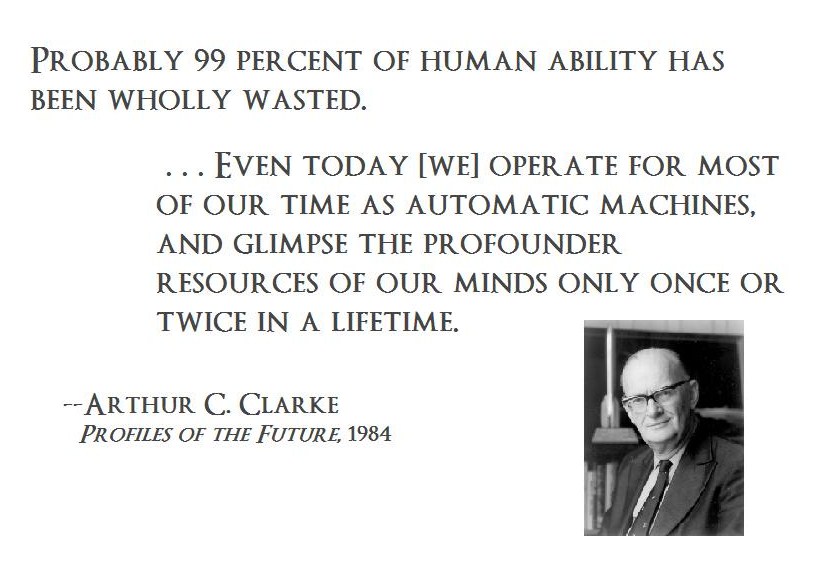
This morning while rereading Hugh Nibley’s essay “Zeal Without Knowledge,” I came across this quote from Arthur C. Clarke. While I don’t agree with everything Clark believed–he was a provocative philosopher in his own right–I do appreciate this:

arthur c clarke quote

In preface to this, Hugh Nibley wrote:

sin is waste

Drat.

Means I need to get off of Facebook again.

(And yes, I am working on Book 5, the title to be released soon.)

Why English as a major is dying

Some years ago I was hired on as an adjunct composition instructor at a public university in the Carolinas. (We’ll allow this English department to remain anonymous.) At the faculty meeting held a couple of weeks before school started, several agenda items had to be addressed. After the usual introductions, someone of importance stood up and announced, “First order of business: the censorship of the freshman reading selection!”

That caught my attention in what would normally be a dull meeting wherein I’d fill half a page of doodles.

Each year the university assigned a novel for incoming freshmen to read in hopes of having an “intellectual discussion” between students and faculty during orientation. (Nice idea in theory, but in reality it usually fails.)

Just days before our meeting, a few parents had objected to the book choice, citing its violence and a few questionable scenes. I’d never heard of the book before (again, we’ll let it remain anonymous) but according to Amazon it was a “coming of age” story about a college student who was hazed. Today I looked it up again to refresh my memory and saw that it never became a best seller since interest in it died off quickly. Its couple dozen reviews hovered around a “3” calling the book dull, unrealistic, and lacking substance.

Freshmen college students procrastinate reading this kind of stuff, especially in their last summer before college begins. 

Which likely explains why, just the week before they were to come to campus, freshmen students were finally picking up the book, not liking what they saw, and complaining to their parents.

Those parents then complained to the administrators, who, afraid of upsetting those parents who paid for their students’ tuition, agreed to pull the book as required reading.

Which in turn enraged the English department. “Censorship!” they cried.

It occurred to me that telling students they didn’t have to read a book (which most of them wouldn’t have read anyway) didn’t constitute “censorship.” No one was insisting that the books be destroyed, or planned to burn them in the commons area. They just didn’t want to read something that offended their sensibilities.

But no! insisted the English Department. This called for action! This called for a . . . for a  . . . STATEMENT!

I nearly guffawed at that, until I realized that the 60 or so faculty around me found that an entirely excellent way to Make a Stand.

Snickering quietly to myself, I then watched the most absurd display of bureaucracy. First, a committee had to be formed to write The Statement. That took half an hour, with several rounds of voting (my memory wants to say it was anonymous and with eyes closed, but maybe I’m just remembering “Heads Up, Seven Up” from elementary school), and finally a small committee was selected, and a chairman was decided, and times were set up for faculty to confer with them concerning The Statement.

(Not an actual self-portrait, but pretty darn close.)

I would have been bored silly—I was there only to pick up a copy of course policies and find out what text I was to use—had I not been so entertained by the seriousness of the process, the lengthy explanations tossed about, and the excessively self-righteous language used to tear down the self-righteous who didn’t like the book selection. (It was pretty clear which faculty helped choose it, and were personally offended.)

After that entire fiasco, which took the better part of an hour, was completed, the next item on the agenda was, How to get students interested in becoming English majors.

I know I snorted out loud then, but covered it with coughing or something, because just moments before I was thinking, “Why the heck am I here? Why did I ever once think becoming a full-time professor would be fulfilling? They’re accomplishing nothing of importance! And just look at my notes: I’ve written, ‘Get me out of here’ over and over! What 18-year-old, in his or her right mind, would watch these proceedings and think, ‘Hey, awesome! I want to be part of that!’?

The next excessively dull half hour was spent in another tidal wave of predictable “let’s have luncheons” (as if college students in this century do “luncheons”) and “let’s demonstrate how valuable an English degree is” (I was struggling to see how mine was useful) and “let’s have an open house” (seriously? An open house? To demonstrate what?).

At some point I probably blacked out from sheer boredom because I have no recollection of when or how that meeting ended. I just know that I wanted to leave, leave, leave.

Oh, and The Statement?

Five people spent two full days writing and rewriting it. And when they finished, they put a copy in each of our mailboxes.

Four pages, single spaced.

That’s no “statement.” That’s a constitution for a fascist country.

I tried to read it.

Really, I tried.

My master’s degree is in rhetoric, but I could NOT get through it. So full of jargon and big, scary words, and sentences that went on and on and on pointlessly . . . I couldn’t even understand the first paragraph.

The Statement Committee threw a new fit of fury the next day when the school newspaper wouldn’t print the statement in its entirety.
They wanted a “blurb.”
Hey, who didn’t?

The local newspaper wouldn’t even touch it. I’m sure they didn’t even know what it was about. I sure didn’t.

I stared at the monstrosity and knew, right then and there, that English as a study was committing suicide.

What happened to writing directly? Plainly? 

I wrote several versions of a statement in my head that day. One went something like this: The point of college is to expose ourselves to new ideas and experiences. We in the English department are disappointed that some of our incoming freshmen are choosing not to do so.

That’s a “statement.” Two or three sentences: something pithy, something tweetable.

Fortunately my husband was offered a job across the country, and just three weeks later I bailed out and moved far away from that stuffy soup.

Today Grammarly posted this cartoon below, which brought back those memories. I commented about my experience, and someone wrote back that he left an English site because it had become a “competition in obfuscation.” Amen! (By the way, “obfuscation” means “to confuse.”) 

Years ago I thought English was the pursuit of reading books and poetry, analyzing others’ perceptions of the meaning of life, and then sharing those ideas with others. The point, I thought, was to try to make life bearable.

 David Masciotra wrote in The Daily Beast,

“Any lover of literature . . . knows . . . it is the enchantment of experiencing life through the consciousness of another human being, albeit an invented one, and gaining unique access to the vantage point gained by entering the mind of its inventor.”

But that’s not what I’ve been seeing.

Instead, my (admittedly) very limited experience is that many professors in English departments try to prove their worth in ever-deepening holes of thought where no one really wants to go. I remember a student in my grad school classes who was unquestionably brilliant, and you could see our professors stiffen every time he opened his mouth and said, “I posit that . . .” What followed next would be a length of jargon and rhetoric that none of us in the class could follow.

In fact, I think that’s when I started doodling in the margins.

Verlyn Klinkenborg wrote this about college students in The New York Times:

“They can assemble strings of jargon and generate clots of ventriloquistic syntax. They can meta-metastasize any thematic or ideological notion they happen upon. And they get good grades for doing just that. But as for writing clearly, simply, with attention and openness to their own thoughts and emotions and the world around them — no.”

His point was to show that students can’t write directly, and even he struggles to state that directly.

This isn’t a new trend, either. In the 1990s, the late Denis Dutton hosted the Bad Writing Contest for professors, and many of the “winners” were English professors.

Steven Pinker believes academics communicate horribly for a number of reasons: trying to impress their readers, to prove they actually know something, and getting caught up in the language itself. But, mostly, he says,

“There are few incentives for writing well . . . In writing badly, we are wasting each other’s time, sowing confusion and error, and turning our profession into a laughingstock.”

Yep. So glad my daughter’s majoring in nursing.

It took Mahrree a couple of weeks, but at the “bottom” of it all was a list she made to elucidate and disambiguate—
Clarify  what the Administrators were advising. Whenever she got stuck or tired trying to decipher the intricately convoluted—
Needlessly complicated language, she asked Perrin for ideas, and also received a few more insights from Shem. She discovered that the changes in instruction were only an advisement—for now. In the nebulous “near future” it would all be compulsorily mandatory—
Unavoidable.

~Book 2, Soldier at the Door

Don’t be afraid of my opinion, because I’m not afraid of yours

I’m fascinated by how many people are terrified to allow someone else an opinion contrary to their own.

If someone says/writes/believes something differently than we do, we’re struck with an almost primal need to purge that difference.
For some reason which I can’t figure out yet, we’re terrified by differences.

The obvious examples are terrorists and racists and any other form of negative “–ist”.
But I’m not talking about the obvious bullies who are acting out of what they believe is “righteous condemnation,” disguising their cowardice.
No, I’m talking about you and me, our neighbors, families, coworkers, students who, when presented with an attitude different than our own, shrink back in worry.

Perhaps we strike out fearful that maybe we’re the ones in the wrong, but we don’t want to change, so we better smack down the opposition. (But that’s only my opinion.)

But here’s a radical notion: What if there’s room for all of us to have our own opinions, and we don’t have to fight every different idea, but simply . . . let them be?

Aristotle said thousands of years ago that the mark of an educated mind is to entertain an idea without accepting it. 

Are we yet evolved enough to follow the Ancient Greek’s advice?
Recent evidence would suggest no.

Think about how many articles you’ve read where an opinion is stated, and commenters rage that the authors are wrong. I’ve frequently published letters to the editor (opinions) and recently published a longer piece expressing my reasons (opinion) why I don’t cry when I send an adult child away on a mission for two years. I was explaining my experiences, yet some commenters said they felt “judged.”

Judged? By MY experience?
What an odd way to think.
(Uh-oh—someone’s going to judge my opinion on that, I just know it . . .)

But here’s the thing: we all express OPINIONS, and we should. These are not statements of fact, not insistences for policies, not movements to obliterate all other opinions.

Opinions are merely interpretations of life based on one’s experience.

And they are all different. And that’s ok. (In my opinion, that is.)

Yet I’ve seen people squirm in discomfort, scowl in surprise, and even rage in fury when someone else’s experience runs counter to theirs, as if their lives have been suddenly invalidated.

But every person feels and interprets differently, and here’s the marvelous truth: the world IS big enough for all of us to have different opinions.
Here are some opinions I’ve heard recently which turned into actual—and unnecessary—arguments:
–Taking trip to Disneyland/Yellowstone/New York City is stupid/dull/overrated and a waste of time and money.
–Home schooling/public schooling/private schooling shows you don’t have any faith in the system/yourself/the world in general.
–Going to college/not going to college is the biggest mistake you’ll ever make.
–Having one/three/ten children is an excellent/irresponsible decision.
–Letting your kids play/not play on the computer/watch TV/not watch TV is a sure way to ruin/help your children.
–Starting a business/working for someone else is the only way to be sure of your future security.

And, fascinatingly, all of these opinions are ACCURATE.

Because these opinions are based upon individual’s circumstances, and if that circumstance is evaluated honestly, then that opinion is correct, even if it runs counter to what someone else believes.
 (But that’s my opinion.) opinion definition

I think vacationing at the beach is dreadfully dull. My in-laws think it’s ultimately relaxing. We’re both correct.

When I taught critical writing, I’d spend weeks trying to explain that various opinions can all be correct, but even by the end of the semester many college students still struggled with that idea.

I had an excellent test of this early in my teaching career. Before Salt Lake City hosted the Winter Olympics in 2002, there was controversy among Utahns about the impact of the games. I had a student who absolutely opposed the Olympics, while I thought their coming was the greatest thing ever. The assignment for the semester was to write an extensive research paper supporting an opinion, and guess what this guy chose for his subject?
The Damaging Effects of the Winter Olympics.
I didn’t like his topic, as you might imagine. While I am a conservationist at heart, living in a host city of the Olympics had been a dream of mine since I was a little kid. (Ironically, we were living in Virginia in 2002, and I confess I went to my bedroom during the Opening Ceremonies and wept because I wasn’t there.)

Anyway, Olympics-Hating-Student was smart. Each day he’d ask me my opinion about an aspect of the Olympics—traffic, recontouring of ski slopes, building of ice rinks, etc.—and then he’d take careful notes of what I said. He’d smile gratefully, smugly even, and would leave me stewing as to what he was up to.
It turns out his research paper became a carefully orchestrated opinion argument to prove my opinion wrong in every paragraph.

It was absolutely brilliant.

Oh, I didn’t agree with a word of it, but I gave him the highest grade I ever awarded: a 198/200 (he had a few comma issues). While I didn’t agree with his opinions, I had to agree that his ideas had merit and value, and while there were not ideas I wanted to embrace, I would allow him to embrace his opinions.

When he got back his paper, I watched as he nervously opened to the last page of evaluation. The grin which broke out across his face was priceless.
His peers, who knew I opposed all of his arguments, glanced at his grade and were astonished.
“We thought you’d hate his paper!” one of them exclaimed.
“I disagree with his ideas,” I told them, “but he’s entitled to his opinions, especially when he’s so carefully researched them and presented them. He did an excellent job. Who said I have to agree with his premise and conclusions?”

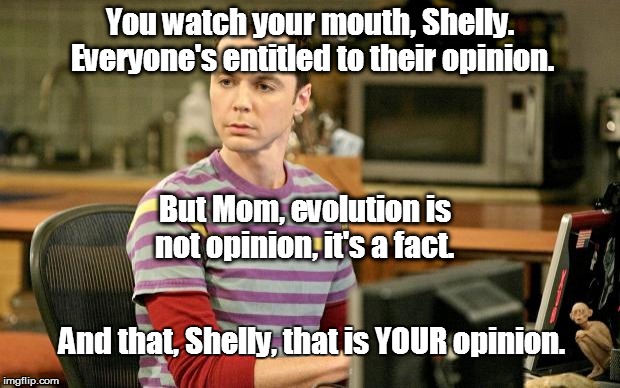
Sheldon Big Bang Theory  | You watch your mouth, Shelly. Everyone's entitled to their opinion. But Mom, evolution is not opinion, it's a fact. And that, Shelly, that i | image tagged in sheldon big bang theory  | made w/ Imgflip meme makerMay I submit the following: We balk at others’ opinions because we’re afraid they may be right.
We feel the need to fight back because we aren’t entirely secure in our own opinions.

May I also submit this: We don’t have to.

If you don’t like what you’re reading, stop reading.
If you don’t agree with someone else, agree to disagree and LEAVE IT ALONE.
Stop fighting. Nothing good comes from a fight. Ever.

I believe that God gave us our agency—our ability to choose—to allow us a full range of experiences in this life. When we, for any reason, try to shut down or deny another person of their opinions, we are essentially taking away their agency. That’s a devilish attitude, and one we need to avoid at all costs, or we become devilish—controlling, angry, and overbearing—ourselves.

HOWEVER . . .
There’s a time to push against another’s opinion, and that’s when YOUR opinion intends to change MY way of:

  • Living
  • Eating
  • Dressing
  • Worshipping
  • Teaching my children
  • Living according to the dictates of MY conscience

Then I will fight back.

There are many obvious examples of this in the world, but let me give you a more local one: A friend of mine recently took her daughter to a musical camp where kids could be trained by professional musicians. The camp fell on my friend’s daughter’s 12th birthday, and to celebrate my friend splurged and bought a store-made cake. She placed it on the food table where other parents had brought snacks, intent upon letting everyone share in her daughter’s birthday celebration.

Except one mother didn’t agree. Putting herself in charge of the table (no one’s sure if she was asked to, but she set herself there anyway), she announced to the children that sugar would make them hyper, and she wouldn’t allow anyone to have any cake, since she didn’t allow it for her own children.

This woman decided—based on her opinion and rather poor science (sugar does NOT cause hyperactivity in children–read this)—that no one should have the opportunity to choose for themselves if they wanted cake.
One person’s mere opinion overruled everyone else’s choices.
That’s wrong.
(In my opinion, that is.)

In our homes we have the right (for now) to impose standards as to what will be allowed and what won’t. In my house I won’t allow abuse, or vulgarity, or pornography, or music and/or entertainment that promote anything like that. In your house, those rules may be different.

But it is NOT my prerogative to barge into your house and force my standards—be they more relaxed or more stringent—upon your family. However, if you come to my house, I expect you to respect how we do things, as I will respect how you do things in your home.

As long as your opinions don’t threaten to take away my freedoms, I’ll keep my mouth shut, and I’ll even be your friend.
But if that line is crossed, if someone’s opinions try to change the way my family lives, then I will push back.

You can live and think and worship and behave differently than me—I have no problem with that, really. We should afford a level of respect to everyone we love. I don’t agree with every opinion of my husband’s, but I won’t detail those differences here right now because we’ve made it 27 years by agreeing to disagree, and I’m not about to disrupt that cart.

We make these kinds of “opinion accommodations” with many people we love.
So why do we not always do so with strangers? With other nationalities, religions, cultures, genders? Why do we feel the urge—even the sanctimonious right—to blast online the opinions and experiences of people we don’t know simply because we can?

Here’s a radical thought (and this is just my opinion): if you don’t like what you’re reading, stop reading it and move on.  

Don’t attack, don’t claim to be judged, don’t cry foul, don’t do anything. Just step away and do something constructive and useful instead.

I tend to clean the kitchen now instead of lashing out with unexplained venom, crying, “What an idiot! Who does he think he is, writing that?!”
“He” probably thinks he’s a person—just like yourself—who feels the desire to share his opinion to help others of like minds realize their experiences are valid. He’s not forcing his way of life upon you, so calm down already and go scrub something!

But then again, that’s only MY opinion, and I’m frankly, I’m entitled to it, as you are entitled to your own.

“What’s wrong with having opinions?” Mahrree said, her voice rising to the pitch of a trapped cat. “What’s more frightening are people with no opinions at all. ‘Oh, that sounds nice, let’s do it! It just feels good!’ What’s wrong with thinking?” 
~Book 3, The Mansions of Idumea

Teachers shouldn’t ask questions to get answers

It doesn’t matter what kind of teacher: public, private, or church Sunday School, the purpose of asking questions isn’t to get answers

(Not my actual Sunday School class, but roughly the same amount of kids.)

If only adults could understand that.

While I’ve taught college freshmen for over twenty years, I’ve also taught classes in my church. Right now I’m responsible to teach Sunday School to 15-16 year-olds, and because there was some kind of baby boom back in 1999, I have a class of 19 teenagers right now. The leaders in my LDS ward think I need “Help,” and today was a classic example of Question Anxiety.

That’s the best way I can put it: when I ask a question, the “Help” jumps in to answer it. Remember, the “Help” is a well-intentioned adult; but this class is for the teenagers, and when I pose a question they sit for a few seconds, thinking.

And that’s exactly what I want: I do not want answers; I want thought.

The older gentleman helping today obviously wasn’t comfortable with the silence, and tried to fill it each time it manifest itself.

But I love the silence! Wonderful things happen during it.

First, there’s the first five uncomfortable seconds when teens give each other the sidelong glance to see if anyone has an immediate answer.

That’s when the adults get nervous, and want to supply something—anything.

Because adults often work with A Plan. No matter what the task or chore or goal, most adults want A Plan, and getting quickly from point B to task H is imperative. Give answers, get moving along.

It’s because most of us were raised in the public school system which, even worse now than ever, has A Plan that must completed, no matter the needs of the children, no matter the level of interest—The Plan (quite often linked to Common Core) must be accomplished.

My son’s 11-year-old friend encountered this the other day. A substitute teacher set up four stuffed animals: a whale, a tiger, a dolphin, and an octopus. She asked the 5th graders which animal didn’t belong in the group.

Before you read further, what would your answer be?

Nice meme. Would read easier if the last two lines were, “to ask questions that EVEN YOU can’t answer.” But you get the idea . . .

My son’s friend said, “The octopus. Because all the other animals are mammals.”

That wasn’t the “right” answer, and the substitute, for whatever reason, came down a bit hard on him for not giving her answer. Instead of acknowledging that his answer was correct as well, and instead of stepping back and thinking, “Hey, clever. I hadn’t considered that,” she instead snapped at him that the tiger didn’t fit, because the rest of the animals were aquatic animals.

Stick to The Plan. Move along. The point isn’t education. The point is completing the task.

How tragic. This 11-year-old was thinking. He was right!

And that’s what teachers should want when they ask questions: the questions should make students THINK!

That’s what happens in my Sunday School class after those first five uncomfortable seconds. In the next five, kids start to muse to themselves, No one else is saying anything . . . maybe I should come up with something?

Another five seconds, and then a hand tentatively goes up with a comment I grin at and write on the board.

Then another hand. And another.

Yes! They’ll get there, without someone stepping in and supplying the answer too quickly for them.

But there’s still one more thing I want to have happen when I ask a question. Thinking is first, their responses is second, and then . . .

Well, let me tell you what happened today. The topic was The Nature of God, and I opened with asking the students, “What do you know about God?”

That was when the Helper, after five seconds, jumped in with several statements of what he, a sixty-year-old man, knew. Frankly, I didn’t care what he knew. I wanted to know what my 15-year-olds knew.

Eventually, they began to offer bits and pieces which I put on the board.

When I wrote, “Jesus has a body of flesh and bones, and not blood,” that’s when the magic happened.

One girl raised her hand. “Wait, Jesus doesn’t have blood anymore?”

“Nope,” I told her. “Resurrected beings don’t. He can’t die anymore, or even be injured.”

A couple of other teens weren’t aware of that either, and then came more questions. “So he could go skydiving and nothing bad would happen to him?”

“You got it. And here’s the awsome part—all of us will someday be resurrected too, with a perfect body of flesh and bone.”

Here’s where the discussion shifted into a little bit of silliness, but I let it.

“So when I’m resurrected, I can do extreme sports and not worry about getting hurt?”

“That’s right!”

Do you see what happened there?

The kids started asking the questions!

THAT should be the goal of every teacher’s lesson: not getting answers to our questions, but getting questions from our students. That means they’re interested. They’re thinking. They’re engaged!

And it doesn’t happen too often, unfortunately. I’ve heard of too many kids asking a question in school, and being told, after an awkward pause, “I’m not really sure, and since it’s not on the test, let’s not worry about that right now.”

Talk about killing the desire to learn. Kids have it naturally. It’s mostly gone by middle school. Can you see how it died?

I’ve also seen this a lot in my freshmen college students. After 12 years in the system, they rarely ask questions more compelling than, “Does the Works Cited page count as part of the six page requirement?”

Oh, I try. I bring in articles about issues directly affecting them, I show them entertaining video clips, and I purposely throw out nuggets such as, “Your high school teacher probably told you to never use the word ‘I’ in your papers, but we all know that’s total rubbish, along with never beginning a sentence with, ‘Because.’”

It’ll take a moment, but always a student will raise a hand and say, “Wait—we can begin a sentence with ‘Because’? What about ‘But’?” And for five minutes we have an interesting discussion, because a student wanted to know that answer, not because the teacher was looking for a programmed response.

Think back to any lectures you remember from college or high school. Do you remember any of them? At all? I remember a handful, and every one of them began with a question a student wanted answered, and ended with a teacher involving all of us in the discussion.

That is education. That is learning.

And it’s rarely happening anymore.

sunday school picture

Click here to see the curriculum for all of the youth in The Church of Jesus Christ of Latter-day Saints. Go ahead–we don’t bite. At least not that hard.

As for my Sunday School class today, Helper began to realize the kids were capable of answering the questions, and to his credit he backed off a bit, especially after I refused to make eye contact with him, but focused solely on the kids. They came through for me again, as they always do, with even a few more interesting questions that filled our 40 minutes quite easily. The LDS Church has purposely changed its curriculum for teenagers 12-18 so that they can run the pace of the lesson, and not the teachers.

If only school systems could do that as well: respect the child as a person wanting to learn, instead of part of a group that needs processing.

Not only would our children be smarter with that kind of child-focused education, but they’d be happier too, which should always be our foremost goal in education: happiness.

This was one of the things Mahrree loved about teaching: the rare moments when a student dares to wonder. The best learning happened when the students asked the questions, not the teachers.

It was also at these moments that she panicked, because sometimes the questions were so unexpected that she was caught by surprise. But it was the good kind of panic that lets you remember you’re alive, like being chased by a dog you know you can outrun, but it terrifies you just the same. It feels great when you finally reach home, or see the dog yanked back suddenly by its leash and you gloat at it triumphantly.

But first you have to run.

She always had a ready answer. “Chommy, what do you think?”

~Book 4, Falcon in the Barn (coming spring 2015)

Why didn’t you do anything to stop him?

“Why didn’t you do anything to stop him?”

That’s what people frequently asked my father. He immigrated to America in the 1950s, and had a subtle yet clear German accent.  “Why didn’t you stop Hitler when you noticed he was ruining everything? He completely changed Germany, and you did nothing about it!”

My dad would answer, calmly and rationally (even though some of those who asked were hardly calm or rational in their verbal attacks). “First, I was born in 1931, so I wasn’t too influential in the politics of the 1930s and 1940s. Second, what could we have done?”

That question has weighed heavily on my mind these past few years as I’ve watched facets of our government morph into something I don’t recognize as America anymore.

Now, this is NOT an Obama-is-Hitler post. But the questions asked of my father have been clanking around in my mind for some time now. “Why aren’t we doing something?”

I won’t go into details of what worries me in our government (except to whine that the ironically named Affordable Care Act isn’t affordable, doesn’t care, and is completely an act; and that the impending immigration reform via executive order [read: tyrannical mandate] would infuriate my immigrant parents who jumped through all kinds of hoops to come to America legally).

But I won’t be surprised when, in years from now, our children ask the same question: “Why didn’t you stop him when you noticed he was ruining everything? He completely changed America, and you did nothing about it!”

IMG_3277

Don’t worry; my baby girl wasn’t traumatized for too long.

Now I freely admit that not everything about Obama is bad. No one is wholly evil (even Darth Vader had a few soft spots).

Personally, we have benefited immensely from the Income Based Repayment program for student loan payments, signed into law by Obama in 2009. Without that, we’d be living in a cardboard box right now, while a huge chunk of our income went to pay off our student loans. I’m grateful for this program and pray that it lasts.

My father, too, was grateful for the Autobahn and Volkswagen, initiatives of Hitler to help the common man. And in many ways, Hitler was a man of morality. He never smoked or drank alcohol, and instituted a “Fast day” where citizens fasted for a meal and were encouraged to give the food they didn’t eat to the poor. Hitler increased education, reduced unemployment, rebuilt Germany’s infrastructure, and—contrary to popular belief and internet memes—relaxed Germany’s gun laws so that more citizens could be armed and even purchase guns at younger ages (the Jews, however, he disarmed, unsurprisingly).

In 2004, my dad was asked to speak to the fourth graders at a local school, and he told them that, “Hitler was a very convincing and inspiring speaker, and he could convert many of his listeners to his ideologies.  . . . Depression, unemployment, and poverty were rampant, and he wanted to turn things around.” And he did.

And that’s when Germans decided he wasn’t such a bad chap . . . until things started to shift.

And that’s when it was too late. Germany was becoming a country unrecognizable to its citizens. Within just twelve years, he changed everything, while Germans stared in disbelief wondering what just happened.

I worry that it’s happening here, too. The Constitution was established to keep our borders safe so that citizens could live their lives as their consciences dictated. But we’ve been drifting away from that for some time now, and considering historically that no republic has lasted intact longer than 200 years, I suppose it’s time for us to implode. As Alexis de Tocqueville wrote, “The American Republic will endure until the day Congress discovers that it can bribe the public with the public’s money.”

I’m definitely no politician, primarily because I feel my heart rate increase, along with my blood pressure, when I read what’s changing in our country. How the Constitution is disregarded. How the Supreme Court overreaches. How states’ wishes and votes are overturned by judges not even in their states. And how the president can do just about anything he wishes through an executive order, while Congress bickers and does nothing.

When Ronald Reagan said, “The scariest sentence in the English language is, ‘I’m from the government, and I’m here to help,’” he was prophetic.

It is the duty of the patriot to protect his country from its government.
~Thomas Paine

My father told the fourth graders: “At Hitler’s rallies the masses shouted, ‘Leader, command; we follow you!’ With this shout, Germans surrendered their reasoning power and forgot to think for themselves. Later we found out that actors with loud voices were interspersed in the crowd, and at the right moments they shouted this cry and the crowd repeated it.”

Are we all just going along with the crowd as well? Because a few well-placed voices are shouting that it’s ok to follow blindly, to let Common Core decide our children’s education, or that the wife of the president can declare how many calories my kids eat at lunch?

I believe there are more instances of the abridgment of the freedom of the people by the gradual and silent encroachment of those in power, than by violent and sudden usurpation.
~President James Madison

We have no excuse for doing nothing about the abridgement of freedoms we’re experiencing. Again, from my dad: “How was it that Hitler had such tight control over the whole nation? The answer lies with the Gestapo, or State Secret Police. Midnight visitors might show up and take that person in ‘protective custody,’ and they wound up in a nearby concentration camp. Smart people knew how to keep silent.”

We’re smart people (perhaps) and we don’t have to keep silent. We don’t have a Gestapo (but we do have an IRS, which Tea Party members would be happy to tell you about).

The Constitution is not an instrument for the government to restrain the people; it is an instrument for the people to restrain the government — lest it come to dominate our lives and interests.
~Patrick Henry

But we do have social media, we have forums, we have ways to complain and protest—many more than we had in the 1960s when they really knew how to protest—yet nothing’s improving. Political parties squabble uselessly, and we citizens suffer for it. Those who hold religious and moral values are increasingly persecuted for not embracing behaviors we deem against the will of God. And despite our public protests on social media, we’re losing.

If ever time should come, when vain and aspiring men shall possess the highest seats in Government, our country will stand in need of its experienced patriots to prevent its ruin.
~Samuel Adams

So how do we do prevent our country’s ruin? What would Samuel Adams do? Thomas Jefferson? I’m sincerely asking for ideas.

I also ask this since I can’t ask my father, who’s still alive at age 83, but whose mind is gone because of Alzheimer’s. Back when George Bush declared war on Iraq, Dad wrote a letter to the editor of his local newspaper stating his concerns about the action, and also wrote to the White House. He was proud of the response he received from Washington, and that his letter was published in the paper, but was discouraged that we still went to war. Twice.

Repeatedly he told me as I was growing up that we had to speak up when we thought something wasn’t right in our country. “We didn’t have that possibility in Germany, but we do in America.”

He was so proud to be an American citizen. He served in the Army, always voted, wrote many letters to politicians, and had the phone numbers for Oren Hatch’s office and the White House on his phone list. And he called them!

dad confused

Dad, and his classic, “Oh, brother . . .” look of dismay.

Later, he amended his answer when people asked him why he didn’t do anything about Hitler. “I was a child in WWII, but as an adult I make sure my opinion is heard. I became an American citizen because I love this country and believe in the pursuit of freedom for everyone. What are YOU doing to make sure this country remains free?” 

Strange as this sounds, I’m glad Dad’s awareness and memory is impaired. He’d be dismayed to see how we’ve strayed from the Constitution he dutifully studied. He’d be wringing his hands in worry that history was repeating itself, trusting a man who thought much more of himself than he should, and took upon him much more power than was ever intended.

Most of all, I still hear him saying, “Why didn’t you do anything to stop him?”

America will never be destroyed from the outside. If we falter and lose our freedoms, it will be because we destroyed ourselves.
~Abraham Lincoln

People tend to trust whoever sets themselves up as the authorities, but at some point each person needs to look at what’s claimed and test it. Is the sunset really pink, or is it more of an orange? What do you see?

Did the government deserve her trust? They acted as if they already had it, Mahrree thought cynically. As if they could just take it, not earn it. And no one was questioning that, were they? They collect our trust as easily as they collect our taxes. We wanted them to succeed so we trust them blindly. Foolishly. And they’re using that. If people stop arguing, stop thinking, and are just willing to take—to trust—whatever the authority dishes out, they’ll accept just about anything— 
~The Forest at the Edge of the World (book 1)


The myth of hard work and wealth

I think there’s been more harm than good done by this statement: “If you work hard enough, you’ll be wealthy.”

I recently met a man named Charles who’s a chef, been working in restaurants since he was 16-years-old, and owned his own restaurant and his own catering business. But he can’t keep up anymore—working from 4am to 11am at the restaurant, catering on the side, and getting to bed by 10pm if he’s lucky only to get up again at 3:30am. He’s stooped over, walks slowly, but still smiles, albeit wearily. He’s 68 years old and doesn’t want to retire, but needs to slow down. However, he worries about the many people who rely on him and his industry. His past generosity means he doesn’t have much saved up, either.

Sara, in her 40s, has a husband is trying to finish his college degree. To help him, she’s now working full-time as a teacher’s aid in a school, and works an additional 20 hours/week at a hotel. In the few hours in between she helps her five kids with their homework so that her husband can study. She has a college degree, but couldn’t find full-time work anywhere in her field, so she’s burning the candle on both ends. Both Charles and Sara work very hard.

How often have you heard this statement? “Get a college degree, and your earning potential will increase.”

I know of far too many people to name with college degrees, with years of experience in management, training, HR, and sales who are currently working part-time jobs–which require no degree–and offer no benefits (we won’t get into the irony of the Affordable Health Care Act right now). There simply aren’t enough full-time jobs, and while a few of these people have considered moving to find work, they’re trapped by houses with no equity in them. Every month they sink deeper into the hole. 

Then there’s my friend with degrees in a hard science and a foreign language, but works as a seamstress. She said “Professional Alterations” was the most useful course she completed in college. And then there’s the friend who finished a graduate degree widely touted as the key to success, but neither he nor the twenty others he graduated with can find work making more than $14/hour. The market’s been saturated with people graduating with that same advanced degree.

I think this one gets under my skin the most: “Work smarter, not harder.”

I read this on an acquaintance’s website. Back in college he drove twenty-year-old German luxury cars, because he vowed he’d always drive new ones in the future. He does, a new model every year, as the head of a company that peddles a “forever young tonic” to vain and aging people. A blogger on his company’s site claimed, “Some people think luck just happens. We make it happen.” Then she went on about how much money one could make selling their snake oil. But I never believed one should become rich by manipulating the vulnerable or stupid. This rouse has been around for generations. It’s not working smarter, it’s working meaner.

How about this one: “Work hard enough, and you’ll get your piece of the pie.”

Or so claims another get-rich website, which buries the actual product they sell but talks all about the vacations their marketers take. The problem with this mantra is that there is only so much pie to go around. But those sitting at the top of a pie kingdom believe in the myth of “spontaneous pie generation,” that they won’t need to share some of the pie they snagged, but if others simple worked as well as they did, another pie would magically appear for them too–and they’re willing to sell you the secret.

As the discussion of the “haves” vs. the “have-nots” comes around again, there’s a prevailing notion of, “I deserve this, and you don’t, because you’re just not good/smart/hard-working enough.”

And this notion is a lie. I’ve always suspected that, but now I’ve seen proof.

Lately my eyes have been opened to how many people in America are hard-working and are just getting by. I thought it was just us, but I suspect it’s the majority. Forget wealth; we’re just trying to cover the mortgage. Like the nearly 70-year-old woman I know who lives with her struggling sister and her family. She works 30+ hours a week in manual labor to help cover half of the very modest mortgage. Hard working? I was by her side for four hours recently, and this so-called “elderly” woman worked circles around me! I was exhausted at the end of the shift and was going home to take a nap. She was going home to bottle several bushels of peaches.

I cringe when I hear disparaging comments about the working poor. And even though what qualifies as “poor” in America is still richer than the vast majority of the rest of the world, there are still millions of good, working adults just getting by month-to-month. Try being a janitor for a week. That’s hard work.

Yes, a great man . . . but he didn’t accomplish it all on his own. No one really does.

If hard work was all it took to become wealthy, there’d be a lot more living in luxury. Take a deep, searching look at the level of hard work many people in third-world countries accomplish, day after day. No one would argue they’re wealthy. So what gives?

The fact is, a great many that have wealth didn’t get there on hard work alone. Quite often we point to Benjamin Franklin as the epitome of working one’s way to the top. But Pulitzer Prize winning biographer Gordon Wood pointed out that Mr. Franklin was the beneficiary of numerous “patronages”: wealthy Pennsylvanians who donated him funds, set him up with those of influence, even paid many of his expenses to get him started with his printing business. “In the end Franklin was never quite as self-made as he sometimes implied or as the nineteenth century made him out to be” (The Americanization of Benjamin Franklin, page 27).

Many of the “greats” have to admit they stood on the shoulders of others, got started with the seed money of friends and relatives, received an inside tip, was in the right place at the right time, even got a bit lucky. Some have attained their positions by manipulation through a product—such as my acquaintance with the anti-aging cream—or have exploited a resource that wasn’t really theirs to begin with.

I love what Brigham Young said, over 150 years ago:

“People think they are going to get rich by hard work—by working sixteen hours out of the twenty-four; but it is not so. . . .
There is any amount of property, and gold and silver in the earth and on the earth, and the Lord gives to this one and that one—the wicked as well as the righteous—to see what they will do with it, but it all belongs to him.” (emphasis added)

Think about that—God’s given more to some than to others, to see what they will do. I sincerely doubt He’s expecting those with more to indulge themselves, but instead to “. . . have mercy on the poor,” as Proverbs 14:21 suggests, for “happy is he” who does.

Now, consider this notion of hard work, from Professor Hugh Nibley, one of the greatest thinkers of the 20th Century:

“What are the qualities that make for success in the business world? Hard work, dependability, sobriety, firmness, imagination, patience, courage, loyalty, discrimination, intelligence, persistence, ingenuity, dedication, consecration—you can add to the list. But these are the same qualities necessary to make a successful athlete, artist, soldier, bank robber, musician, international jewel thief, scholar, hit man, spy, teacher, dancer, author, politician, minister, smuggler, con man, general, explorer, chef, physician, engineer, builder, astronaut, scientist, godfather, inventor.

. . . You don’t have to go into business to develop character . . . There are over one half million millionaires in the country [in 1979 when he delivered this speech]—but how many first-rate composers or writers or artists or even scientists? A tiny handful.” (emphasis added; “Gifts,” Approaching Zion, pages 102-3).

I fear that many in our society don’t hold in any esteem those who truly work hard. Instead, we’re envious of those who seem to get away with working less, yet still get more. That’s what the 1% vs. 99% protests of last year were about: people wanted the magic spell to spontaneously generate their own pie, and if given that magical pie, the cynic in me suspects it wouldn’t be shared either. That’s why we uphold the corrupt system of some getting more only because we hope to rise to that level of luxury and leisure ourselves.

But that’s not how it’s meant to be.

Giyak exhaled. “Colonel, I appreciate your sense of fairness. Very few men have that anymore. That’s what makes you an excellent commander, I’m sure. But politics is different. More delicate. Those that live in the Estates are, are . . . more achieved. More deserving of their station in life. They worked harder, are smarter . . . I don’t know. Perhaps the good doctor could explain to us the differences in achievement in one’s life . . . but you see, those who nature have favored . . . nature has favored. That’s all there is to it. We, as a political entity, must also recognize that nature has chosen some for success rather than others.”

But Perrin wasn’t convinced. “I just worry about a society that deems one person more worthy than another. I believe in the Creator, and I believe He created us all equal. To see us deferring to some and neglecting—I’m sorry, not ‘neglecting,’ but marginalizing others in order to favor another? They’ve already been ‘rewarded’ with more by their status. Is it truly fair or right that a builder of a school makes three times as much as an eggman? Don’t children need food as much as they need education? Or why should I as a colonel make more than my major? We work the same hours, at the same fort, doing each other’s job most of the time . . . If extra silver’s to be given, it should be given to him with the greater need—”   ~Book 3, The Mansions of Idumea

This isn’t the last you’ll hear from on this issue of money, sharing, and worth. Oh dear, not at all. I’m just getting started . . .

Who decides what your children are taught?

Question: Who should be in charge of your child’s education—the school board, or the federal government?

While you chew on that, allow me to introduce you to a concept from classical rhetoric, called the “logical fallacy.” There are dozens of ways in which information is presented to an audience that screws up the logic—either accidentally or purposefully, in order to manipulate—leaving no one the better informed.

The question I posed at the beginning? We call that a “false dilemma.” There are only two options provided, so it’s a trick question.

The answer should be, NEITHER.

school board visit

When was the last time you heard of a school board visiting an actual classroom?

Who’s responsible for being in charge of your child’s education? It should be YOU!
Years ago, it was. Ever read the “Little House on the Prairie” series? Remember how the school boards came to be?

They were parents of the students, usually over a very limited region, such as a neighborhood or small town, and that board selected the teachers. Not only that, they told the teachers what they wanted their children to learn. If the parents didn’t approve of what the teacher was doing for their children, the teacher was booted out, leaving the parents and the school board to choose someone else more apt to meeting the individual needs of their unique children.

Tragically, we lost that system less than 150 years ago.

Why is that tragic? Because what’s replaced it is so massive and bloated that it cares nothing about your individual child’s needs, but is focused entirely on achieving goals to ensure that this country is producing workers to keep it competitive. Yes, that sounds dismal and even callous, but it’s the truth. No longer are we worried about developing the thought and knowledge of individuals, but in getting those individuals to conform to a group that we can more easily place in order to improve our economic standing. It’s all about money now, not about developing people. (I’ve ranted previously about that here and here.)

And it’s no coincidence that Common Core Curriculum, funded a great deal by Bill Gates, relies the old tried-and-failed assembly line system of education. (We’ve known for over a hundred years that all children can’t be successfully “produced” like a tool, but someone failed to let Gates—the creator of Windows 8—know that.)

Just getting the teenagers to pass the Final Administrative Competency Test—which over the years had been so simplified and leading in its questions that Mahrree often thought a sheep had a fair shot at passing it if only it could hold a quill to mark the ‘yes’ and ‘no’ boxes—was the purpose of education now.
~ Book 4, Falcon in the Barn

I bring all of this up because, once again, Common Core is in the news. As I write this (July 2014) a few states have abandoned it, reclaiming the right to educate their students according to the children’s needs (although state and even local school boards are still too big to be effectual). However, I live in a state notorious for spending very little per child (as if funding=educational excellence, another fallacy no one wants to address) and lately there’s been a spate of letters to the editors, and newspaper articles trying to defend it.

Just today I read one from a new school teacher eager for her first year of teaching, and enthralled with the idea of Common Core. She insisted all children surely can achieve at the same rates and levels, and I shook my head in sympathy. All of her naïve and optimistic enthusiasm would be drained by, I’m guessing, October.

However, I couldn’t help but notice, based on her letter, that she’d been very well indoctrinated by the educational department of her university, and I suspected that a variety of logical fallacies were likely employed to do so.

Mahrree realized some time ago that she was now the only teacher not enamored with the government’s control of education, likely because all of the teachers around her had gone through the Department of Instruction’s very thorough instruction, and were wholly converted to the notion that government knows best.
~Book 4, Falcon in the Barn

Does this come across as harsh?

Not any harsher than what I overheard a few weeks ago. I signed up my grade school children for some afternoon summer camps at the local elementary, and while waiting for them to finish their projects, I overheard one new teacher talking to another, slightly more seasoned. The new teacher said something like this:

“I’m really struggling to get some of these kids into the rubrics. I feel like I’m not representing them correctly. For example, last year I had a handful of kids easily complete tasks, earning them a score of ‘1.’ But then I had others that I had to cajole, bring back on task, then have them correct their work over and over until they finally got it right. [sigh of exasperation from the teacher] Yet on the matrices, they also earned a ‘1.’ But that’s just not fair, in my eyes. They shouldn’t receive that score because of how much work went behind it. [And in my mind I’m thinking, ‘Hey, sounds like they earned that grade more than those who achieved it easily.’ But wait—here comes the kicker:] So how do I force these kids into the right places on the district rubrics?”

Yes, that’s right; where do I shove them on the form? It was clear by his tone and gesturing that he really didn’t want to have to deal with children that didn’t easily complete the tasks, because they were skewing his rubrics, matrices, or whatevers.

But worse than that, his worry was not on meeting the needs of the students, but on meeting the needs of the school district administrators.

Stunned by the rather formulaic and cold manner in which the teachers proceeded to discuss the categorization of children, I didn’t say a word and pretended I didn’t overhear their conversation. (Besides, I’ve learned the hard way when to shut my mouth.) But that discussion hasn’t left my mind.

Why wasn’t the new teacher asking about why some of the kids struggled?
Why wasn’t he worried that many had to be cajoled, and brought back to task over and over?
Doesn’t that signal levels of boredom? Frustration? Is no one worried about that?
And since when did achieving something easily become the benchmark we embrace? There’s a great deal more learned in the struggle, in the revision, in overcoming an obstacle to finally get it right. We’re not celebrating that anymore? Apparently there’s no space on the form for, “Breakthrough Achievement: mastered the 3 times tables, after two long, difficult months. Celebrating all around.”
Oh, but there should be!

Over the years I’ve met several teachers who, having started their careers back in the early 1980s, have abandoned teaching before retirement age because, they told me, “It wasn’t fun anymore.” By that they meant, the joy was gone; they couldn’t read to their students (I remember listening to my teachers reading us novels up to an hour a day; yes, Little House on the Prairie), or develop crafty projects to reinforce lessons, or do messy but interesting science experiments. Greater demands from those furthest away from the actual children have siphoned off the elements of happiness—and learning CAN be a happy thing!—leaving these teachers depressed and worried for their students.

Most of these bright-eyed and optimistic teachers felt certain every student could be coerced into learning, but in a few years they, too, would slump into the same dreariness Mahrree witnessed in older teachers who knew the system didn’t work, but whose only power against it was to leave it. Maybe they, too, at some point remembered the time when parents directed learning, when students asked the questions, and when ideas were discussed, not forced.
~ Book 4, Falcon in the Barn

The worst part is, even after years and years of reforms, our educational system has NOT improved, and we are outpaced by dozens of countries. There are far too many studies to prove it. Google them, and join in the depression.

Then again, that was a generation ago now, and the only class Mahrree knew of that broke all of the lecture-regurgitation rules was her own group full of “special cases:” the students no one wanted because no one could handle them.

Occasionally Mahrree speculated that if she had additional “difficult” students to educate in her own way, that she just might have enough to foment a full rebellion.
~ Book 4, Falcon in the Barn

More and more I’m thinking, that’s not such a bad idea . . . In fact, it may eventually become the only option. And I’m making sure my kids are ready for it.

Idioms for idiots

Because hats don’t weave themselves. ~Sergeant Beneff (Book 3 “The Mansions of Idumea”)

In books 3 and 4 I have a character named Beneff who has an idiomatic problem with idioms. I wrote him, in part, as an homage to my father, who was intensely frustrated by American idioms: those phrases that everyone understands, even though they frequently make no sense.

Here’s a typical conversation my father would have with anyone who’d listen:
“Why do Americans say ‘Back and forth’? How can one go back without first going forth? It should be, ‘Forth and back’.”

Dad, a German immigrant, would sincerely ask this of everyone, looking for a logical answer, while I, as a child, would look for a convenient exit.

People would give my dad an uncomfortable smile that said, Have you taken an unusual medications today? before they’d shrug and say, “I . . . never thought of that before.”

After all, cows know how to smell the sunset. ~Beneff

However, almost always these innocent bystanders in our neighborhood/church/grocery store would later find my dad and say, “You know, you’re right! I’ve been thinking about it for days/weeks/months, and we say that wrong.”

But it’s still “back and forth” despite my dad’s aggressive reeducation programs.

dad confused

My dear father, making the face he usually did when confused by something, usually English.

And it’s still “Head over heels in love,” too, despite my father’s protests to the contrary. “Your head is ALWAYS over your heels! It should be, ‘Heels over head in love.’ Who came up with these things?”

Because if the boot leaks, check with the bakers. ~Beneff

That’s the age-old question, isn’t it? Where idioms come from? I found it quite easy to generate a number of Beneff-idioms that almost make sense, all in one afternoon during a particularly dull church service. And sometimes I wonder if that isn’t where some of our stranger phrases came from: the mind of someone slightly overheated, trapped on a bench, wrestling with a bored toddler. But there’s no definitive answer as to why we’re stuck with phrases that, even if you think you understand the context, still are illogical.
(Fathom out “whole nine yards”; I dare you.)

Over the years I’ve realized my father—now in his 80s and suffering from Alzheimer’s—was right. He became quite fluent in English, so much so that it’s still his remembered language, and not German. Once when I was a child he pointed out a butterfly and said, “Someone in English got that wrong, too; it should be a ‘flutterby’.”

(However, considering that German word for butterfly is “Schmetterling,” which sounds like something you need to whack repeatedly with a baseball bat to keep it down, I don’t think German is all that superior to English.)

After all, when the birds fly, it’s time to count the bushes. ~Beneff

052

(My mom certainly didn’t think he looked “bad.”)

Dad’s frustration with English began when he first came to America in 1953 as an eager 22-year-old, hoping for a new life after WWII. He’d been practicing his English, and when he went through immigration in New York, he was relieved all of his papers were in order. The agent inspecting them handed them back to my dad, who promptly and properly thanked him, to which the man responded, “You bad!”

My dad was stunned to be labeled so quickly, and that the man was smiling at him when he declared my father bad. For days my dad was shaken by this, and even heard other Americans declaring “You bad.” Finally, he realized that it wasn’t “You bad,” but “You bet!”

And that confused him even more.

Soon Dad connected with a relative, and mentioned this strange phrase to him. His relative explained that “You bet” was a weird American way of saying “You’re welcome.”

“But I don’t understand; they want me to bet? Bet what? I’m not a betting man!”

My father’s first few weeks in America were a bit stressful, as you can imagine.

As the wind blows, so squirrels are to trees. ~Beneff

All kinds of phrases flummoxed him:

“Why is dropping a hat making you do something faster?”

“But cutting mustard is easy!”

“Rule of thumb . . . well, my thumb is exactly one inch wide.”

“Hold your horses . . . hey, I understand that.” (And he used it a lot.)

But he always blushed whenever he said, “I’m pooped!” because he was never quite too sure about that one.

Anyone learning a second language is appropriately bewildered by idioms, and as a college student trying to learn German, I went to my dad for help with some of his native tongue’s idioms. But we both gave up.

“Look, we say ‘bite the sour apple’ and you say ‘bite the bullet’,” my dad tried to explain. “How is that more logical?”

“But I don’t think they mean the same thing,” I countered.

“Sure they do! They both mean, ‘Later, you’ll have to go to the doctor.’”

Twenty-five years later I’m still wondering about that.

And then there’s my German mother who, for years, thought the phrase “You’re crazy,” was “You’re grazy.” One day she confided to me, “I don’t even know what the word ‘grazy’ means, and I can’t find it in the dictionary.”

049

After 50 years of marriage, my mom was more than happy give her business to local bakeries, or her children.

She’s also the woman who, frustrated after failing yet again to master a pie crust, yelled, “Who came up with that phrase, ‘Easy as pie’? That’s a stupid idiom, and an even stupider dessert . . . get me some chocolate!”

Because that’s not a pig clucking. ~Beneff

Mercy out, mercy in

I was walking down the hall at the community college where I taught business writing to adults returning to college when I heard the words, “I will be merciful to those who show mercy.”

I stopped dead in my tracks, because it was evening and the halls were deserted.

Sometimes God likes to smack me upside the head.
“Well . . . thanks for that insight,” I said quietly to the hall as I continued on my way, perplexed.

Moments later one of my students came jogging around the corner, looking frazzled. During the day he drove a big truck—a giant dump truck in the nearby copper mine. When he had introduced himself to the class at the beginning of the semester, he said he’d spent the last ten years literally driving around in circles, and was ready for something new.

He’d been a good student, but now he stopped before me, breathless. “Mrs. Mercer! I know the paper is due tonight, but I didn’t get it done. Last night my little boy got really sick, so I spent the night with him in the ER because my wife’s pregnant and also sick, and I know I should have taken my work with me to finish . . .”

Somewhere during his panicked explanation, I quit listening, because all I could think of was “mercy.”

Take his school work to the ER and write while he held his sick toddler?

While he explained in graphic detail what ailed his son, I remembered the advice I’d been given when I was a TA in grad school: “Students will give you any kind of excuse to get out of turning in work on time. Don’t fall for it. Now’s the time to teach them that there’s only one definition of ‘on time,’ and anything less deserves to lose points. The real world doesn’t accept ‘late work.’ A real job would fire them for ‘late work.’ Teach them about the real world.”

What stupid advice, I thought.

Before Big Truck Driver could go on, I knew exactly what I had to say. “How’s your son?”

He stopped and stared at me. “Uhh, he was dehydrated and they had to do an IV which he didn’t enjoy, but he’s much better today.”

“And your wife?”

“Better too.”

“So how long do you need to finish your paper?”

“But it’s due tonight!” he reminded me, unnecessarily.

(Ok, maybe it would have cracked my driveway . . .)

“I’ll be grading those papers for days. Get it to me whenever you can.”

He grinned and turned it in to me by the next night. He even drove it over to my house on his way out of the copper mine. (This was before we were in the habit of emailing documents, and I’ll confess—I was disappointed he didn’t show up in his giant CAT.)

Shortly after that incident, others showed mercy to me, and over the dozen years or so since that evening at the community college, I’ve observed this principle I’ve learned to call “Mercy Out, Mercy In.”

Some call it karma, but I’ve discovered the mathematics of it are not a one-for-one relationship. For example, if I were to assign a numeral quality to the mercy I gave to my student, I’d give it a 2.

But when Big Truck Driver handed me his paper that night on my doorstep, the relief and gratitude he exuded was a factor of at least 50.

Something had miraculously multiplied, likes loaves and fishes.

I know, because I’ve felt that same unexplainable math in my life. Someone shows me a touch of mercy, but what I experienced at the receiving end was a much larger measure than what was given. I’ve been granted all sorts of things I like didn’t deserve: time, understanding, forgiveness, forgetfulness, and second chances. And third chances. And fourth chances.

Just recently I was on the end of “mercy in” again. No, I’m not about to give the details of some horrendous experience, because those “share all” blogs make me intensely uncomfortable. But something smaller will illustrate my point.

After spending over a month trying to understand the programs and equipment necessary for recording an audiobook, then recording my first chapter again, and again, and again, I submitted it to my mentoring group.

Rejected.

I confess I shed a few tears, which I rarely do. I had invested four weeks, over thirty hours, sold some personal items to afford the necessary equipment, and suffered through a learning curve that went so steep it toppled on top of me a few times.

I wanted to quit.
But I couldn’t quit.
I was so frustrated, but I so desperately wanted to get it right. The situation seemed hopeless and I felt utterly stupid. How could others succeed while I just couldn’t seem to figure it out?

It’s hard to come back from feeling completely stupid.

Then there was some “mercy in.” One of the reviewers sent me the short message: “But the reading was very good.”

Numerically, that probably cost her a value of 1, and maybe took her all of 15 seconds.

But I felt it a value of 100.

I dried my tears, licked my wounds, spent the next couple of hours experimenting, reconfiguring, rerecording (my fifth time on that same chapter), then submitted again . . .

Almost there.

I fixed a few more items . . .
Submitted yet again . . .

SUCCESS!

All because a mentor handed me a morsel of encouragement, a tiny tender mercy, and it was enough to get me where I needed to be.

I wondered later if that mercy meant so much to me because of what had happened the day before.

I currently teach a freshman composition class, and two of my students turned in their assignments that were  . . . well, completely wrong. One unintentionally plagiarized while the other fell victim to what most college freshmen do: if you’re not sure how to complete the essay, write a book report. (The assignment was an annotated bibliography.)

I had a choice: I could fail them both, saving me from having to grade two more papers, or I could offer some “mercy out.”

The answer was easy. I wrote to each of them, “You’ve misunderstood the assignment, and as it is, you’d earn a failing grade. But I want you to learn this; you’ll need it for the rest of your college career. So how about you take another crack at it, and turn it back in to me in 48 hours? Here’s what you need to do . . .”

That response cost me all of five minutes, maybe a factor of 3, including the extra time I’ll need later to grade their late papers. Marginal. Minimal.

But my students were most grateful (after they were chagrined and panicked). The mercy I extended to them cost me so little, but they received so much more.

Interestingly, the day I finally got approval for my audiobook recording, someone else wrote on my thread where I had requested feedback. This man, who I’ll call Bill, wrote, “I admire your persistence. You have much more than I do. I just can’t seem to get this right either.”

I saw a study once that suggested people born before 1975 will always struggle with technology. Bill was born much earlier than I was, according to his profile picture, and I knew his frustration.

Once again I had a few ways to respond to this: I could have ignored him, or I could have said, “You’re right, Bill. It’s too hard. No one blames you for quitting,” because hey—he’s actually competition for those who may choose between listening to his book versus mine. Why encourage the competition?

But after I had just experienced so much “mercy in,” there was only one response.
I started a new thread, addressed to Bill.
“Don’t give up! Now that I’m so close, I can taste it, and it’s marvelous. You’re so close!”
That cost me maybe a 1.

The moderator of the site jumped in with, “She’s right, Bill. You are very close to success, and I have a friend that can help you.”

When Bill later wrote, “Thanks, all. I think I will give it another shot,” you could feel his hope growing, his frustration lifting, and his joy returning: all results of receiving mercy.

Ready to hit the “smite” button. While this is one of my all time favorite “Far Side” cartoons, I don’t ascribe to the gospel of Gary Larson.

And it cost me so little.

We live in a vindictive society, where three-strikes-you’re-out sounds quite generous compared to the ever increasing no-tolerance policies that leak into everything. That’s why it’s even more important for individuals to give—and receive—mercy. We can’t survive without it.

In other terms, we could consider this repentance and forgiveness, terms which I’ve discovered hold negative connotations in some people’s minds. “Repentance” often creates images of an angry Deity throwing punishments at sinners.

But years ago I heard a much better, and more accurate of repentance: a loving Father with His arm around His child and saying, “Yes, you failed. But you know, failure doesn’t have to be permanent. How about we let you take another crack at this? I’ll even show you what to do . . .”

I think Greg Olsen has a better handle on “mercy out, mercy in.”

I’ll be the first to confess that some days, giving mercy is much easier than others. And those “others” days? They can be brutal–no doubt. There seems to be no mercy left in the world, for anyone.

But over the years I’ve discovered that it doesn’t cost me that much–practically nothing at all–to show mercy: to be kinder, to encourage, to let slide a mistake, to forget a slight, to ignore an insult, to think the best of a person or situation, rather than imagining the worst.

And really, it’s easier. Vindictiveness breeds anger and revenge, and frankly those efforts are exhausting!

It’s simpler to smile, offer mercy, and go on. Then, when you least expect–but need it the most–mercy will come back at you, with more force than you could ever hope for.

Mercy out, mercy in.

Mahrree felt they had been granted so many miracles in such a short time that it seemed as if the tender mercies of the Creator were focused entirely on her family. It didn’t seem fair to be the recipients of so much.

They had suffered some too, but in the balancing of the Creator the miracles always outweighed the tragedies. ~The Mansions of Idumea

Book 3 is coming! (And so is some other great stuff, but you have to read to the end to find out)

Book 3: The Mansions of Idumea is in its final editing stages (meaning, I’m going through it when I’m not grading students’ essays, or taking children to lacrosse practice, or cleaning the toddler’s jello mess, or helping another child with homework . . .)

I’m hoping to release it by the end of April (yes, of this year, and that clarification is pointed to a wonderful but annoying friend; you know who you are, so don’t act all innocent).

Thanks so much for asking, for prodding, for rolling your eyes at me when I promise that it IS coming, but I want to get it as good as I possibly can, and that takes time.

You see, I’m a fast and sloppy writer; I actually have the entire 8-book series fully drafted and waiting in my computer, and I completed the saga in just over 14 months. 

But oh, is it messy!  “Fast and sloppy” also means “rather crappy.” I never claimed to be a good writer. But I am a decent editor, if not slow. And since I don’t notice issues on the first edit—or even on the thirtieth (and honestly, that’s about how many times I go through each book, cleaning it up, tweaking the language, improving the pacing, clarifying the dialogue, etc.) it takes me a bit of time to make it readable. And even then, once I have the paper copy in my hands, I find about a dozen minor proofreading errors that eluded me each pass. (That’s what revised editions are for, correct?)

Self-published authors don’t have the luxury of professional editors (well, they could if they shelled out the big bucks, which I don’t currently don’t have) so we rely on marvelous friends who are generous with their time and help go through our drafts.

And we also rely on understanding readers who embrace the story and overlook teeny tiny errors that they’re sure will be fixed on the next release.

For some more exciting news (aren’t you glad you read this far?) I’m currently turning Book One: The Forest at the Edge of the World into an audio book (and as I read it I circle those nagging typos to correct later this year). Once it’s ready, it’ll be available as FREE DOWNLOADS from podiocast.com.

So no, my friends, I haven’t been sitting around doing nothing since I released the first two books, and there’s still a great deal more to come!