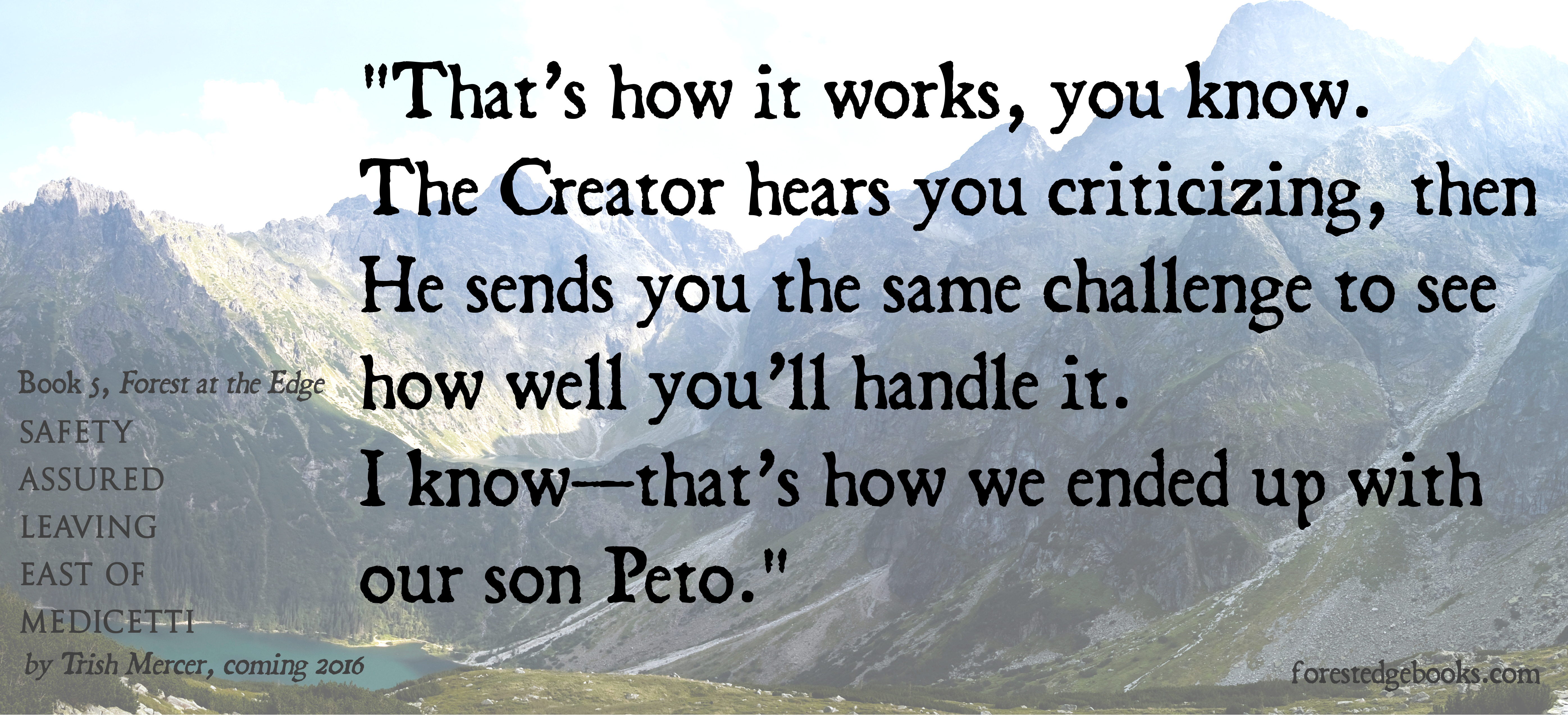
Book 5 Teaser–Life’s a test, not a holiday

High Polish Tatra mountains

My mantra . . .

This is what I chant to myself when the kitchen pipe leaks, and black mold destroys the drywall and carpeting in my son’s basement bedroom . . .

When our two ancient vans have one problem after another after another . . .

When my plans for the day get blown out of the water by a minor crisis, so that the next day I have twice as much to take care of, until another small disaster hits, which means the day after that will be three times as busy . . .

When finances take a hit, when goals get delayed, and deadlines loom, when hurdles get larger, and rewards grow smaller, and the world mocks and rages and derides . . .

Or when I can’t even resolve the little things, like finding comfortable shoes for my huge and wide man-feet, or hemming my daughter’s prom dress by the weekend, or taking my preschooler on a walk to the park, that’s when I remember . . .

Oh, that’s right. I’m not here on vacation. I’m here on a lifelong test.

(I could, however, use a ten minute break . . . )

High Polish Tatra mountains

Why aren’t mothers the main protagonists of books or movies?

Have you ever noticed mothers are not the main character . . . in anything?

Try this: name every Disney movie where the mother is absent and/or dead.

Are you done yet? There’s a lot, isn’t there?

And when a mother is present in a book/movie, what’s her role?

Supporting.

Try this: name a book or movie where a mom is the principle protagonist.

Yeah, none sprang to my mind, either.

Recently I ran into a series of articles about “Strong Female Characters,” and how they tend to collapse into a few categories:

  1. they’re heartless witches, manipulative and demeaning; or,
  2. they’re remarkably tough—like a female male—until the male shows up to aid/rescue/eclipse her; or,
  3. the females vanish from the story because they really didn’t play much of a role anyway, only to show up at the end as an afterthought.

When analyzing the stories I love, I realized to my dismay that most of the females fall into one of those three categories.

For example, “How to Train Your Dragon 2.” I liked that movie, until my husband pointed out that not only is the mom rather useless after we meet her, but Hiccup disobeys his father, gets him killed, then still gets to become the chief. Dave thought all of that was pretty unfair. Then again, he’s the father of five sons. Image result for valka how to train your dragon

But dang it, he was right, especially about Valka. She’s powerful, but useless, and never really mothered her son, aside from giving him some pat advice when he needed it.

At least she fares better than most female/mother figures in literature and movies. Consider “The Emperor’s New Groove,”  “Cinderella,” or any other Disney movie—

Except for “Mulan.” Mulan is brilliant, in every way. She not only has BOTH parents (rare in Disney), but even a grandmother, and Mulan does the rescuing, several times. (And, thankfully, Disney allowed Merida to “Brave”ly keep both of her parents, although the mother needs saving later.) 

Still, even in “Mulan” the mother is in the background, only as a supporting role.

Not that there’s anything wrong with the supporting role; it’s vital, in everything. Where would any of us be without those who support us?

By why not make mother The Hero?

That thought was part of my unconscious when I created Mahrree for my series “Forest at the Edge.” When we first meet her in The Forest at the Edge of the World, she’s a single woman, albeit motherly in that she teaches school and worries immensely for her students. Then we have the obligatory romance (because hey, I’ve got some Strong Male Characters, too) and then she becomes a mother.

Sometime around there, while drafting the series, I realized that I was writing a main character that I hadn’t encountered before: a mother actively trying to improve the world for her children. (Aside from sappy made-for-cable movies or disease-of-the-week tales.)

Everything she says and does is in effort to reform her government, allow her children options in their future, and make sure school isn’t ridiculously boring.

“Mom Wants to Make the World a Better Place for Her Children”. It’s a universal theme, so why isn’t it more prevalent in what we read and watch?

Why have young mothers, middle-aged women, and even grandmothers not been the movers and drivers of a plot? They are when they’re in a family, and everyone knows it. And I don’t mean in a snarky, antagonistic way; enough of evil step-mothers.

I have friends who see themselves as primarily mothers, but are also involved in politics, providing aid for abused women and children, volunteering to preserve the environment, fighting pornography, promoting families, helping their schools, and improving the health and finances of those in need.

Maybe writers and Hollywood don’t see that as exciting as clichéd “Save the World” themes, but these women really are saving the world, more than any fictional superhero will.

I’d love to see more thoughtful mothers, experienced grandmothers, and confident women playing bigger roles in the narratives of the world, because they do that everywhere else.

Terry Pratchett gets close at times, with his witches who aren’t evil but keep the balance in the world, and in their villages. Nanny Ogg, who has more than a dozen children and oodles of grandchildren, is occasionally a major player in the witches books, but even then, Granny Weatherwax, who was never a mother, prevails as the main protagonist.

Mahrree Peto Shin isn’t a character I created, as I erroneous stated earlier; she manifested herself to me through one shocking, powerful image that I won’t reveal entirely here, because it happens in book 8 which will come out in probably another 3-4 years. (Book 5 will be out before this summer.)

But that image—of a woman facing an enormous threat, alone—riveted me. I wondered for months how she came to that position, and she slowly revealed her story to me, until I had enough to begin writing it.

(As an aside, I’m not psychotic; lots of writers have had this experience of characters demanding that they write their story. I can see how the ancient Greeks believed they had muses speaking to them, and my daughter gave me a mug which reads, “Writer’s Block: when your imaginary friends refuse to talk to you.” It’s true, you know.)

The “Forest at the Edge” series isn’t wholly about Mahrree, but about her family. She plays a major role in that family, and all the trouble she causes is primarily because she’s a worried mother.

The mother-perspective is powerful, more so than the perspective of a president, or a general, or a king, or any other hero. Those characters may lead countries or armies, but I doubt they could ever genuinely love them as much as a mother loves her children. References comparing mothers to bears and their cubs aren’t accidental.

Imagine Harry Potter being told from the perspective of Molly Weasley, who had seven children in peril, along with Harry who she tried to mother.

Image result for molly weasley

Or Hunger Games, from the perspective of President Coin, who lost her child.

Or even “Brave,” from the perspective Queen Elinor, who tries to help her daughter find a husband, then has to be saved from her unintentionally turning her into a bear. 

How engrossing, heart-breaking, and hopeful would these perspectives be?

Maybe . . . maybe they’d be too much.

Too close to reality. Too gut-wrenching.

Maybe that’s why it’s rare to find a mother-perspective in literature, because all of us have mothers, most of us appreciate them, and deep down we’re worried about what they’re really thinking.

Maybe many of us are still suffering from Bambi’s Mother Syndrome, the idea of losing mother, or seeing things from her perspective, which may be too intense. (Although Disney loves to make children miserable with mother-loss. No adult movie franchise kills off mothers as much as Disney.)

As moms, I think we frequently have a hard time facing our greatest fears for our families and their future.

But I think it’s time we tried. I submit there isn’t a stronger force in nature or in humanity than that of a mother trying to protect and provide for her children.

What fantastic stories that premise could ignite! Let’s see them!

High Polish Tatra mountains

Book 5 Teaser–Mahrree’s big mouth

Parenthood, summed up in one horrible bathroom incident

My four-year-old is my youngest of nine children. You’d think that after 25 years of being a mom, I’d be an expert, but you’re never an expert, I’ve decided.

Especially when it comes to potty-training.

With our first child, I took the excellent advice to “not rush it.” This was the early 90s when having your barely-know-how-to-walk one-year-old potty trained was the rage.

It was actually the mom who was trained, to rush her tiny charge to the bathroom every two hours and plop the toddler on the toilet with great hope. Never being that disciplined, I instead encouraged and suggested, and finally had a trained daughter when she was three.

I followed that same laissez faire approach with my other kids, too, but my sons took a bit longer.

Ohhh . . . my sons and potty training.

Boys are the worst, and I have five of them.

I won’t name names, but one son had a propensity for “forgetting,” and he was well into preschool age before accidents weren’t a weekly—or daily—affair.

Another son would, in a half-asleep stupor, mistake his closet for the bathroom every night. It took us weeks to figure out where the smell was coming from, and why. Once we did, we had to replace the carpet and pad in there, along with a few toys.

Another son simply refused to use the toilet, afraid of it. One of his first public potty encounters was with a toilet which automatically, and noisily, flushed itself. He was sure that all toilets were ready to swallow him whole.

Another child was perfectly easy to potty train, leaving me to believe I’d finally figured things out and was a fantastic mother.

Nope. He was just an easy kid.

And we’re not going to talk about the years of bed wetting. Which were years. (I wept with joy when Febreeze was invented.)

So when it came to potty training Boy #5, I didn’t have any illusions that I knew how to do it within 48 hours, or tear-free, or bribery-free. We just went for it.

GEDSC DIGITAL CAMERA

(We’ll allow #5 to retain his dignity and remain anonymous.)

(If you’re a bit squeamish, perhaps you don’t want to continue reading. But if you’re a parent, none of this will be new to you.)

Fortunately #5 had no problem with #1. Watching his older brothers (who were happy to show off their skills) encouraged him that he wanted to be as big as the teenagers he adored.

It’s #2 that’s been the horror.

He won’t do it on a toilet. We don’t know why. It’s not as if toddlers are good at articulating their reticence about certain activities.

We started trying waaaay back before his third birthday, and while he’s been an expert at shooting the water for over a year (we won’t discuss aim, which even my bigger boys seem to struggle with until they leave high school), the idea of sitting and plopping was a no-go.

Instead, he grabs a pull-up, puts it on himself, hides in the privacy of his bedroom, then comes out ten minutes later with a coy smile and says to me sweetly, “Mommy? Can you please change me? I love you.” Batting his lashes is the crowning touch.

“But I don’t love doing this,” I tell him each time he assumes the position and I pull out the baby wipes.

“Yes, you do. Because you love me. But don’t tell Daddy I do this.”

It always makes me feel dirty when he says that. But Daddy knows.

Daddy frowns at Pull-up Boy, and promises greater things, like setting off smoke bombs or exploding fireworks tanks, if #5 puts #2 in the potty.

We had success after Christmas, when we promised him a shiny new fire engine that makes noise if he went. (Go ahead, judge me for bribing my child. I don’t care what anyone thinks anymore.)

He did it once, and we immediately took him to Walmart, and he loved his fire engine . . . and he never went #2 again because he got his reward.

I hate it when the kids are cleverer than me.

But yesterday, something changed.

I was in the kitchen making dinner when suddenly my 4-year-old stood there, beaming. The fact that he wore only a t-shirt, and nothing below, gave me a hint as to what he was going to exclaim.

“Mom! Mom! I did it! I put stinkies in the potty!”

“Really?!” I don’t know who was happier.

“Come see!” and he took off running to the bathroom.

That’s when I realized that not all of the stinky got into the toilet. A lot of it was smeared down the back of his legs.

As a parent, there are times that you brace yourself for what you’re about to find, and you recite in your head, No matter what, I’ll be cheerful. No matter what, I’ll be cheerful . . .

When I arrived at the bathroom, the story was waiting for me.

First were his pants and underwear, tossed on my bedroom floor as if he were in a hurry.

Then, the pull-ups, left sadly next to the door, because there wasn’t enough time.

Then . . .

The bathroom.

I steeled myself, because sometimes, no matter how often you tackle a mess, it’s shocking when you first encounter it.

But #5 stood next to the toilet, beaming in joy. “Look! Some of it got in!”

It did, along with half a roll of toilet paper.

The rest was on the seat, the floor, and the bath mat.

Boys struggle with having two outlets, and sometimes they don’t have full control of either. My son stood in a yellow puddle, grinning madly.

There was only one option for me as his mother.

“I’m so proud of you!” I cheered and clapped.

Full of praise and happiness, I suggested we finish wiping him up, waist to toe, and I sent him to tell his siblings the good news so I could tidy up the bathroom.

That’s where my 15-year-old found me a few minutes later. “He actually went stinky in the toilet? Whoa . . .” and he backed up when he saw how I straddled one mess to wipe up another. “I was about to say, Bet you’re glad he didn’t give you a mess in a pull-up, but—”

“But say nothing to him,” I warned Big Brother. “This is a huge step for him—”

You’ll have to take a few huge steps just to get out of there—”

I pointed at him. “The mess isn’t important,” I said. “Nor is it important that I had to use five baby wipes on him, and that I’ll use about a dozen Clorox wipes in here. What’s important is that he finally did something hard for him. We cheer and praise, and clean up the mess quietly later, without making him feel anything but joy for his accomplishment, which has been years in the making.”

And that, I realized, summed up parenthood.

Along with this request to Big Brother, “And bring me another trash bag, please.”

Oh yes, being their mother was by far the most difficult work she’d ever undertaken. And it also was, by far, the most satisfying. At the end of the day she knew she’d accomplished an enormous amount of work, even if the house looked as messy as it had in the morning. But at this point of her life, messy meant success. Things happened.

~Book 2, Soldier at the Door

Hoarding your praise doesn’t make it more valuable

When I was asked to be a “responder” for a writers and artists fest our school district hosts each year at the university, I wasn’t quite sure what to expect. My daughter had participated when she was in middle school, spending five agonizing minutes reading her writing in front of two “responders,” several peers, and some of their parents.

Thirty people might as well be thirty thousand when you’re thirteen.

Knowing the fragile natures of both writers and middle schoolers—combining the two is Mentos and Diet Coke–I anxiously drove up to the campus this morning, praying that I’d say the right things to these young writers.

The purpose of the fest is to encourage budding artists and writers, to give them a forum to perform, and to receive feedback from professionals such as authors and teachers. Encouragement, not criticism, is the point, because heaven knows sixth, seventh, and eighth graders don’t need any hits to their very delicate egos.

Even love taps can shatter them.

The co-responder in my room had done this for a few years, and gave me excellent pointers as to what to say when the child was finished stammering nervously through their work. Karen Clegg pulled the most wonderful words out of the air, and bestowed them lovingly upon the trembling tweens.

I hoped I could do half so well.

I took notes as the kids read, told them what I liked, read back to them their triumphs (knowing how thrilling it is to hear someone else read your words out loud, in an appreciative way), and thanked them for their time.

After the first session, a mom came up to us during the break and said, “Are you watching the faces of those kids when you talk about their work?”

“No,” I confessed. “I try to avoid that.”

I’m not sure why or how, but quite often I get too much from someone, especially their eyes. While they tell me a few innocuous words, I perceive an onslaught of emotions, stories, experiences, and history. Hopes, fears, frustrations, and joy hit me in the face like a frozen snowball, often when someone’s only telling me something mundane. I’m one of those people who rarely look folks in the eyes, because I’m never sure when that deluge of data may suddenly hit me. It’s easier to just listen than look.

“Watch them,” this mother insisted. “Most of these kids don’t hear such words from adults they don’t know. They devour what you say. Watch them.” 

So when round two arrived, with a new batch of fresh, pimply faces, I tried to concentrate on their expressions, and for the most part it was painful.

Have you ever had the experience of reading your work in public?

Try taking your heart, placing it on a plate, then setting it in front of hungry wolves. The emotion is roughly the same.

One of the readers that round was a tiny boy who puberty has decided it’ll visit later, maybe when he’s 17. He was the scrawny kind of thing that others sit on and don’t even realize it. He could barely look over the podium to see us responders at the table in front of him. Shuffling his pages, he wore a hesitant grin of expectancy, and dove in.

Karen and I were taking turns responding, and Tiny Man was mine. He read with great feeling the beginning of a sci-fi book he was crafting at the tender age of twelve, and later my cohort told me she was relieved he wasn’t hers, because she didn’t know anything about sci-fi. But I’m a nerd.

When he finished in his five minutes, I said, “So I’m sensing themes of steampunk in your writing.” And I looked at him.

His eyes were so bright and enthusiastic that I was startled, and I realized that I was probably the first adult he’d met there who knew what steampunk was. He nodded enthusiastically.

“How much more of your story have you written?”

“I’ve got 80 more pages!” he announced proudly.

“Wow. Took me until I was 40 to get 80 pages. So where does the story go from here?”

I’m sure I went over time with him, as he happily told me the rest of the plot, forgetting about the audience in front of him and the other kids waiting their turn. The boy positively glowed with delight to tell a stranger about his book. 

I could barely look at him, he so hurt my eyes.

For my next turn, a girl stood up, the very picture of thirteen-year-old gangliness. She, too, had been neglected by the Puberty Fairy, and trembled behind the podium, her straight brown hair framing her freckled face, and she began to read. It was essentially two pages of an ode to a special young man who had rescued her from some difficulties in her life, and there I sat, knowing that in a few minutes I’d have to deliver an encouraging critique of her description of a modern-day Thor turned mortal.

When she concluded, and the audience finished applauding, she looked to me with terrified eyes.

I couldn’t look at her for long, but I did manage, “What you’ve written is essentially a thorough character analysis. Most teens wouldn’t be able to see as deeply as you have. Heck, most adults can’t either—” and that’s when I was shocked by her response.

She had teal-tinted braces. How do I know that? Because her face split into such a wide grin that I could see every last tooth.

I wasn’t expecting that reaction, especially considering how somberly she had read her piece.

Unable to watch her anymore, I looked down at my copy of her words and did as I had with the others: read the lines I liked the best, explained what was working well, and what traits as a writer I felt she was demonstrating. I glanced up a couple of times, and nearly choked up.

Have you ever seen a tween grin out of pure joy? It’ll break your heart.

The same thing happened, again and again, and while I tried to make an effort to look at the kids, as my partner did so well, I found it much easier to sift through their pages finding more examples to praise.

At the end of each session, we stood at the front and handed back our notes to their work as they filed out, the kids giving me shy smiles as I thanked them for sharing their writing.

I was nearly in tears at the end. The fact that one of the last writers wrote a poem about her mom who died last year didn’t help much. Nor did parents coming back in to thank us for our words, to tell us that a son never gets such praise from anyone outside the family, or that a daughter is terrified to speak in front of others, and would be happy for the rest of the week.

All I did was listen, intently.

All I did was give 60 seconds of approval.

All I did was make an effort—and occasionally, it really was an effort—to find something to compliment. But there was always something to appreciate.

All I did was pray, “Dear Lord, tell me what this child needs to hear,” then I said those words which came to my mind, and the child nearly exploded in glee and relief.

After, we went to the luncheon where hundreds of middle-schoolers were collecting their food and talking about their experiences, that cute kid over there, and the author Tyler Whitesides, of the Janitor series, who had addressed them.

As I made my way through the noise and gaggle, I knew instantly which kids in the crowd had been “mine.” They waved timidly, offered me careful and happy smiles, and I’d wink back or grin, as if we shared some secret. We were friends.

I admit I shed a couple of tears as I left.

I’d never before realized how just a few words could mean so much, and I worry that I’ve been too stingy with my compliments in the past, as if hoarding my praise somehow makes it more valuable.

I realized that I paid out mere pennies of compliments, but what was received were pounds of gold that those tender teens will carry with them, hopefully for the rest of their very costly teenage years. They’ll need every ounce of encouragement to make it through.

And I’ll try to keep giving them more so that they never run out. Encouragement doesn’t cost me a thing.

“Mrs. Shin’s the only teacher who actually teaches. She’s also the only one who listens.”

~Book 5, Safety Assured Leaving East of Medicetti

Leader-servants and presidential candidates

When someone requires service, it’s fascinating to see who steps up to provide it. Quite often, it’s not who you’d expect.

Some years ago my husband and I were in charge of setting up and serving Christmas dinner for our ward (church group, congregation). We anticipated a good turnout, about 150 people, both members and neighbors, because no one turns down a free dinner.

A few people had been assigned to help us, but on the evening of the dinner they were unable to come. So my husband and I, and our capable children, scrambled to set up the buffet as best we could.

Soon, some members of our ward noticed we were shorthanded, and volunteered to help. To this day I’m still impressed by those who chose to serve, rather than be served.

The first was our bishop (pastor, rector, preacher) and his wife who were supposed to be relaxing that night, instead of helping as they always did. In addition to being our bishop, this busy gentleman was also a college math instructor and basketball coach. He and his wife cheerfully positioned themselves in the kitchen where no one would see them laboring, to hand our children platters of turkey,  ham, and potatoes for the buffet, and to prepare backups.

The next couple who stepped were in their sixties, and busier than anyone I knew, so most deserving of a peaceful evening. He was the president of the liberal arts university where we worked, and his wife was behind the scenes of everything. Without a word they set to filling and putting out pitchers of water on the tables, and setting out salt and pepper shakers.

The third couple who joined us immediately rearranged the buffet tables, so that two groups could go down either side, servicing four lines most efficiently. Then again, the husband knew all about efficiency. He had recently retired as the CFO of a well-known, high-priced clothing company whose name I won’t drop here because it’d drop your jaw, and had come to our little university as a volunteer to help with finances.

In terms of importance, these three couples were probably the most important in our small community in Virginia. In terms of education, financial standing, prestige, and anything else the world ranks, no one compared.

In terms of service, no one could compare, either. Now that I think about it, none of them asked if they could help, or how. They just saw a need and filled it. I don’t know if any of them sat down to eat, but instead assisted us all evening in keeping the buffet table full.

My husband and I were both astonished by who came to our family’s aid that night. Even though it’s been many years, I’m still awed by their examples.

Did I mention that the wives and the bishop all stayed afterward to do dishes? And that the university president vacuumed up, while the retired CFO put away tables and chairs with our kids? And that none of those six left until they were sure all the work was done?

I doubt any of these three couples would remember that evening, because it wasn’t a once-in-a-lifetime expression of service; it was something they did every single day.

Recently we discussed this incident with our children who were too young to remember that dinner, or were not yet born, because it coincided with our scripture of the week, from Mark 10:43-44:

43 But so shall it not be among you: but whosoever will be great among you, shall be your minister:

 44 And whosoever of you will be the chiefest, shall be servant of all.

The school where these six people served with us, Southern Virginia University, has as part of its motto to turn students into Leader-Servants. None of us are working there anymore, but that mission statement has stayed with me.

Neal A. Maxwell once wrote, “The leader-servant is perfectly epitomized by Jesus,” and,

No leader can be fully effective without love, and those who try to serve without it will not be properly motivated, and may even feel resentment and a sense of slavery. (The Neal A. Maxwell Quote Book, pg. 194; emphasis added)

It’s an election year. We’re choosing new leadership. When I read about candidates, I’m not looking for evidence of financial success, or business acumen, or charisma, or moxie, or guts.

I’m certainly not looking for someone to voice my anger, to shout or disparage or drag down or accuse.

I’m looking for someone who knows how to serve, who feels genuine love and concern, who desires to help this country, not merely be known as the leader of it.

But so far, I’ve mostly heard young Perrin’s attitude toward leadership. His response is something I was taught years ago in a business leaders course I was forced to endure, but I rephrased it for book 3 in less exalted verbiage:

“No leader is truly great who doesn’t know how to serve,” Hogal told him. “Service first, leadership later. First rule of leadership.”

“No it’s not,” Perrin retorted. “First rule of leadership is to identify the rival and eliminate it through defeat or feigned friendship.”

Hogal sighed. “A true product of the king’s educational system. Learned your lessons well, I see. . . .Trust me; to be a great leader, you need to be a great servant.”

~Book 3, The Mansions of Idumea

leader servant

I still have hope that a great leader-servant to show him or herself this year; for another George Washington or Abraham Lincoln or Thomas Jefferson–a true statesman who’s greatest concern is to help the country, not exploit it or use it for self-promotion. The kind of leaders who won’t lock up at night until they’re sure everyone who’s serving under them are taken care of first.

It’s time to make serving an honorable tradition again.

Not a midlife crisis–just black licorice on quinoa

No, I wasn’t having a midlife crisis.

GEDSC DIGITAL CAMERA

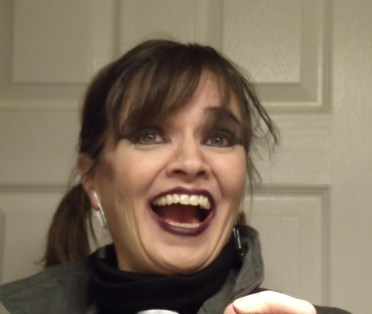
Someone in my church asked me to do this. Really. Ok, not dress exactly like this, but as something “unrecognizable.”

It’s a group activity called “Where’s Waldo,” and ten adults from our church group (called a ward) were asked to dress up and hang out in the local Walmart while groups of our youth, ages 12-18, with their leaders, found us. I was instructed to “really get into the part,” so I dressed up as best as I could, put on make-up I’d never used before, and since I don’t own jewelry, made up my own goth look with paperclips. (I’ve seen safety pins used in piercing, so I wasn’t that far off, right?)

Then I drove to Walmart, and as I pulled in to the parking lot, I laughed out loud. “Wait—I have to WALK into the store like this! Someone’s going to take my picture and put it up on that website that makes fun of Walmart shoppers.” At least no one would know who I was, because I kept my glasses off. (Worked for Clark Kent, too.)

But my 17-year-old daughter had said, while I was preparing for my big acting scene, “You have to change your walk, too. You have a ‘Trish Mercer’ walk that’s kind of distinctive.”

“It’s because my mom used to make me practice walking with books on my head when I was your age. Victorian England, but in 1980s Utah.”

So as I parked my minivan, I practiced my scowl. As I headed into the store I traipsed, slouched, then finally sauntered in, moving like a sophisticated zombie as I got into my part.

0209161829Grabbing a cart, I headed to the back of the store and loaded it up with Coca Cola Zero, because it was in dramatic black boxes, which matched my dramatic black clothing, and my son’s dramatic dark gray trench coat. I also picked up a tribute magazine to David Bowie, then ‘hung out’ in the bakery department to read it.

And waited.

An adult from my ward was to come by with slips of paper that I’d give to the teams of teens. The kids had to ask me, “Are you a Waldo?” then I’d give them a ticket as proof they’d found me. After they had ten tickets, they were to race back to the church (adult leaders were driving, thank goodness) to see who got their first.

But no one came by, and the stray thought went through my head, What if this was just a set-up to get me to dress up bizarrely and make the rest of the shoppers nervous?

Because by this point, I’d noticed—even without my glasses—that carts would approach, hesitate, then turn or take a circuitous route around me. I felt badly about that, because I’m usually a cheerful shopper, smiling at others and saying “excuse me.”

But not last night. I could feel the darkness of my clothing, the drama of my makeup, and the pinching of the paperclips on my earlobes. Altogether, that meant I wore a perpetual scowl.

I felt terrible that the way I dressed and presented myself made others feel uncomfortable, and maybe even threatened. (But not terrible enough to quit.)

So I tried to ignore everyone else as I thumbed through the tribute to David Bowie, reading about his wild early years which I felt I was living right then. That’s when my cell phone rang. It was my neighbor Elise, also in the store dressed up (whew—wasn’t a set-up) asking if I was there yet. “Yep, hanging out in the bakery department, like I’m supposed to.”

She chuckled. “Well, Cindy’s been looking for you. I’ll send her over again.” A few minutes later Cindy approached me nervously, until her eyes lit up. “Holy cow, that is you! I walked past you twice but didn’t dare talk to you.”

“Sorry,” I said. “Without my glasses, I can’t recognize faces until they’re right in front of me.”

“Very convincing,” she said, handing me the tickets I was supposed to give the teens. “And the Bowie magazine is appropriate.” She took one last look at me, shuddered briefly, and left, and then I waited.

And eventually . . . the fun began.

I kept my head down as I read, but I could see feet approaching from different directions as the sweet and innocent youth of my church approached the strange gothy woman in the store. You see, we live in a quiet valley where nothing too exciting ever happens, and where people are pretty much white bread and baked potatoes.

I was black licorice over quinoa. No one knew what to do with me.

Waldows in Walmart Feb, 2016

Our collection of “Waldos.” I’m in the middle, looking as disinterested as possible.

As I saw the feet tentatively congregate around my cart, I’d slowly look up, with as much snarling apathy as I could muster. “Like . . . what do you want? I’m reading my Bowie, here. Can’t you tell?

Then their eyes would bug out, they’d take a step backwards in alarm, and someone would mutter, “Isn’t that Mrs. Mercer?”

“I don’t know . . . I think so. Whoa.”

“Are you . . . are you Waldo?”

I’d roll my eyes dramatically (yes, I practiced that too) and fished in my trench coat pocket for a ticket. “Oh my gosh, look—can we get this over with already? I’m late for a Walking Dead party, you know.”

That’s when they’d start smiling and laughing, but still they stayed back a few feet.

One of the leaders, a lovely woman in her 60s, stared at me in shock. “Trish? Oh my gosh . . . Trish?!”

Only for her did I break out of character, because she really did seem disturbed. “Cindy didn’t recognize me either,” I consoled her as her group of five girls hustled off after the next clue.

But for the other groups, I just glared menacingly and went back to flipping pages of my magazine after I handed them their tickets. I think a few of the younger girls were worried by my appearance, and I nearly lost it when a fifteen-year-old boy exclaimed, “Wait—she’s my Sunday School teacher!”

I may have lost all credibility with him.

But all of the effort was worth it when one high school girl said, “Wow—I thought you were a teenager.” I’ll hold on to that one for a long, long time.
GEDSC DIGITAL CAMERA

I’ve lost 30 years! And my mind!

After a while the groups of kids slowed down, and I finished reading, waiting for the call that we were done. At the end of the Bowie magazine, looking at pictures of him in his 60s with his spikey gray hair and dazzling smile, I couldn’t help but think, “He was a great looking senior citizen.”

Image result for david bowieI flipped to the earlier pages and felt as uncomfortable as I had when I first walked into the store, dressed up as something I really wasn’t. Bowie—actually, David Jones—seemed a lot happier and more handsome in his later years. The gray hair suited him.

By the time the call came for “All Waldos to come to the front of the store,” I was relieved. While it had been fun to dress up and freak out the youth of my neighborhood—especially since it wasn’t Halloween—I was anxious to become me again. While I had a small shopping list in my pocket, I couldn’t bring myself to actually buy anything in my present get-up.

As I approached the other Waldos at the front of the store, everyone’s jaws dropped. I have to admit I rather enjoyed the attention—I’ve never been a jaw-dropping woman—but I also was glad it wasn’t going to last more than a few minutes.

Waldos in Walmart Feb 2016

“Like, totally . . . I’ve got a Walking Dead marathon to get to.”

At home, my husband took one look at me and said, “Are you going to need a shower to get all of that off?” I had even gone so far to buy a gray hair touch-up kit to darken my bangs and color my streaks of gray. “You really don’t want to keep using that stuff, do you?” he hinted.

I’m blessed to have a husband with the same attitude of my dad, who once said, “I don’t like a lot of makeup on my wife. I want to be able to recognize her in the morning, not wonder how some stranger got into my bed.”

“No,” I assured my husband, “this it was just for the night, and yes—I need a long shower.”

I took a couple of selfies in the bathroom, because that’s what you’re supposed to do after you spend an hour putting on makeup, and then I tried to wipe it all off. Half a jar of Vaseline later, I took a shower to scrub out the rest of the dyes and gunk.

GEDSC DIGITAL CAMERA

Never let middle-aged women take selfies.

This morning as I looked at myself in the mirror to get ready for the day—gray streaks highlighting my hair again, and pale, dull eyes looking back without any ringing makeup—I knew that was a much better look: the clean, basic, unmade me. Kind of like Bowie in his later years, looking genuinely happy in his rawness.
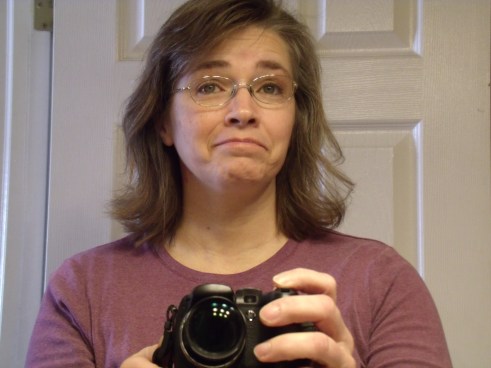
GEDSC DIGITAL CAMERA

What, you’re supposed to use a cell phone for a selfie? Have you seen my cell phone?

I’ve discovered that with the right makeup and the right clothing, I can look like just about anyone, as skilled make-up artists have demonstrated. Even untalented me turned myself unrecognizable.

And I don’t like that.

I’ve always been averse to lots of makeup, and I think it started way back in the 1980s, when coincidentally I first fell in love with David Bowie’s music.  I also noticed a Robert Plant video where the same makeup and clothing turned a variety of different young women into creamy, rubber copies of each other. It struck me as strange, and as sad.

I never wanted to be an imitation of someone else.

So I’ll go out today as usual, “au natural” (but dressed, so don’t panic). (Ok, I’m wearing a tiny bit of eye shadow and mascara, so people can find my eyes.) No one will mistake me today for something I’m not. Because even if I had an identical twin, no one can copy my look.

(Not that anyone would want to, but that’s a rambling topic for another day.)


Book 5 teaser–The Creator, criticism, and thinking twice

I’ve had several readers ask about Book 5, Safety Assured Leaving East of Medicetti and I’m pleased to report that yes–it’s coming along well. I can’t devote as many hours to it as I wished each day, because I have five kids at home–half of whom I homeschool (work out that math)–and a side business I run on Etsy, so I have to try to strike a balance. If I could just learn to not sleep, progress would be much faster.

But because I’m so excited about this book, I’ve decided to give you a teaser each week in the form of a line or two from the story. Here’s the first, which I’ve learned from personal experience:

High Polish Tatra mountains

(At least half my trials come to me this way. I’m slowly catching on to keep my mouth shut.)

The “Thank you for Being a Grown-up” campaign

Enough of hearing about people who act like children. Let’s start recognizing people who act like grown-ups!

Recently I wrote about being a better Grown-up (yes, with a capital G), and that got me thinking: there are people who I look up to and admire, and it’s time that they know that.

These are folks who take responsibility for their lives—no excuses; they do the right thing, especially when it’s hard; they make their corner of the world better for everyone in it.

These are the people I want my children to emulate, and who I hope to be like when I fully Grow up.

So I’m instituting a campaign, and you’re welcome to participate. Each week identify someone who displays Grown-upness, and show them gratitude by copying and pasting the sign below on their Facebook or Twitter feed. 
Thank you for being a grownup

(Suitable for printing out and taping onto a refrigerator.)

This could be for:

  • the friend who tried to right a wrong, or admitted they had made a mistake;
  • an acquaintance who defended a belief with with kindness and civility;
  • the teacher/coach/tutor who goes the extra mile with your child;
  • the teenager/neighbor who shoveled your walk without being asked, and without being paid;
  • the relative who’s always been a source of strength for you;
  • a coworker, mentor, or former teacher who inspires you.

You get the idea.

Maybe you want to tell this person what they did to earn your appreciation, or maybe you want to keep their deeds a secret. It’s up to you.

We need to draw attention to positive behavior, for the sake of our rising generation.  Our kids need to know who they can look up to: REAL people. (Not famous twits.)

There are lots of real Grown-ups out there, but they don’t get enough attention.

(Hint–real Grown-ups don’t take offense at every little thing, they don’t complain endlessly, they don’t expect others to rescue them from their poor choices, and don’t need someone else to police their every action.)

So let’s give them the attention they deserve! Let’s emphasize positive behavior, give others hope, and show our kids how real Grown-ups behave. (No, you don’t have to have kids to participate.)

It doesn’t cost you a thing, but may reward everyone in ways we can never count.

Thank you for being a grownup

(Go ahead–copy and paste wherever you wish. I’ve got millions of these.)

12 reasons why I want to be a better Grown-up

A young mother who was recently put into leadership of our church women’s group told me she was worried that she didn’t “adult” properly on her first Sunday in charge, but I assured her that she displayed a great deal of “adultery” at church. (She’s still hesitant to speak to me.)

I was proud of her worry, though. She understands that being an adult, or a “Grown-up,” is a good thing, and she wanted to do it right. Too many people, however, are content to remain “Children”: they don’t want responsibility, they expect to be handed everything as if they were still babies, and they’re easily offended if the world doesn’t go their way. 

But being a Grown-up is a great thing. Here are 12 ways that Grown-ups make the world a better place, and why I’m resolving to be a better one. First, some definitions:

“Grown-ups” can be any age, and they’ve discovered that life isn’t about satisfying themselves: it’s about serving others. And when you take care of others, most of your problems take care of themselves.

“Children” are adults of any age who still think life is about getting all they can for themselves, and whose single-minded selfishness causes frustration to just about everyone they come in contact with.

Here’s why being a Grown-up is better:

  1. Grown-ups are modest. While they’re proud of their spouses and family’s accomplishments, they aren’t Children who brag incessantly about perfect grades, or post college acceptance letters online, or post a hundred photos of their latest and expensive vacation. Grown-ups will discreetly mention a promotion or a child going to college to let friends know that a change is occurring, but they also know that many of their friends are struggling, and that boasting about successes frequently make others feel inadequate and discouraged about their own failures.
  2. Grown-ups are discreet. They’re careful with what they reveal, especially on social media. While Children air out all of their dirty laundry about family, work, or awkward personal problems, Grown-ups think before posting, pause before venting, and consider if they really want the entire world knowing their troubles. Grown-ups realize that most people don’t want to know, and that unloading your troubles to only a couple of people who can really help resolves their problems much faster.
  3. Grown-ups build up others. They are concerned about making everyone around them feel comfortable and loved, and when they ask how someone’s doing, they really want to know. Children, on the other hand, are concerned only that everyone notices they are in the room. And they want to be The Most Important Person, too, so they frequently insult or tear down others, then claim they are only “teasing” when they go too far. Grown-ups, however, go out of their way to lift those who are flailing, encourage those who are discouraged, and be genuinely kind to everyone, everywhere. It’s rare when someone notices that a Grown-up has a problem; they won’t advertise it or draw any attention to themselves.
  4. Grown-ups are secure. They don’t need expensive cars, fancy clothes, remodeled homes, or any other status symbol because they are confident in who they are. Children, however, are easy to spot because they make sure you see they have the latest, biggest, and most expensive of everything, because that’s how they feel important. They excessively post selfies of themselves desperately searching for praise and approval. Their possessions define them, whereas Grown-ups are defined by what they know, who they love, and what causes they worry about. Grown-ups never create drama, but Children always do. Children crave drama, and never realize that everyone else hates it. 
  5. Grown-ups are selfless. They care more about others than themselves. Among Grown-ups is the company president who stays after the holiday party to vacuum so the janitorial staff doesn’t have too much extra work; the grandmother who’s absent from the big family party because she’s in a back bedroom with an overwhelmed four-year-old, reading him a book; the popular teenager who decides each day at lunch to sit with the loner kid because he needs a friend. Children, on the other hand, steer every conversation to themselves, don’t listen to anyone else, and sulk when not enough attention is given them. A Child may be the grandfather who pouts because he thinks he’s been disrespected by a clueless grandchild, the employee who feels her accomplishments should have been publicly acknowledged at the boss’s luncheon, and the college student who complains no one is his friend when he does nothing but play games on his computer all day.
  6. Grown-ups make life easier. They step in when a problem arises. They clean up the messes, they offer the jobs, they pick up your kids, and they spend their Saturdays helping you move. Children cause problems, and when their family/coworkers/friends see them coming, people tense up and tell each other to brace themselves. But when the Grown-ups arrive, people relax, smile, and know that everything’s going to work out. 
  7. Grown-ups are responsible. They pay the bills, balance the checkbook, clean up the house, cook the meals, go to work on time, and check the air pressure in the tires, even when—especially when—they don’t want to. Grown-ups work first and play later. Children reverse that, and as a result their lives are more chaotic than they need be. Children have to be prodded and nagged to do nearly everything, and are resentful when someone doesn’t swoop in and rescue them from their consistently poor choices. When a financial windfall comes to Children, they blow it on vacations and toys. When Grown-ups come into money, they pay off debts, donate some to charity, save the rest, and blow maybe only a hundred bucks on dinner out for the family.
  8. Grown-ups are generally happy. That doesn’t mean they don’t have problems. But because they are mature, they seek solutions to their problems and humbly change their behavior when they see their faults. They realize that everyone has struggles, and they don’t see that as something to resent, but to transcend. Problems become challenges, which become triumphs. Children, on the other hand, are generally miserable. Because they expect the world to conform to their desires, they are frequently disappointed and rarely see that they are the root of their problems. Children demand others make them happy, without realizing that happiness is cultivated from within. 
  9. Grown-ups are tolerant. They don’t feel threatened by others’ ideas, but allow all people to make their own choices and believe what they want to. Grown-ups don’t need everyone to approve of them, nor do they need constant reassurance that what they do or want is perfect. Grown-ups are content with themselves and with who they are, so they aren’t easily brought down by dissenting opinions or nasty barbs. Children, however, feel threatened by everyone and everything, if insults are intended or not, because they have no sense of self outside of public approval. They demand everyone to conform to their views and desires, and feel terrified of the world at large because it doesn’t acknowledge them as the center of it.
  10. Grown-ups take care of themselves. They get proper amounts of sleep and exercise, they pick up new skills, they learn how to use new technology, they read books and newspapers, and they pay attention to their health. Grown-ups realize that hot dogs and soda hasn’t been an acceptable lunch since they were eleven years old, and that their physical and emotional health is something they can—and should—take control of. But Children want to follow every impulse, and balk when someone suggests they eat better, or exercise more, or go to bed at a reasonable hour. They want to live like irresponsible teenagers as long as they can, but then are resentful when they need a handful of pills each day just to function. Children rationalize and whine they have no control over their situations, that genetics or family expectations hold them back, but Grown-ups accept that nothing, really, is out of one’s control.

    Image result for ron swanson eating a banana gif

    Ron Swanson eats the occasional banana, although he hates it, because he’s doing it for his wife and children. Ron’s a Grown-up.

  11. Grown-ups ‘fess up. They are honest—with themselves and with others. When they make a mistake, they own up to it, apologize, and try to make amends. But Children will rarely admit their errors, and will pretend, in the face of all evidence, that they didn’t do anything wrong. They’ll even try to shift the blame to someone else, even when everyone else can see they are at fault. Children think that admitting faults makes them smaller, but in reality confessing mistakes and rectifying them like a Grown-up is what earns people’s respect.
  12. 23 Times Ron Swanson Was Inarguably Right About The World

And finally,

  1. Grown-ups sacrifice, without telling you the cost. They will give you their time, their money, and their love without ever letting you know how much it may inconvenience them. They give whole-heartedly, because they’re more concerned about you than themselves. Children may give those same things, but they’ll remind you—even years later—about the cost of their sacrifice. Their concern is not with your well-being, but with getting acknowledgement for their service, which then is no service whatsoever.

People love and admire Grown-ups.
They barely tolerate Adult Children.
I want to be a better Grown-up.

   “Perrin, I don’t know of another family that would give up as much as you have. Shem told me that you and Mahrree had amassed a fortune in your cellar. You were by far the richest family in all of Edge.”
   “Wait,” Peto frowned, “we were even richer than Trum?!”
   Mahrree waved him off, but shrugged. “Well, I suppose . . .”
   “When you saw people in need,” Gleace continued, ignoring Peto’s slack-jaw and Jaytsy’s rapid blinking, “you gave every last slip of gold and silver, along with the jewelry you inherited, to pay off everyone’s losses in Edge. You also took that caravan of supplies from Idumea, despite the fact that you could have lost your position in the army, because you felt it the correct thing to do. You and Mahrree don’t care for possessions or status, but for people. Already you understand.”
   “How much did all of that cost?” Peto demanded, still shocked to realize his parents had given away a true fortune.
   “We never counted the cost,” Perrin said. “Never count the cost.”

~ Book 5 (releasing in 2016) Safety Assured Leaving East of Medicetti

Christmas–it’s not what you may think it is.

Despite the many “feel-good”—and “feel-crappy”—movies and TV shows out there with a holiday theme, Christmas is not about families (or anti-depressant medication).

Despite the numerous sightings in stores and malls, Christmas is not about Santa, or even children, as noble and sweet as that sentiment sounds.

Despite the Obamas’ introduction to the 50th airing of Charlie Brown Christmas special (one of the very few shows that blatantly states what Christmas is about), Christmas is not about “tiny trees” that “need a little love.”

It’s also not about getting the best deal-of-the-year on TVs, cars, movie tie-ins, clothes, furniture, or bacon flavored anything.

It’s not even entirely about a tiny baby born in Bethlehem, although that’s the start.

nativity

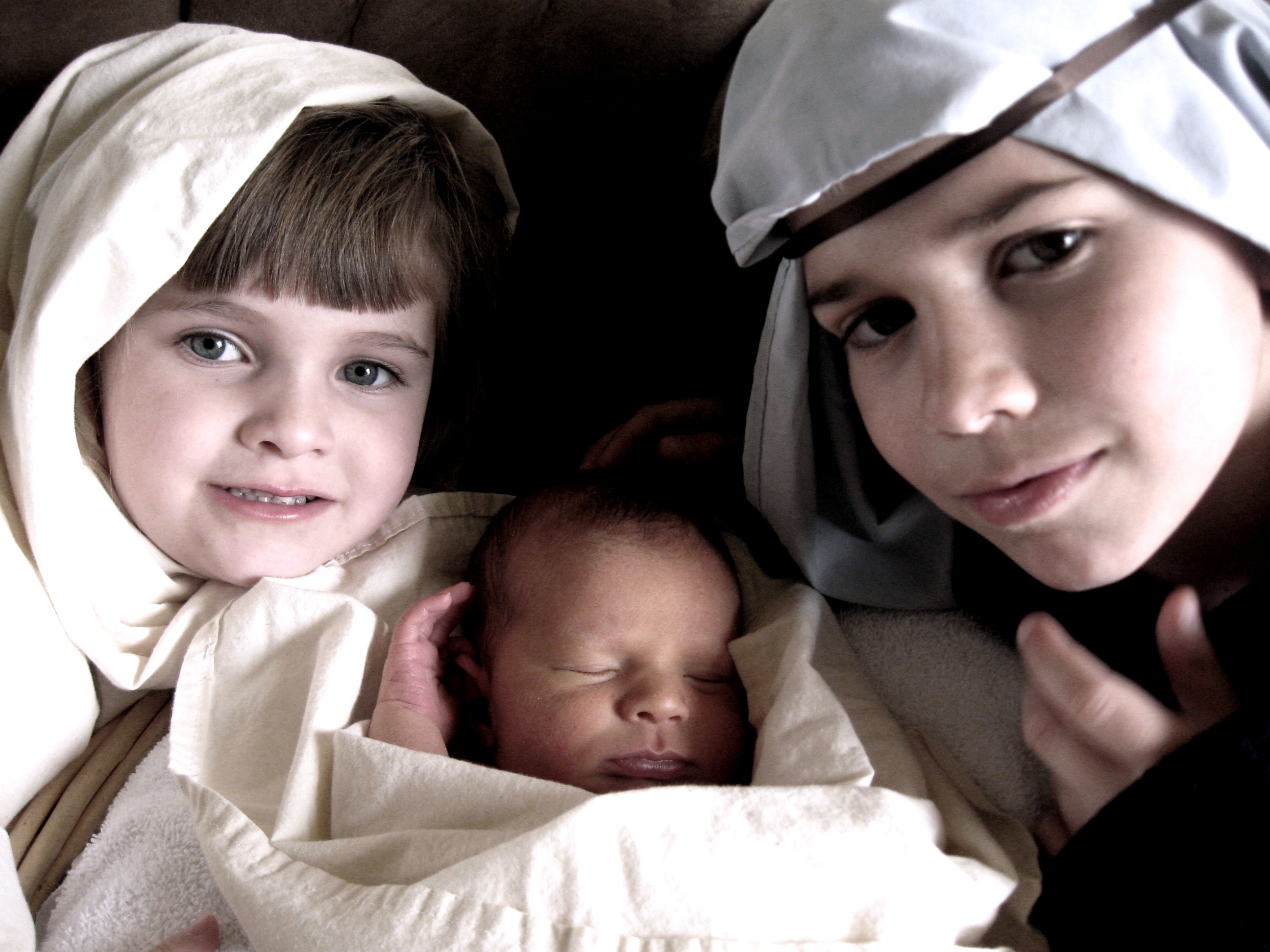
(Four years ago my ninth–and last–baby was born. I staged this photo of him with #7 and #8 children. This became our Christmas card that year, my favorite one so far.)

Christmas is about Christ, about his inauspicious birth in a cave, about his utterly selfless life and example which culminated in his laying down his life for his friends—us—and then his astonishing resurrection three days later.  Luke 2:6–7, The holy family

Christmas—along with Easter—is a reminder that death is temporary, and that life can be eternal.

It’s a reminder that our big brother Jesus Christ understands our pain, our struggles, and our despondency because he also experienced it all so that he would know how to comfort us. John 20:3–18, Mary hears Christ while looking for Him at the tomb

It’s a reminder that he took upon us all of our sins, and that if we do our part and repent, he can do so much more for us; he can take away our sin and leave us clean and new and whole again. Mentally, spiritually, and physically.

It’s a reminder that we can be renewed, and that every person who ever walked the earth will one day be resurrected with a glorified, perfected body, and that all pain will be taken away and replaced with such joy that we mere mortals can never imagine.

It’s about granting us the ultimate desire people have dreamed of since the dawn of time: immortality.

John 20:3–18, Mary Magdalene speaks with the resurrected Christ

Talk about the greatest gift in the world!
Christmas . . . it’s all about Christ.

(Thank you, lds.org, for the photos.)