The Economy of Enough

I’m writing this blog in an attempt to exorcise my desire for an IKEA kitchen.

ikea kitchen

Yep. Just like this one. Sigh.

Mahrree squirmed.
To find herself so immediately gripped with envy and desire surprised her.                  ~ Soldier at the Door

I suffer from this desire every few months, and I don’t even watch HGTV anymore—the channel that usually made me unsatisfied with everything in my house. I let my subscription to “Better Homes and Gardens” expire because I didn’t need to see any more examples of rooms I’d never have.

Because I’m satisfied with what I have.
(Let me chant that to myself a few more times . . .)

This is my current kitchen, exactly how I saw it when the realtor showed it to us over five years ago. A bit outdated, the appliances are 15 years old, but it’s functional.

IMG_3502

(I went so far back in time, because only under the previous owners was the kitchen ever so clean. And I haven’t been able to update anything anyway.)

The kitchen’s small.
Really small.
Especially for a family of 10.
But it was all we could afford, in a nice neighborhood, and so I just sighed sadly and decided, “I’ll make it do.”

And I have, for five years, but still I’m plagued by daydreams of IKEA kitchens.

“This is hardly the way to impress others.”

Mahrree shrugged, never having been much concerned about Mrs. Hili’s opinions. “I’m not worried about impressing others. I don’t even know who I should worry about.” ~Soldier at the Door

virginia house

Cute, in the right light, and from the right distance.
(We won’t discuss the ever-present smell of decay, though. Or the smell of skunks, who lived in the crawl space.)

But here’s the thing: I had vowed back in 2001 that I would ALWAYS be happy with a modern kitchen–no matter its size–because for five months I didn’t have one. When we first moved to Virginia we lived in a house condemned to be demolished. When it rained, the water poured in from a dozen points. There were vines growing on the inside of the house, and the kitchen—

Ugh, the kitchen.
One sink, with no hot water.
One cabinet, no drawers.
Old stove/oven which had two temperatures—off and broil.
The fridge was less than 15 years old, but the carpet had been put in decades before. (Yes, very old carpet in the kitchen. You can smell it, can’t you?)
There was a pantry, along with several mouse traps.
Of course there wasn’t a dishwasher, we supplied our own microwave, along with a dresser drawer for utensils and a small table to act as a counter.

virginia kitchen

Bottom right corner you can see the edge of the stove/incinerator, and behind me is the fridge. And that’s everything. Really.

And I made that work, for five months, for a family of eight. That autumn we moved into a brand new house with beautiful oak cabinets and 150 square feet for the kitchen–and enjoyed it for almost six years–but I remembered the condemned house and realized I could deal with just about anything.

So why do I keep forgetting that when I look at my current kitchen?

“Does this mean you’re no longer satisfied with what the Creator has chosen to bless us with?”  ~Soldier at the Door

Why can’t I look at what I’ve made functional for five years and realize I don’t need any more?

“But if we don’t need more—”
“Everybody needs more, Mrs. Shin!”  ~Soldier at the Door

Maybe it’s just human nature, to look upon something and want to improve it.

Or maybe it’s just plain selfishness, wanting to pamper ourselves. I still can’t figure out why it’s so darn hard to buy into Alina Adams‘s philosophy, a Ukrainian immigrant and now a columnist about frugality in New York:

Coming from childhood poverty and a one-room apartment where she only had one dress to wear affects how she views her budget and what she actually needs.
“When you realize how little you need,” she said, “it is difficult to spend money on things you know you can do without.”

Years ago I read about a movement in Japan where people became minimalists, possessing only the barest of essentials. For one chef, that meant she gave up her rice cooker (shocking her neighbors) because she already had one pot. She eventually downsized so much that all she owned could be packed into the back of her Toyota.

But maybe it’s something else.

“What I’m trying to get at,” Mahrree tried to explain, “is that we’re simply not worried about impressing people. We’re more concerned about what the Creator thinks of us.”

Mrs. Hili shifted her gaze to Mahrree’s deliberately sweet expression.“Yes, yes of course. Although I think you’re completely wrong, Miss Mahrree. I mean yes, we worry about the Creator’s opinion, but we live in the world. We have to impress the world.”

“Why?” Mahrree genuinely wanted to know. 

Perhaps that’s still the root of my obsession with an IKEA kitchen. The few times neighbors have come into my house, I’m genuinely anxious that they’ll see my kitchen, and then . . . what will they think?

But that’s just vanity, I know. Years ago I thought I eradicated that fear of “What will others think?” I’ve done quite well in many aspects, but when it comes to my kitchen? Sigh.

Maybe it’s bigger than that, though. Our very economy is based on the premise that we’re never satisfied, that the notion of “enough” means, What I have, plus a little bit more, ensuring that we continue to be obsessed with getting more and spending more, and never reaching that elusive state of satisfaction.

Now, I don’t have thousands of dollars to throw on luxury, but daggumit, I want to make something beautiful! I want to add color! A new design! Improvement to my environment!

So despite all I’ve just written, I’ve decided I’m going to spend money on my kitchen, because my soul is hankering for something just for me!

I’m going to make a drastic change to my kitchen, and it will cost around $5.
I’m going to put up a photo–just one photo: the picture above of my daughter standing in the kitchen of the condemned house in Virginia.
Now every time I’m plagued with fantasies of IKEA kitchens, I’m going to stare at that picture.
Then, when I look at my current kitchen, in comparison it’ll be fantastic!
Because it truly is enough, and I will choose to be satisfied.

(Especially since I won’t let in the neighbors anymore.)

17 Rules of Pregnancy for Husbands (updated)

Updated for a friend who’s wife is, well, confusing him . . .

In Forest at the Edge of the World Joriana Shin sends her son a list of how he should behave when his wife is pregnant. A few points are mentioned in the book, but some readers have asked me to post the full list.

Having been pregnant nine times, I feel I have a bit of experience with the topic. I will hand the list below to my own sons and son-in-laws so that they won’t accidentally destroy themselves with their own ineptitude.
(Heaven knows my husband could have had a list like this. I don’t think I’ll ever get over #3. Neither will he.)

15 17 Rules of pregnancy for husbands 

1. She will become irrationally testy at the most unexpected moments. Let her.  Remember, the reason she’s expecting a baby is, after all, your fault.

2. Remind her how beautiful she looks carrying your child. And be grateful you’re not the one that’s expecting, because you’d look ridiculous.

3. Never, ever use the “f” word; don’t even think the “f” word in her presence. If you say “fat,” is should be only in reference to something on your steak. (Also never say something such as, “Speaking of walruses . . .” when you see her roll over.)

4. Her vocabulary may change, including words you’ve never heard from her before, such as “weensy,” and “sweetadorableness” and “thatisthecutestthingever.”

5. When she can’t sleep, don’t attempt to give her any advice such as, “Just close your eyes and relax.” Instead kiss her on the cheek, tell her you’re so sorry, and then make yourself comfortable on the couch. For the next five months.

6. Do not attempt to bounce anything off her belly, even if you’re sure the pebbles would sail an impressive distance.

7. Accept the blame for everything. Everything.

8. Remember to look her in the eyes every now and then, before evaluating her bulging belly. And whatever you do, do not let your eyes bulge in surprise. Those changes are, after all, your fault.

9. No matter how tempting, do not use her belly as a shelf.

10. She will feel the need to reorganize everything. Help her. Remember: your fault.

11. Near the end of the pregnancy, don’t tell her it will all end, because she won’t believe you and may try to harm you.

12. Don’t try to poke her belly button back in.

13. If you absolutely feel you must say, “Whoa, is that normal?” do so in the kindest, most helpful tone possible. And try not to flinch at her answer.

14. When she goes into labor, do your best to comfort her: rub her back, massage her feet, tell her she’ll be just fine. She’ll likely be aggravated by every attempt you make, but still try. And don’t take it personally when she shrieks that you will never be allowed within twenty feet of her again. She’ll change her mind in a few months.

15. After the baby comes, she will cry and cry and cry. Your wife, that is. If she doesn’t stop in a few weeks, call her doctor. Carry her in to the office, if you must. She’ll thank you later, in a few months.

16. Early on, remember: food, your house, and especially you do NOT smell as bad as she claims. Probably. After the first three months her nose will recalibrate, and then she’s going to make up for everything she’s missed out on. Until then, shower frequently, carry mints, and don’t even THINK about fish.

17. Morning sickness (afternoon, evening . . .) is NOT in her head. It’s caused by massive surges in hormones. And so is anger, so if you dare suggest her illness is in her head–well, you’ve been warned.

What else should be on the list?

We don’t do Santa

We don’t do Santa at our house.

anti santa

Now, before you label me a killjoy, call social services because I’m a terrible mother, or weep for my children because I’ve lost the Christmas spirit and am destroying the holidays, allow me to explain myself. Then you can start sending the critical responses.

I promise this won’t be a rant such as I once experienced delivered by a woman who was fond of pointing out that the letters in Santa can be rearranged into Satan. (She was also fond of roasting the opossums that wandered into her yard; I never accepted her offer to sample her stew.) This is an explanation of how we’ve chosen to do something more.

We used to do Santa for our three oldest children (who are now in their twenties) when they were younger, but over the years we’ve distanced ourselves from the magic, tricks, and well . . . deceit. Our six younger children never hear us mention Santa, unless we happen to be talking about a town in California.

As a child I dearly wanted to believe in Santa, despite the incongruities of his origin and abilities. I went to the point of analyzing, as thoroughly as my eight-year-old brain would let me, how he did everything in one night (magic dust, with some sort of cool physics involved), who all the other guys in Santa suits were (secret agents, bugged with mikes and recording devices to send the messages to Santa), and where he lived (under the ice cap—and this was many years before “The Santa Clause” movie; they stole my idea). I also concluded that the version of his origins, as told by the claymation TV show “Santa Claus is Coming to Town” was likely the most accurate, primarily because I thought the name Burgermeister Meisterburger was genius.

Bmmb

(And I also suspected my ancestors looked like Burgermeister Meisterburger.)

I still struggled with aspects of Santa, such as why reindeer seemed a viable mode of transportation, and the fact that Santa’s handwriting looked exactly like my dad’s calligraphy. But I eventually decided that my dad simply changed the tags once the presents arrived because elf writing was illegible.

So it was with utter shock and dismay that I received this news at age nine, casually delivered by my mom: “You know Santa’s not real, right?”

No, I did not!

In fact, I’d wrestled with this so-called truth for years—since I was five, at least—to make sense of a man of magic when I knew—knew—there was no magic.
So the whole Santa-thing was really a trick?
And the entire world was in on it?
What was the point of that?!
Why did all the TV shows and movies and stores and schools and even church, of all places, perpetuate the mythology as truth only to eventually say, “Ha! Fooled you!”

I was devastated. Then I was furious.

What other cherished beliefs from my infancy would be revealed as also hoaxes? For many months I worried that something else, something far more important and vital to my happiness, would also be revealed as a scam.

Fast forward fifteen years, to when my husband and I have a child old enough to know about Santa. Suddenly all those feelings of betrayal rushed me when my husband asked, “So how should we do Santa?”

I didn’t want to! I didn’t want to expose my children to the same beloved stories only to find out later they were merely stories.

But, family and societal pressures told us our children had to have Santa, and who were we to buck tradition? So, for our first three children, we did Santa. Visited him, sent him letters, wrapped the presents “from” him in special Santa paper, and all was fine until those kids started asking legitimate questions about his veracity.

Now I had a problem. I had always vowed I would never lie to my children (that’s not the same as teasing, which is a completely different form of torture). When they asked a sincere question, I would always give an honest answer about everything, from the Tooth Fairy to what Daddy means when he waggles his eyebrows at me.
(“Um, that means we need to talk. In the bedroom. Choose a movie—any movie you want.” Ok, so my honesty is relative.)

But the Santa Really Exists (SRE) movement meant I had to lie to my children, if only to protect their innocent friends from the reality. And I hated that.

So, after a few years of this moral quandary, I told my husband I simply wanted to quit Santa at our house—who were we to buck tradition? Whoever we wanted to be!—and happily he agreed. Since then, we’ve never regretted the decision to focus on our family and friends, and not even bring up the old fat man in red with an odd laugh like garden tools.

What are the benefits of not participating in SRE?

First, Santa doesn’t come off as a jerk. Trying to explain to my children the disparagement of Santa in delivering toys made me feel like a fraud.
“Why did the neighbor kids get a lot more from Santa than you did? Uh, you see, Santa doesn’t actually make the toys; he’s like a Secret Shopper. He buys the presents, wraps and delivers them, then sends us the bill. Yeah, that’s right.”
That was the only way to explain why our budget for each child was $45, while the neighbors had a budget of $300 for each kid.

My children accepted that answer until the year we were in a position to do a Secret Santa for another family. They eagerly helped us choose and wrap presents, but then the unavoidable question arose: “Why isn’t Santa shopping for them and just donating the presents?”

“Well,” I invented wildly, “he’s asked us to help him because, um, he’s too busy—”

“What, buying presents for the rich kids?” my eight-year-old daughter asked cynically.

I didn’t have an immediate answer for that. No matter what kinds of stories and explanations I created, Santa came across as a self-serving jerk whose services were available to the highest bidder. That’s not the spirit of Santa.

Second, we don’t have to lie to our children. By not playing into the SRE game we don’t have to keep up the façade that, something that I’ve always taught my children isn’t real, suddenly is for the month of December. Don’t get me wrong, we enjoy fantasy and magic—Harry Potter, Narnia, dragons and Merlin—we’ve got all the books, movies, costumes and games, and it’s fun and serves a purpose, but just not in the real world.

In our early parenting years we frequently struggled with juggling the mythology of Santa with the story of Jesus Christ, who we hold as reality. Once one of our children even said, “My friend at school said Santa is just your parents. So what is Jesus?” The notion of magic and miracles was so confused in her first grade mind she wasn’t sure what to believe.

And that bothered me, to my core. That was precisely what worried me as a nine-year-old. I had even decided, when I still believed in Santa, that on some level Jesus and Santa were related, and shared priesthood power and magic to accomplish Christmas.

Then Santa was revealed to be pretend, and so what about Jesus Christ?

For more than a year I paid very close attention in church each Sunday (well, it’s one way to get a kid interested about religion), waiting to hear something that would suggest that Jesus Christ and priesthood power were also just convenient and “fun” little lies. In fact, an acquaintance of mine who became disenchanted with all organized religion and the notion of God, told me the seed of that was planted when he learned Santa wasn’t real. It was society’s aggressive tactics to preserve this imaginary man, and the lengths to which everyone bought into the lie, that shocked him and led him to believe that everything is, at its heart, a hoax.

But I knew, in my heart, that Jesus Christ was not a hoax. After that year of deep ten-year-old introspection I developed a testimony of my Savior. I still believe in Him, and in my Heavenly Father, and in the Holy Ghost. I have felt them too many times influencing my thoughts and decisions to pretend my conscience is that clear and forward-planning. I have experienced miracles and even seen the laws of physics altered on two occasions to prevent potentially fatal car accidents. I have heard whispers, felt nudgings, and even once encountered a gentle cosmic slap upside my head trying to knock me into awareness when I was particularly hard-hearted.
God is real and involved and intensely worried about our welfare. Santa, however, is not.

I didn’t want my children facing those same troubling questions about what is real and isn’t, especially at such tender ages, so we quietly abandoned Santa a dozen years ago. When my children ask me the hard questions, such as if the Tooth Fairy is real, I answer with, “Is the Tooth Fairy magic? Remember what I’ve told you: magic is only pretend and for fun, but the power of the priesthood in Jesus Christ is very real and very powerful.” They don’t worry about magic anymore, because they have something better.

But, you may fret, what about the Spirit of Christmas? The Spirit of Santa?

Someone once remarked that Santa is the Savior in costume. That got me thinking: why not cut out the middle man and get straight to the Savior? We don’t need to be “Secret Santas”: we can be something grander, realer.

In other words, why not let Christmas be the time that we try even harder to be . . . like Christ? It’s His birthday we’re celebrating, after all. Why not celebrate it by doing what He did?

When you think about it, much of what we do in the name of Santa is what the Savior did and taught. Want to help that single mom down the street? Do so, and in the right spirit. Think about what the Apostle James wrote in describing pure religion: to visit the fatherless and widows in their affliction. (James 1:27)

Want to bring clothing and gifts to those in need? Visit those who are ill or lonely? Go ahead, and remember who suggested it first (hint: wasn’t Santa). Naked, and ye clothed me: I was sick, and ye visited me: I was in prison, and ye came unto me. . . . Inasmuch as ye have done it unto one of the least of these my brethren, ye have done it unto me. (Matthew 25:36; 40)

Let’s donate, share, encourage, serve, and love in the name of Christ, not Santa.
Yeah, Santa’s a good guy and all, but not nearly as great as the Savior of the world. 

So don’t feel sorry for my children because they don’t have Santa. Oh, they’ll get plenty of presents on Christmas Day from their parents and siblings, along with stockings full of candy and Pringles, and there will be a few surprises snuck in after they’ve gone to bed on Christmas Eve, but if they happen to leave out a plate of cookies, they’ll know they were eaten by Mom and Dad while we put the candy canes on the tree.

Our kids don’t have Santa, but what they have instead are parents that don’t lie to them (well, not about anything important) and a truer sense about the meaning of Christmas.

After all, it’s Merry Christmas, not Happy Santa Day.

“I don’t hold with traditions just for tradition’s sake. I’m rather progressive that way.”
~Perrin Shin, “The Forest at the Edge of the World”

Why we quit Common Core

“Why is it considered a burden for parents to select what’s best for their children to learn? That’s the parents’ duty. My job is to help the parents provide that teaching.”
~Mahrree Peto, The Forest at the Edge of the World

I drafted those words—the question of a school teacher in a different time and in another world—over four years ago, before I knew anything about Common Core Curriculum. As a homeschooling mom since 2002, and a college composition instructor, I’d developed my own concerns about public education long before I was forced to confront Common Core head on. But the worries I had then about schooling have now festered into an ulcerous wound.

Education used to care about the children; now the system serves only itself.

I remember reading about Laura Ingalls Wilder, and how the parents were the school board, the parents chose the teachers, and the parents decided how they wanted their children educated.
I don’t need to tell any of you how far we’ve run away from that idea.

Not so long ago most children in elementary enjoyed school, their natural curiosity still remaining intact despite the introduction of bubble-sheet testing which I remember with lingering trauma in the 1970s. While it certainly wasn’t perfect, school was more about doing the times tables, spelling tests, listening to the teacher read from a novel out loud for an hour after lunch (yes, really), enjoying three (yes—three) recesses, spending time in music, and doing weekly art projects that frequently took quite a bit of time but resulted in rather amazing things. And this manner of education—again, while not perfect—still produced from my school many doctors, professors, scientists, and humanitarians.

For those of you don’t know, that’s now how school is anymore.

When I first pulled my children out in 2002, my then-first-grader’s teacher told me, “I’m so glad to see you doing this. When I first started teaching thirty years ago, my purpose was to show children the joy in learning about the world. Now we can’t do that. We teach coding, we teach filling in bubbles—heaven forbid I should try to make anything, especially reading, fun.”

Now, it’s not the idea of a universal core of knowledge that’s disappointing, but the application of it. In frenetic attempts to follow the Common Core Curriculum standards sold to schools—along with the bribe of funding—teachers have been forced to impose lessons and practices that leave the parents scratching their heads. My kindergartner last year spent a great deal of time filling out answers on bubble sheets, a not-so-subtle intimation that her ability to properly color in the little circles will be crucial to evaluating her future.

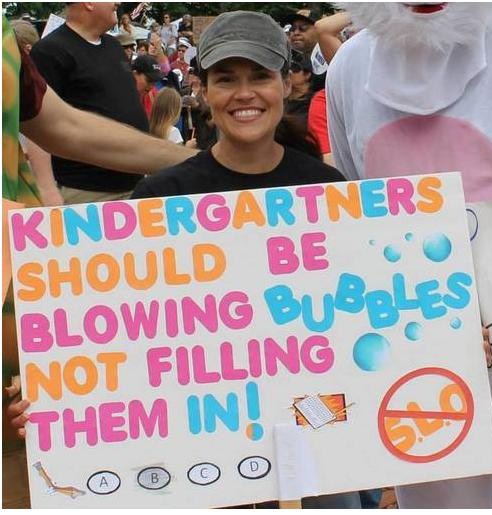
bubble sheets

No, I don’t know who this is, but I concur with the sentiment.

Her first grade is proving to be more of the same, and now with timed reading tests designed to push six-year-olds to read random words faster and faster. Comprehension doesn’t seem to be a concern; only speed. My daughter is slowly beginning to lose heart.

At back-to-school night last month I heard many mothers express how, in kindergarten, their children were so excited for school, but now some of their fifth graders dread each day.
“What happened?” I heard one genuinely confused young mother say to her friend. “And does it get worse when she hits middle school?”
I was cringing so hard I’m surprised she didn’t hear it.
What happened?
We’re killing our children’s natural curiosity.
Will it get worse?
Uh, yes. Sorry.
How did this happen?

Through the same old nonsense we’ve always been dealing with in public education: the out-dated notion that all children are inherently the same, and can be “programmed” in the same ways to create the same output, namely an adult that will become an industrious worker.

The model doesn’t work; in fact, it has never worked for more than a fraction of the population. For as many doctors and professors my schools churned out, there were just as many who dropped out of college, failed to complete any kind of professional training, and never rose above being a checker at the grocery store. There are always children that fall through the cracks because they can’t fit the inflexible mold.

And Common Core, which is merely the same model in an updated website with a heavier hand and a stiffer mold, won’t succeed either.

First, anyone who’s had more than one child will tell you they are NOT all the same. I have nine, and you’d think that with so many kids we’d start recycling some DNA combinations. But mystifying each child is different, despite coming from the same gene pool, being raised in the same house, and eating the same food.

Half of my kids figured out reading at age 4. The other half couldn’t grasp it until age 9. One third of my children love math—one doesn’t even write down the formulas when he does algebra—while another third of my children tremble in terror when approached by a number attached to a letter. The other third are blissfully in the middle. Some of my kids find science dull, but others try to actively blow up the house while others try to put everything back together again. Some read nonstop all day long. Others grumble at the sight of the book.

Every child is unique, but years ago educators decided to shove them all into an assembly line of education where the same information is fed to them in the same way, NOT because it was the best way to teach, but because it was the cheapest way to process the greatest amount of students per teacher.

With all respect to John Locke, the tabula rasa notion of seeing humans as “blank slates” waiting for their minds to be filled with knowledge—a theory which has been debunked for generations, except among some educators with influence—ignores the fact that humans are born with personalities, with various learning styles, even with unique ways of perceiving the world. Ask any parent with more than one child: they come different.

Yet altering education to truly teach individuals, instead of groups, requires vast changes that education boards, university education departments, and most of all the government does not want to do, even though we see effective models in Europe and Asia. (And perhaps that’s why we don’t want to change; we resent the idea that someone else innovated something first.)

It’s simply too hard to change, argue those entrenched in the old traditions. Simply too hard to do the right thing.

So instead we take the outdated assembly line, add bells and whistles and unproven theories, and shove more kids through it hoping to disprove Einstein’s platitude that doing the same thing over and over, and expecting different results, is the definition of insanity.

Well, public education has gone insane.

And now, forcing Common Core—a method of teaching and an application of curriculum which has NOT even been fully tested—has dealt yet another great blow to children.
It’s making them hate school.

Now, I acknowledge that in every class there are those who will thrive. My 1st grader is like that: she loves school. However, already the love is fading. As I mentioned before, she’s growing discouraged. Despite reading at a 2nd grade level, she’s perplexed by reading rows of nonsense words and random sentences as quickly as possible in a minute, and math, which comes to her naturally, is becoming unnecessarily confusing. This frustration with education rarely occurred when we homeschooled.

I’m in a unique situation to compare the differences because I exclusively homeschooled my kids for nearly a decade, then put them into public school over two years ago when a pregnancy at age 42 scared me into thinking I wouldn’t be able to keep up with my kids’ needs. I had a 6th grader and a 7th grader thrust into the middle school, and they had never spent a day of school in their lives. We were all terrified. They adjusted and, to my great relief, they were not only on track but a little bit ahead, manifested by their straight A’s.

I also, with great trepidation, put my then 7-year-old high functioning autistic son into 2nd grade, and braced for impact. He had a very sweet teacher, concerned resource instructors, and eventually learned to read and deal with the crowd.
Still, he begged to come home for third grade, as did his older brother in 6th grade who found the math class too slow and the science too shallow.

Fast forward to this year; my now 9-year-old autistic son wanted to try 4th grade, hearing about how great the teachers were, and wanting to spend more time making friends. So we eagerly prepared him making sure his was on target academically and as socially as an autistic boy can be. He was ready!

It took only one week for him to beg to come back home.

At three weeks, he started clenching his fists when trying to complete math pages that were filled with several methods of doing multiplication our trusty Saxon math didn’t cover. And then, faced with the option to complete a problem such as 49 x 28 = ? in any of the three ways he’d learned, he’d freeze, unable to know how to proceed. (For examples of the multiplication confusion some of our children are exposed to, watch this video.)

At four weeks he started clutching the sides of his head every night as he looked at his homework and whimpered, “I’m too stupid!”

That’s when I started getting mad.

He’s not stupid. Want to know about pyroclastic flows? Tectonic plates? The theories behind black holes? Ask him, but then make yourself comfortable because you’re going to hear everything. He’s read all he can on the subjects and knows the documentary section of Netflix as intimately as some kids know the starting lineup of a basketball team. Ask him about ecology, and get ready to hear a dissertation about saving the environment, misconceptions about global warming, and his opinion on the big bang theory. Remember, this kid just turned 10-years-old.

But because he can’t conform to the Common Core Curriculum he thinks he’s stupid and he hates school.

At his parent-teacher conference I learned that academically, he’s right on track.
But at his nightly parent-child conferences, I’ve learned that his anxiety is through the roof.
So Friday was his last day of school. We’ve quit Common Core, and starting Monday he’s schooling at home.

His frustration is not just because he’s autistic, either. I have a junior in high school taking math who asks me every night for assistance. Not even his teachers can fully understand the homework, tell their students to skip certain problems, and the photocopied pages they use have so many errors it likely doesn’t even matter what the real answers are.

My 9th grader is also expressing similar frustrations, and asked to be homeschooled part-time this year because Common Core was so focused on filling in the right bubbles for the tests that she anxiously felt she wasn’t learning anything useful.

Anxiety and stress do not improve education; they strangle it. Learning can be a joy, but oddly our society has adopted the notion that if there isn’t suffering, there isn’t progress.

If you think junior high kids are moody now, just watch what will happen to our elementary kids over the next few years. I fear that by the time they become teenagers, their teachers will be permanently on valium. common core meme
There are many other arguments about the insufficiencies of Common Core, about how it was foisted upon states by dangling the lure of money in front of them, and how its main purpose is to produce good workers, when, for years, many of us thought education was about producing a populace that could think for themselves and identify was is truth and what is error.

But what’s really baffled me for many years is why the government has decided parents are inadequate in knowing what’s best for their children. I started writing my books in an effort to puzzle it out.

“Miss Peto, why do you find it disturbing that the Administrators select what’s most important for our children to learn?”

She really wasn’t sure, but it sat on her strangely. “Captain, what if the Administrators choose to teach that which is against the beliefs of the parents?”

“I can’t imagine any situation where the Administrators would recommend teaching anything that would be contrary to the welfare of the world,” the captain said. “If anyone would be out of line, it would be misguided parents.”

Exactly who would be deciding what was best for the world, Mahrree wondered, and what was best for an individual? (The Forest at the Edge of the World)

Why have we removed the curriculum decisions from the parents?
Could it be because our government has ceased to see us as someone they serve, and instead see us as a means to their own ends? My school teacher protagonist thinks so.

“You said the other day that I needed to get to the bottom of this!” she said fiercely. “Well, here it is: Parents are stupid, Administrators are smart. Hand over your children to the Administrators with no questions debated so they can pour their own ideas into the children’s minds, while parents worry about nothing else except getting more gold! Gold which they then hand over to the Administrators in higher taxes. Ooh, very clever! The Administrators get richer while families fall apart!”

Perrin’s mouth opened and shut several times, but he knew that when his wife was on a rant, there was no safe way to interrupt her.

“And then what happens to the children?” she gestured wildly. “Give the government a few years, and I’m sure they’ll be telling the children what jobs they can have, so they make sure our children make them enough gold and silver!”

Perrin lifted a finger, likely to try to interject that she had an intriguing point, but he pulled it back a moment later when she began to froth. His contribution could wait.

“Well, I’ve had enough. I’m going to give them a piece of my mind so they can see how intelligent mine really is!” (Soldier at the Door)

Yes, the nature of this character is to get a bit overwrought, but for what other purpose is there for the government to feel the need to take over the education of our children?

“Parents feel stupid because their government tells them they are, so they’re humbly—and even willingly—allowing someone else to guide their children’s teaching. But there’s another reason,” her husband hesitated. “This way the Administrators get to pick and choose what the growing generation learns, and anything that’s not supporting the Administrators simply isn’t covered. In one generation, the entire population should be as loyal to the Administrators as they are—or were—to their parents’ beliefs. Whatever they say, the people will believe.

“And that’s precisely what the Administrators want: the only authority influencing the world will be theirs.” (Soldier at the Door)

I submit that the federal government, in mandating what we teach our children, is attempting to influence the development of the rising generation so as to meet the financial and political needs of the government, not the needs of our children to become intelligent, thoughtful adults. No, this isn’t about mind control, but it’s a form of manipulation, of getting what they want out of us because they have all the power, and we have less every year.

Don’t believe the government is manipulative? As I write this the federal government has imposed a shut-down (or convenient slimdown, as some would argue) because of a budget impasse.
But the nature of the shut-down, and those areas that have been affected, is very subjective: subject to causing the most ire and discomfort among citizens. The randomness of road and park closures (outdoor monuments on the Mall in DC are suddenly inaccessible?), websites that are down (only because someone pushed a button to deny access), and services that are suspended (WIC’s been closed! Starving babies!) have all been carefully orchestrated to twang the most heartstrings with the least amount of effort.

Manipulation of the public, at its finest.

Just out of curiosity, I looked up “Ways to tell if you’re in an abusive relationship.” Read this list from Dr. Phil, and think of it in terms of the federal government and you. My friends, we ARE trapped in an unhealthy relationship.

I support my local school and the teachers—many of my friends are teachers—but I realize they have no power to stop this level of manipulation of public education. They, too, are stuck in an abusive relationship and are doing the best they miserably can in a bad situation.

But I’m fortunate in that I work only part-time, so I can, starting next week, teach my son at home again. He’ll learn tried and true math principles thanks to Saxon 54, he’ll learn to spell, and spell again, and spell yet again until he gets all his words right without the pressure of a ticking clock (which, autistics will tell you, can be quite maddening) and he’ll explore science and history without the fear that he’s hopelessly stupid.

I’m also not going to time how long it takes him to read something, because the boy doesn’t read; he savors. He analyzes diagrams and concentrates on charts. Pondering has become a lost skill, one that I refuse to deny my son. The point isn’t the volume of pages being read, it’s the depth of understanding he gets from the reading.  As an English teacher, I’ve encountered many students who have read quickly through the texts, but remembered very little, so they have to reread, and reread yet again.  Skimming isn’t the same as absorbing, but don’t tell Common Core that.

So today we quit Common Core, abandoned this one-sided relationship that doesn’t care one bit about my son but yet is obsessed with the data he produces.

But what about everyone else who can’t commit such a quiet act of pseudo-civil disobedience such as homeschooling in protest of Common Core? I wished we could band together and overthrow this nonsense, but that’s a bit vague.

What we can do is talk with our kids and let them know what we feel and think, how we believe and understand, and let them know that what they learn out there may not necessarily be what they should believe in here.

“There’s one thing we can do,” Perrin said. “We can make sure we’re not touched by whatever may be coming. In our house we will discuss and believe whatever we want. We can recognize for ourselves that the sky is dark and threatening with a storm obviously on the way, and explain to our children that the rest of the world has been conditioned to believe the sky is blue, despite all evidence to the contrary.” (Soldier at the Door)

My friend, a single mother who works full time and has two kids, wrote this: “I’ve come to the conclusion that school is where my kids go to be babysat while I’m at work, and they actually start learning when they get home. I have noticed that school seems to teach them WHAT to think, but not really HOW to think. I have to say that worries me the most. I try really hard not to browbeat my kids into agreeing with me, but I do want them to be able to back up their arguments logically.
“If I think of the schools as being responsible for educating the kids, I get very stressed out at the things they don’t know, and then get to stress again over the crap they ARE being taught. Some of the crap they come home spouting is just plain nuts, and it’s hard to stay calm sometimes during our little ‘debunking’ sessions. Makes for a really busy day for me, but sadly that’s how it is I guess.”

Yes, sadly for now, that’s how it is. But at least we still have the freedom to talk to and educate our children whenever and however is possible for us. And we better exercise that freedom for as long as we still can.

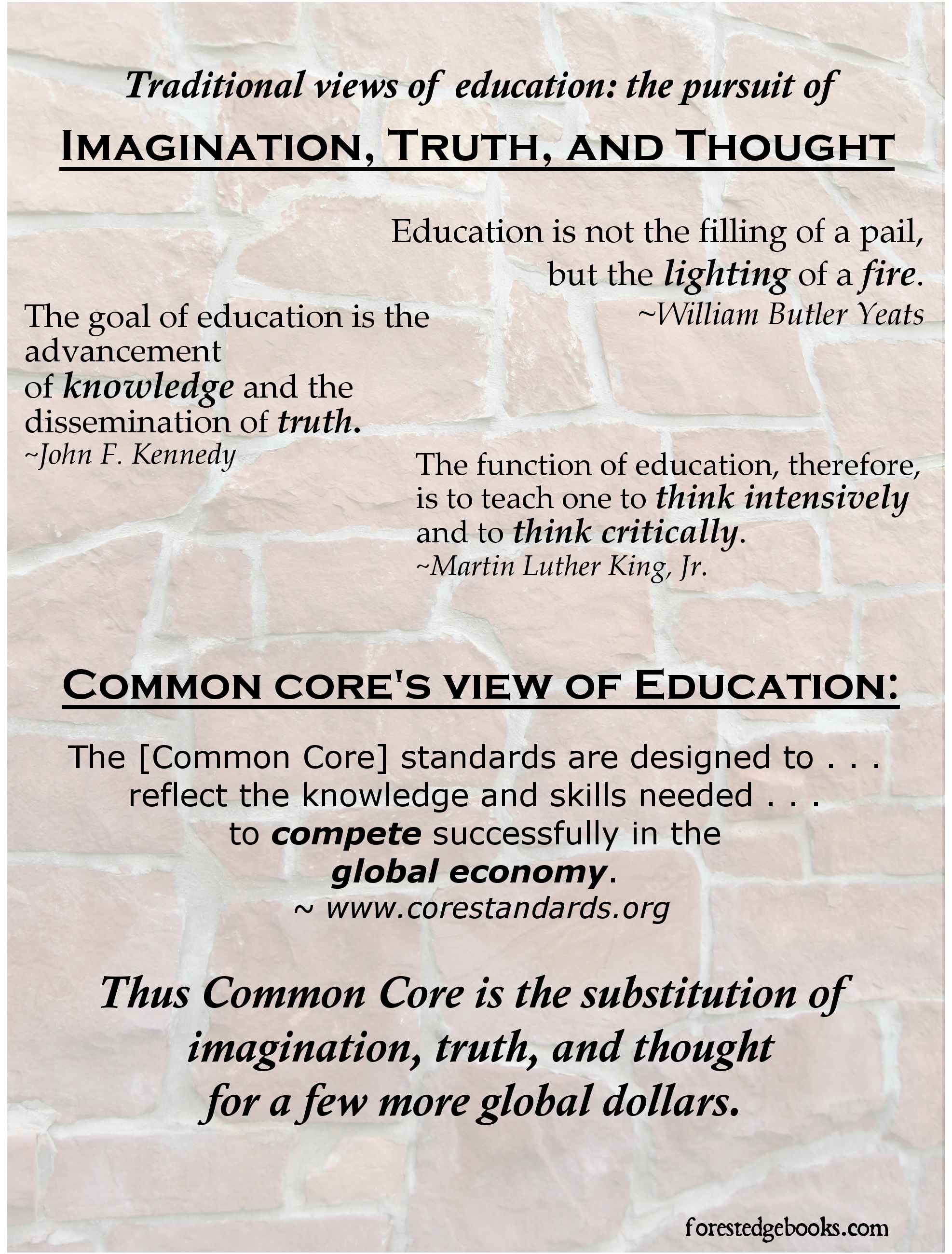
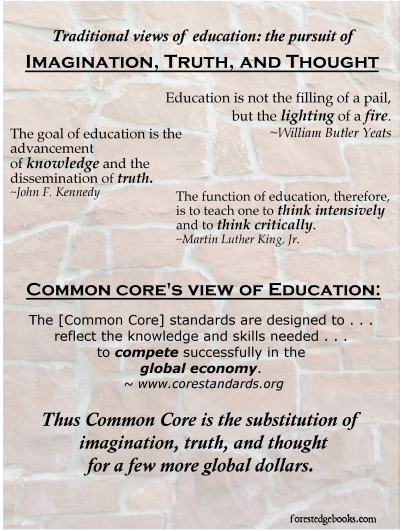
In the meantime, if you’re still unconvinced that the direction Common Core is taking us is not our children’s best interests, consider the changing opinion of the purpose of education. We used to be concerned about lighting the imagination, pursuing the truth, and developing critical thought, but no longer. Take a look at this statement from the Common Core website (emphasis mine):

The standards are designed to be robust and relevant to the real world, reflecting the knowledge and skills that our young people need for success in college and careers. With American students fully prepared for the future, our communities will be best positioned to compete successfully in the global economy. http://www.corestandards.org/

In other words, the purpose of education is to make money in the world. Common Core is demoting our children from thinking, creative beings, into busy little worker bees that make more honey for the governmental hive.

So if you think the purpose of life is to capitalize on the global economy, then surprise—Common Core is the route for you.

But I personally believe humans are destined for higher purposes and greater things. I’ve already discovered there’s much more to life than just money, and that’s what I want my children to discover as well.

common core meme

My 10th child

Yesterday a delivery arrived–one that I’d been waiting for, for more than four years now–and once I lugged it into the house I couldn’t bear to open it.

044

It was, what I’m now starting to think of it as, my 10th baby.
I have nine children (yeah, really–all birthed by me, no twins), but the amount of effort and sleepless nights I’ve put into the Forest at the Edge book series feels very much like another child.
And yesterday it arrived. And, just like my human babies, I happily cradled the bundle handed to me, but didn’t dare inspect it. Because . . . what if something is seriously wrong?
What if this amazing little thing isn’t as perfect as the doctor proclaimed, but has three nostrils?
Or a large birthmark on its neck like I do?
Or . . . looks more like me than like my hunky husband?

And it’d always be my husband who’d take our newborn out of my arms and start to unwrap the impossible blankets. “Let’s see what we have here!” he’d say cheerily, while I clenched my hands by my face and worried that my sweet darling would have some defect that would cause him or her heartache, and that I wouldn’t know how to alleviate that pain.

Yes there were birthmarks–cute ones, on the tuchus or the bottom of a foot–and there were minor oddities and bizarre flexibility that, as my children grow older, proudly demonstrate to squeamish by-standers. But all in all the baby was pretty darned good.

I needed my husband again yesterday.
He saw the box on our bed and, always eager to open a package, asked, “Ooh–what’s this?”
“My books,” I whimpered.
“Open it!”
“I can’t!”
What if something was horribly wrong with them? I already knew of a couple formatting glitches I can’t seem to work out, and a few typos despite my going through it 30+ times . . . but what if there was something far worse?
I couldn’t bear it.
“I’ll open it,” my husband decided.
“No! Yes! I don’t know–”
He already had out his keys and slashed the tape. Then he opened the box and looked.

023

Cringing so hard my cheeks hurt, I asked, “Well?!”
Slowly he nodded. “Look pretty good to me.” He was reading the back cover of one of the books, still nodding. “Do you want it?”

Do I want my 10th baby? The actual paper copies of the books I’ve been writing since early 2009? (Actually, since it’s two books, maybe my 10th and 11th?)

I held out my hand nervously . . . then sighed in relief as he gave me Forest and Soldier. Not bad. Not bad at all.

Then, just as I did with my babies, I suddenly wanted to show them everything in the world. And, just like my babies, I started taking pictures.

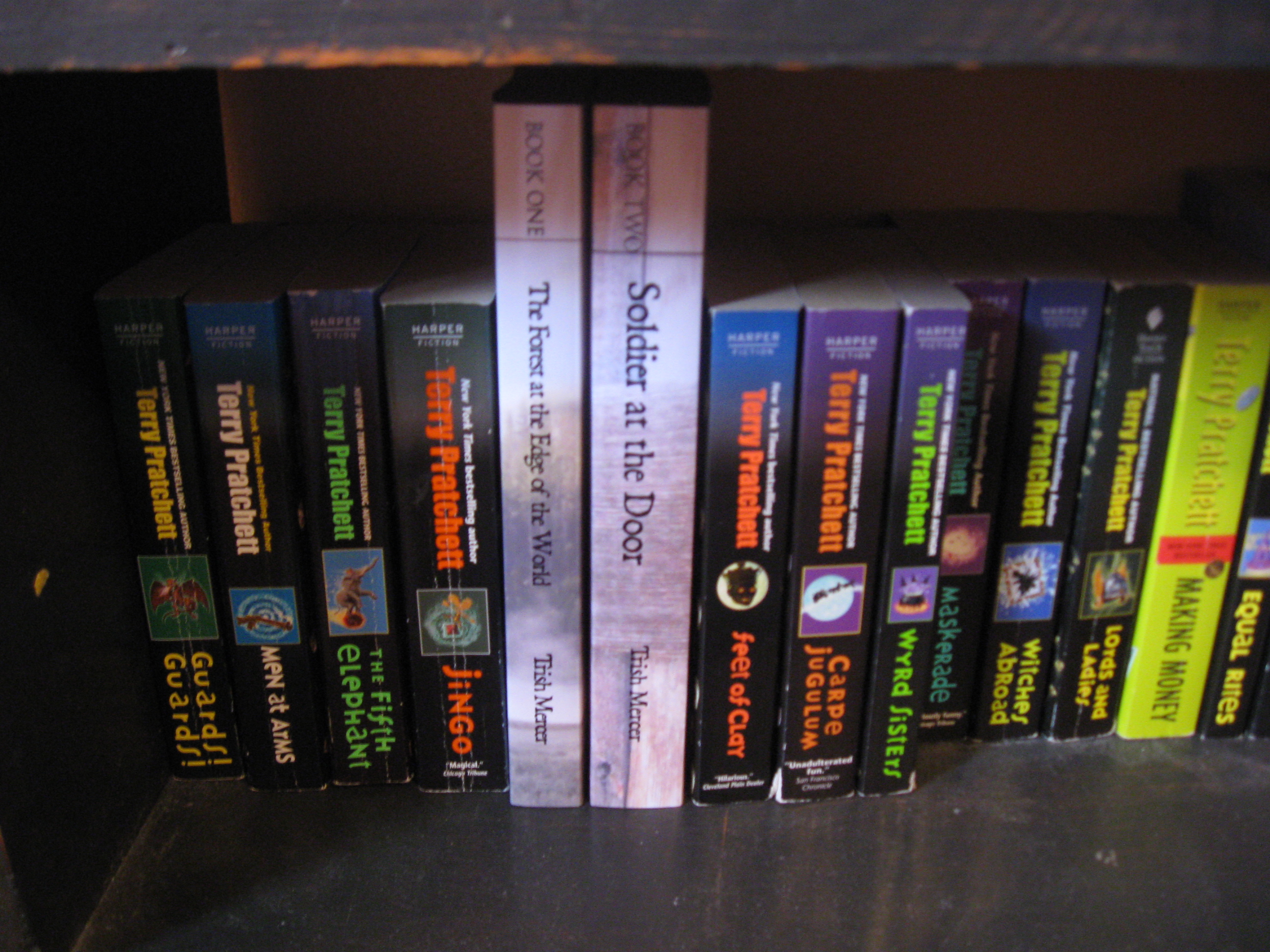
First, I introduced them to my hero and mentor, Terry Pratchett. Don’t they look cute on the shelf together?

017

Then I introduced them to the bathroom, which is always a good place to know in a new house. Top of the tank, for your reading pleasure.

018

Then, the bathtub–waiting for me to actually dare take them near water–

020

Oh no! They fell in!
Oh, there’s not water.
Silly Forest and Soldier!

019

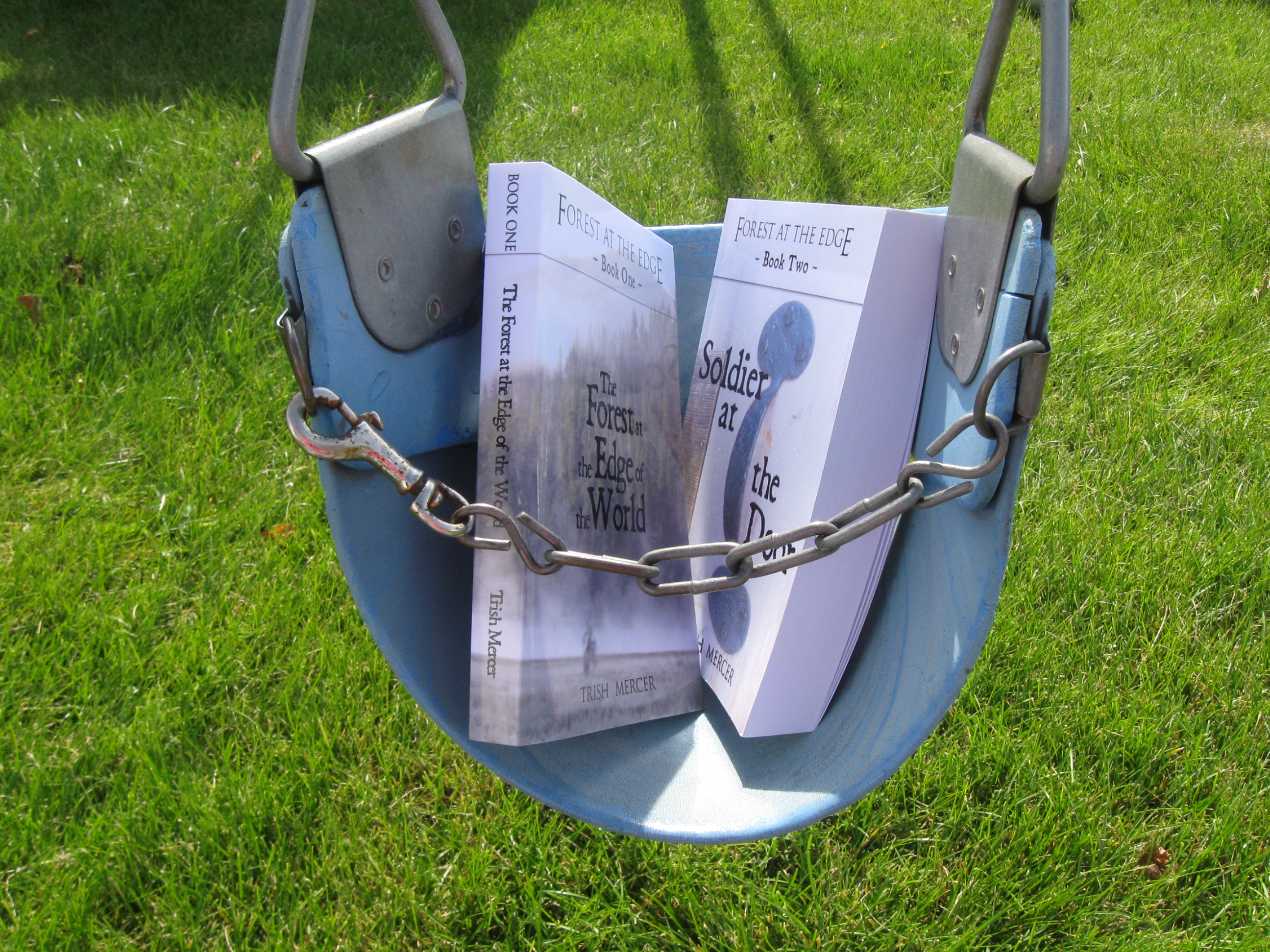
They also liked the baby swing in the backyard. Hold on, boys!

024

Then it was time to have a tea party with their friends . . .

027

And at this point I began to think, Maybe this is a bit silly?
I mean, seriously–would books really have a tea party with themselves?

Of course not.
They’d have a tea party with OTHER books!
So I introduced Forest and Soldier (they were pretty uncomfortable at this point, but already they have some sense of propriety so they soldiered on) to my other three inspirations; women who demonstrated that even “regular moms” can create books, and they unwittingly dared me to write: Shannon Hale, Jessica Day George, and Joanne (J.K.) Rowling. (The books all want to have a sleepover later. With popcorn. But I just vacuumed, so I’ll have to think about it.)

033

(I’ve met two of these authors, and bashfully said nothing about how they inspired me.
But some day I will. )

Finally I brought Forest and Soldier back to where they were conceived–my computer. On the screen is a list of the current drafts I have of the entire series (my file of past drafts is immense) and I showed them where they began. I’m going to save this picture as motivation; I’ve done it twice before, so I can do it six or seven more times to bring to life the entire family/series.

037

And then, I put Forest and Soldier back into the box.
Not because I’m still overwhelmed or anything by being a real mom, I mean, author.

Just because it’s nap time.

Cost of raising a child? Try $1800 a year, not $13,393

Costs of raising a child per year: Government’s estimates– $13,393/year.
My actual estimates— $1,800/year.
Something’s amiss, and naturally it’s Washington that’s missing it.

You’ve likely seen the terrifying infographic below claiming that it costs a crotch-kicking-romance-killing $241,000 over 18 years to raise a child.

The U.S. Department of Agriculture’s  (USDA) annual report on the Expenditures on Children by Families has found that a middle-income family with a child born in 2012 can expect to spend about $241,080 for food, shelter, and other necessities associated with child rearing expenses over the next 17 years.

That amounts to $13,393/year.
That’s also amounts to a lot of hogwash.

How do I know? My husband and I have six children at home (a total of nine, with three out of the house) which would mean we’re spending $80,358 for our children alone.
But we earn less than $60,000 year combined, so something obviously is not adding up. That’s because we don’t budget like the government (no rational person ever would).

Even Canada has caught on that these numbers are unrealistic. According to Frasier Institute, the cost is closer to $3,000-$4500/year. But even that’s too high.

Just don’t believe the government’s numbers.
The $241,000 “average” comes from the USDA. “Average” means “not really applying to anyone.”
Actually, it means that while some families may actually spend far more than this staggering sum (and just how often did the USDA figure in the Kardashians?) many other families spend far, far less.
Still, I’m amazed that normally thoughtful people who’d never believe government numbers (remember, these are the same people we trusted with home mortgages) suddenly and wholeheartedly embrace this figure which terrifies them from ever having a family, or justifies their reasons to becoming a parent only to a goldendoodle (just don’t look at the estimates as to how much it costs to own a pet per year. Hint: over $1,000).

This figure of $241,000, or $13,393/year, is misleading, because “averages” serve no one well. I know of no one who actually spends this amount, but I can show you over one hundred families who choose—choose: key word here—to raise a family on much less. Now, this is NOT to say that everyone can raise their children on the amounts I demonstrate below, but my math shows that taking the government’s advice on how much should be spent is probably the worst idea since the government decided to get a handle on health insurance.

So here it is, the government vs. the Mercer household.

Housing: Housing a child purportedly costs 30% of the $13,393, or $335/month. This rate suggests that each time a child is born, you must purchase a house that’s bigger to accommodate said child.
Nonsense.
If that were the case, our mortgage would be nearly $3,000 more a month. Granted, if we were just starting out and living in a studio apartment, we likely would need to eventually move to something bigger, accounting for the $335 increase. But adding a child to a household doesn’t mean adding on another wing.
My husband and I deliberately chose (there’s that key word again) to live in a rural area where we could buy a 2200 sq. ft. house with nearly 1/3 acre of land for a mortgage of about $1,000/month. While I grew up near a big city, and my husband was raised on the east coast near the ocean, we both decided to relocate to a less expensive area, purposely choosing a rural environment that we could afford on one income. True, this puts us at quite a distance from extended family, but it allows us to raise our children how we choose to, without outrageous expenses. Even so, for a time our family of 10 once existed in a three bedroom townhome for nine months. Several sets of bunkbeds were utilized, stuff was stacked creatively, and while the situation was far from ideal, we actually found ways to be happy.
Families can make do with much less than a private bedroom for each child (and all the unnecessities that some think need to go with it, such as one’s own TV, computer, and Xbox), and still be happy.
Actual cost of housing: nothing. Just shove the new kid into an existing bedroom. We call it “sharing.”

Education/Childcare: 18% or $2,410/year. This is another figure subject to choice. Because we chose to live in a lovely-yet-less-popular community, we don’t need me to work full time to afford that $3,000/month mortgage, so the cost of childcare is one we can happily ignore.
Still, there are school fees, but they’re not this high.
And high school sports can be costly, but not this much.
The real budget killer here is childcare. I realize that for some, such as single parents, there’s simply no getting around it. But perhaps there are some parents who worry that the government may come around and demand a check for that $13,393 a year to ensure their child(ren) are being raised according to the USDA’s expectations, so some couples may believe this amount must be paid out for childcare.
It doesn’t. We’re living proof. And I can show you another one hundred families as proof as well. 030
Actual cost: $200, because all of us know “free” education isn’t really free.
(Interestingly, the years that I’ve homeschooled my kids, I’ve found that the costs of books and supplies were actually far less than $200/per child. Go figure.)

Health Care: taking 8% of the $13,393 means that a healthy child costs $1,071/ year. Really? Why? Insurance rates that cover families generally don’t increase depending on the number of children. I admit that we currently rely on CHIP for our children, and pay a modest premium every three months, but it’s not $1,071.
If, heavens forbid, a child has a chronic illness—which is rare but does occur—the costs will naturally be higher. But I’ve calculated the cost of injuries (trips to the ER for stitches and broken bones) and doctor visits for illnesses for our family over the past 20 years, and found it to be much lower than $1,071.
Actual costs for a healthy child: $200/year.

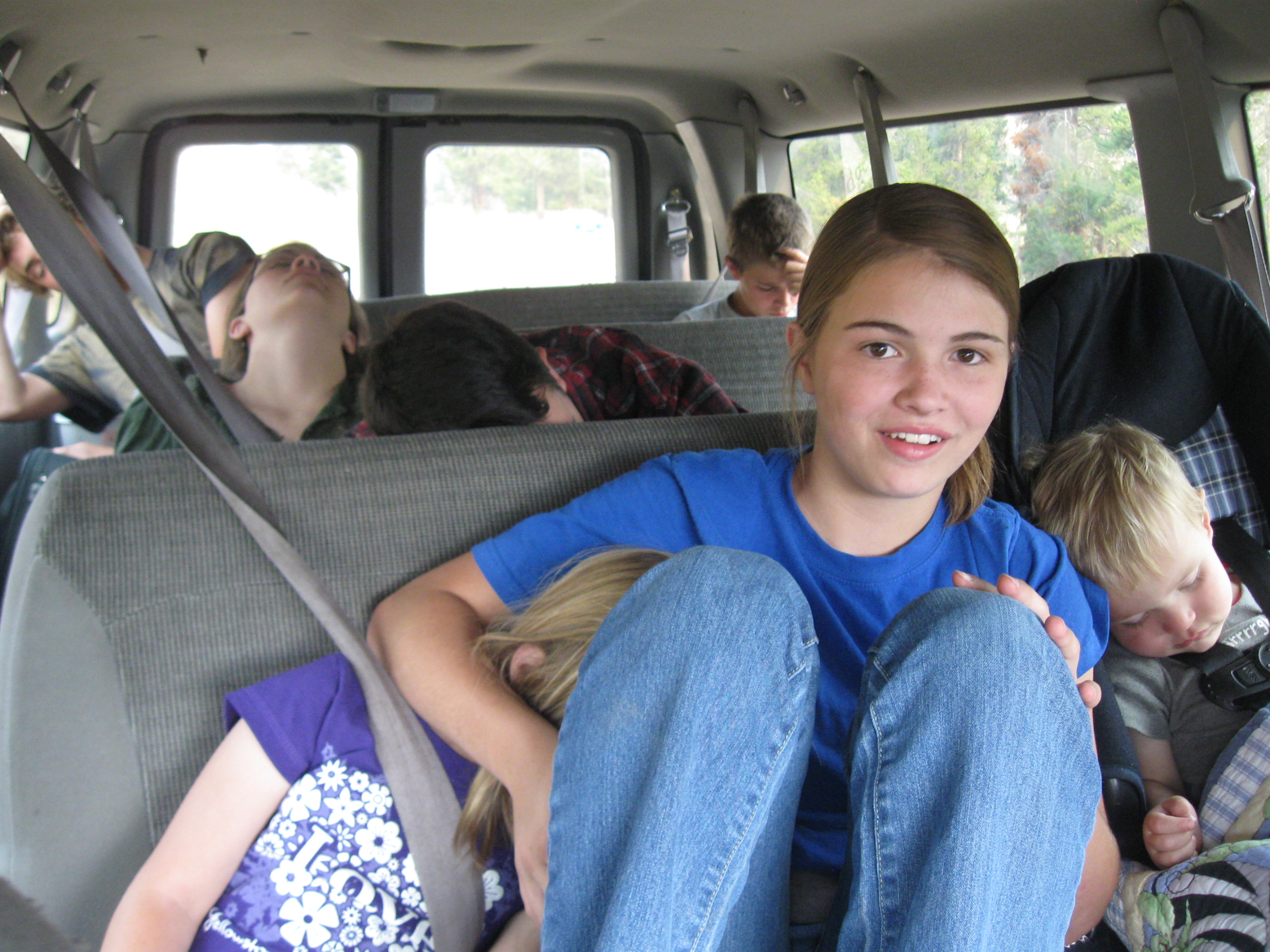
Transportation: $1,875/year is what one little darling will supposedly cost you. But here’s the thing—driving around with six children in my van (and yes, I’d still have a van even if I didn’t have kids because I love the space) costs the same as just driving myself around. They go to the same places I do, and as for the claim that mothers must be a taxi service for their children? I just don’t taxi them around. If they want to do an activity, they can walk, bike, or scooter there. Again, we chose our home location to make that a viable possibility. 2013 Yellowstone 297
And no, your child does not need to be given a car for the 16th birthday. If your children thinks it’s a necessity, then let them earn the money for the car, the gas, and the insurance premiums. It’s amazing how suddenly faced with being responsible for those expenses, a car just isn’t that important anymore.
Actual costs: nothing added.

Clothing: at 6% is $803/year.  I don’t even spend that much on myself!  This is an easy place to be frugal: jeans from Wal-Mart, T-shirts from Target, and shoes from Payless. Name brands are simply foolishness, especially when kids stain, tear, and outgrow overpriced bits of cloth. 005
We also believe in hand-me-downs. My closet is filled with bins of gently (and roughly) used clothes. Each season I sort through them to find older sisters’ clothes that fit younger sister, and bigger brothers’ jeans that can be cut into shorts for littler brother. Garage sales are also great deals, and word has gotten around my neighborhood that I’ll take anyone’s cast-offs off their hands. This year, because two moms cleaned out their closets, I haven’t needed to buy my toddler any clothes for the winter.
Actual cost: $300/year

Food: $2,142 or $178/month. At this rate, my family of 8 would require $1,428/month in groceries. But I spend about $750/month, including diapers, shampoo, cleaning supplies, etc. We rarely eat out, cook nearly everything from scratch (tastes better, is healthier, and takes only about 15-30 minutes more per night—I know, I’ve timed myself) and we are mindful of portion control. I honestly couldn’t imagine how to spend $1400 a month; if I did, I suspect we’d have some obesity problems, which would likely demand an increase in our health budget and clothing allowance.
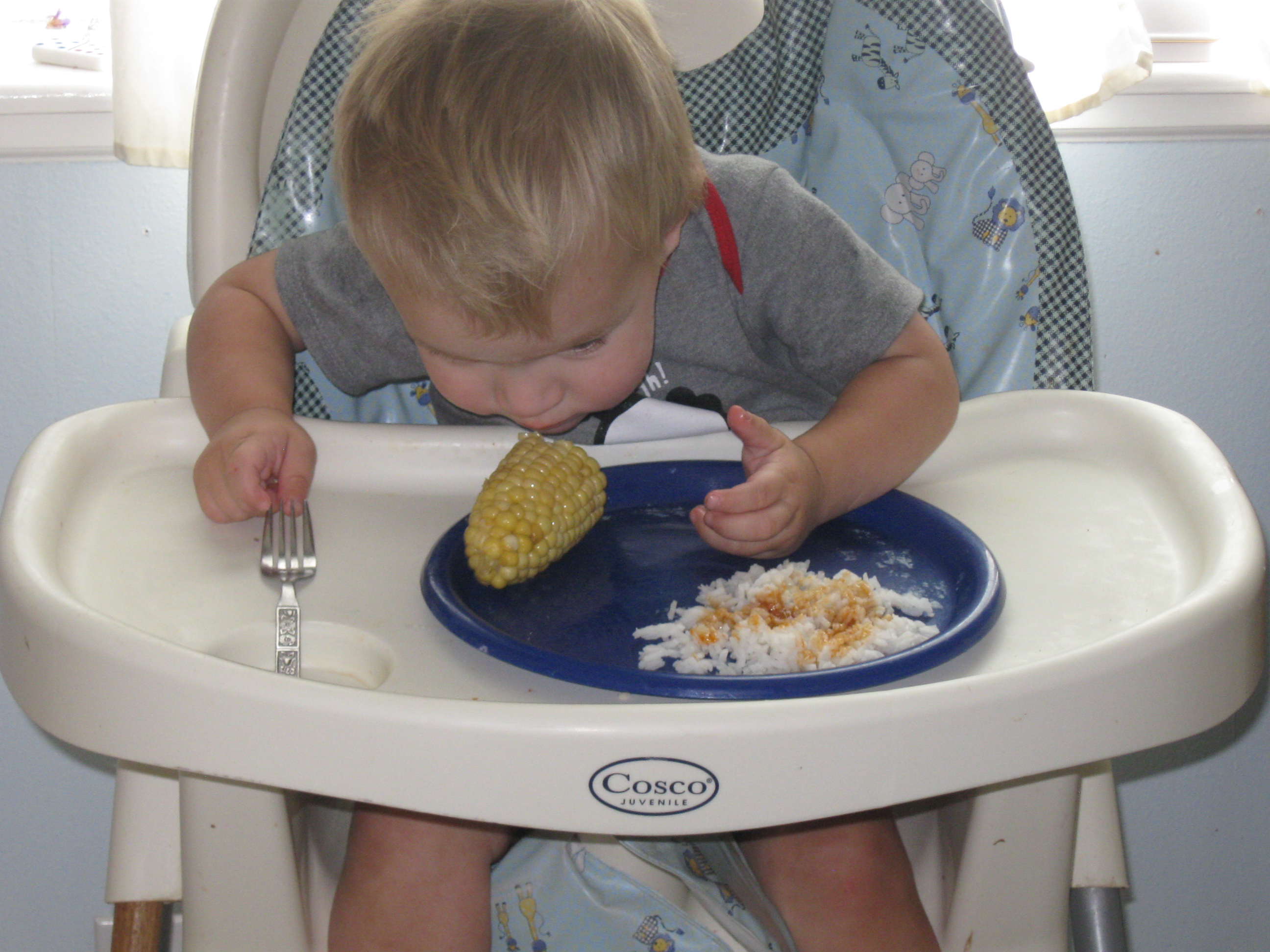
I admit that my teenage son eats far more than my toddler son, but it balances out; my toddler subsists on what most toddlers do—a daily cup of milk, three grapes, two crackers, and oxygen. His appetite will match his brother’s in a few years, but a bit of planning ensures that it won’t be an extreme shock to our budget when that happens. I’ve kept to this budget for over a decade now.
Actual cost per child: about $93/month or $1125/year.

017

Miscellaneous: 8% or $1071/year or $89/month. This assumes karate lessons, soccer and baseball teams, and piano/sousaphone lessons.
Some will argue these extras are necessary. I’ll argue that what a kid really needs is some time to be creative, so I raise free-range children.
They wander the neighborhood in search of other children who they then “play” with. It’s an odd concept, but one I remember from my childhood in the ‘70s. Fortunately in our chosen rural community, “playing” is still allowed. They throw and kick balls to each other, do tea parties, play board games, make weapons out of foam and pvc pipe, and do night games. Sometimes my kids want piano lessons, so they swap babysitting for lessons. There’s always a way for a child to earn the costs to cover an “extra,” and learn a bit about the value of a dollar as well.
(Incidentally, don’t believe the line that sports will earn your child a scholarship to college. Add up the costs of the sports, gas for travel, and uniforms each year, then realize that the average student receives a sports scholarship of only about $500/year, and the math is easy. If it isn’t, maybe your child isn’t really college material.)
Actual cost per child: $0

So my grand, penny-pinching, free-ranging, fashion-ignoring, home-cooking, actual total cost per child per year?
$1,800.
times 6 
$10,800/year for my current family of 6 children. And no, we’re not supplementing our income with food stamps or any other assistance beyond CHIP.

You CAN have a family, without enormous costs. Come by my modest home and I’ll show you. And so will my neighbors, and their friends, and their families . . .
Don’t let the supposed costs of raising a family scare you away from experiencing a fantastic adventure. Remember—the cost of a year’s upkeep on a goldendoodle is about $1,000/year, after the initial investment of $500-1,000 for what is, essentially, just a mutt.

Kids last longer, are far more entertaining, and far more rewarding. You really want to learn about the world and about life? Have a baby. You’ll be astounded, because everything—every last little thing—that you thought you knew about the world will change profoundly. It’s supposed to. You’ll become wiser, braver, and utterly amazed.

mercer-97
And besides, kids are ultimately a much better investment than anything else you can think of. I promise.

Miley Cyrus, may I have five minutes?

Oh, my poor girl—are you really so lonely, so desperate, that you’ll do anything to get attention? You don’t have to. You can be a woman—a real woman—without becoming a prostitute, which I’m afraid is what you’ve done. You’re selling your body, but you could do so much more.

First, let’s put you in a classic little black dress, because I just can’t look at you in  . . . whatever it is you’re wearing.

Miley black dress

See? Don’t you feel so much better?

I suspect you want to show you’re not a “good little girl” anymore, although I don’t understand why so many in Hollywood think being “good” is “bad.”

But your behavior isn’t “adult.”
Strutting around in your underwear is what my toddler does.
And pretending to mate in public is what dogs do in the street.

You could do so much more.

Exploiting your body isn’t groundbreaking or original—you’ve just fallen for the oldest trick in the book.  Check the Old Testament—you’ll see that selling your body has been around for thousands of years. It’s not art, it’s vulgarity, and you can do so much better.

Look beyond the cheering fans in the audience, and see the reaction of adults—real adults, not mere grown-ups (my explanation about the difference is here). Adults who, by the millions, learned of your embarrassing exploits via the news.

We’re not cheering—we’re cringing.
Millions of women are rolling their eyes in frustration that, once again, the message has been lost that women have infinite value, fantastic worth, and incredible potential.

Millions of men squirm and look away because your behavior arouses something in them, and it makes them uncomfortable because they prefer to use those feelings for true women who respect and protect their bodies.

And the men who are enjoying you? They’re they same flabby, smelly guys that linger at the bra section of Wal-Mart. Creepy and icky, Miley. You can do so much better.

You could still be a real adult woman.

But right now you’re headed down a path that will not end well. I don’t care how many times you’ve watched “Pretty Woman,” females who sell themselves short don’t have happy endings. Look at Lindsey Lohan and Amanda Bynes. (Actually, let’s not, or I’d have to “paint” little black dresses on them, too.) There are thousands of porn actresses who can tell you about a life of misery and self-loathing. No woman deserves to feel that way about herself. None. Not even you.

You can do so much more.

You want to prove you’re an adult? Than do something adult-worthy. Real adults—real women—use their influence and names for good. You may be too young to know these women, but do a little reading about Princess Diana and how she used her name to change the world’s view of AIDS victims.

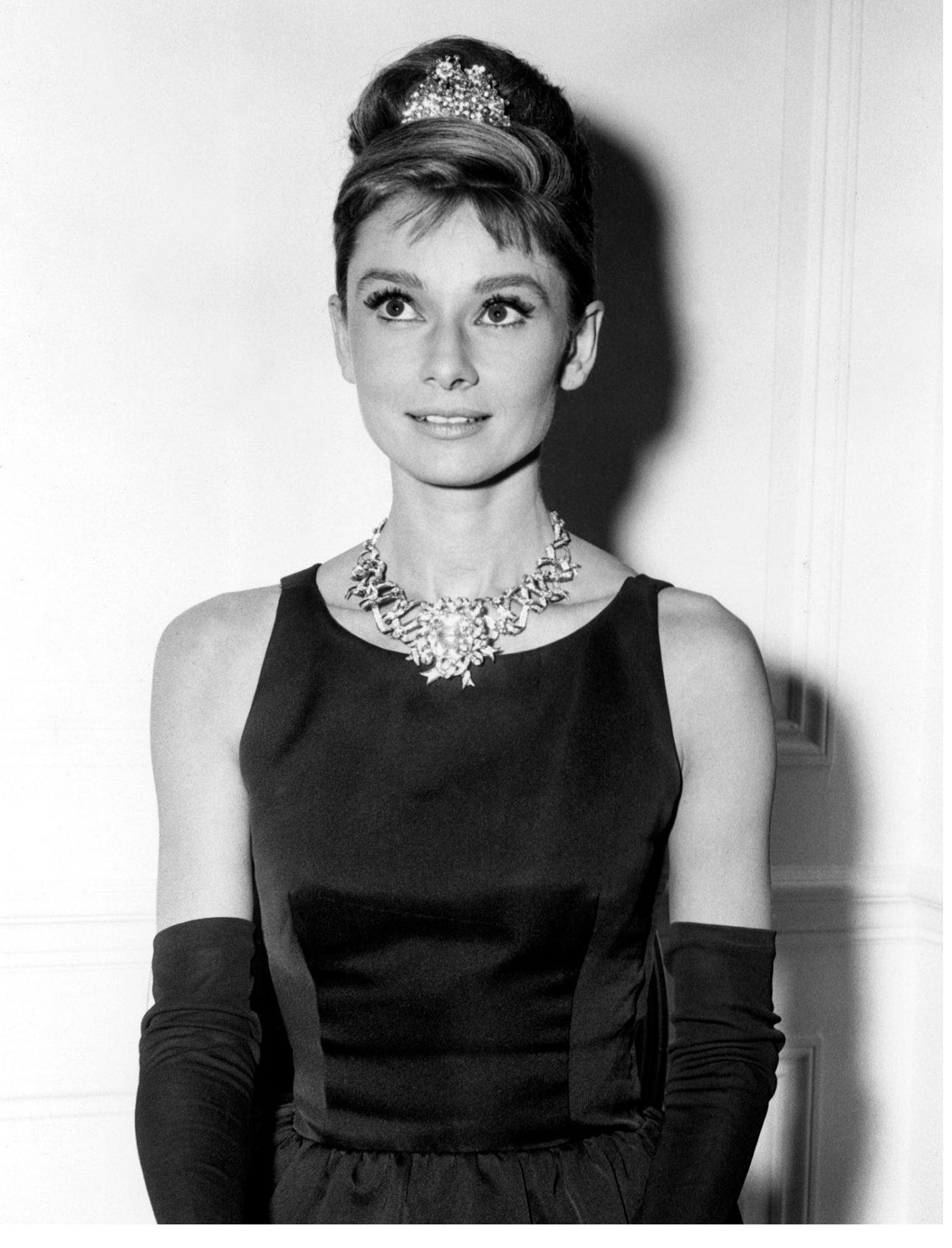
Another little black dress . . .

Watch a few Audrey Hepburn movies, then look up how she spent her name and her later years taking care of starving and neglected children.

hepburn

And another little black dress.

Take a good look at Eleanor Roosevelt, then find out what she did for civil rights when no one else was talking about it.

And yet another classic black dress.

Real women–real adults–do real important things.

So can you.

     Despite the chill in the air, Sareen seemed determined to show Shem exactly what she had to offer. Not surprisingly, several soldiers had converged around Shem to share in the view.
     “Oh Sareen, this is just becoming sad,” Mahrree muttered, wishing someone would point out to the girl—maybe Sareen’s mother, who didn’t seem to be around—that her displaying behavior was most inappropriate.
     . . . But for the moment, Sareen was happy for the attention that, someday, she’d realize she didn’t really want.

~(Soldier at the Door, Book Two)

One parent’s response to Time’s “The Childfree Life”

“When having it all means not having children.”

I read that subtitle from Time Magazine’s “The Childfree Life” and I thought:
When did having it all mean becoming as self-centered as the two-year-olds these non-parents sneer at?

Then I thought: 
When did having it all become the purpose of life?

I don’t think that’s a question many people worry about anymore, but it’s a most important one.

But let’s leave that aside for a moment and look at the question of, What’s the purpose of having kids?

I don’t like the answers of “As a duty to our society,” or “To perpetuate the species,” or “So someone will pay for my social security when I retire.” (That’s my reaction when people accuse me of being “overly reproductive.”)

All of those answers smack of some washed-out diatribe, a dull and pessimistic penance for being on the earth. But parenthood isn’t about passing on misery or fulfilling a duty. It’s about becoming an adult, with attitudes and understanding worthy of the definition of “maturity.”

I’m sure most of us didn’t become parents because we wanted to become “mature,” though. It’s a secondary and unexpected benefit, like panning for gold and finding diamonds as well.

As a young married I wanted a baby because I thought they were cute. I had the same affliction as many people whose pets double as their children: I wanted something to dote on, to dress up, to call “My Widdle Wiggy-wums” in public.

And then I had the baby.

It was nothing like carrying around a pet/pretend child (which we pathetically did with a cat for the year before).

Now, some who choose to be childless may defend their position by claiming their animal is like their baby. And I know they feel love and affection for it, but to believe a pet is the same experience as having baby is like comparing spending the afternoon in a wave pool with a vacation in Hawaii. The difference is miles apart.

I knew I would love my child, but I was completely unprepared for every aspect of the world to suddenly change. (And to also feel stupid for dragging my cat to stores.)

Parenthood causes a shift. I’ve seen it in nearly every new father and mother. The shift may occur as early as during pregnancy, or may not happen until the child reaches the first birthday, but at some point a person shifts from being a self-centered mere grown-up to a full-fledged adult.
What’s the difference?

Mere grown-ups (and it’s easy to become a grown-up; just don’t die before you’re around nineteen) look at the world and muse, I wonder what it can give me today.

Full-fledged adults (a much more fulfilling accomplishment than merely aging) look at the world and cry, Dear God! How do I make this a better place for my baby!? And everyone else’s baby?

It’s a drastic shift, a necessary shift.

The shift makes you forget about your own petty needs and wants (such as a shower and a decent night’s sleep), and makes you rabid about your child’s.

It’s the shift that makes you stop reading the sports page first and start paying attention to the headlines about education.

The shift that makes you more interested in local and national elections, in crime rates in your neighborhood, in safety in transportation, and in how the future will look in twenty years.

The shift moves mountains. Ask any parent whose child has been diagnosed with a mysterious or even fatal disease. They’ll rearrange all kinds of geography and even defy the laws of physics for that child.

In fact, I’m willing to submit that the vast majority of improvements to society—any society, in any year—was started by someone who was a father or a mother.

Because they felt that shift, and realized the world wasn’t about “having it all”; the world is about making it better for everyone.

The surprise of parenthood is that life becomes so much more meaningful when it’s lived for those you care for, rather than just for yourself.

Maybe avoiding this shift is why a certain segment of the population, not only here in America but in many parts of the world, rejects parenthood. They want to stay children themselves, always indulgent. That may sound like a flippant evaluation, but I’m sorry to say that each deliberately childless person I’ve encountered has had the same trait of, “It’s all about me, dear. Now would you tell that child to be quiet? I’m on a conference call here in the park.”

That’s why I submit that childlessness doesn’t solve problems, but it increases them.
I don’t believe that we should have children because one of them may change the world– someday–but I submit that we when we have children we feel the need to make the change–today.

Now I agree that parenthood isn’t some magical bullet that shoots maturity into people.  They are those who have no business having children, who still regard their Chihuahuas with more affection than they do their tweens.

And there are also some true adults who are childless not by choice but by biology, who do more than just send a couple hundred dollars to a children’s hospital and think they’ve done their part for the future of the world. These full-fledged adults dote on their nieces and nephews, volunteer to coach little league and scouts, and teach the children in Sunday school.

I’m worried about the grown-ups who forgot to outgrow the “mine!” period of toddlerhood. Perhaps the most disturbing element about “having it all” is that it resonates with the increasingly pervasive entitlement that seems to be overtaking the developed world. At some point we need to realize that the more each of us tries to have it “all,” the less there is for everyone else.

And when, in the history of the world, was anyone ever happy when they got everything they wanted? Even Alexander the Great cried like a baby (and threw a tantrum like a toddler) when he realized there was nothing left in the world for him to “get.”

Joy has always come from giving more than we get, from serving more than demanding. That invaluable understanding is what parenthood gives you.

And that also, by the way, is the purpose of life.

“My children have me tied?”
The thought had never occurred to Mahrree. True, her life was completely different now. And she didn’t participate in anything outside of the house. And she hadn’t thought about the condition of her hair in nearly two years. Or the condition of her clothes. Or her house. Or garden.
But caring for these little children, who she thought were funny more often than frustrating, loving more often than loud, was an honor. It said so in The Writings, and she’d chosen to believe it from the moment she knew she was expecting her firstborn. And choosing to believe it had made all the difference in her attitude as a mother.
Were they difficult?
Yes.
Demanding?
For some reason that word just didn’t seem right. 
(Soldier at the Door, Book Two)

“She knew that in a very real way, she controlled the world. At least, she controlled the way her students would see it.”

“That’s right, sweety—that’s a dog. Doggies are bad. They will always bite you, even if they look nice. Keep walking . . .”

That was the conversation I overheard between a mom and her three-year-old daughter yesterday. I was pushing my son in a stroller past them, and glanced over at the evil beast behind a massive fence.
It was a small, fluffy mixed breed dog, panting happily, not snapping at all.

Not that I’m a huge fan of dogs—I tolerate them, at best—but I worry when an adult passes along their fears, irrational or not, to their children.

I cringed, but the damage had been done.
The child shuddered obediently and gripped her mother’s hand as they rushed home. The girl had been indoctrinated.

The thing is, we all indoctrinate our children, in good ways and bad.
I’ve heard some adults argue that “religious nuts” brainwash their kids into believing in their faith, but it’s still propaganda when adults persuade children to not believe in anything at all.

As parents we literally present the world to our children—a view which they then spend the rest of their lives believing or disproving, or talking to a therapist about.
A difficult question then is, What view of the world have I given to my children?

My mother was a classic case of paranoia run amok. Suffering in Germany as a child during WWII, losing her parents, her grandmother, and several cousins to the war, seeing some of her family interred in concentration camps, then escaping from her home (now a part of Poland) to the west by herself as a 16-year-old, just one day ahead of the invading Russians, is going to leave some scars.

Unfortunately, she refused to have those scars looked at, insisting every time we tried to get her treatment for her Post Traumatic Stress Disorder that she had things under control.
She didn’t.
She feared the world. She was afraid of people in uniforms (she hated the Boy Scouts—just like Hitler Youth, she claimed), people in stores (you never know why they’re looking at you), and people just chatting in the halls at church (she knew they were gossiping about her). Every person was a potential threat to her happiness, as it were.

Sometimes she was fine, going for months being cheerful and even joining in the conversations with other women in our neighborhood.
Then suddenly something would snap again—we never knew what the trigger was—and for many months and even years she was sure everyone hated her for her German accent, and that someone was coming to get her.

All of that rubs off on a kid, and even though I learned to distance myself from her delusions and paranoia as a teenager, I still feel my chest tighten when I see a group of women and I think I’m supposed to talk to them.
But rhetoric courses I took in college demonstrated how each person views the world in a different way and, most importantly, those views can change.

In my mom’s later years, her paranoia blossomed—one of the lesser-common side effects of Parkinson’s disease is hallucinations. And she did them magnificently.

My 40th birthday will always be memorable because she called to wish me a happy birthday, then said, “Well, your father’s all but out of the family now since I discovered he’s been having affairs.” The man was 78 at the time. My mom also complained about the listening devices in the house, the person living in the attic demanding sugar, and the horrible statue garden my brother and his wife had put up in the backyard.

My older sister called me two hours later to say, “I just had Mom committed to the mental hospital to stabilize her. How’s that for a birthday present?”

Now, four years later, my mother barely knows where she is or who she is. As her life slips away, I mourn for her that she never fully knew just how wonderful it could be. The world held her hostage since she was a little girl. She never knew how to change her view of the world, nor did she fully realize that for the past sixty-plus years she had a very easy life. All she could focus on was her fear.

That’s why I cringed when I heard that mother yesterday telling her daughter to be afraid of dogs. Undoubtedly she’s had some trauma in her past that she never got over, but to pass those fears on to someone innocent?
To taint an entire collection of creatures with just one ugly color because of a bias?
To assume that we as adults truly know how everything is, and that we’re completely correct in all our assumptions?

I don’t know whether to call that prejudice, or arrogance, or ignorance.
Whatever it is, it needs to be resolved to give our kids a fair and fighting chance.
And that’s probably the toughest thing for a parent to do.

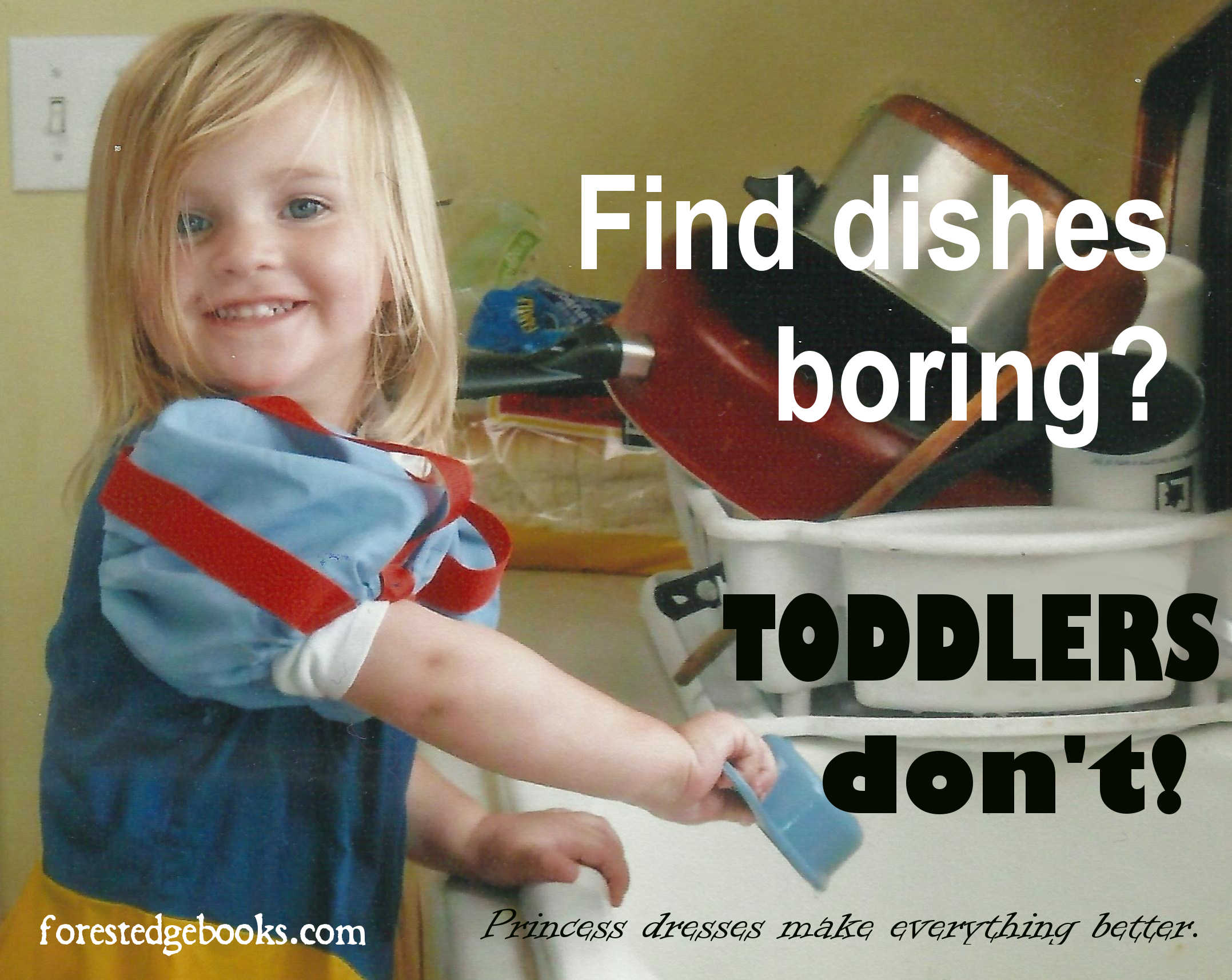
There’s no job too tedious that can’t turn terrifying when a toddler tries to help.

toddler quote

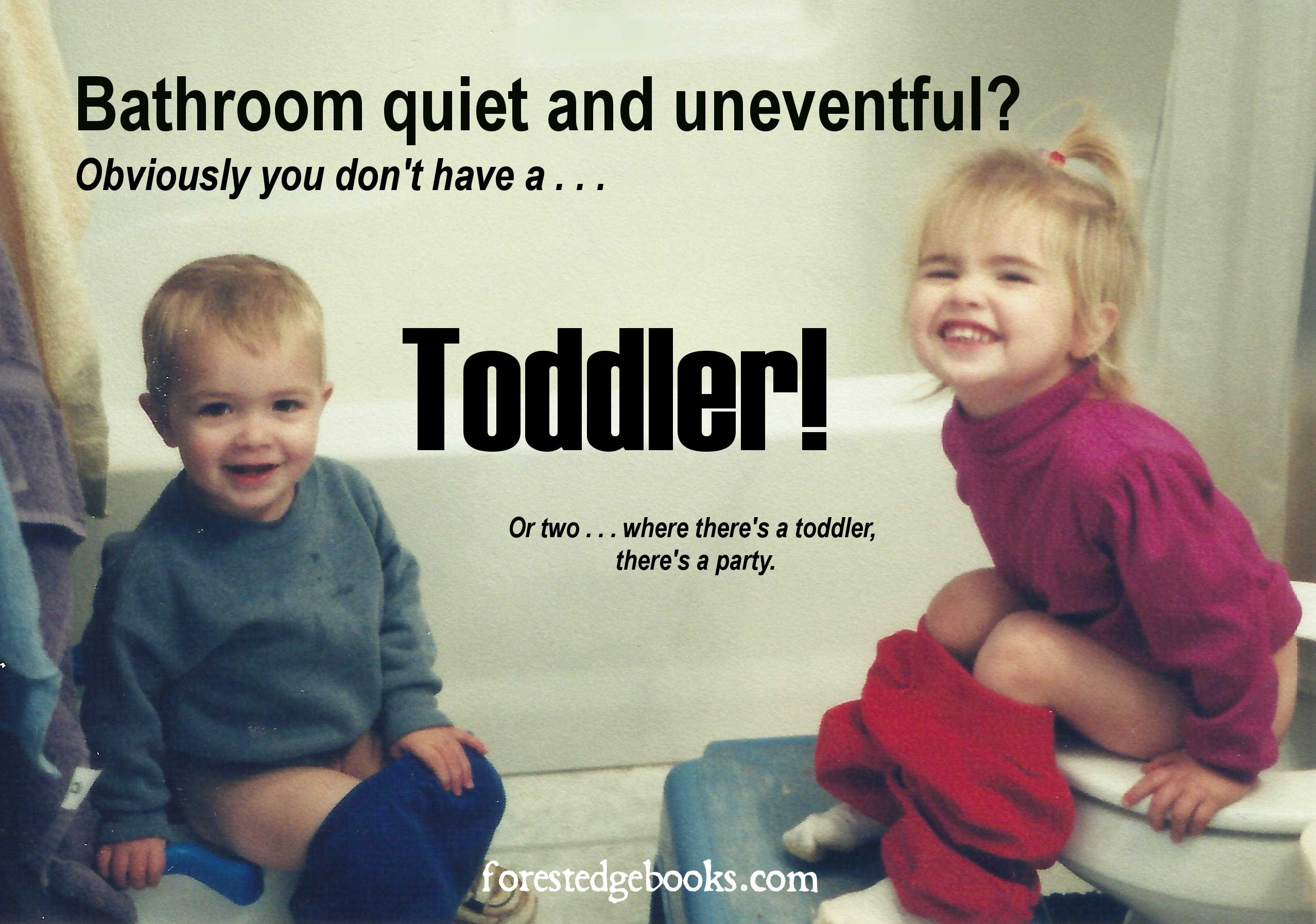
Nothing is as frightening as a toddler running with a pair of scissors . . . unless he’s running with a wet toilet plunger. And you know why it’s wet.

potty babies

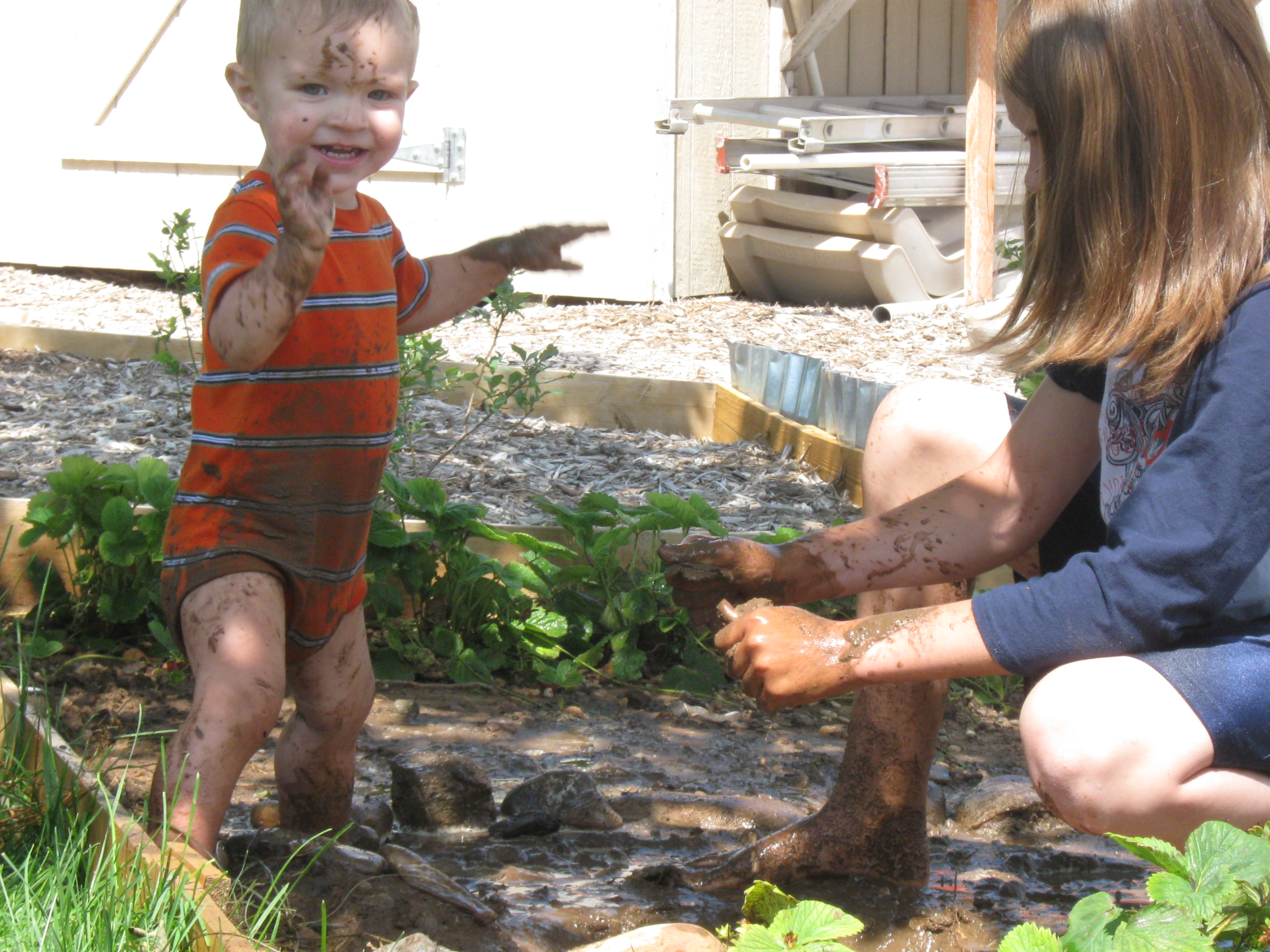
I’ve come to realize that toddlers are the true terrors of the world. Sweet, hilarious, and darling, they can turn any ordinary event into something unpredictable, and anything somewhat challenging into a true trial. (Think: tents and campfires and forests and Yellowstone National Park and . . . toddlers. My heart rate’s already up, and we’re not going until August.)

tess tractor

I call my current toddler “The Motivator.” If any of my older children are slow to get a job done, I release The Motivator. He can find the butcher knife in the open dishwasher in two seconds flat, can dump a laundry basket in three seconds, and what he’s able to accomplish with an overflowing garbage can in four seconds is Al Qaida worthy. When my kids see him coming, they know they better work FAST.

dalton cabinets

I should rent him out to those who think their lives are dull. After half an hour, they’ll be cured.

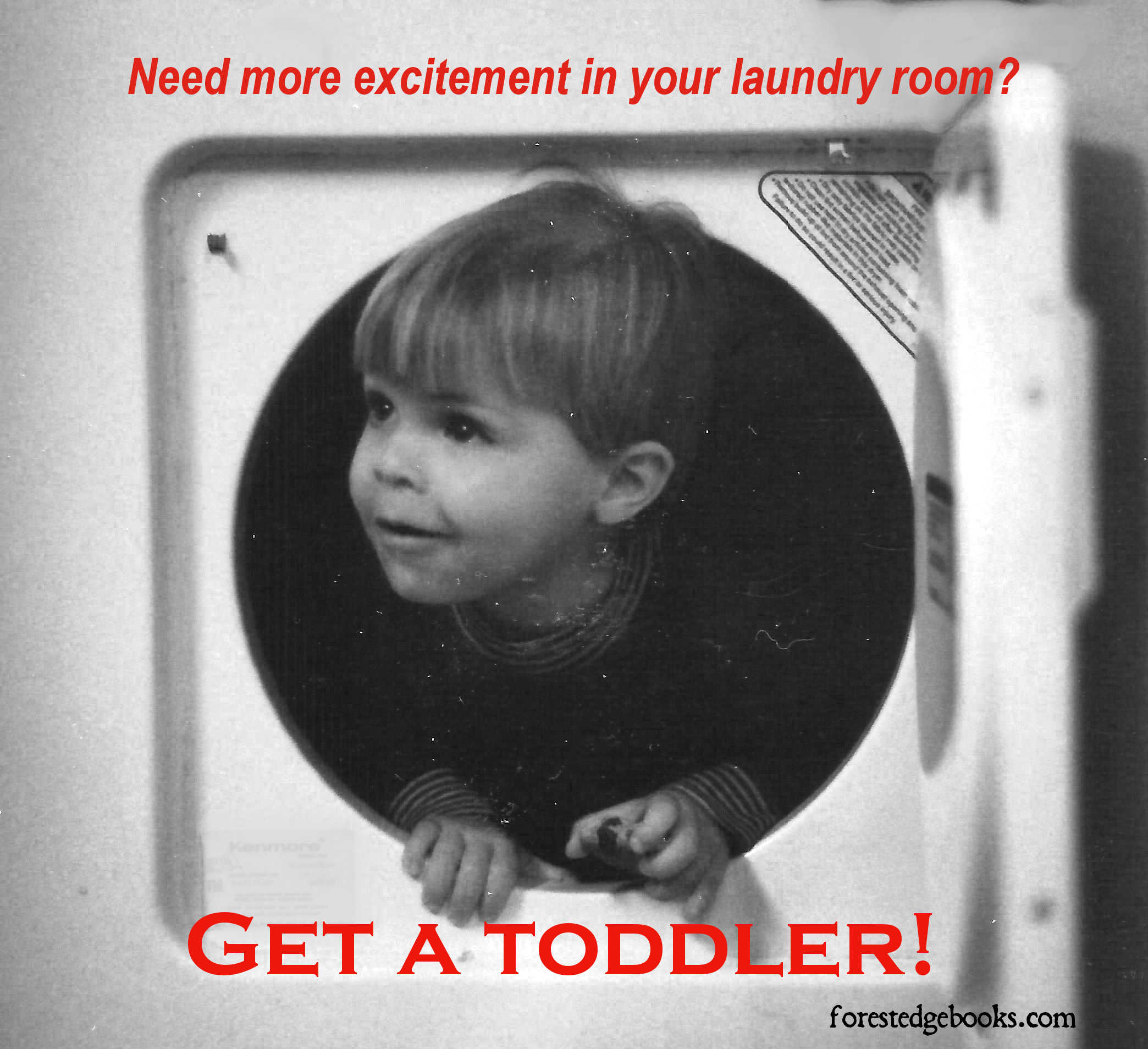
teagan dryer

Do you find replacing bathroom plumbing boring? I have a remedy for that. Painting a bedroom? Fixing the starter motor in your car? Reorganizing a cabinet? Simply sweeping the floor? Oh, I have the motivation to make all of those jobs far more exciting.

zoe dishes1

And if you have a kitty litter box, you’ll really wished you didn’t.

And if you have a sewing box, you won’t much longer.

bubba bath

I write a bit about toddlers in my book, and I visited memories of my own nine children as toddlers (my last is 18 months old) for realism, because as Utah’s Poet Laureate Lance E. Larsen has said, “Writing is often more a matter of collecting and eavesdropping than inventing.”  I discovered there’s no way I could “invent” toddlers. They’re just far too inexplicable.

dalton pretzel nose

I adore toddlers. They’re the most exciting, terrifying, adorable, terrifying, kissable, terrifying creatures on earth. That’s why I’ve taken so many pictures of them over the years, and why I say a prayer of thanks each time they drop off to sleep.