Boiling brownies and other hazards of life at sea level.

I’ve been living on the coast of Maine for 10 days now, and I’m utterly useless at functioning at sea level.

First, I can’t bake at 20 feet altitude. In the ten years that I’ve lived in the mountain west, I’ve redone all my recipes for altitudes of about 4700 feet.

Here’s my fantastic, greatest brownies at sea level:

2010-02-02 01.46.16

Yes, the butter is boiling. And they are “done.”

My daughter’s 8-year-old friend, born and bred in Maine, peered at the pan as I pulled it out of the oven and said innocently, “Why don’t you just make regular brownies?”

Thought I did, sweety.

My brain doesn’t know how to function this close to the ocean. Like a dull blanket tossed over my head, I’m heavy-brained and slow. It’s not the scenery, which is beautiful. In fact, it looks a great deal like my favorite place on earth: Yellowstone.

The photos above are from West Quoddy, Maine. (Which is actually east?)

But Yellowstone is about 8,000 feet above sea level. I’m a genius in Yellowstone! If I could live there for three months, I could solve every major world problem AND write the greatest American novel. I can THINK there!

But in Maine, I stare at the fridge trying to understand where the milk went until a child (a child under 10, mind you) points out that the gallons are in the door.

Heaven help me.

There have been studies that show people who move to high elevations, like Denver or Salt Lake City, often struggle. Lab rats demonstrate hypoxia, or lack of oxygen, which leads to depression.

I think a reverse happens for me, that my mind can’t handle this thick oxygen so it slogs aimlessly, trying to understand Maine.

For example, they make hot dogs this bright red . . . on purpose.Image result for maine red hot dog

I checked the label, and there’s not one but two red food dyes, so this is intentional. I’m sure there’s a perfectly reasonable explanation, but I can’t grasp it.

Another example: there are no screens in the windows in this house (or in most houses—yes, I’ve been peering at other people’s windows; I’m already getting a reputation around here). Insects here are very determined. Three evenings ago, I cracked opened a window in bathroom to vent it (no exhaust fan, which may have gone the route of the screens) and found in the morning a massive gathering of moths and bugs hovering around the bathroom light, plotting their new government.

In the mornings, I come at them with paper towels to reduce the invasion force before my kids see them massing and panic.

Tonight I’m sure they’ll have a caucus about how to combat the Evil Hand of Wiping that reduces their forces every morning.

Wait—maybe tonight I’ll remember to close that crack in the window before I go to bed.

Took me three days to realize that may be a viable solution.

I can’t function at sea level.

We’ve been blessed to have friends who tell us each day how life is like in Maine (see, Kim Smith? I mentioned you and Mike) and have kindly said, “Um, but this is how it is in Maine. You have to adjust.”

It’s not like it’s bad; it’s just not what I expect. For example, these flowers, lupines, grow everywhere wild in fantastic displays. I can’t fathom that. There are also very few dandelions. The lupines have eaten them. Brilliant.

2010-01-25 19.59.37

There are wild Labradors in the waters of Maine. Or maybe this was someone’s pet, I’m not sure.

2010-01-25 22.23.14

I’m not sure of anything here.

The town doesn’t pick up trash, but Tony will, once a week, if you call him. He pulls up on Thursdays with his truck and tosses our bags in the back for what destination, I don’t know. I’m just grateful. The stove runs on a propane tank, but the water heater is electric, and the toilet flushes upward to a septic tank and leach field about 20 feet up the hill above our house.

I can’t fathom physics here.

Depending upon the time of day, the water in the tidal river either flows up or down in front of my windows. My head spins trying to keep track of the tides. Sometimes the water is dead flat, reflecting everything perfectly like a lake.

I can’t figure out why.

People are very friendly, even though they drop their “r”s and remind me of Mr. Quint and his siblings on “Curious George,” which is comforting.

Image result for mr quint curious george

Thank you for being patient, Mainers, and for letting me call all of you Mr. Quint.

This meme will also work here. Replace Boston with Maine:

Image result for boston khakis meme

The small town parade on the Fourth of July, however, was just like our small town parades back in the west, with balloons and streamers on ATVs, and fire engines honking, and random pieces of candy tossed out of vehicles to friends along the roadside. A few hit us. Chocolate. Because it’s not 98 degrees outside, but only 73, they can throw chocolate. Brilliant. Some things have felt like home, I just need to keep finding those.

This, below, didn’t feel like home, but it was exciting: Eastport, Maine, on the Fourth of July with a navy destroyer behind us.

Displaying IMG_1079.JPG

I told my kids that while standing on that pier, we were further east than anyone else in the United States. That’s when my 17-year-old son, who didn’t even want to leave the van and stood in protest behind my husband taking the picture, said, “But Mom, there are about a dozen more people further east than us on this pier. They win.”

That’s my ray-of-sunshine child, my builder of confidence. He was absolutely right. And since it was overcast, I’m not even sure if we were east or not. I’m just making things up as I go along, as I’ve been doing ever since I got to Maine.

I didn’t get lost getting to the post office or the recycling center yesterday, so I take those as small victories.

And seeing as how I didn’t even realize it was Wednesday, the day I usually write my blog, until the day was nearly over (and why this posting is coming on Thursday), I’m gonna take every victory I can get until I figure out how to function at sea level.

It’s still June, right?
Move from Utah to Maine, Day 4–Welcome to the east, Kirtland, and our 29th anniversary

(Current location, Batavia, NY, a town in upstate New York which has at least four different ways to pronounce it and we’re probably still not saying it correctly.)

Something strange happened as I stepped out of our hotel this morning into the heavy, warm, humid air of Ohio. Memories rushed me, and it was as if I were for the first time in many years eating a dessert my grandmother had made me but I’d forgotten about. The mugginess, the trees, the farms, the gray air—suddenly I remembered all about living in Virginia for five years and thought, “Wait a minute—I LIKE this!”

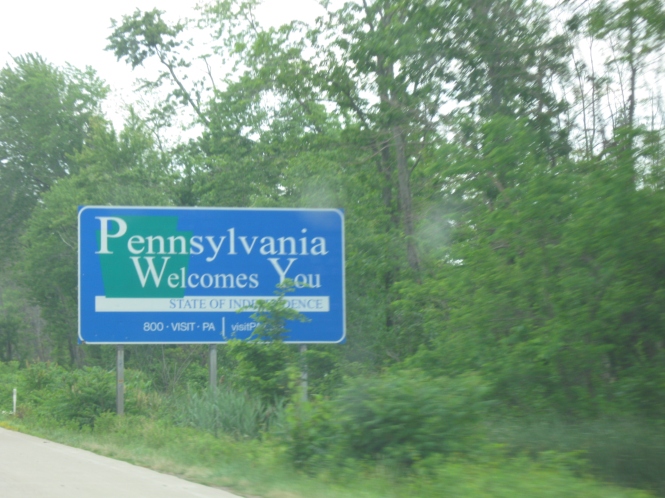
Driving through Ohio, Pennsylvania, and New York has felt like the states are welcoming me back (we’d visited here a few times over a decade ago), like they’re that friend you had in high school that you forgot all about until she friends you on Facebook, and you think, “Oh yeah! YOU! Oh, I forgot you! I’m so glad we’re together again!”

The east coast is my forgotten high school friend. Every mile I’m getting more excited to renew our friendship.

2010-01-20 02.05.11

Why yes, I do DO feel welcomed!

Shortly after this I heard my 5 and 9-year-olds in the back seat having the following conversation:

“Housebuilder and General Grievous want to come over to play.”

“Ok, but we have to move the silly putty and get out the magnifying glass.”

I just don’t know, I really don’t.

I have to put in a plug about my kids—my three oldest take turns driving and willingly take the younger ones to the restrooms, get them treats, and make sure no one’s missing. Everyone has tasks, and they are all good about retrieving the radios to be recharged, getting everyone’s bags and coolers into the hotel, and packing everything up again. This cart below will be packed to the top before it gets to the elevator:

2010-01-20 05.01.00

(Shortly after this, another woman used this trolley putting on it three small grocery bags. I nearly scoffed and said, “Lady, THAT’S not the way to use that trolley!”)

I don’t even have to deal with my 5-year-old at night because his 20-year-old brother takes care of him. I am incredibly grateful that they are all remaining good-natured, cheerful, and willing each day. They wake up on time, get themselves to the breakfast buffet (which is the BEST part of each day—all kinds of food that I didn’t have to make and that I don’t have to clean up!) then they make seating arrangements, my 18 and 20-year-old trading off driving the minivan depending upon who’s the least tired, my 17-year-old acts as servant to his siblings sitting behind us in the big van, and the 13-year-old is my husband’s navigator in the moving truck.

I thought today, on our 29th wedding anniversary, that my husband and I have been blessed with incredibly good kids, and that they are who they are not because of anything we’ve done raising them, but because they came to us that way. We don’t deserve any of it, I know.

I’m writing today from Batavia, NY, which isn’t too far away from Toledo, OH, and although Siri had us get on and off and on and off the freeway around Cleveland pointlessly (but we got lots of views of it, as you can see below), that’s not why we made so little progress.

2010-01-19 20.19.18

We took a detour to Kirtland, OH, for four hours where we visited the Mormon church sites where the early pioneers were in the 1830s and saw their store, houses, sawmill, and ashery.

(I had NO idea such a thing existed: burn ashes?! That’s like watering water!)

We then took a tour of the Kirtland Temple owned by the Community of Christ and heard the same history, but with different angles which proved to be excellent family discussion during lunch at yet another Wendy’s (although my 17 year old snuck in a Little Caesar’s pizza), comparing the different takes on the history.

2010-01-19 21.31.20

Twelve years ago we did the tour of the Kirtland Temple where the young tour guide pointed out only the architecture, but this time a preacher of the Church of Christ named Rick led the tour. He actually talked about the spiritual significance of the structure, and led our group of fourteen tourists in singing the first verse of “The Spirit of God Like a Fire is Burning.” That’s always been my favorite hymn, and I will never be able to forget the experience of our few out-of-tune voices singing it there in the room where it was first performed and where so many important and fantastic experiences occurred. It was all I could do to keep from tearing up. Our tone-deaf singing actually sounded good together, for probably the first and last time ever.

2010-01-19 23.59.59

We got into our hotel room at a decent hour (before 9 pm!) for once, and compared notes about if the pleasant toll booth worker was perhaps a different gender than they were dressed up to be. My husband now has foot cramps, and my sons are punching his feet to make them feel better. It’s not working, but still they valiantly try with even more punches. I’m doing a load of laundry now, enjoying the broken dryer which runs continuously without any coins needed, wondering what else I could throw in there just for fun.

Tomorrow we’re heading to Palmyra, NY for some touring and then on to New Hampshire, where I’ve always wanted to visit and always wanted to say this:

(Interesting note–that movie was actually filmed in Virginia where we used to live, so actually we WERE in the movie New Hampshire, not the real one. Actually, none of that was really interesting, so just never mind.)

What if we just quit bothering with the world? The easiness of essentialism.

What if, instead of worrying about the world and its expectations, we focused on only a couple of key items and let the rest of world just . . . go on its way?

Think about that: maybe there’s only a handful of things we really need to worry about, and as for the millions of other demands the world makes upon us we just ignore them.

Wouldn’t that be amazing?

My friend clued me into “Essentialism,” which redefines minimalism and suggests that we should “discern what is absolutely essential, then eliminate everything that is not.” Greg McKeon argues that we get too caught up in the non-essentials: “non-essentialism is this idea that everything has to be done and that you have to do it all. Everything is equally important so therefore I have to try to do it all. That’s an idea — if I can do it all, I can have it all.”

But what if we don’t bother with doing it all? Why would we want it all anyway?

What if we quit following every news outlet, every fashion, every new-and-latest thing, every competition and demand for our attention, and focus instead on only a few ESSENTIAL points?

We’d be a heckuva lot happier!

Consider how simpler life would be if we:

  • stopped fretting that our houses aren’t up to date (no, you don’t have to put shiplap on every wall),
  • that our kids aren’t excelling in every sport/musical instrument/dance/karate/theatrical production (freeing up afternoons and weekends),
  • that we’re not on top of every trend (anyone remember how fast Pokemon Go came and went? Men’s rompers will go the same way, so don’t give them another thought). 
  • And what if we let the world go on its way . . . without us?

I think about life in the 1800s, how people focused on survival, their immediate family and neighbors, their little communities, and had no idea what the gossip was on the other side of the state or the world. They could think about real things, urgent things, important things.

Whereas we think about silly, petty, and divisive things.

But we don’t have to. We can center our lives on very few priorities and shut out everything else.

So what would those priorities be? How about the only thing that really matters: developing Christlike attributes.

To become like Him is the main reason we’re on this earth, going through this trial of life to see what our hearts really want, and to see how we can become more like Him. And you know what? I’m thinking more and more that being like Christ is the best and only worry I need.

And that “worry” isn’t even a concern. Look what He said in Matthew 11:

 28 Come unto me, all ye that labor [to keep up with the demands of the world] and are heavy laden [with the world’s expectations], and I will give you rest [because we set that all aside].

29 Take my yoke upon you [and throw off what the world expects of you], and learn of me [instead of the world]; for I am meek and lowly in heart: and ye shall find rest unto your souls [because I teach the peaceable things of the kingdom].

30 For my yoke is easy [way easier than anything the world demands], and my burden is light [lighter than anything the world shoves upon you].

Matthew 11:28, We find rest in Christ

And that’s all there is to it.

People assume that because I have nine kids I’m constantly busy and harried. But the truth is–and sometimes I’m embarrassed to admit it–I’m not. Quite often I can spend hours each day in pursuits I enjoy–writing, reading, researching–because we don’t bother with the non-essentials.

My kids aren’t involved in many activities; we don’t run around endlessly every afternoon from one thing to another–I let them entertain themselves like some 1970s throwback mom. I don’t demand perfect grades from them (grades aren’t an indicator of future success anyway), but I let them push themselves, which they do.

My house isn’t spotless or trendy (I’ve got better things to do), I make simple meals for dinner, and, frankly, I’m pretty relaxed most of the time. I almost feel guilty about that . . . but then I decide I don’t need to bother with worldly guilt, either, and let the feeling go.

We take care of each other, study the gospel, go to church, play together, educate each other and . . . that’s about it. Easy.

I am, however, trying to increase the amount of time I spend on others, trying to find additional ways we can be of service, because that’s really the purpose of life: taking care of others as Christ did.

The apostle James put it in simple terms:

27 Pure religion and undefiled before God and the Father is this, To visit the fatherless and widows in their affliction [taking care of the vulnerable and needy around us], and to keep himself unspotted from the world [ignore the world].  ~ James 1:27

That’s it. Only two things, just like Christ said to the lawyer in Matthew 22:

37 Jesus said unto him, Thou shalt love the Lord thy God with all thy heart, and with all thy soul, and with all thy mind [not giving any of your heart, soul, or mind to the world which will treat you cruelly].

38 This is the first and great commandment [which will keep you unspotted and unburdened by the world].

39 And the second is like unto it, Thou shalt love thy neighbor as thyself [by taking care of the vulnerable and needy].

40 On these two commandments hang all the law and the prophets [and you need not bother about anything else].

Simple, sweet, and satisfying! (Unlike the world.)

We can do that. Anyone can do that.

And we should, because consider these words of Christ:

36 For what shall it profit a man, if he shall again the whole world [be accepted by it, follow its trends and demands religiously], and lose his own soul? [Worldliness kills the soul—simple as that.]  ~Mark 8:36

I’m not saying it’s easy to shut out the world. I’ve been working on doing that for quite some time now, trying to cut off more and more connections to it, especially through social media. Our family quit TV and radio some years ago (just getting rid of advertisements significantly increased peace in our lives). There are still many aspects I struggle with, and likely will my entire life. It’s hard to live in the world and not have some of it rub off on you, like trying to squeeze between muddy elephants without getting dirty.Image result for herd of muddy elephants

Purposely not doing what everyone else around you is can be a little disconcerting. Sometimes I suffer from FOMO: fear of missing out. But just because the crowd is insistent, just because you feel the need to be like everyone else, you don’t have to be. This image, which I ran across many years ago, has seared deeply into my soul. I want to be that guy.

Image result for man in crowd not heil hitler

I’m discovering that when I ask God how I can step further away from the world so that I can be closer to Him, He gives me ideas, nudges me away from distractions and gently prods me toward more important activities. He wants me and my family to be unspotted, and He wants to ease our burdens. I have full confidence that He can get us all the way where we need—and want—to be, because, awesomely, He’s already done it himself:

“These things I have spoken unto you, that in me ye might have peace [because haven’t you grown weary of keeping up with the world yet?]. In the world ye shall have tribulation: but be of good cheer; I have overcome the world [and so can you].”  ~John 16:3

     “You look so tired, Young Pere. So weary, my sweet boy. Did you ever have a day of peace in the world?”
     “No,” he sighed. “Not that I remember.”
     “Then isn’t it time to let go of the world?”
     ~Book 8 (Yes, there’s a book 8!)

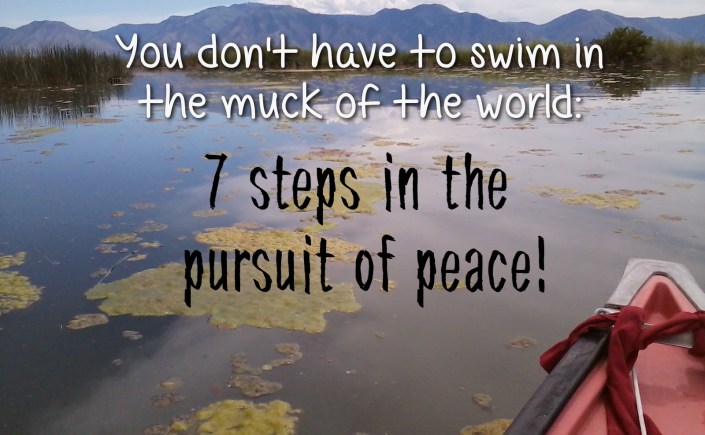
Don’t care what the world thinks: 7 steps in the pursuit of peace!

In a quest for a more peaceful existence (I really wish I could live in the world of Books 5 and 6 of my series), I’ve been eliminating that which causes undue stress. No, I’m not abandoning my house or nine children, but I’ve been thinking about my dad, how he was the most calm, pleasant, peaceful man I knew.

IMG_0529

My dad, Rudy Strebel, in 2007, holding a granddaughter.

Not that his life was easy—he suffered as a child in WWII Germany, then had a wife he dearly loved but who had frequent and violent bouts with PTSD from her traumatic life as a refugee. In their 50+ years of marriage, I never knew him to lose his temper with her but did his best to soothe her paranoia and terror, every time. And I can count on three fingers the amount of time he slightly raised his voice at me.

He chose to be peaceful, and he was also very careful as to what he let into his life. He didn’t read, watch, or listen to anything that could harm his spirit or drag him down.

He wasn’t ignorant of the world, but he purposely distanced himself  from it to remain unspotted as it splashed in filthy waters.

Lately I’ve been trying to pursue peace as he did, and have implemented ways to limit what weighs down my mind and soul. I’ve incorporated a number of minimalist ideas, and I’m finding greater calm in my life by doing the following:

  1. Unsubscribe! To those emails that entice you to see what’s on sale, what the latest thing is, what you “really don’t want to miss!”

Miss it anyway. Don’t be lured in, don’t be tricked into buying something simply because it’s a great deal, and don’t waste time reading what can’t elevate you. It’s all distracting, even just deleting it, having to swat it away like a pesky mosquito. Get rid of them altogether. I’ve been opening, scrolling down, and unsubscribing from dozens of emails–even from places where I still buy something once or twice a year–and my feeds are cleaner, sleeker, and calmer. All that remains now is that which is really important for me to consider.

2. Unfollow! Here’s an awesome feature on Facebook: stay friends, but stop seeing every little thing they do.

Image result for unfollow facebook

I’ve realized that I care only about my family (we have a secret group just for us), and some neighbors and friends who consistently demonstrate insight and humor–qualities I value.

The other hundreds of “friends”? I’ve unfollowed them. I can always check on them every few months if I feel the need (if I remember who they are).

In the meantime, I’ve cut out a mind-cluttering stream of whining, bragging, complaining, and comparing. It’s been like leaving junior high all over again–sweet relief!

Now I have a feed of primarily funny, inspiring, and heartfelt posts.

Twitter, Instagram, all those others? I don’t even go there, but you can also pare those down significantly to refine your life.

3. Tune out! I quit listening to the radio years ago and felt my blood pressure in the car normalize instantly. We never watch TV news, I skim the newspaper for only important news, and I’ve quit following nearly every online news outlet.

The result? The world keeps on churning but I don’t have to swim in that muck. I know what’s going on, but I observe only from a distance. Getting angry over the world doesn’t fix it. Stepping away from it, however, allows me to continue raising my family with peace of mind.

4. Ignore trends! Years ago, I quit following trends in home décor, clothing, and etc. by eliminating magazines and TV shows that told me what I had was out of date. How much more I love my house and wardrobe now that I’m not worried what the world thinks of it! And I’ve saved a lot of money, too.

And no one, ever, has said anything about me not being trendy enough. It’s like no one really cares.

5. Don’t participate! Like my dad, I’ve chosen to not listen to music that degrades or is “hard.” I listen to soundtracks and trailer albums instead. I read only books that satisfy and uplift; one summer, I sent back nearly a dozen library books after their first chapters because they were smutty, suggestive, or crude. I don’t watch rated-R movies or anything excessively violent, vulgar, or profane. All of that introduces anger and angst to my soul, qualities I’m purposely ushering out.

Yes, it’s sometimes hard to find something current to watch or read, but there are also a lot of classics out there waiting to be discovered. I’m also taking up my dad’s habit to read more biographies of truly great people, and more doctrinal works that teach me deeper about the nature of God.

6. Choose kindness! This one can be tough, especially for me because I inherited my mother’s cynical mind and tongue (when she was well, she was acerbic and hilarious). My father, however, while full of dad-jokes (he invented them all), was also unfailingly kind, even to his end. He suffered from Alzheimer’s, but the staff at his assisted living center said that while many in his condition became angry or violent, my dad never did. It was as if his mind had been choosing for so long to be kind that it simply didn’t understand rudeness.

Kindness softens the soul, and when I’m kind to people, especially strangers, sweet peace comes. As an introvert, I don’t like talking to people and tend to be abrupt with strangers, especially when I’m checking out with my groceries. I need this t-shirt:

Introverts t-shirt

But I’m trying harder to smile genuinely, thank sincerely, and respond to their questions with more than two-word answers.

I’m also trying to consider everyone with a kinder heart, and a more generous attitude. Even just thinking kindly brings peace.

7. Be quiet! No, not “kindly shut up,” but I mean, take time to be quiet and disconnect. Yesterday it was 85 degrees, so I took my 5-year-old son to a splash pad. I watched him for 45 minutes racing the sprays and screaming when the water went up his nose. He dried off for ten minutes and we watched a front-loader moving dirt the whole time, seeing how much dirt he dropped as he drove.

It was “quiet” in that I wasn’t listening to music, or playing on my phone, nor was I even reading. I was simply enjoying the water splashing, the boy yelling (happily), and the truck moving dirt. Purely peaceful, purely disconnected from the bigger world. I could focus on the most important part of the world, right in front of me. 

I am finding greater quiet and calm in my life in a world that’s increasingly not, and I’m always looking for new strategies. What works for you? How do you eliminate the world and its nonsense, and find peace and serenity instead?

“We don’t care about what the world thinks of us, Young Pere. You know that. We left it behind and have never regretted it.”

Peto realized there were many pure men and women, but they couldn’t exist in the polluted world.

~ Book 6, Flight of the Wounded Falcon      

I don’t understand why people like lighthouses and lobster boats—a plea for enlightenment!

In a few weeks I’m moving to the coast of Maine, and I have a problem. I don’t understand something vital to the culture: the appeal of lighthouses and lobster boats.

I need some serious education here because these are iconic symbols. But when I see a lighthouse I think, “What a rickety old building. I guess it’s clever to build it round, but why didn’t they build it into a square shape? And why is it still here?”

Image result for maryland lighthouses

Umm, ok. So it’s a round tower. Why should I like this?

I went through a lighthouse on the mid-Atlantic coast with some relatives a few years ago, and as we left the falling-apart, mildewy structure, I commented, “Someone should just knock this down and improve the view.”

You would have thought that I suggested cutting up the Declaration of Independence to use it as toilet paper.

That “ruining the view” attitude is also my problem when it comes to lobster boats. They’re rusty, look perpetually 60 years old, and get in the way of seeing the water and trees around. But there’s some romantic mystique that I’m missing, because people have photos and paintings of lobster boats everywhere, and some folks even decorate with buoys and lobster traps.

Image result for lobster boats in maine

I can’t see the scenery for the boats!

I feel like Ben Wyatt in “Parks and Rec,” discovering that everyone in Pawnee is enamored with a miniature horse named Lil’ Sebastian. But he doesn’t get it. “It’s just a small horse,” he points out, and everyone glares at him.

Image result for ben wyatt lil sebastian

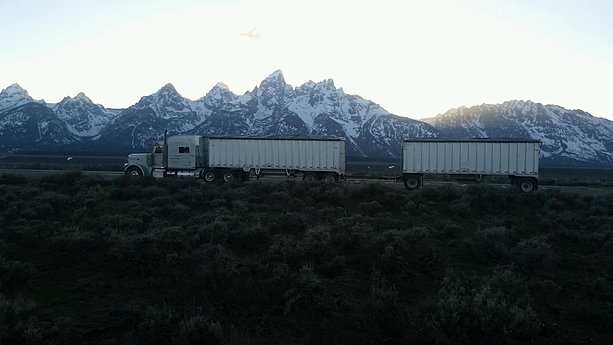
To me, the lobster boats would be like seeing a long-haul vehicle in front of the majestic Tetons. Get that vehicle out of the shot!

Image result for tetons long haul truck

Or visiting a lighthouse is like going to tour a motor home instead of looking at the Rocky Mountains behind it. Why are we looking at this?

Image result for mobile home rocky mountains

We value what our culture trains us to value, which is why I love the mountains and Yellowstone and the rugged, wild west. A relative from the east coast, however, once went through Yellowstone and came back with this shocking evaluation: “Three days of just bison, hot water, and no TV? I’ve had enough of that dullness to last me a lifetime.”

Oh! Blasphemy!

Then again, this was the person who took me through the lighthouse and thought it was the greatest thing for a hundred miles around.

And I thought it was . . . dull.

You can see that I have a problem—the coast isn’t my culture and I don’t yet know how to appreciate it. I’ve tried researching this, but the assumption is that everyone already knows why lighthouses and lobster boats are appealing.

I want to learn. My parents learned how to embrace their new culture of the wild west after they immigrated from Germany. They learned to love barbecues, pioneers, deserts, and even said “Howdy” on occasion, and meant it!

So I’m issuing a plea: Explain to me the charm, lore, and love of lighthouses and lobster boats. Why are they appealing? Why should I get excited when my dear husband says we’re going to visit them?

Teach me to love the culture of my new home.

If I’m doing the wrong thing, TELL ME!

English was my mother’s second language, and she had a good command of it except for one word: she pronounced “crazy” as if it began with a g—“grazy.”

As a teenager, that drove me grazy-crazy, and finally one day I told her that.

“What?!” she exclaimed. “I’ve been saying it wrong all these years, and NO ONE TOLD ME?”

“I didn’t want to hurt your feelings,” I said meekly.

“But I sounded like a fool in the meantime and looked like an idiot. You should have told me sooner!”

I’ve thought of her anger and humiliation (she was studying Shakespeare at the time, just for fun, and usually beat me in Scrabble) and realized that I didn’t do her any favors by not correcting her errors.

I’ve seen a spate of postings and blogs lately about “loving” people and not correcting them when they stumble, because that’s “judging.”

Love=good.

Judging=bad.

But what about correction?

When a child writes the letters in their name backwards, or a teen driver crosses the double yellow line, or they punch in 10 minutes instead of 1 minute on the microwave, we CORRECT them: show them the mistake and help them fix it. That’s not judging or condemnation or shaming. That’s HELPING them get things right.

If ever I’m on the wrong track with something—an idea, a philosophy, a belief—please, TELL ME!

Don’t let me wander off some literal or proverbial cliff because you’re worried about “offending me.” Maybe you’re wrong, maybe I’m wrong, but let’s get it figured out.

People are quick to pull out the “God loves me anyway” argument, in all its various forms, but conveniently forget this in Proverbs 3:

11 My son, despise not the chastening of the Lord; neither be weary of his correction:

12 For whom the Lord loveth he correcteth; even as a father the son in whom he delighteth.

Love=correction.

Here’s love in action:

Young Pere said to his grandmother, “How about, you love me enough to let me go?”

Mahrree stared at him before saying, slowly, “If I love you enough, I will allow you to do something that I believe is potentially damaging to your soul?”

“Yes.”

“Young Pere, you were more logical when you were eight! What kind of nonsense is that? If you love me enough. I love you enough! I love you so much that I’ll refuse to let you do such a thing without a better reason, even if you throw a fit and declare you’ll never speak to me again! That’s how much I love you, you ridiculous boy.” (Book 6, Flight of the Wounded Falcon)

Friends and family, love me enough to tell me when you think I’m making a mistake. Correct me, even if you think it may offend me.
How else will I know what the right thing is to do?

Because I want to avoid this:

Mahrree was worried about whose side she was really on. The only way someone could be “surprised” would be because they were sure they were on the Creator’s side, but weren’t.

What if they were already on the wrong side and didn’t recognize it?  (Book 2, Soldier at the Door)

By this same token, be warned that I will tell you if I think you’re doing the wrong thing.
You may become offended, that’s fine with me.
You may unfriend me. Again, that’s ok.
But I love you enough to tell you the hard truth, as I see it, to correct you if I worry you’re heading down the wrong lane.

I may be wrong (it’s happened quite frequently), but know that I will speak up because I don’t want you making bad choices, and I expect you to do the same for me.

I don’t want any of us to go grazy.

Why I want my kids to have “dirty” jobs

Currently, my 18-year-old daughter has the crappiest job in town.

She’s helping clean the filters at our town’s sewage treatment plant. She gets outfitted head to toe to plastic slickers, then helps in the once-every-four-years-task of scraping off the “cake” (it’s not really cake) from filters, runs the filters through a washer, and puts them together again. It’s monotonous but easy work, and it’s a good temp job at $12/hour, which is more than any other job in the valley for unskilled labor. And since she’s interested in processes, it’s giving her some insights as to if she wants to pursue engineering in college.

But it’s far from glamorous. In fact, she rushes home from work and takes a hot shower for 20 minutes. One afternoon she said, “I know I asked for spaghetti, but can we have something else for dinner?” I told her I was planning on ravioli, and she said, “Good, because today I learned what a parasite looks like, because I found one: long and red and wriggling, like spaghetti in sauce, come alive.”

I don’t think we’ll be having spaghetti for a very long time.

You may be thinking, “Why do you let her do this job?!”

Because I want all of my kids to have a dirty job at least once in their lives. Mike Rowe has commented extensively and beautifully on the merits of hard, filthy work, and here are my two cents’ worth: my daughter will, in her future, encounter nasty, vile things: family will get sick all over her, disasters will occur in her house or yard, and she will run headlong into manifestations of “Yuck!” that only she can resolve, because she’s the only capable adult around.

Life is revolting and disgusting, and we can’t run away from it. Being a grown-up means handling the hard stuff. And it helps to have some early practice in it.

I won’t detail the horrors I’ve had to mop up, but I knew I could do them because when I was a newlywed, my husband and I worked at a hospital in an east coast city. Back in the 1980s, this facility struggled to follow protocols, and there was contamination everywhere. (It was later temporarily shut down.) I discovered these messes the hard way when we were contracted to take out the trash while the regular trash guy had an extended vacation.

I never before realized how disgusting surgical trash can be. Nor will I ever forget the sound of wet, bloody bags splatting, and breaking, in labor and delivery. I think I wore a permanent wince for those weeks, and also rushed home to take very hot showers, especially when we encountered incorrectly disposed of “sharps.”

But because I endured that bloody crap (literally) I knew I could handle anything else adult life would throw at me.

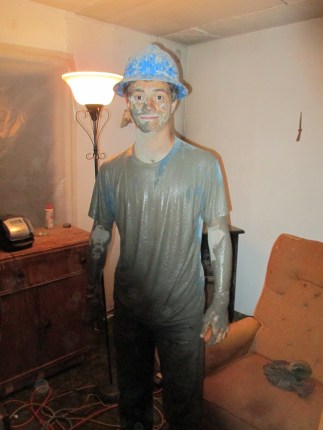
That’s why I let my two oldest sons work in the oil fields of North Dakota as roustabouts. They’ve been covered in oil, worked in weather -20 degrees below zero spraying salt water to clean rigs, labored in 90-degree weather climbing into slimy pipes, and lived to tell about it.

037

My second son learned on his first day at work as a roustabout to NOT take off the protective gear too early. The work’s not done until it’s COMPLETELY done.

In fact, nothing built in them more confidence, which they needed before joining the military or becoming LDS missionaries.

This is crucial confidence, not some fluffy, fake self-esteem too many teenagers and adults are laden with, but well-earned, struggled for, “Look at the work we’ve accomplished!” worthy kind of pride. They’ve learned at an early age that they can do hard things.

Which means they can do just about anything.

Everyone deserves to have those moments, to feel that sense of accomplishment of having done something necessary for society, something not everyone else would readily step up to do. I have to admit I’m proud of my kids not running home after the first difficult day on the job, whining that they never want to go back, although I’m sure they wanted to. Overwhelmed, I’m sure each wanted to quit their jobs, but they stuck with it, until they rose to the challenge.

Gordon B. Hinckley rightly said, “There is nothing in all the world so satisfying as a task well done. There is no reward so pleasing as that which comes with the mastery of a difficult problem.”

My oldest daughter spent a long, hot summer on the Utah-Arizona border digging up Native American artifacts in 110-degree heat, drinking gallon after gallon of water to keep hydrated as she shoveled for hours in the dirt. Weeks later she still found dust in her gear.

Image may contain: one or more people, child and outdoor

(In archaeology, the office is outside.)

My second daughter is in her final year for her bachelor’s of science in nursing, and there’s no dirtier work than nursing. She’s been covered head-to-toe in, well, everything, and when she becomes a labor-and-delivery nurse, it’ll only continue.

IMG_1712

(White scrubs don’t stay white.)

We have four more children who I also hope will have demanding and dirty experiences. We’ll be moving to the coast of Maine this summer, and already my husband is looking for lobstering jobs for our 16-year-old son and investigating what “seaweed harvesting” entails. Then there’s the blueberry harvest.

Hard, dirty work also puts all other kinds of work into perspective. Recently my nursing school daughter commented that her current lab analysis job, which is so monotonous that she can watch Netflix while doing it, is wearing on her because of its dullness. But it pays for college and, she was quick to add, “I remember working at scout camp making three meals a day for 300 scouts in a substandard kitchen with faulty equipment all summer. THAT was much worse and paid far less. No, this is a good job and I’ll continue it until I graduate.”

My oldest son, a former roustabout, works every morning cleaning a fast-food restaurant. It’s easy, comfortable indoor work, he says, compared to cleaning oil rigs outside in the winter.

You just can’t buy that can perspective for your children. They have to earn it on their own, and it’ll be theirs forever.

Nor can they learn respect in any other way for those who do these kinds of hard, dirty work ALL THE TIME. My sewer-working daughter loves to hear the stories of the men who work in the treatment plant, and they’ve shown her their clever solutions to problems when the “expert” engineers said their requests weren’t reasonable. They take great pride in their work, and she’s proud of them. My sons are still in awe of the men they worked with in the oil fields, who are still there, year after year, in all kinds of weather.

We’ve been trying to instill respect for work in our kids. Our youth are growing up in the laziest generation ever, with few jobs for kids under sixteen to do, and not a lot of options available for high schoolers, either, depending on where you live. Even lawn mowing jobs have been taken over in many areas by “lawn care professionals” with trucks and trailers and expensive equipment.

It’s up to parents to point out important work happening all around us and teach kids to appreciate labor and how it benefits us.

Recently our furnace died, and two men came to install a new one. My five-year-old watched in rapt fascination as they maneuvered the old furnace up the stairs, brought down the new one, then cut and pounded and made quite a ruckus to get the new one into position. My son whispered reverently to me, after the noisiest work was over, “That was cool!” I told him I agreed, and that he could train to do that kind of noisy work when he grows up, too. He was delighted.

When the power went out this past winter, it was during the coldest days we’ve experienced in decades. After a few chilly hours, the power was restored and I checked online to see what had happened. In local social media circles, there were predictable complaints from disgruntled customers. I told my thirteen-year-old about that, and before I could comment, he said what I was thinking: “But it’s -15 degrees outside and windy! Those guys must have been freezing trying to fix the frozen lines. I bet none of those complainers had any idea how hard the job was, and they just sat at home wearing extra sweaters.”

I’d never been so proud of my son for appreciating the hard work of others in terrible conditions. I’d be even prouder if one day he did that same kind of work.

Nearly every work is worthy work (drug dealing, prostitution, and like excepted). There is no such thing as a too-lowly job. Every time I had a baby, I made a point of thanking the lady taking out my trash because I remembered doing her job.

Everyone who works deserves respect. I had an older relative who was notoriously rude to service workers of all kinds, until her own niece began working fast food. After watching the frenetic hustle of a lunch rush, my relative realized she could never do such laborious work simply because she didn’t have the stamina, and she began to be more civil to every worker she encountered.

One year, just a couple years ago, I worked as a “washing tech,” meaning that I sorted, washed, dried, and folded laundry for a large facility. Both my husband and I were underemployed at the time and were taking whatever work offered to us. As dirty work goes, it was relatively clean.

A couple of friends commented to me that they were shocked that someone with my degrees and experience was “only” doing laundry. I told them that while it was “only” $9/hour, no other jobs had presented themselves, and we had bills to pay and children to feed. It was good work, my arms became stronger, and I learned that I’m really lazy about getting our clothes clean at home. (I still am, but I’m much better at folding now.) I was grateful for the opportunity, and also glad that my kids could see that work is work, that you take what you can get because any kind of work is more ennobling than sitting around doing nothing and waiting for handouts. 

Hinckley also said, “It is work that spells the difference in the life of a man or woman. It is stretching our minds and utilizing the skills of our hands that lifts us from the stagnation of mediocrity.” (“Articles of Belief,” Bonneville International Corporation Management Seminar, Feb. 10, 1991).

My third daughter with the crappiest job may not wholly believe this yet. When she comes home from the sewer treatment plant each day, I remind her (after her shower) that nothing will be too gross after this experience. She shrugs and says, “I hope not.”

But I already know she’ll be pulling memories from this job for decades to come. That she’ll remember how more than once something brown flicked onto her unprotected face, and that she did not die from it. That she learned what real, solid work looks like, and that after this, everything will be a piece of cake.

(Umm, the real kind of cake, not the “sewer cake.” Maybe.)

He lay in his cot, tired but not as exhausted as the other new recruits. There was something to say for having been raised on an orchard and cattle ranch. He knew how to work and it showed. He completed every physical requirement in near record time while the other flabbier, weaker young men stumbled and flailed.

~Book 6, Flight of the Wounded Falcon, coming later this month!


Book 6 Cover: Flight of the Wounded Falcon, coming in May!

A few tweaks and edits still need to occur, and the back cover needs some adjusting, but I simply couldn’t wait any longer to show you the cover!

Book 6 front cover

Finding a model stand-in for an older Perrin Shin was, I was sure, going to be difficult. I needed a tall man with whitening hair and a presence.  I mentioned my quest to my oldest daughter, and Madison immediately begin sending me links to professors she’s worked with during her undergrad and graduate school years at Brigham Young University in Provo, Utah. I felt quite awkward “analyzing” these professors for Perrin-like qualities, as if on some kind of bizarre dating ritual. (I apologized in my head to their wives, and to my own husband, as I carefully scrutinized each candidate who had no idea he was part of this evaluation.)

Among the profiles was Dr. David Crandall. In fact, he was the first recommendation that my daughter blurted out. Madison has been his head TA for some years now, and when I saw his picture, I gasped.

Perrin Shin is an Oxford-trained anthropologist?!

I asked Madison what he’d think about standing in as a model, and she said, “He lives among the Himba in Africa every summer. You’re not going to find a more chill man anywhere. I’m sure he’ll do it!”

So I wrote an email, then rewrote it and rewrote it, a lengthy message trying to explain to him the book series, the character, what I hoped he’d be willing to do (dress up, walk around in trees, wrangle little boys), and I sent it off, holding my breath.

My daughter asked to see my email after the fact, and then she sighed. “Mom, he’ll read only the top line and skim the rest. He’s a busy man!”

But I’d already sent it, had oversold it, and my doom was sealed.

Until he responded a couple days later with, “Sure, why not? When?”

Uh . . . ok! I made costumes, I checked calendars for travel (I don’t exactly live near BYU), and found an afternoon he was available.

On the day of the photo shoot I became anxious and nervous, and during the two-hour drive I kept thinking, I’m asking a grown man–a stranger–to dress up so I can take pictures of him. Who does this sort of thing?! I don’t always do well with real live people. But I couldn’t back out now, as my teenage son frequently reminded me in the car when I’d start to hyperventilate again.

My entourage and I met him at the duck pond on BYU campus, where mature trees grow up a hillside. Dr. Crandall smiled amiably—yep, very Perrin-like—and strolled over to greet Madison, his right-hand woman in managing his dozen freshmen courses and teaching assistants. Intimidated by his height and presence, and that I was about to order him to do my bidding, I handed him the shirt I wanted him to wear. He put it on, looked around cheerfully, and said, “Now, what exactly are we doing again?”

I nearly snorted. Madison was right—he hadn’t read my explanations (there had been follow-up emails where I wrote him short stories, and he responded with a short sentence). I was struck by the notion that he didn’t have time to read my emails, but because he appreciated my daughter’s work, he willingly gave up half an hour to help Madison’s mother with whatever she was up to.

Feeling flustered as I always am when I try to tell people what I do (I’m horrible at marketing myself), I gave him the exceptionally condensed version of the Forest at the Edge series, and explained the set-up for the shots we’d be taking.

He nodded benignly and said, “All right, tell me where to walk.” He was so laid-back, so easy-going, I could have led him into Hades and I think he would have merely looked around and said, “Interesting architecture.”

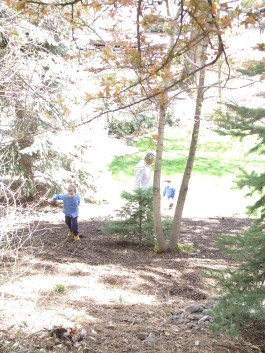
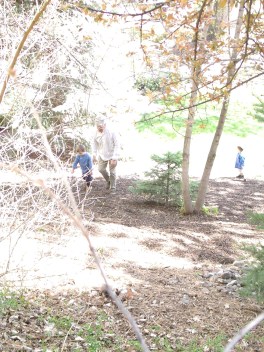
Instead, I did the next worst thing: I released upon him a five-year-old and a two-year-old. Then I said, “Just try to walk with them, while I go far, far away up this hillside and take pictures. Boys, stay with Dr. Crandall,” knowing full well that wasn’t going to happen.

For the next half hour Dr. Crandall gamely tried to keep up with, drag along, or find the two preschoolers as they wandered off, got distracted, or got excited. [When you read the book, you’ll see how fitting the whole scenario was.]

GEDSC DIGITAL CAMERA

“Dr. Crandall, we’re losing one . . .”

GEDSC DIGITAL CAMERA

“Now we’ve lost the other one . . .”

In the meantime, my son-in-law Austin Pearce and I took photo after photo, hoping that something might work since we’re not experienced action-shot photographers.

Eventually, we decided we had enough shots. Dr. Crandall took off the shirt I gave him and said, teasingly, “And a star is born! Good luck with your book.”

“I’ll let you know how it goes,” I said bashfully. “It’s part of a series. Umm, I’ve got a couple of readers. Actually, the series has been downloaded about thirty thousand times, so yeah—you just might become famous!”

See how I’m such a goober with real, live people? This is why I write, so I can hide behind a computer and not face anyone and babble goofily at them. In his field, Dr. Crandall is already famous. (His own book, The Place of Stunted Ironwood Trees is cited in this recent article.)

Once I looked at the pictures on my laptop, none were what I was hoping for. Initially I had hoped to capture profiles or sharp, distant images of Dr. Crandall, nothing too close or detailed, because I want readers to picture the characters as they wish, without cover art over-influencing or taking too much away. But none of those shots had worked.

Slightly discouraged, I remembered that none of my book covers have been what I originally wanted, but have turned out in surprising ways. I began to fiddle with half a dozen photos, when this emerged.

Book 6 front cover

And suddenly, it was perfect. Dr. Crandall gripping the two-year-old’s hand while earnestly watching the steep terrain he was leading him up (does he have perfect hair or what?), the curious/cautious expression on the littlest boy’s face, the other boy working to maintain balance—suddenly it was representative of many aspects of Flight of the Wounded Falcon, metaphorical bits I hadn’t anticipated but were manifesting subtly, and I knew I had my cover. The trees, the background, the angles, the motion—I never would have been able to stage that purposely.

I contacted Dr. Crandall’s secretary recently so that I could send him a thank you gift, and found out that he’s already in Africa again, hanging out with the Himba and a bunch of students for the summer. How chill is that? (Did I use that word “chill” properly? Shows how un-chill I am. Is “un-chill” a word?)

So chill, my friends–Book 6 will be coming soon in May (after a few more tweaks, a few more edits, and a proof or two). I can hardly wait to share it with you.


Book 6 teaser–What do you find entertaining?

Just as you can learn a lot about a person by what they laugh at, so too can you understand their character by what entertains them.

What one watches, reads, puts up on their walls, and pours into their minds will tell you a lot more about someone than what comes out of their mouth.

book 6 world's entertainment

(I can’t help myself–the first thing I do when I walk into someone’s house is evaluate the art on the walls and glance at the titles on the bookshelf, if there is one.)

The Internet Civility Award (TICA): Who will you award it to?

The other day something astonishing happened on my Facebook page.
Friend #1 posted his feelings about government spending, and Friend #2 chimed in with an opposing viewpoint.
Friend #1 presented more evidence.
Friend #2 countered and began to escalate.
This is the astonishing part: Friend #1 explained his beliefs, then APOLOGIZED if he stepped on Friend #2’s toes.
Even weirder, Friend #2 responded by saying no apology was necessary and that SHE was sorry for getting emotional.

AND THAT WAS IT. CIVILITY! Kindness! Respect!
They remained friends, and everyone went merrily on.

I, however, messaged both of them and told them I believed they each earned The Internet Civility Award (TICA). Since there wasn’t one yet, I couldn’t give it. But here it is now. (Yes, I just made this up.)

TICA The Internet Civility Award

Copy and paste this on anyone’s social media page to recognize them for kindness and respect.

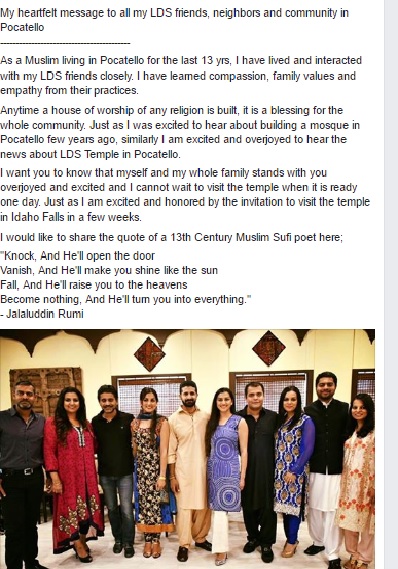
I’ve written about civility before, but lately I’ve been watching for it, and it’s out there. For example, the LDS Church (Mormons) recently announced plans to build a temple in Pocatello, ID, and a Muslim family who lives there posted publicly on Facebook that they were happy for their LDS friends.

Muslims and Mormons

CIVILITY! Kindness! Respect!

In looking for examples of civility to share with my children, we recently became addicted to “The Great British Baking Show,” not because we’re any good at baking, but because we love watching the contestants. It’s a competition, with each week a Star Baker identified, and someone sent home.

The amazing thing is watching these contestants HELP each other, GIVE each other advice, and when one of them wins, they CHEER their fellow competitor. And when someone gets sent home, they WEEP genuine tears for their loss.

Image result for the great british baking show hugging  Image result for the great british baking show hugging

CIVILITY! Kindness! Respect!

I realized the need to point out good behavior to my children during last year’s presidential election. My kids read over my shoulder when I’m on Facebook, looking for movie trailers and videos of screaming goats. My 9-year-old was stunned to see the posts of supposedly “mature” adults she knew, calling candidates names and behaving very uncivilly.

My 4th grader said, “That person’s a GROWN-UP! Why isn’t he acting like one?”

That great question led to a discussion about kindness and respect for all people, if we like them or not. Everyone deserves kindness. Everyone.

She agreed with me that we should unfollow this person, along with a few others, who didn’t demonstrate “grown-up” behavior online.

But I want to reward those who act like mature and civil adults (even if they’re still kids), so I will be awarding TICA  TICA The Internet Civility Awardto those who demonstrate excellent behavior in the face of rudeness, intolerance, and anger, and I’d love for you to join me.

When you see someone approach a conflict with grace and dignity, with kindness and respect, paste this image to them and let the world know that here’s a person who still knows how to behave.

TICA The Internet Civility Award

Maybe if we point out civil behavior more often, more of it might occur.

“That’s the way to respond! With respect like that, you’re already two weeks ahead of everyone else.”

~Book 6, The Flight of the Wounded Falcon, coming May 2017