Why I made all my books free (and title release for book 5!)

If you go to Amazon/Smashwords/and-the-like you’ll see that my four books are now all available as FREE DOWNLOADS, and this is a PERMANENT change. (The paperbacks still cost money, because I’m unable to give those away, but I adjusted the prices so that I make nothing from them. Literally nothing.)

Why the heck did I do that?!

Because I felt, intensely and undeniably, that I should.
Because as I’ve stated elsewhere in my blog that I didn’t come up with this story; it was gifted to me.
Because when you’ve been given a gift, freely, you don’t then go around charging other people for it.

I’ve spent thousands of hours trying to improve these “gifts,” these stories. I started the series five years ago and spend an unconscionable amount of time developing them to the point that they’re just this side of readable. And while it’s been an enormous undertaking–I’ve never worked harder or longer on any other project besides motherhood–I’ve enjoyed it immensely, and felt incredibly blessed.
It’s been my therapy, when my sister and parents were ill and dying.
It’s been my escape, when we were severely underemployed and struggling.
It’s been my motivation to study deeply some theories, philosophy, and writings I normally wouldn’t.

It’s been a complete joy, a pure blessing. A true gift from God.

And I need to give that gift away.

It’s not like I ever made big bucks from this series anyway. I barely paid off my computer from the proceeds one year.

But something I read just the other day affirmed what I’ve been feeling for a long time now. Those words come from the Book of Mormon (yes, I’m a Mormon–a practicing Christian, as I’ve confessed before). When I read the following in my studies the other day, I felt a cosmic slap upside the head:

 29 He commandeth that there shall be no priestcrafts; for, behold, priestcrafts are that men preach and set themselves up for a light unto the world, that they may get gain and praise of the world; but they seek not the welfare of Zion.

 30 Behold, the Lord hath forbidden this thing;  . . .

 31 But the laborer in Zion shall labor for Zion; for if they labor for money they shall perish.

~2 Nephi 26: 29-31 (emphasis added)

As I’ve stated here in my bio, I believe in the concept of Zion—a group of people that are of one heart and one mind, where individuals choose (unlike socialism and communism) to share all things freely so that there are no poor among them, and are focused on improving their minds and increasing their knowledge, not their possessions. And I also believe creating this kind of society is doable in our future.

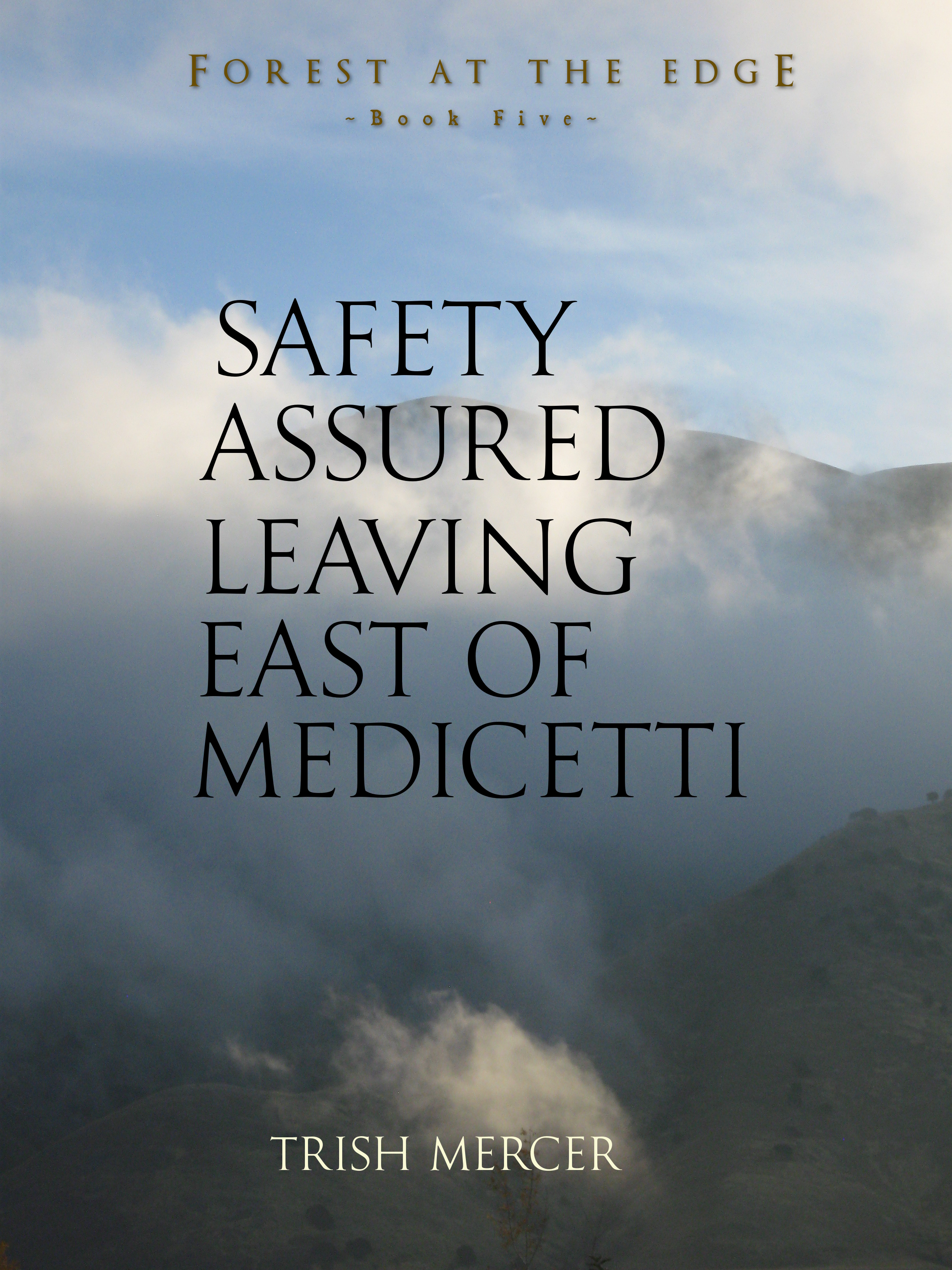
That’s why I’m writing. That’s why I’m so excited–and anxious–to get out Book 5, titled Safety Assured Leaving East of Medicetti (the enigmatic nature of the title is explained in the book; here’s a hint–it’s a code). I still hope to release in Spring of 2016. I had planned all along to make Book 5 permanently free, and held on to the idea that I can make a buck-fifty on the other books, no problem.

No. No, I need to be as open with all of my books.

Safety Assured book 5 PreCover

This isn’t the OFFICIAL cover yet. But this was the magnificent sunrise only this morning, and I realized it’d be a perfect background for Book 5 in the meantime.

To be honest, I was hoping to make some money because we’re crushed by an enormous student loan debt which we have no hope of paying off. I should be a brain surgeon with a debt like that. (Fortunately for all people requiring surgery, I’m not.)

But I’ve decided to have faith that if/when God wants me to pay off that debt, He’ll provide us with the right opportunities. Selling the inspiration He’s given me is NOT the way, however.

I have three other books kicking around in my head completely unrelated to Forest at the Edge, and maybe through one or all of those we’ll finally come into the money that will allow us to get out of the debt.

So today I happily announce that my series–which people either LOVE! or HATE! based upon the feedback I’ve been getting online and privately–will always be permanently free.

Enjoy! (Or bash, whatever.)

Do writers have agendas? Well, duh . . .

Recently I was accused of having “an agenda” in my books.

My very mature response to that was, “Well, DUH!”

Writers ALWAYS write with an agenda—a purpose. It’s WHY we write!

If you ever took a composition course in college, the first chapter in the textbook is all about “Writing With Purpose.” If you hated your English 1010 course, it was because you didn’t care; you didn’t want to write, you just wanted a grade.

But writers? We care. A LOT. That’s why we write. We don’t care about a grade; we care about getting out the word.

So when I was accused of having “an agenda,” I scratched my head a bit and thought, “Well, yeah!”

Doesn’t everyone?

Suzanne Collins didn’t crank The Hunger Games during a weekend because she was bored.
J.K. Rolling didn’t handwrite the Harry Potter series only because she was out of work and had nothing better to do.
E. L. James didn’t write 50 Shades of Grey because . . . You know, I really don’t want to go there. Scratch that.

My point is, EVERYONE who writes, creates, composes, produces, directs, sings—whatever, EVERYONE has an agenda. Creating art—especially a book series—takes months, but more likely years. We don’t do it because it’s only for fun. We do it because we want to make A STATEMENT.

Subtle or obvious; outrageous or timid; traditional or unconventional. I don’t care what writers or artists may say, we ALL have an agenda behind our work, which is the impetus that shoves us to create. writer agenda

You may not like certain entertainment because that “agenda” or “statement” doesn’t fit your mindset. I personally don’t like horror movies, hard rock music, or romance novels. None of them fit my mindset. But that doesn’t mean they’re wrong. They’re just not my cup of cocoa (because I don’t like tea, either).

Which leads to the next puzzler about my critic: they didn’t like my “agenda” for one of my characters. This character is a young woman who rejects an overbearing potential suitor in order to spend time with a young man she admires. They work together, they  fall in love, and they get married. They continue to work side-by-side in their business, and are thrilled when they discover they are expecting a baby.

Yeah, brutal stuff.

The critic stated that this wasn’t something they’d want their daughter to read.

Uh-huh.

Still scratching my head about that one.

For the world these characters inhabit, their behavior is completely acceptable and timely. [WARNING–POTENTIAL SPOILERS AHEAD!] If my agenda-fearing-complainer is worried that the characters are young, the character’s parents were 28 years old when they married. It’s all balanced.

  • But maybe it’s because the young woman is still a teenager, but a very mature one who cares nothing about the world’s trends and fashions, but has been through hardship, knows her mind, and demonstrates that quite well.  (How many teenage girls in our world fit this description? Not enough, yet.)
  • Maybe it’s because her belief in the Creator, and her devotion to The Writings, help her deal with the disappointments she’s experienced. (God? Scriptures? In a novel? Isn’t that illegal or something?)
  • Maybe it’s because she, with her love interest, runs a farm and dairy which, again in the culture of the book, is a respectable and important job.  (I kind of thought growing food was a noble occupation in our world as well, but maybe not?)
  • Maybe it’s because the idea of having children makes her happy, because in the book’s culture women are allowed only two children and they are treasured. (Believe it or not, there are still people in our world who want to have babies, and nothing’s “wrong” with them.)

Really, all of THIS is “an agenda”?

Love and marriage and family and religion and working together are all somehow . . . wrong?

Well then, yes: I have an agenda. As I’ve stated before (especially here), I believe in love.
I believe in marriage between a man and a woman.
I believe in growing together as a family, in having children, in working and learning together.
I believe all these things are good and important, and I’m not going to apologize or back down.

Instead, I sit here shaking my head in astonishment that the world has gotten to a point that I have to defend such a radical way of life. And I always will, trust me.

In the meantime, here’s an abbreviated passage from late in Book 4, The Falcon in the Barn, which was likely deemed so offensive. (I’ve tried to eliminate spoilers, leaving instead only “hinters”.)

“I guess I’m just surprised,” Mahrree murmured as another two women whose children she used to teach took a circular route around her. “This has always been such a nice village—”

“A nice village?!” Jaytsy nearly wailed.

A dozen people trying to get around them moved even faster.

Mahrree stared at her daughter in surprise.

“A nice village!” Jaytsy announced sarcastically, glaring at a few more dozen who stopped in their tracks to see what Shin was erupting this time.

“That’s what my mother just declared: Edge has always been such a nice village. And I wonder,” Jaytsy said, her voice booming as far as her father’s as she addressed everyone who had ears, “exactly what village is Mahrree Shin remembering?”

People leaked out of market fronts to cluster in whispering groups.

Now Mahrree knew how her family must have felt when she stood up at the amphitheater: complete dread.

“Jaytsy, I really don’t think—”

Mrs. Briter gently but firmly brushed her mother’s hand away. “Surely Mahrree Shin remembers this village before it turned on itself to steal goods from those who died from the pox! Surely she remembers a village that appreciated its commander—”

Mahrree bit her lower lip and took a step back from her daughter. She’d seen that look before, in Perrin’s face. Jaytsy Shin Briter had something to say, and everyone was going to hear it.

Mahrree hadn’t realized before how much Jaytsy favored Perrin. Her dark brown eyes were wide with fury and her voice developed an authoritative quality that insisted everyone stop what they were doing and listen. Jaytsy carried the blood of the greatest officers the world had ever seen. Couple that with the fact that the generals’ descendant was also in the throes of expecting a baby, and it was a very dangerous combination indeed.

Mahrree took another protective step back. “Oh, dear . . .”

“—A commander who, on more occasions than you will ever know, put his life on the line to defend each one of you!” Jaytsy bellowed to the rapt and growing audience.

A few women broke away from the crowd and trotted purposefully down an alley.

Mahrree noticed, but Jaytsy didn’t, or she didn’t care.

“And this is how you repay the Shins for their years of sacrifice and dedication? By ignoring them? . . . A nice village? I’m looking but I’m just   . . . not . . . seeing . . . it!

Mahrree’s fists were clutched near her face in nervous fascination. . . . [As Jaytsy continued her rant, Mahrree kept] an eye on the growing crowd that was stunned silent. Villagers had subtly rearranged themselves, men in some groups, women in others. A few more women had slinked away and now Mahrree saw why: Chief Barnie was being reluctantly led to the market by a gaggle of outraged women. . . .

“Jaytsy, well said,” Mahrree hinted. “I think you’re done—”

Mrs. Briter’s chest heaved furiously as she turned her glare on Chief Barnie. Two women were pushing him into the open space, and his stuttering steps made it obvious he would rather have been anywhere else in the world right then.

“Mrs. Briter?” He cleared his throat and firmed his stance.

Jaytsy folded her arms defiantly in a Perrin-like manner, and Mahrree massaged her cheeks. If she weren’t so worried as to what might happen next she would’ve been bursting with pride.

“Yes?” Jaytsy said with so much malice that Mahrree marveled how Barnie still stood erect.

“Do we have a problem?” Barnie timidly asked.

“She’s debating!” a woman shouted from the concealing safety of the crowd. “There’s laws against that!”

Mahrree watched her daughter, praying her response would be appropriate.

Jaytsy’s hands moved to her hips. “A debate?” she shouted. “Barnie, do you see anyone challenging me? Talking back?”

The crowd couldn’t get any flatter as Barnie obediently glanced around. He shook his head.

“That’s right. Two people are needed for a debate. I’m just . . . delivering a free history lesson!”

That did it. Mahrree couldn’t hold it in anymore. She burst into a grin which she quickly covered with her hand.

None of the villagers dared move a muscle. Even the angry knot of women glanced at each other hoping one of them could think of what to say next.

“Now,” Jaytsy began as she bent down to pick up her bread bag from the ground. She didn’t move like an expecting woman but more like a general retrieving his dropped sword. “My mother and I will be shopping here twice a week when the shops open, and if anyone here has a problem with that, I suggest you arrive after we leave. Mother? We need to start dinner.”

DISCLAIMER~ This very offensive, agenda-laden excerpt is from Book 4, The Falcon in the Barn. Read at your own risk.

We’re wasting ourselves

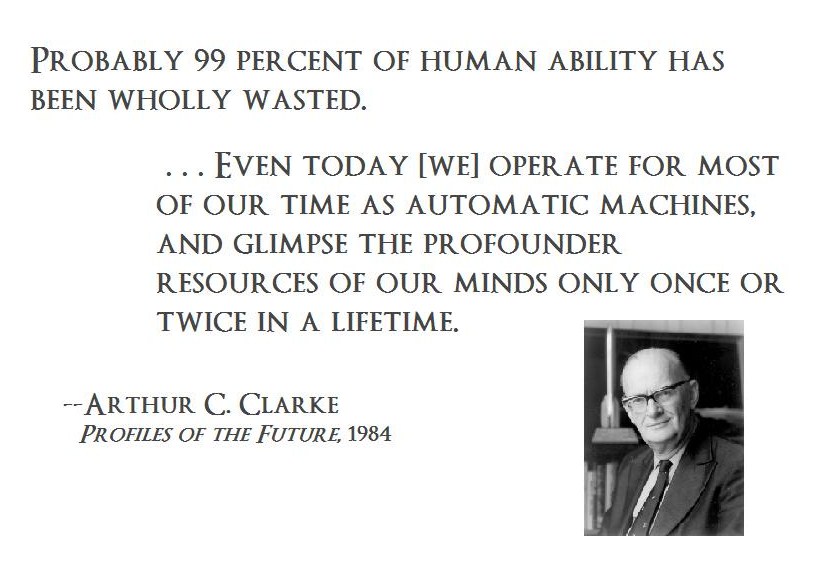
This morning while rereading Hugh Nibley’s essay “Zeal Without Knowledge,” I came across this quote from Arthur C. Clarke. While I don’t agree with everything Clark believed–he was a provocative philosopher in his own right–I do appreciate this:

arthur c clarke quote

In preface to this, Hugh Nibley wrote:

sin is waste

Drat.

Means I need to get off of Facebook again.

(And yes, I am working on Book 5, the title to be released soon.)

We adults have ruined the world for our kids

Once again someone has sent me a trite old email about “How great things were in the past!” and “How awful things are today!”

Surely you’ve seen these before, the less-than-subtle comparison that when we were kids we knew how to be kids, unlike kids today who are pathetic pansies.

However, there are two major problems with such grossly inaccurate nostalgia trips: 

1) Life was never as good as we remember it, and;

2) If we don’t like the way life is for our kids, we—their parents and grandparents—are to blame.

First, let’s look objectively to some of the ridiculous claims about how we “survived” and are somehow inherently “better” than the younger generation.  Many pieces like this one detailed below float around, but since this is the most comprehensive, we’ll use it to demonstrate the selective memory problems so many in the older generations suffer from. This one is called:

TO ALL THE KIDS WHO SURVIVED
The 1930’s 40’s, 50’s, 60’s and 70’s

(From: http://www.corsinet.com/braincandy/hage5.html)

First, we survived being born to mothers who smoked and/or drank while they carried us. So there’s no problem with mothers smoking and drinking during pregnancy? Or are you willing to admit that no, not everyone emerged as “good” as you?

They took aspirin, ate blue cheese dressing, tuna from a can, and didn’t get tested for diabetes. And they also had a lot more problems during childbirth as a result. But you don’t remember your birth, so obviously this detail doesn’t matter.

Then after that trauma, our baby cribs were covered with bright colored lead-based paints. Lead-based paint causes problems in mental acuity, which the author of this piece of propaganda demonstrates all too well.

We had no childproof lids on medicine bottles, doors or cabinets and when we rode our bikes, we had no helmets, not to mention, the risks we took hitchhiking. And the author also doesn’t remember that children died from poisonings at higher rates than they do now, and that many children suffered from brain damage or worse when they crashed on their bikes. There were consequences. Although brain damage causes us to forget . . . 

As children, we would ride in cars with no seat belts or air bags. And the families who died in car accidents back then aren’t around to explain how seat belts and air bags would have saved their lives.  

Riding in the back of a pick up on a warm day was always a special treat. Stupid, but special. Again, loss of memory=brain damage. (Or marijuana use. Go ahead–ask Grandpa about the drug culture of the 60s and 70s.)

We drank water from the garden hose and NOT from a bottle. So why don’t you let your grandkids drink from the hose?

We shared one soft drink with four friends, from one bottle and NO ONE actually died from this. No one dies now, either. It’s usually kids’ parents and grandparents who freak out about them sharing. 

We ate cupcakes, white bread and real butter and drank soda pop with sugar in it, but we weren’t overweight because WE WERE ALWAYS OUTSIDE PLAYING! But an enormous amount of the adult population is overweight now, because you never outgrew drinking soda and eating sugar. Type 2 diabetes, anyone? Everyone?

We would leave home in the morning and play all day, as long as we were back when the streetlights came on. So why did you create a society where your kids and grandkids can’t have such freedom? Why do you call social services when you see kids walking by themselves to a nearby park?

No one was able to reach us all day. And we were O.K. It’s not kids who buy cell phones to carry around; it’s their parents.

We would spend hours building our go-carts out of scraps and then ride down the hill, only to find out we forgot the brakes. After running into the bushes a few times, we learned to solve the problem. But when your kids/grandkids ask to use supplies in the shed, you yell at them to not make a mess, not make any noise, and go to their rooms and be quiet. So they turn to their games . . .

We did not have Playstations, Nintendo’s, X-boxes, no video games at all, no 99 channels on cable, no video tape movies, no surround sound, no cell phones, no personal computers, no Internet or Internet chat rooms……….WE HAD FRIENDS and we went outside and found them! So why do you now yell at the neighbor kids when they’re outside running around and making noise? Why do you call their parents and threaten to sic the cops on them for accidentally running across your lawn?

We fell out of trees, got cut, broke bones and teeth and there were no lawsuits from these accidents. Kids don’t file lawsuits; their parents file lawsuits. Why are you doing this now?

We ate worms and mud pies made from dirt, and the worms did not live in us forever. So why do you not let your own kids/grandkids explore this way?

We were given BB guns for our 10th birthdays, made up games with sticks and tennis balls and although we were told it would happen, we did not put out very many eyes. Kids don’t call the cops on other kids with BB guns. Adults do that. Why did you change?

We rode bikes or walked to a friend’s house and knocked on the door or rang the bell, or just walked in and talked to them! So stop accompanying your children, or telling them to use a phone, or tell them that you don’t want them out on their own.  

Little League had tryouts and not everyone made the team. Those who didn’t had to learn to deal with disappointment. Imagine that!! So now that you’re coaching these teams and have put your kids in these sports, why have you changed the rules?  

The idea of a parent bailing us out if we broke the law was unheard of. They actually sided with the law! So why don’t you respect the law anymore, and defend your precious “innocent” babies instead?

This generation has produced some of the best risk-takers, problem solvers and inventors ever! And has also produced adults that over-parent their children and limit their development. Why is that?

The past 50 years have been an explosion of innovation and new ideas. Surely you don’t think YOU’VE accomplished all of that, do you? Millions take credit for the work of just a few thousand. 

We had freedom, failure, success and responsibility, and we learned HOW TO DEAL WITH IT ALL! And yet you’re afraid to let your children and grandchildren have that same experience?

You might want to share this with others who have had the luck to grow up as kids, before the lawyers and the government regulated our lives for our own good. Ah, I see! Individuals don’t have any responsibility—it’s all the lawyers government’s fault!? You just claimed earlier to have “responsibility,” but only when it’s convenient? No, I’m sorry. You can’t pin all of these changes on the government. And how many of you are lawyers? We all have to take responsibility for how our children turn out.

And while you are at it, forward it to your kids so they will know how brave their parents were. And just how dramatically they changed the world you now live in. Yes, your parents and grandparents destroyed everything when they became grownups. Remember that when you choose their nursing home.

How many of us have naively imagined Thanksgiving looking like this? How often have we actually achieved it? Everyone smiling? Yeah, me too.

The problem is the “good ole days” never really existed. Even in the 1950s—a classical age many of our older generations hark back to—we knew this.

Morris Wright in 1957, wrote this about the beloved Norman Rockwell paintings that I’ve used in this blog:

“We might say that Mr. Rockwell’s special triumph is in the conviction his countrymen share that the mythical world he evokes actually exists. This cloudland of nostalgia seems to loom higher and higher on the horizon . . . and disappears from view . . . leaving the drab world of common place facts and sensations behind.” [emphasis added] (Approaching Zion, Hugh Nibley (1989), page 523. )

Here’s another plug for “Those were the good ole days” that never were.  https://www.facebook.com/1035wimz/photos/a.180388971978038.49555.121975634486039/871131596237102/?type=1

And another that touts many poor decisions as “ok” and “Hey, we survived.” However, I appreciate that she prefaced her list with this:

Now, as a parent myself, my own parents like to tell me I’m too overprotective.
“Really?”
“Well, you survived,” they say.
“Yep, but it seems like the odds were against me.” http://thestir.cafemom.com/big_kid/165499/21_Things_80s_Kids_Did

Another “We had it so tough but we also had it so great, so we’ll just ignore all the other bits.” https://amyunjaded.files.wordpress.com/2012/03/70s-80s.jpg

This one’s more balanced, with an interesting comparison of a few decades ago with today. There are advantages and disadvantages to both times, and let’s remember that. http://preventdisease.com/news/15/020515_10-Differences-Child-Grew-Up-70s-Compared-To-Today.shtml

Check out this video by Nature Valley Granola, and ask yourself: who bought all the gadgets for their kids and grandkids? Who’s responsible for teaching them how to really play outside? It seems that some adults are realizing that hey—all of this is our fault. And we’re also the solution. https://www.youtube.com/watch?v=is5W6GxAI3c

The next time someone older than 30 (yes, don’t trust anyone over 30!) sends you a nostalgic turn of the belly via email or social media, challenge them with this: Prove that life really was better “back then.” And don’t let them use only their hazy and selective memories. Make them use real data. 

Don’t worry. They won’t. They can’t. They’re still not sure what “Google it” means.

In many ways our society is far better than it ever was. Yes, we have huge and glaring problems—I rant about those enough, so I won’t do so here—but we’ve also done a few things right. For example:

We’re far more compassionate.

  • Many decades ago a relative of mine committed suicide. His grieving family was shunned, and even a basic burial was denied him. Today, we’re far more helpful to those suffering from mental illness, and we open our arms to love those left behind when someone loses the fight.
  • To those of various religions. Only fifty years ago this was a very Protestant country. Catholics and Jews were commonly snubbed. Ask your grandma about the fear of a Catholic John F. Kennedy running for president. Although we still have far to go, we tolerate others’ beliefs far better than we ever have. Mormons like me haven’t been run out of a state since the 19th century.

We’re far more accepting. 

  • Of different races. Seriously, we are. Ask anyone who grew up in the south in the 1940s and 1950s. Ask them what they remember about where the blacks and whites lived, and where they got drinks of water, and where they worshipped. We’ve made HUGE strides. The problems we have now are frequently manufactured and piddly in comparison.
  • Of homosexuals. The closet door has been open for a long time now.
  • Of different lifestyles. Just a decade ago anyone who was a vegetarian was snickered at. Now, a lot more people are looking to eat healthier, smarter, cleaner. “Alternative” is becoming “mainstream.” We’re less worried about “fitting in,” which is marvelous progress.

We’re far better about acknowledging and fixing problems.

  • Not so long ago, alcoholism was ignored. It was a condition whispered about, but rarely helped. Just ignore it and the problems will go away, was the shallow hope.
  • Oh, and advertisements used to feature doctors, babies, and even Santa to sell cigarettes. Admirable, very admirable.
  • Abuse in the home was also another “Don’t talk about” issue. Kids would come to school bruised and battered, wives (or worse, husbands) would have black eyes from “accidents,” and it was very rare that anyone ever stepped in to help.
  • Same with sexual abuse. We tend to think that’s a recent problem, but it’s not. Kids who were sexually abused in the 1970s were told to just “forget about it,” and their parents would as well. Employ the trusty, “Ignore it, and it’ll go away,” like that giant elephant in the living room which grows bigger and stinks more horrendously every day.

We’re far better at talking. 

About all those issues above, and many, many more. Some senior citizens think we talk too much—they derisively call it “gossip”—but frankly, I wouldn’t want to live in any other generation. Yes, we’ve got problems far worse than many of our ancestors faced, but we also are tackling them in ways they never dared.

“But the older generation, with its propensity to remember everything far better than it ever was, will be a harder sell.”  ~Chairman Nicko Mal, Book 3, The Mansions of Idumea

I nearly gave up because of half an ounce.

“Half an ounce?! No!!!”

I’m normally an up-beat person. My mantra over the past 15 years has been, “I will make this work!” It’s become a challenge to take whatever fragments I’ve been given and put them together into something I really didn’t think would function, but does.

But every once in a while too many of those fragments pile up. For some reason, it’s the little things that get me down, not the big ones.
etsy business card

My business card. Just print, cut out, stick in your wallet.

I have an Etsy shop, and because various websites have highlighted my Harry Potter clock and sock sign, and my Geek/Nerd clock, I’ve been successful enough to quit my part-time job. Now I stay home making products, devoting more time to homeschooling, cooking healthier, ghostwriting a biography on the side, and—oh, yes—editing book 5.

Several times a week I bring my labeled packages to my local post office, but last weekend the postal worker said, “Hold on a moment. We recently noticed a problem.” She put my package on the scale and it read one pound and barely half an ounce. “You’re just a tiny bit over. Anything over one pound puts your packages in the next price range.”

I was stunned. “But they’ve always weighed just under a pound!”

007

The digits of doom and despair . . .

She shrugged in sympathy. “Something’s changed, though. You’d be amazed how little things can add up.” She suggested I rework my shipping, and I went home worried and embarrassed. Had I been cheating the US postal service lately with packages suddenly too heavy?

And that’s when the spiral hit. Maybe you never do this, but a perfect storm of scenarios can make me sink rapidly. My despair spin looked like this:

  1. I’m done for.
  2. Because the packages are too heavy,
  3. my shipping charges will skyrocket, and,
  4. my profits will be cut dramatically, so
  5. I won’t make the money we need for the bills, and
  6. I’ll have to get another job again,
  7. because I’ll have to shut down my Etsy shop!

Those seven steps took me all of about 20 seconds.
It was just one of those days, when the weight of a tiny pebble hit me like a boulder.  By the time I got home four minutes later, I was utterly dejected. Having little hope, still I borrowed a scale from a neighbor (I have since bought my own) and, remembering my mantra, mumbled, “I’ll make this work.”

I came up with that phrase 15 years ago when we had our sixth baby and a foreclosure notice. Several months of little to no work meant we could no longer afford the house we thought we’d live in for the rest of our lives. No matter what we tried, we failed at. It felt like God didn’t want us to succeed, at least not there.

In desperation, I agreed to follow my husband who thought we should move to the other side of the country and try a different kind of life. We packed up whatever would fit in a U-haul truck, my little children said good-bye to their friends, we gave away some of our pets, said farewell to all of my family, and, with only a few dollars and a humble job awaiting us, we trekked to the east coast and moved in with his family who could offer us three bedrooms for our clan of eight.

Struggling with post-partum depression (my baby wasn’t yet two months old), financial disaster, and living in a state I didn’t know and with zero friends for our family, I miserably decided, “Somehow I have to make this work.”

And so for the next few months we tried. Because we were in a suburb of Washington DC, I took my kids as often as I could to the Mall and the museums, and tried to find ways to enjoy our new environment. But it was tough. Housing was impossibly expensive which meant we couldn’t find a place of our own, my husband’s commute was over an hour, and there wasn’t a mountain to be seen anywhere. But still I kept thinking, “I have to make this work. God sent us here for a reason, so I have to make this work.”

After a few months my husband was offered another job in a much cheaper area. He moved into the heart of Virginia, and five months later we were able to join him. That was possible because someone miraculously bought our former home the day before it was to be auctioned off. That same week an old house became available for us to rent, across the street from my husband’s work.

Commute time, one minute by foot.

virginia house

Our rental house in Buena Vista, VA. We were the last occupants of this magnificent home.

There were some catches, though. The house was officially condemned, to be torn down in a few months to make way for new construction. But until then, the owners agreed to let us live with mice in the attic, skunks in the crawl space, roaches in the kitchen, and vines growing through the siding into the house. When it rained, we set up buckets to catch the water. But, at $350/month, I knew we “had to make this work.”

And we did. I was so happy to be together as a family again, and in the dingiest house I’d ever lived in.

Miraculously, another five months later we moved into a brand new house which we loved for five years, and when we sold it we were miraculously able to pay off the debt we still carried from the old house we had lost.

Those were heavy weights to wield, but we made them work.

So why, several years later, did I freak out over less than an ounce of weight?

Sometimes the smallest things feel insurmountable, like the brick in my path which makes me fall to my knees and weep. But strangely, if someone were to throw a brick wall in front of me, I’d rub my hands together and say, “I’m gonna tear down that wall!”

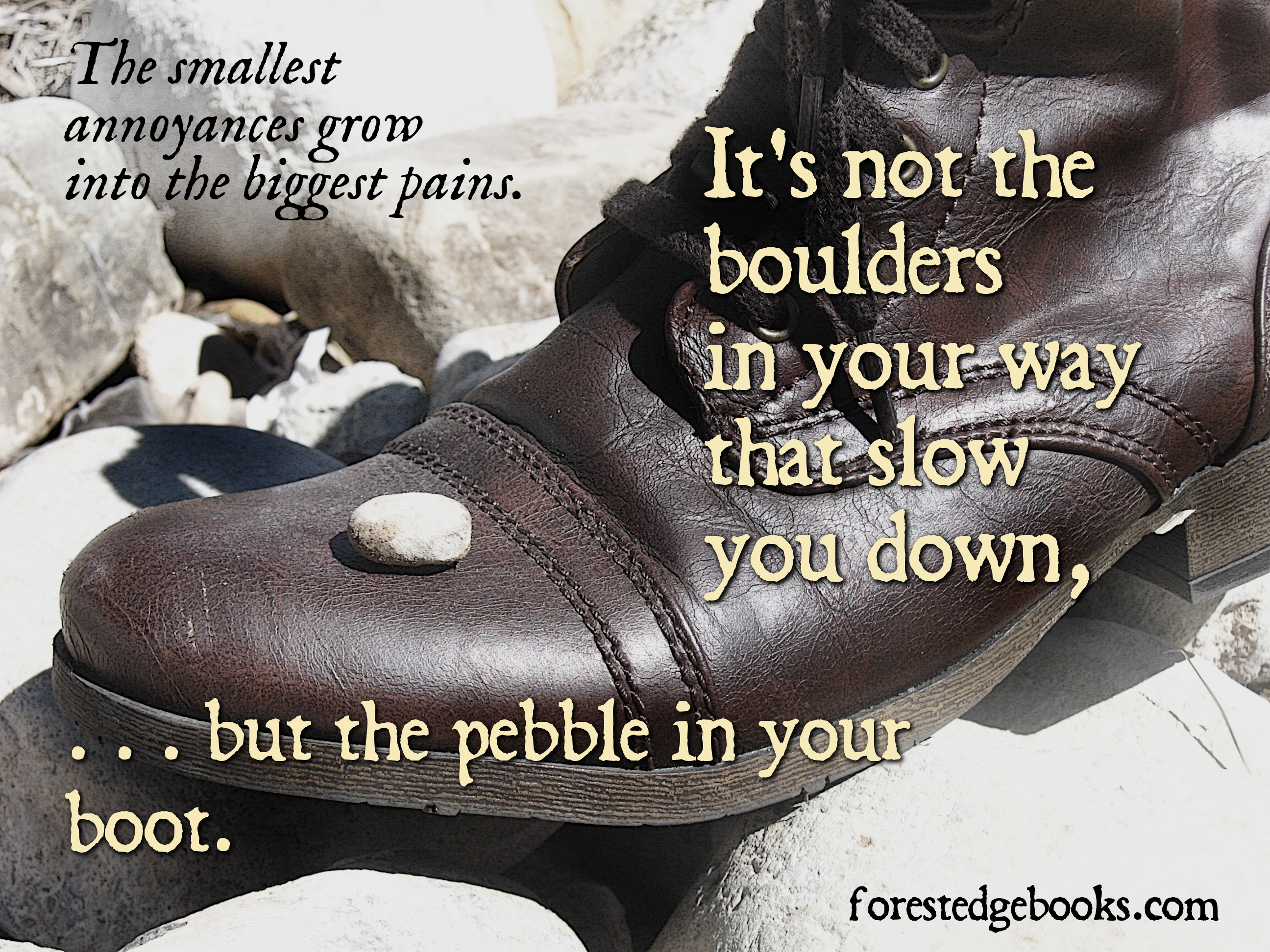
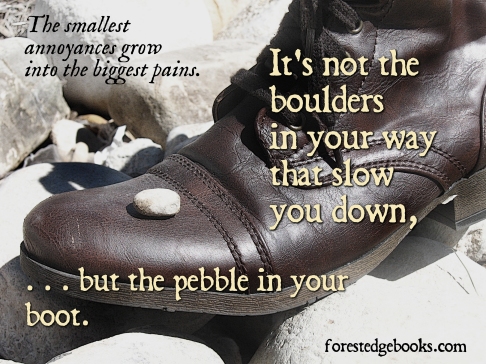
Maybe it’s the niggling smallness of it, the constant tiny bits that just wear us down. A pebble in a shoe bumping against the toes is much more annoying than a rock one has to climb over. Day after day after day, it’s the little things that just get to you. pebble and boot
I had a few dozen of those niggling issues last weekend, so hearing that I had “a weight problem” pushed me ridiculously to tears. “I don’t know how I’ll ever fix this! It’s all over!”

But still I worked it, because I just can’t bear to quit. I bought new packing supplies and weighed all of my products (identical items had different weights!) but still couldn’t find the problem. Aggravated, I thought, Fine! I quit! Which I really didn’t mean, but the words came clearly to my mind, “You’re going to quit over half an ounce? That’s not like you.”

No, it wasn’t like me, but I was being petty and indulging in a little pity party. I’d been working on major projects for other people, and hadn’t had time to spend on my own work. (Not regularly visiting Edge leaves me edgy.)

My next thought was, “You’re treating this like a ton, but you know it’s only half an ounce. You can beat half an ounce.”

Yes, losing our house and moving 2,000 miles away—that was a ton.

So was moving back west, which we did when our 8th baby was just four weeks old, and I drove our 15-passenger van all the way from South Carolina to Idaho in four days, and the U-haul my husband drove broke down every single day.

IMG_0728

The fuel gauge was also broken (along with the braking system), and this is where the truck stopped one day, out of fuel. Yes, just that close to the gas pump.

We’ve also again faced the crushing weight of under-employment, and the medium bone-breaking weight of medical bills, of debt, and of major appliances dying.

But here’s the weird thing: as I look back on those problems that fairly crushed or merely bruised me, I see that weight as only a few hundred pounds: difficult, but not impossible. We made it work! No big deal!

My perception has changed not just because of hindsight, but because we didn’t carry that weight alone.

Fifteen years ago I began to finally learn what Christ meant when he said “Take my yoke upon you, and learn of me; . . . For my yoke is easy, and my burden is light.” One day, about two months after we had moved to the east coast, I was so discouraged by our plight that I finally said out loud, “Dear Father, we moved, but we’re still in a mess. We can’t have a home of our own, my kids can’t find friends, and I really hate so many trees that make it impossible to see where I’m going! I give up. What do you want me to do?”

The moment that I said, “I give up,” something clicked. What I was “giving up” was having things my own way, and insisting upon my will.

That day I gave up all my expectations of what I thought my life should be, and I handed it all over to God.

Things began to change. I found myself praying for ways we could serve others, and a few problems quickly arose where all of us needed to help. While we were focused on helping others, we were much more satisfied with our situation.

Since that miserable-yet-important year, I’ve discovered that we can get by on much less than we expected. For example, our family of 10 once lived in another rental house for four months without a couch. We survived with three camp chairs in the living room and a few blankets on the throw rug which covered a wooden floor. It was far from comfortable, but we made it work.

I have to remember those days when the weight wasn’t as terrible as I thought. I especially needed to remember that last weekend when, after several hours of experimenting, I stared dumbfounded at my clocks and wondered how I could reduce packaging without increasing risk of breakage.

I kept reminding myself, “It’s only half an ounce. How dare I give up over half an ounce!” I felt like that scene in “Apollo 13” where they try various configurations to start-up part of the spacecraft without it going over a certain voltage, but they failed again and again.

Finally I headed into my bathroom to brush my teeth (somehow that always clears my mind) and as I did so I prayed, “Dear Father, this may sound silly, but I’m so frustrated. Why are my packages overweight now? How can I fix this?”

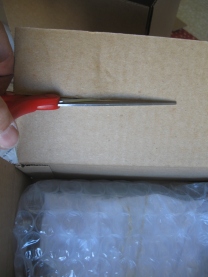
As I reached for my toothbrush the thought came clearly, “The boxes are overweight. They were made differently, and now they’re too heavy.” In my mind I saw myself cutting off part of one flap—enough to reduce the weight, but not too much as to compromise the structural integrity.
004

It’s embarrassing how many hours it took me to come up with this solution.

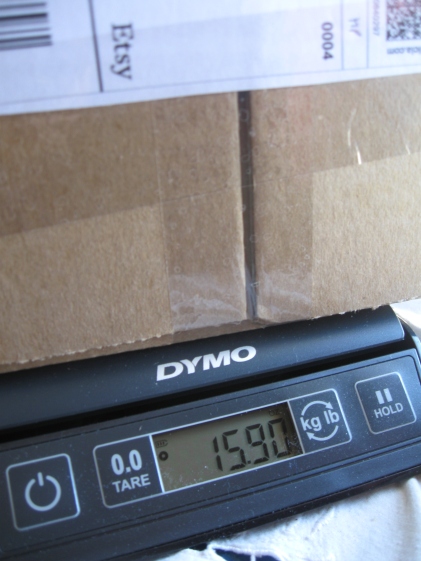
I ran back to the boxes (brushing teeth could wait), cut off half a flap, weighed it with my product and packaging and—yes! Removed all the weight I needed!
002

Magic numbers! Under 16 ounces!

“Really?! That was the problem? That’s the solution? We made it work!”

006

Ship ’em all out, Ethel–we’re good to go!

As I did a bizarre little dance celebrating that my business-which-was-never-out-of business was back in business again, I sent up a few prayers of gratitude as well.

I felt as if the heavens answered back, “You’re welcome, again. But you didn’t have to fret or despair. Why do you take upon you these burdens, then decide to heap on a few more just to make yourself fully miserable? No one’s asking you to do that. In fact, how many times have you read, Take my yoke upon you, and learn of me; . . . For my yoke is easy, and my burden is light?

Oh. Yeah.

Someday I just may remember that God can easily handle half an ounce, and also a full ton. And I’ll skip the part where I make myself miserable. Some day I’ll just instantly “ . . . drop my burden at his feet, and bear a song away.”

“Remember the saying, ‘The smallest annoyances—”

“—grow into the biggest pains.’” Perrin sighed and finished the familiar phrase. “‘It’s not the boulders in your way that slow you down, but the pebble in your boot.’”
~Book One, “The Forest at the Edge of the World”

Supporting Religious Freedom, everywhere

(I recently updated my About page to reflect what’s below, but I feel so strongly about this that I wanted to share it here as well.)

Astronomers estimate there are 160 billion (yes, with a “b”) alien planets in the universe.

I assert that God created all of them, the entire universe, and that we’re not the only ones floating around in this massive existence knowing about our Creator. (See Hebrews 11:3 or Moses 1:33)

So what might life be like on just one of those 160 billion worlds? What might God’s Plan of Salvation look like on another planet?

universe picture

(In the summer I look up into the night sky, slightly northeast from my position, and I’ve pinpointed a star which I think may be Edge’s sun. But please don’t ask me to map it.)

That idea is what drove me to write the “Forest at the Edge” series, to explore how God’s gospel might be manifested in another part of the universe.

So far I haven’t found any genre of literature which tackles this point of view, so I’ve struggled finding the correct niche for my books.

The books are “fantasy,” but there’s no magic or mythical creatures;
The books are “Christian,” but Christ isn’t overtly mentioned because He didn’t live on their planet;
The books are not, however, “sci-fi” because there’s no speculative science in them, although exploring life on another world seems to fit the bill.

See my problem?

I’ve always been intrigued by the notion of different cultures and different worlds. My kids will tell you I’m a Trekkie at heart. (Some years ago I made all of them matching Star Trek uniforms for Halloween.) But I’ve always been a bit disappointed that no sci-fi/fantasy world I’ve encountered ever has God. Yes, they have “god(s)” created by their culture, but I have to find a sci-fi/fantasy series or show which dares to touch the real God with a 10-foot-planet. (C. S. Lewis’s The Chronicles of Narnia is the only one I know of that comes close.)


So I’m out here writing about a Christian society which originates, lives, and dies on a planet somewhere else than earth. And oh, is it fun!

What would a God-directed creation look like on another planet? How would He populate another world? What kinds of limits, terrain, people would be there? What would their belief systems look like?

I think they’d look a lot like ours.

I wholly trust that there is life on other planets, but aliens aren’t creepy blobs or elongated masses with telepathy, or even possessing Spock-like ears. “Aliens” look just like us: human beings made in the image of our shared Father in Heaven. (Animals, however, may likely be very different than our earth’s, but I’m not creative enough to come up with those so I stole earth’s animals for my series).

I think our spiritual siblings on other worlds experience trials and tests, frustrations and fears, happiness and holiness quite the same as us. That’s because God’s plan of salvation is the same everywhere in the universe, because He is the same everywhere. As philosopher Pierre Teilhard de Chardin has famously said,

“We are not human beings having a spiritual experience. We are spiritual beings having a human experience.” (I would add, either on this world or one of millions others.)

At the heart of that human experience is the test of our wills. What do we want more: to follow God and His will for us, or to follow after our own impulses? And at the root of that is our ability to choose what we worship, how we live, and what we pursue.

But as I’ve been writing this series, something fascinating has happened: each year those choices become more restricted by those who would control us.

When I started drafting this series back in 2010 I couldn’t have comprehended how much American society would change in the following five years. Future books seven and eight describe a world which frankly terrifies me, and it seems we’re running headlong to that end in our world. (I’m not pretending to be a prophet; I’ve merely read the book of Revelation a dozen times for ideas. That John the Beloved really knows what he’s talking about.)

As a result, much of the “Forest at the Edge” series pivots upon this declaration:

“Make your decisions as to what to embrace, but let me embrace my belief.” ~Perrin Shin, The Forest at the Edge of the World, Book 1

In 1836 a prophetic man wrote the following words: “We claim the privilege of worshiping Almighty God according to the dictates of our own conscience, and allow all men the same privilege: let them worship how, where, or what they may.” (emphasis added)

Suddenly I realize that what I’m writing is about supporting religious freedom. Today, in 2015, I declare that our freedom to “worship how, where, or what [we] may” will soon be under hot and direct fire. Denying people their ability to worship is the first step to imposing a tyranny. Tyrants, being merely well-funded bullies, are stealing away our ability to control our lives one little liberty at a time.

tyrants

I don’t like bullies. I had my share of them in gradeschool. Sometimes it’d be nice to retreat to the very edge of the world and hide from them. But now’s not the time to run away. Now’s the time to take a stand. I only wished I were as brave as Mahrree who declares without reservation:

“I will defend the right for any one to question any thing. Each person has the right to find her own answers and believe as she wishes!”
~Mahrree Shin, Falcon in the Barn, Book 4

I’m warning you right now, the world truly is out to get you.

Excuse me, but your ignorance is showing

Recently a mother of an autistic son in the Salt Lake Valley found the following stickers on her car around her Autistic Child sign:

autism stickers car

Love the random capitalization on the stickers. Hey, let’s make this letter big, just for fun!

What caught my eye, however, was this sticker. Exactly what’s this supposed to mean?

entitled

Uhh . . . what?

It means that the perpetrator is embarrassingly ignorant, on many levels.
Ignorant of autism.
Ignorant of appropriate behavior. (Stickering someone’s car? Really? That may be considered vandalism unless it’s a wedding.)
Ignorant of the English language.

There are marvelous and cringe-worthy examples of ignorance everywhere. A few samples I gleaned from the Internet:

asia

I guess “euthanasia” was too hard to spell?

Image result for bad protest signs

What we call “irony.”

Image result for bad protest signs

So they’re hoping for many years of the same thing?

Image result for bad protest signs

Strange, I haven’t seen “half-breed muslin” at my fabric store. (And does it look like that “d” was an afterthought?)

I’m trying to decide what causes such public ignorance. Does passion for the movement cause one to forget how to punctuate, or even spell?

Or does one protest because they are ignorant?

Of course, ignorance isn’t confined merely to those who protest, nor are all protestors ignorant. Some actually know what they’re talking about.

nazi

Ok, maybe not.

But some people, it seems, never know what they’re talking about. Back in the 1980s we were newlyweds, and my husband whisked me back to “the east.” I was worried, because I had this ignorant notion that all east coast people were sophisticated, smart, and sharp. I, however, was just a little doofus from the west. How would I ever communicate?

Then I met a young man who asked what my maiden name was. When I told him Strebel, and that my parents were immigrants from Germany after WWII, he developed this odd smirk and said, “So your family were Nazis?”

I was shocked.
Worse than that, I was livid! The Nazis had ruined my families’ lives. My ancestors fought the Nazis!

I started explain that, but the young man just waved me off and said, “Yeah, you’re all Nazis.”

My new husband pulled me away, knowing there was no reasoning with ignorance.

Image result for bad protest signs

Look at her face. This is not a happy woman. Probably because she’s outraged that she doesn’t know what “you’re” means.

I’ve thought frequently about that incident over the years, and subsequent others. Back in the 1980s when I was working at a trendy clothing shop on the “sophisticated” east coast, one of my coworkers, upon learning I was LDS (a Mormon), said, “Oh, my dad said your husband can have all the wives he wants, that you belong to a cult, and that you drive horses. How come they let you out to work here?”

Oh, where to start! After an hour’s discussion trying to dispell all of that, she still regarded me suspiciously. She knew the truth, or at least liked her ignorance more than she liked my explanations.

Sounds like hell will be pretty full. I know Mormons like me are doomed, but sports nuts are damnable? I was ignorant of that.

Finding the truth was harder 25+ years ago. We didn’t have the Internet. We had to make some effort to visit libraries, read newspapers, or watch the TV news or a documentary. (Really, I’m not trying to sound sarcastic here.)

But today there’s no excuse for ignorance. We have so many resources about anything and everything, and all for free.

And maybe that’s the problem: for every drop of credible information out there, you can find a flood of rumor and nonsense. There are no fact finders on meme generators, our society’s new bumper stickers of truth. Anyone can create anything, and those who “think” they know won’t bother to research the truth.

Actually, these pyramids were built by paid workers, and by farmers and villagers who volunteered during the off season believing that their labor would help ensure their own afterlife. No slaves were harmed in the building of these pyramids. http://www.pbs.org/wgbh/nova/ancient/who-built-the-pyramids.html

I’ve discovered something about the ignorant: they’re afraid.
Afraid they may be wrong.
Afraid they won’t recognize the truth when they see it.
Afraid to change their attitudes.
Afraid to be humble.

Back to my “You’re all Nazis” man. The more I learned about him, the more I realized he was truly ignorant.

He didn’t read, which is the hallmark of ignorance. Not the news, not books, not anything more than bumper stickers, which constituted the bulk of his education.

His little smirk was his signal of fear. I’ve seen this odd trait in many scared people. Either they’re lashing out in a full, terrifying rage, or they’re trying to pretend they’re more confident than they are, hence the smirk. Watch for that, the next time you’re confronted with someone who’s particularly unpleasant. You’ll see their terror cowering behind the smirk. 

prop_8_protest%20women.jpg

Oh, they’re protesting the CHURH. Whew. For a minute there, I thought they were protesting my church.

I feel badly for these people, I really do. There’s no need to be fearful, there’s no reason to remain in ignorance. There’s such a wealth of information in the world, and many good, kind people who would be willing to share what they know with you. 

But that takes humility: recognizing that we don’t know everything, and that we still have much to learn.

Unfortunately, ignorance is exceptionally prideful.

I may be a “mavrik” if I knew what it was. Perhaps you could also explain what a “socialest” is?

I worry that America is dying

This is my father’s coffin, July 2, 2015. These are the soldiers folding the flag that covered him.050

And while I watched the ceremony yesterday, I was struck that not only had my father died, but my country is dying, too.

I worry deeply about America. I agree with so many others who have written more eloquently, and angrily, that America is no longer the greatest country in the world.

And that would have broken my father’s heart. It’s odd to put it this way, but I’m grateful that Alzheimer’s took away his mind these past few years so that he couldn’t understand what was happening to the country he proudly became a citizen of 60 years ago. He loved America, but he wouldn’t recognize it today, and I worry about what it will be like in another 60, or even 6, years.

I worry because we are not united.
I’m not naïve; I doubt that this country has ever truly been “united,” aside from a couple of occasions. Once would have been during WWII when outside enemies provided us something to fight against instead of each other.
The second would have been a brief second honeymoon after 9/11 when we realized that our land was under no special protection, that we could be attacked like any old place, and that scared us.
But only for a time.

I worry because we all want to be victims.  
The notion of “freedom” has expanded and contracted in bizarre ways, granting to one segment of society the ability to act and demand anything they wish, while another segment is berated and demonized for nearly anything they express.
The fascinating thing is that every segment of society will claim to have been the one persecuted against. We scramble to cry foul and demand vindication and, hopefully, a huge payoff from a lawsuit.
No one wants to be independent anymore.

I worry because we want revenge.
In the past, in any quest for rights, the group feeling oppression marched and protested and demanded equality. And when they achieved it, they rejoiced.
But not anymore.
Many now want to punish those who they believed oppressed them (whether real or imagined), and drag up old wounds to make new ones. We don’t seem to believe in cooperation, or friendship, or forgiveness, or anything else we should have picked up from Sesame Street (I hesitate to say “church” because that may be deemed “offensive”.) We want to hurt those we believe have–or may in the future–hurt us.
None of us seem to want to break the vengeance cycle that could truly unite and free us.

I worry because we really aren’t free anymore.
Not free in choice of health care, school lunch, minimum wage, or even soda consumption.
Some of us aren’t free to choose to do a job, or to reject that job.
Some of us aren’t allowed to speak our conscience without being labeled or libeled. Many of us worry that our liberties will soon be our liabilities, especially if we express what we believe concerning God and His laws.
Soon what passes as “free speech” may be so tightly constrained that there will be nothing free in any speech anywhere.

I worry because we have become a country of selfish children.
Read stories of our ancestors during the Great Depression, or either of the World Wars. They sacrificed for their families and their neighbors. They knew true poverty. Millions of families–not just a few thousand, but literally millions–sent off husbands and sons to WWII, and over a million were wounded or killed. Food was rationed, as was clothing and shoes and gasoline, and Americans labored willingly to help their country succeed.
Today “sacrifice” is an ugly word, and we whine if we lose wi-fi. Even those who the government has deemed impoverished live with luxuries our grandparents didn’t dare dream of. We insist on being indulged, and “I’m entitled” is the phrase that pays. We’ve become soft and wimpy, and I think our ancestors would be ashamed.

050 cropped

Are we becoming only a reflection of what we used to be?

As I watched the flag suspended over my father’s coffin, the silhouette of it reflecting on the stainless steel (my mother chose their coffins; she loved the glint of silver), I felt that shiver of worry that not only had my father passed from this world, but so also had much of this country which he had loved.

He had emigrated from Germany at the end of WWII. He knew an oppressive society where the leadership demanded complete obedience, where freedoms were restricted, where children were forced into a near worship of the government, and where anyone who spoke against it was carted away to a “work camp” never to be heard from again.

I worry that as the so-called Greatest Generation passes away, so too will our memory of what they endured in totalitarian regimes, and why they fought so hard against them.

And mostly I worry that we’re running headlong into repeating the history we no longer remember.

Don’t be afraid of my opinion, because I’m not afraid of yours

I’m fascinated by how many people are terrified to allow someone else an opinion contrary to their own.

If someone says/writes/believes something differently than we do, we’re struck with an almost primal need to purge that difference.
For some reason which I can’t figure out yet, we’re terrified by differences.

The obvious examples are terrorists and racists and any other form of negative “–ist”.
But I’m not talking about the obvious bullies who are acting out of what they believe is “righteous condemnation,” disguising their cowardice.
No, I’m talking about you and me, our neighbors, families, coworkers, students who, when presented with an attitude different than our own, shrink back in worry.

Perhaps we strike out fearful that maybe we’re the ones in the wrong, but we don’t want to change, so we better smack down the opposition. (But that’s only my opinion.)

But here’s a radical notion: What if there’s room for all of us to have our own opinions, and we don’t have to fight every different idea, but simply . . . let them be?

Aristotle said thousands of years ago that the mark of an educated mind is to entertain an idea without accepting it. 

Are we yet evolved enough to follow the Ancient Greek’s advice?
Recent evidence would suggest no.

Think about how many articles you’ve read where an opinion is stated, and commenters rage that the authors are wrong. I’ve frequently published letters to the editor (opinions) and recently published a longer piece expressing my reasons (opinion) why I don’t cry when I send an adult child away on a mission for two years. I was explaining my experiences, yet some commenters said they felt “judged.”

Judged? By MY experience?
What an odd way to think.
(Uh-oh—someone’s going to judge my opinion on that, I just know it . . .)

But here’s the thing: we all express OPINIONS, and we should. These are not statements of fact, not insistences for policies, not movements to obliterate all other opinions.

Opinions are merely interpretations of life based on one’s experience.

And they are all different. And that’s ok. (In my opinion, that is.)

Yet I’ve seen people squirm in discomfort, scowl in surprise, and even rage in fury when someone else’s experience runs counter to theirs, as if their lives have been suddenly invalidated.

But every person feels and interprets differently, and here’s the marvelous truth: the world IS big enough for all of us to have different opinions.
Here are some opinions I’ve heard recently which turned into actual—and unnecessary—arguments:
–Taking trip to Disneyland/Yellowstone/New York City is stupid/dull/overrated and a waste of time and money.
–Home schooling/public schooling/private schooling shows you don’t have any faith in the system/yourself/the world in general.
–Going to college/not going to college is the biggest mistake you’ll ever make.
–Having one/three/ten children is an excellent/irresponsible decision.
–Letting your kids play/not play on the computer/watch TV/not watch TV is a sure way to ruin/help your children.
–Starting a business/working for someone else is the only way to be sure of your future security.

And, fascinatingly, all of these opinions are ACCURATE.

Because these opinions are based upon individual’s circumstances, and if that circumstance is evaluated honestly, then that opinion is correct, even if it runs counter to what someone else believes.
 (But that’s my opinion.) opinion definition

I think vacationing at the beach is dreadfully dull. My in-laws think it’s ultimately relaxing. We’re both correct.

When I taught critical writing, I’d spend weeks trying to explain that various opinions can all be correct, but even by the end of the semester many college students still struggled with that idea.

I had an excellent test of this early in my teaching career. Before Salt Lake City hosted the Winter Olympics in 2002, there was controversy among Utahns about the impact of the games. I had a student who absolutely opposed the Olympics, while I thought their coming was the greatest thing ever. The assignment for the semester was to write an extensive research paper supporting an opinion, and guess what this guy chose for his subject?
The Damaging Effects of the Winter Olympics.
I didn’t like his topic, as you might imagine. While I am a conservationist at heart, living in a host city of the Olympics had been a dream of mine since I was a little kid. (Ironically, we were living in Virginia in 2002, and I confess I went to my bedroom during the Opening Ceremonies and wept because I wasn’t there.)

Anyway, Olympics-Hating-Student was smart. Each day he’d ask me my opinion about an aspect of the Olympics—traffic, recontouring of ski slopes, building of ice rinks, etc.—and then he’d take careful notes of what I said. He’d smile gratefully, smugly even, and would leave me stewing as to what he was up to.
It turns out his research paper became a carefully orchestrated opinion argument to prove my opinion wrong in every paragraph.

It was absolutely brilliant.

Oh, I didn’t agree with a word of it, but I gave him the highest grade I ever awarded: a 198/200 (he had a few comma issues). While I didn’t agree with his opinions, I had to agree that his ideas had merit and value, and while there were not ideas I wanted to embrace, I would allow him to embrace his opinions.

When he got back his paper, I watched as he nervously opened to the last page of evaluation. The grin which broke out across his face was priceless.
His peers, who knew I opposed all of his arguments, glanced at his grade and were astonished.
“We thought you’d hate his paper!” one of them exclaimed.
“I disagree with his ideas,” I told them, “but he’s entitled to his opinions, especially when he’s so carefully researched them and presented them. He did an excellent job. Who said I have to agree with his premise and conclusions?”

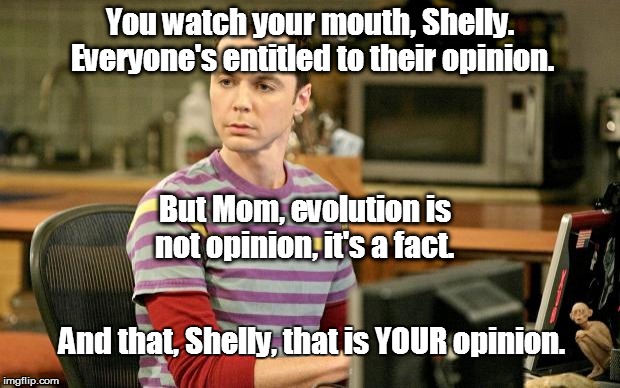
Sheldon Big Bang Theory  | You watch your mouth, Shelly. Everyone's entitled to their opinion. But Mom, evolution is not opinion, it's a fact. And that, Shelly, that i | image tagged in sheldon big bang theory  | made w/ Imgflip meme makerMay I submit the following: We balk at others’ opinions because we’re afraid they may be right.
We feel the need to fight back because we aren’t entirely secure in our own opinions.

May I also submit this: We don’t have to.

If you don’t like what you’re reading, stop reading.
If you don’t agree with someone else, agree to disagree and LEAVE IT ALONE.
Stop fighting. Nothing good comes from a fight. Ever.

I believe that God gave us our agency—our ability to choose—to allow us a full range of experiences in this life. When we, for any reason, try to shut down or deny another person of their opinions, we are essentially taking away their agency. That’s a devilish attitude, and one we need to avoid at all costs, or we become devilish—controlling, angry, and overbearing—ourselves.

HOWEVER . . .
There’s a time to push against another’s opinion, and that’s when YOUR opinion intends to change MY way of:

  • Living
  • Eating
  • Dressing
  • Worshipping
  • Teaching my children
  • Living according to the dictates of MY conscience

Then I will fight back.

There are many obvious examples of this in the world, but let me give you a more local one: A friend of mine recently took her daughter to a musical camp where kids could be trained by professional musicians. The camp fell on my friend’s daughter’s 12th birthday, and to celebrate my friend splurged and bought a store-made cake. She placed it on the food table where other parents had brought snacks, intent upon letting everyone share in her daughter’s birthday celebration.

Except one mother didn’t agree. Putting herself in charge of the table (no one’s sure if she was asked to, but she set herself there anyway), she announced to the children that sugar would make them hyper, and she wouldn’t allow anyone to have any cake, since she didn’t allow it for her own children.

This woman decided—based on her opinion and rather poor science (sugar does NOT cause hyperactivity in children–read this)—that no one should have the opportunity to choose for themselves if they wanted cake.
One person’s mere opinion overruled everyone else’s choices.
That’s wrong.
(In my opinion, that is.)

In our homes we have the right (for now) to impose standards as to what will be allowed and what won’t. In my house I won’t allow abuse, or vulgarity, or pornography, or music and/or entertainment that promote anything like that. In your house, those rules may be different.

But it is NOT my prerogative to barge into your house and force my standards—be they more relaxed or more stringent—upon your family. However, if you come to my house, I expect you to respect how we do things, as I will respect how you do things in your home.

As long as your opinions don’t threaten to take away my freedoms, I’ll keep my mouth shut, and I’ll even be your friend.
But if that line is crossed, if someone’s opinions try to change the way my family lives, then I will push back.

You can live and think and worship and behave differently than me—I have no problem with that, really. We should afford a level of respect to everyone we love. I don’t agree with every opinion of my husband’s, but I won’t detail those differences here right now because we’ve made it 27 years by agreeing to disagree, and I’m not about to disrupt that cart.

We make these kinds of “opinion accommodations” with many people we love.
So why do we not always do so with strangers? With other nationalities, religions, cultures, genders? Why do we feel the urge—even the sanctimonious right—to blast online the opinions and experiences of people we don’t know simply because we can?

Here’s a radical thought (and this is just my opinion): if you don’t like what you’re reading, stop reading it and move on.  

Don’t attack, don’t claim to be judged, don’t cry foul, don’t do anything. Just step away and do something constructive and useful instead.

I tend to clean the kitchen now instead of lashing out with unexplained venom, crying, “What an idiot! Who does he think he is, writing that?!”
“He” probably thinks he’s a person—just like yourself—who feels the desire to share his opinion to help others of like minds realize their experiences are valid. He’s not forcing his way of life upon you, so calm down already and go scrub something!

But then again, that’s only MY opinion, and I’m frankly, I’m entitled to it, as you are entitled to your own.

“What’s wrong with having opinions?” Mahrree said, her voice rising to the pitch of a trapped cat. “What’s more frightening are people with no opinions at all. ‘Oh, that sounds nice, let’s do it! It just feels good!’ What’s wrong with thinking?” 
~Book 3, The Mansions of Idumea

4 reasons to purge the phrase “I’m so busy!”

It’s the battle cry of our generation: “Oh, I am sooo busy!”

Find someone who isn’t busy. I dare you.
Everyone is.
And I’ve come to the conclusion that it’s a terrible line. 

We pull out this phrase for a variety of reasons–maybe proudly or in an attempt to garner sympathy. Maybe as an excuse for some failure, or maybe even as a proclamation of our worth.
But all of these reasons are, to be brutally honest, quite lame.
We wear our busyness as a crown of self-imposed honor, and it’s time to chuck that crown.

  1. We’re not as busy as we think we are.

“Too busy” is a relative term, just like “a great bargain” and “delicious tofu.” What one person claims as “busy” may be another person’s “slow” day.

Our lives, while often very cluttered, are actually simpler than we realize once we get some perspective. For example, watch an episode of “Call the Midwife” to see just how labor-intensive—and even terrifying—life used to be in the “idyllic” 1950s, or read this account of a pioneer woman in the 1840s:

“Drusilla Hendricks had most of the responsibility for taking care of the family, including her husband who was left an invalid after being wounded in the Battle at Crooked River. ‘I had to lift [my husband] at least fifty times a day, and in doing so I had to strain every nerve,’ she recalled. With five children under the age of ten, this young mother tried to survive . . . by taking in boarders, tending a garden, milking cows, feeding livestock, maintaining her home, and preparing the family’s daily need for food and clothing.”
(Women of Nauvoo, Holzapfel and Holzapfel: Bookcraft, 1992; pg. 35)

(I read that passage while sitting on my cozy bed nibbling on a chocolate gluten-free cupcake which I had been “busy” baking earlier.)

Drusilla wasn’t an exception. Read this about “typical” frontier life:

“In the frontier community of Nauvoo, women made soap and candles, both long and tiring chores. They spun thread and weaved cloth to make clothing and even worked at shoe making. A wringer and a washboard always stood nearby. For clothing to be very clean, the white things were boiled with homemade soap, making wash day a day-long affair. Care of animals often fell to women; they built fences, took care of the ‘kitchen garden,’ and helped in the fields, all this while pregnant about thirty percent of the time.” (Ibid. pg. 36)

(After reading this, I guiltily tossed in another load of laundry, dropped in some store-bought detergent, turned a few buttons, and walked away.)

  1. No one likes a martyr.

Sorry, but whining about busyness is terribly uncomfortable to listen to. Claiming to be “too busy” sets you squarely in martyr territory, and while friends and family may croon and say, “Oh, you really are!” inside they’re anxious for the conversation to be over so they can get away from you.

Or so they can ruminate internally that their lives are so much busier than yours, you little sissy.

Think about this uncomfortable question: why do we feel the need to brag /complain about our busyness? What are hoping to get out of it?

These words, spoken by a dear old man back in 2002, have haunted me for over a decade:

Sometimes we feel that the busier we are, the more important we are—as though our busyness defines our worth.
We can spend a lifetime whirling about at a feverish pace, checking off list after list of things that in the end really don’t matter.
~Joseph B. Wirthlin

Are we claiming “busyness” because we’re desperate to prove our worth? Maybe.

Consider these words:

Isn’t it true that we often get so busy? And, sad to say, we even wear our busyness as a badge of honor, as though being busy, by itself, was an accomplishment or sign of a superior life.
Is it?
I think of our Lord and Exemplar, Jesus Christ, and His short life among the people of Galilee and Jerusalem. I have tried to imagine Him bustling between meetings or multitasking to get a list of urgent things accomplished.
I can’t see it.
Instead I see the compassionate and caring Son of God purposefully living each day.
~Dieter F. Uchtdorf

Ouch.

If even Jesus Christ was never “too busy,” I shouldn’t be either.

  1. “Too busy” is a lame excuse. 

Yes, this suggestion is even more uncomfortable than accusing one of playing the martyr, but claiming that we’re “just too busy” may be a way of rationalizing away why we didn’t do something we knew we should.

I confess I’m guilty of this, because it’s just so darn easy to get away with it. I’m frequently “too busy” to drive an hour and a half to visit my parents in their assisted living center more than a few times a year. (They both have dementia and Alzheimer’s so what was the point, anyway?) Yet when my mother suffered a series of strokes last year, and was slowly dying, somehow I found the time to drive down and sit by her side every day and/or night for five days until she finally passed.

I wasn’t too busy to watch her die, and that week alone made me re-analyze my every claim of “too busy.”

  1. “Too busy” suggests we have lost control of our lives.

Being too busy—if  we really are (seriously, watch “Call the Midwife”!)—means that we’ve let too many activities, or obligations, or hobbies, or distractions clutter our days.
It may mean that we can’t prioritize what’s most important each day.
It may mean we don’t have the bravery or honesty to say, “I am unable or I don’t want to do x, y, or z.”
It may mean we don’t have the discipline to shut off whatever electronic gadget is sucking away our time.

What we think is a reasonable, viable excuse may actually be a confession of immaturity.

Now, I’m not saying that we don’t have a lot to do in our lives—we do. There are constant demands on our attention. Why, even as I’m typing this up I’ve stopped twice to change my 3-year-old’s clothes (mysteriously, he keeps getting wet by his 11-year-old brother innocently holding a hose, and is now wearing his fourth set of clothes since this morning), chatted half a dozen times with my kids, discussed weekend plans with my husband three times, gave permission to a teenager to make popcorn, filled my 3-year-old’s cuppy, and that was in the space of maybe an hour.

However, I’m trying to strike from my vocabulary the phrase, “I’m so busy,” although I likely let it slip once or twice as in, “Sweety, I’m a bit busy right now . . .”

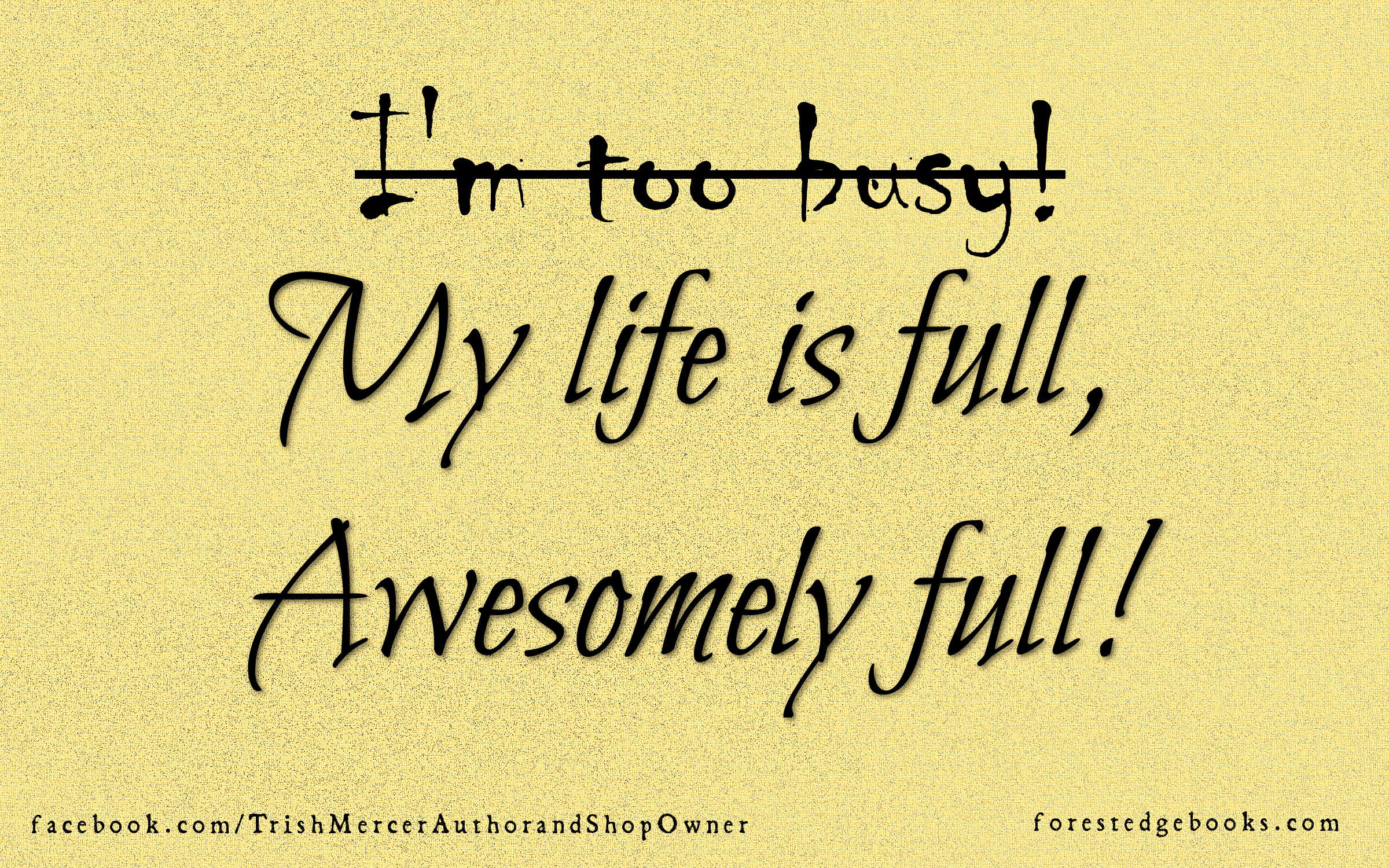
Instead, I’m trying this, (at least on everyone else): “My life is so full! Awesomely full!” im too busy

Notice the shift in tone and attitude?

Fullness is completeness.

Being full is usually a good thing (except in the water balloon that my three-year-old brought in the house. Clothing change #5. Another load of laundry which will take me all of five minutes to run.).

Having a full life suggests that nearly every element in my life is there because of my choice. I have CHOSEN this life.

All of us, unless we’re slaves (and I’m not being flippant here: I mean true, cruel slavery, and not something you claim you are to your preteens’ many activities) have chosen our lives to be as they are. Even in the most difficult of circumstances, we still have choices. Rarely are we ever forced into one course of action, and while the options before us may not be ideal, we still have a choice.

For example, at one point last year I was busy working two part-time jobs and running a small Etsy shop. I could have quit one of the jobs, but that would have meant finding another way to pay the power bill which would have meant . . . getting yet another job.

I was tempted to grumble at how hard my husband and I were both working for what felt like only a couple of bucks an hour, but we were working, and slowly improving our circumstances. Instead of complaining that my life was “too busy” to do what I really wanted to do—edit my books or get maybe six hours of sleep—I chose instead to be grateful that I wasn’t just sitting on the couch reading movie descriptions on Netflix (and wondering when the next season of “Call the Midwife” will finally arrive).

I had things to do, obligations to fulfill, people who needed me, and I realized how much I appreciated being needed.

However, I’m not advocating taking on more than we can reasonably handle. That’s where we need to be mature enough to objectively evaluate our lives and say, when necessary, “No, I’m sorry. I can’t organize the Little League luncheon or make party favors for fifty people.” Otherwise we still become martyrs who have taken on too much and eventually have a total breakdown.

Additionally, we frequently have several good things we need to do at the same time, and that’s where prioritizing comes in. Deciding which to do can be difficult, and who to tell “I just can’t do that for you.” But someone once told me that “Other people’s needs should always come first.”

I knew a man who told his son that he had to skip watching him play ball that evening because their neighbor’s sprinkler system was geysering into the neighbor’s basement, and the dad wanted to go help. He said, “It was good for my son to see that I was putting aside something that I thought was important–watching him play ball–for something which really was.” While his son was initially disappointed that his dad was “too busy,” when he saw the flooding mess he offered to skip his game and help as well. Suddenly he was “too busy” to play ball, because he was doing something better.

Living a “busy” life is frequently drudgery. But living a “full” life is marvelous. The sense of I’ve accomplished something good for my family and others is, I think, the purpose of life. What would be worse than no one wanting my help, my advice, or my labor?

So don’t complain/brag about being “too busy.” It’s an awesomely full life!

And really, what would be worse than an awesomely full life?
An awfully empty life.