Book 6 Teaser–The one thing those in power fear


book-6-teaserthose-with-power-threatened

I’ve been trying to find examples where this isn’t the case lately, but . . . nope.

Perhaps the biggest threat to institutions are those folks who actually spend five minutes thinking about the issues. Most people just deliver a knee-jerk reaction (emphasis on the “jerk”) concerning any issue–racing to protest, to complain, to throw a fit–without actually analyzing why they are.

In my inconsequential opinion, every political side has become extremist and sensational, leaving what (I hope) is the majority of us watching the swirling all around us, waiting for a break in the action so we can make a collective run for it.

It’s those who ponder and think, who don’t jump to conclusions or accept the scandal of the day as doctrine, who will (hopefully) eventually change the world.

Or escape it.

Book 6 teaser–Only the bravest pursue the truth

We’re past the day when we can trust the media and public figures to give us the truth. The world isn’t interested in accuracy; it’s interested in self-promotion.

More and more, those who seek the truth will find themselves in solitary pursuits, but what better cause could there be?

book-6-teaser-bravest-woman

How to stop hating the opposition in 7 short steps

You despise that person (you know the one), and all that they stand for. Their face is on everything and everywhere, and why they’re famous or even admired baffles you to nausea. If they would just die (and everyone else in their little groups) the world would be a better place.

But that’s not going to happen, nor is wishing someone to die a mature attitude that anyone over the age of nine should still possess. Our rhetoric about people and public figures has degenerated to level of grade school recess fights, and it’s time to reverse that. Not just to teach the rising generation how to handle those who they don’t like, but for us adults to have some peace of mind, and some peace in heart.

As I’ve tried to find ways to get along in my mind with those people whose very existence rankle my ire, I’ve devised this list:

  1. Acknowledge that every person—EVERY person—has some good qualities. No one is ever wholly “evil” or “bad,” no matter what the memes say about them.
  2. Find that good quality. Identify it, and not in a sarcastic manner. Recognize that even the “worst” politician, athlete, Hollywood type, or even next-door neighbor has some worthy ability. Maybe they’re very tenacious, or are devoted to their kids, or aren’t fazed by criticism, or have a unique way of looking at the world.
  3. Next, grab hold of that quality, and admire Yes, you heard me right: admire that ability to do whatever, and isolate it in your mind as their redeeming factor.
  4. Do NOT add a “Yes, but,” after that, the words which negate that admirable quality you just identified. There is no room for “Yes, buts.” At least, not at this step.
  5. Now, whenever you see or read something about that person, and you feel your blood pressure rising with rancor, recall that quality, and say to yourself (and here’s where the “Yes, but” comes into play), “Yes, but she seems very skilled in applying eyeliner.” (See, it doesn’t have to be an exceptionally noble trait, but something you can admire.) “Yes, but he genuinely seems to like his current wife,” might be another. Or, if you’ve got nothing else, you could think, “Yes, but I’ve never heard of that person sending rabid gorillas to the international space station.” Repeat this line in your head about the person, over and over if necessary.
  6. And move on. Do NOT continue to read or listen to or watch that person who you so despise. Change the channel, turn off the device, click past them, and find something more settling for your ulcer.
  7. Finally, repeat to yourself: “I do NOT have to get angry about someone. I do not have to spout off in social media, or repost that snarky meme, or comment below the article about why that person should die. I can MOVE ON” (remember step 6?).

7-steps-to-not-hating-the-opposition

Repeat as necessary, and revel in your new-found peace.

You have very little time in life; don’t waste any of it being angry at a public figure who will never care what you think, and will never know.

Go pour some love on someone instead. Valentine’s Day is coming, after all.


Mahrree rarely thought about the twenty-three Administrators who now ruled, and likewise those Administrators thought nothing of her at the northern edge of the world.

~Book 1, The Forest at the Edge of the World

gorillas-and-iss

On book 6, planes, and the best friends you don’t remember at the airport

Random thoughts, in no particular order:

#1: Book 6 went out to my beta readers last week, which means it’s well on track to be revised and released by (hopefully) May 2017!

#2: I’m going on a plane Wednesday morning for the first time since 2003, when I had a genuine panic attack upon take-off. So if you hear on the news of anyone melting down on a flight on to Philadelphia, just roll your eyes and say, “Lemme guess . . .”

#3: I sat for six hours at the airport yesterday morning, (I’ve been going there a lot lately) thanks to the inefficiency of the US army, and was fascinated to think of how many people passed by me for the first time, and the only time, on this earth. A man from India repacked his bag next to us and chatted with my son about serving in the military. Some folks on the other side of us were in town from Chicago for the Sundance Film Festival. A snowboard team waited forever to check their boards.

As I watched people parade by–some looking as disoriented as I usually do in the airport, some appearing to be well-traveled experts–I was almost struck with the notion of touching each person (except there were too many TSA agents around), wondering just how far those folks would go, and if our paths might ever cross again.

The lady with the high heel boots and the Yorkie tucked under her arm.
The mom with three kids who each hefted their own bags and followed her obediently.
The grandpa walking arm-in-arm with his teenage grandson who was flying for the first time.
The lady in the bathroom who called her friend in a panic because the car rental agency didn’t want to give her a Ford Mustang because she would be driving through snowy mountain passes, but told her she’d be better off in a Jeep Cherokee, and only after her friend assured her that was an excellent idea did she relent.

Where do they all come from, and where will they all go? Will I ever see any of them again in this life?

I believe that before we were born, we all knew each other intimately. We had hung around together for at least thousands of year, if not eons.

But birth is, as Wordsworth reminds us, “but a sleep and a forgetting,” and every time I’m in such a crowd, I wonder that if we were all allowed to remember what we meant to each other once before, if we wouldn’t stare in astonishment and embrace in excitement. 

I can’t help imagine that we wouldn’t hurry past each other, or grow impatient with someone slower ahead who is clearly inept (my apologies already to my fellow travelers on Wednesday), but that we would shriek for joy that finally–FINALLY!–we found each other again.

Occasionally I’ve experienced, when I first meet someone, a flare of recognition, a heart-leap of, “There you are!” I know that person, already, and am getting the opportunity to know them again on earth. But that’s happened for me only a handful of times.

The rest of the time, we barely make eye contact as we hurry from one place to another, engaged with one important task or another. Maybe we exchange a friendly smile as we negotiate a line, and we’ll sit next to each other on the plane oblivious to the notion that perhaps this was once one of our greatest friends, and will be once again after we “wake up and remember.”

And that’s the best part: I’m confident that in the next life we all will recognize each other again, and trade notes about where we were and when in our mortal experiences, and discover that once, our paths did cross in a busy airport on a bleak day in January.

But something burned in Perrin’s heart. It caught him so much by surprise that he almost gasped. He took the boy’s face in his hands, because something was so familiar about that moment, about that face . . . He had seen this before.

~Book 6, to be released in late spring 2017

The chapter may be ending, but the book keeps going

Since last summer, I’ve felt I’ve been dying a slow death. We’re in the long process of moving cross country in June, but not until some major events in our family occur: a granddaughter born, a daughter off to college and back again, a son marrying, another son returning home.

I find myself looking at every day, every activity, and morbidly thinking, “This may be the last time that we ever . . .”

Miserable.

However, God isn’t pleased when I mope, and I’ve discovered Him slipping ideas into my head, such as, “Yes, but you’ve done that so many times, don’t you want to do something new?”

As I get book 6 ready to send out to my beta readers this week (yes, that means it’ll be revised and released in late spring!) I’m realizing that life is a number of chapters, but still all one book. I’ve had many chapters which could be called Childhood, High School, College, Husband and College, Small Children and More College, The Riverton House, The Maryland Year, The Virginia Years, The South Carolina Months, The Idaho Falls Months, The Hyrum House.

I rather expected that The Hyrum House chapter would take another 20 years. The house isn’t my favorite that we’ve owned, but the neighborhood, the views, and the rural location with access to big cities certainly is.

Everything was nearly perfect. Which, naturally, meant that God said, “Time to shake things up a bit.”

That shaking is making everything fall apart. Our family will be scattered, and we’ll be too far away from our adult kids and grandchildren to see them on a regular basis. Since we actually enjoy each other’s company, that’s a bit of a heartache.

That’s when I scowl at this chapter ending and think, “I’m starting to hate this book.”

Because surely the next chapter can’t fix anything, right? We’ve had a few chapters that I really didn’t like, and the photo albums from those years are never touched. I was grateful to slam the book on those pages when they were over.

(By the way, fair warning to my beta readers: there’s a chapter in Book 6 that you will hate. Maybe two. Ok, likely three. Three chapters you will want to slam the book on. But remember–the story’s not over yet.)

But other chapters, I let my mind revisit and enjoy them, but also find something odd happening: I don’t want to necessarily relive them. I was happy for that time, but there’s no going back, thank goodness.

I’ve never understood people who miss high school, even into their older years, wishing vainly they could go back to those glory days. Sure, there were good times, but aren’t there good ones coming, too?

It’s those little thoughts, that prodding from Above, that remind me it’s ok to bring this chapter of my life to a close. God knows that I get restless with stagnancy. That once I’ve worked on a project for a few months or years, I begin to look around for something new. When a job no longer is a challenge, I need a new one. (This book series has been the longest I’ve ever spent on a project, because it continues to challenge me every day.)

While I crave stability, I have to confess to myself, and my husband, that I don’t exactly mind that he changes jobs every few years, that my mind begins to feel claustrophobic in the same place, and while my anxiety disorder causes me to clench in fear at change, that trapped part of my head is screaming, “Lemme out!”

(Brains are messy places.)

It’s when I’ve memorized the street signs, the aisles at the grocery store, how long it takes to get to the pizza place, that I find myself simultaneously thinking, “How nice that I know that so well. That makes me feel secure. Now I’m bored. What’s new?”

So it’s with equal parts of excitement and dread that I watch the last few months of our Hyrum Chapter play out, that I remind myself that it’s still part of my book, that it’s shaped our characters in unforgettable ways, and that we take it with us wherever we go.

And I try to remind myself that the next chapter will also be interesting in unexpected ways, and that I very well may look back years from now upon our new Maine Years chapter, think, “Oh, but that was the best one yet!”

(I just barely looked at the date–which I haven’t done in days–and realized that yesterday was the anniversary of my mom’s death, three years ago. And yet, even her story still continues . . .)

Perrin quietly shut the door behind him and ran his hand along it. As soon as he let go of it, that would be the end—

He felt Mahrree squeeze his other hand, and she reached back and touched the door as well. “I’m sure they have oak where we’re going,” she whispered, and let her hand slide down the door.

And Perrin removed his, clasping it into a fist. He gripped her hand tightly as he whispered in her ear, “Come Mrs. Terryp. Let’s find our new world.”

And neither of them looked back.

~Book 5, Safety Assured Leaving East of Medicetti

Disconnectedness was marvelous! Now, how do I keep it up?

The past few weeks of holidays and visiting family and minor emergencies of illness and injuries and broken-down cars and blizzards has meant that I’ve been much less connected from the world than usual. Without time to edit Book 6 (which I’m actively doing again right now, never fear) I wasn’t on my laptop nearly as much, which meant that when I needed to take a break, or look up a reference, I wasn’t trolling the internet seeing what nonsense has been going on.

And it was . . . marvelous.

Think about it—to not know what irked thousands of people that hour? To miss the tantrums over nothing? To skip seeing who all was offended or marginalized or thought everyone else in the country is too pampered and here’s a thousand reasons why?

Delightful!

For those few weeks of less-connectedness, I was at peace, even though I was fending off massive whirlwinds of worry.

But not worrying about the world and its opinions was . . . heaven.

not-worry-about-the-world-heaven

Now those weeks are over, and now I’m back to hard-core laptopping, and I find myself pulled stupidly back into the discussions, the comments, the articles, the self-righteousness in every corner, and I wonder . . . How do I regain that lovely peace I had so recently?

I know part of my problem: FOMO—Fear Of Missing Out. I’m a recovering news hound, desperate to know everything that’s happening everywhere, because if I don’t know what’s happening, how can I be prepared for what may (and likely may not) happen to my family in the future?

I also have an obsession with reading everything that crosses my way. In the car, I glance at every billboard, every street sign, even graffiti. My eyes have to take it all in. It’s even worse when I’m on social media. Every blasted headline, word, image, comment, etc. I feel compelled to read. I’ve been like this since kindergarten: someone took the time to write it, I need to honor their efforts to read it.

It sounds noble, but it’s utterly absurd.

So I’m sincerely asking: how do you train your mind to hold back the avalanche of too much information, especially when you work on a computer every day? How do you discipline yourself to look to see only if your daughter responded to your message, and not get caught up in a circular debate elsewhere about what constitutes religious persecution?

I don’t have a smart phone, blessedly, otherwise I’d be on overload all the time. We also don’t have cable/dish/TV, but watch only Netflix and Amazon Prime, which gives us a great deal of control over what never gets into our house.

But that blasted laptop, which is my best friend and confidante, is also like a gossipy fishwife, tempting me with news about some frivolous or important issue (don’t know until I’ve read it), or some images of an awesome volcanic eruption (which I need to show my volcano-obsessed son) or something stupid some celebrity said (I don’t know what actress said at whatever award ceremony, nor do I want to; the only celebrity news I ever pay attention to has to deal with Star Wars or Harry Potter alum).

img_2147

Lappy, I both love you and resent you because you enable my worst habits. Fie you. Never leave me!

I’ve narrowed down my problems to Facebook (I don’t understand Twitter, I’m too old to “get” the other social media pages, I limit myself to visiting only 10 posts on Pinterest and go there ONLY if I have a legitimate need, and I have a Google Plus account that I visit maybe once a year, which seems that’s as often as anyone else visits Google Plus) and a couple of news forums (or those pretending to be, like Yahoo).

Oh, but they call to me. And I feel guilty if I don’t know what they’re crying about, or what’s happening with them, as if I’m doing something wrong by not being connected, as if I owe it to the world to join in the melee.

But then I’m annoyed with myself for falling for their inane click-bait titles, or wasting precious time on someone’s ill-thought-out tirade.

So tell me—how do you decrease your involvement in nonsense so that you can be more connected to the real sense of world of home and family and neighborhood instead?

How have you pulled heaven a bit more to earth?

I desperately want that. (And yes, I’m realizing that my posts for 2017 so far have consisted of asking for advice; this may be a new trend since I’m not clever enough to come up with something earth-shattering each week.)

“There’s nothing in this world I want anymore,” Perrin said. “Nothing except to take my family and leave it.”

~Book 4, The Falcon in the Barn

How do you teach your kids—and yourself—responsibility? My successes and failures, resulting in house-elfness.

Parents, I have a question: when do you show mercy and rescue a child, or when do you let them suffer with an unforgettable lesson?

How do you teach responsibility without potentially damaging your child?

That’s a quandary that plagues me nearly every day. I give you Exhibit A, my youngest daughter, age 9. Yesterday she asked blithely, “Where’s my coat?” as she was getting ready to walk to school in 17-degree weather.

That’s not what a mom wants to hear, that a coat’s missing. “Did you hang it up like you’re supposed to?” I asked, with an appropriate amount of nagging inflection.

“No,” she said, a bit indignant. “I brought it home, all wet, from playing in the snow at my friend’s house yesterday. It’s in that . . . bag . . . right . . . there.” Her voice became very quiet as she realized that house elves don’t work here, and that she hadn’t told me that her soaked coat had spent the night growing colder nowhere near the laundry room.

i-am-not-a-house-elf

Because I was on my way out the door to take my college-aged daughter to catch her bus back to school, I hastily threw the coat into the dryer, set the timer for 25 minutes for when my youngest had to leave, and hoped for the best.

I was torn between hoping her coat would be snuggly warm for her brisk walk to school three blocks away (I usually drive her on mornings like this), and hoping it’d still be a bit wet and cold to teach that girl a lesson in responsibility.

And then I spent the next few hours wondering, What would be the best outcome?

How do you know when to rescue a child from their irresponsibility, and when to let them flounder?

Somewhere along the lines I must have done something right with my oldest daughter, Exhibit B. She is so over-the-top responsible that she’s prepared for every contingency. As a freshman in college, she had an emergency food supply while other students were trying to scavenge pizzas from dumpsters at night, and under her bed she stored dozens of bottles of water, “just in case.” And the girl never ran out of toilet paper.

Growing older has only firmed that. On New Year’s Eve last week, she came up with her two little ones so we could go shopping while grandpa babysat. As she brought in a huge overnight bag, she began to apologize. “I know—we’re staying only a few hours, and the drive is only two hours, but what if the snowstorm comes in early? What if we’re stranded here, or in the car?” She had changes of clothes for all of them, extra bottles and formula for her baby, additional cuppies for her toddler, and snacks.

But I said, “This is what moms do: anticipate disasters. Prepare for the worst. Coming to the rescue for your babies is what you’re supposed to do.”

I was pondering this rescuing attitude as I drove with my middle daughter to her bus stop. At what age should the rescuing stop? Or at least be curtailed to allow the child to find solutions themselves?

My daughter mentioned that two of her roommates had gone back to school the night before and each had texted her with the same message: “I forgot my key. When are you coming back?”

I began to scoff sadly, thinking about those poor, freezing college girls assuming that naturally someone else would be responsible enough to unlock their apartment. Someone else would save them from the predicament they chose not to prepare for . . .

Until I spun around in my seat in the van and asked my daughter, “You have your key, right?”

She smiled smugly. “Of course I do.”

Whew. Thank you, Exhibit C. (By the way, her roommates were rescued by an aunt who lived in the area and brought them to her house for the night, since the apartment mangers were out of town.)

Before I could become too prideful that I’d taught this daughter right as well–at least to remember apartment keys–I remembered that she was the one I accidently left at a Target in Roanoke, Virginia when she was six, and has never let me forget it.

(All of her siblings said she was in the van! I swear it! I went right back again to get her! And I found her with a security guard eating popcorn as she sobbed! How often do I have to apologize for being irresponsible and trusting her four older siblings who swore she was in the vehicle?!)

(She’s also the child who nearly drowned in a high mountain lake when she was 7 without me noticing, and also walked into the deep end of a neighbor’s pool when she was 6, also without me noticing. It’s a miracle she’s made it to 18.)

I realized that this child has been conditioned to expect the worst outcome, to know her mother will be too distracted to realize when she’s in trouble, and that she best take care of herself because mom’s too big of a flake to do so.

So maybe that’s a good thing, letting them flounder in deep, cold water, literally and metaphorically? Look how responsible my middle daughter became because I wasn’t.

(Ok, yeah, that’s a pretty lame argument.)

Now I have to admit that my oldest is so responsible likely not because of anything I taught her, but because we moved around so much when she was growing up, and because I leaned upon her and her sister, only two years younger, so much for assistance. My oldest daughters have become responsible out of necessity.

Survival of the most self-reliant.

So back to my youngest; when I picked up her from school in the afternoon (worried that maybe her coat had been wet, was still wet, and it was only 22 degrees outside and walking home would make her deathly ill, even though I “know” cold weather doesn’t cause a cold because my second daughter who’s a very responsible nursing student will remind me of that fact, every mother knows deep down that yes, cold weather causes colds!), she cheerfully said, “Oh, my coat was toasty warm all the way to school. You should put it in the dryer every morning.”

I didn’t know what to do with that.

Instead of being seen as the kind and thoughtful mother who came up with a solution to make sure she wasn’t cold (rescuing), or my daughter thinking that she should be more accountable and at least tell me when something needs drying and hanging up (teaching responsibility), somehow I’ve been assigned a new task in the mornings of making sure Her Highness’s coat has been adequately warmed in the dryer for half an hour (house-elving).

After being a mom for 26 years, I realize I still don’t know what I’m doing.

How irresponsible of me.

I’m open to your suggestions.

5 packing and wrapping tips to add cheer/irritation to your holidays

If you’re like me, you’re up to your shoulders in packages needing to be wrapped and sent. Here are five sure-fire tactics we use every year to add festive cheer (or flagrant irritation) to our Christmas. (Some of these are actually useful.)

  1. Cheetos make a great package filler, the puffed bags a much better (and more tasty) treat than packing peanuts in a package. img_2019But, unlike packing peanuts, I wouldn’t recommend taking them OUT of the bag and pouring them in your package, or you’ll have a very unhappy postal worker at your front door, caked in orange dust, demanding an explanation. (Not that I have any experience with that.)
  2. Disguise obvious gifts like DVDs, video games, and books by slipping them into cracker and cereal boxes. Then revel in the expression on your child’s face as they excitedly open their . . . box of Ritz? img_2032 (But the kids are on to us, knowing that the Chick’n-in-a-Biscuit box always carries DVDs. But not this year; I’m actually giving them boxes of crackers FILLED WITH CRACKERS for Christmas. This will also serve as a test to see if any of my kids actually read my blog.)
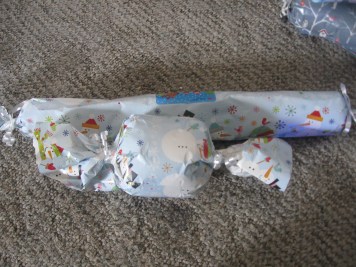
  3. Clothing doesn’t need to be put into cereal boxes or purchased gift boxes which then get thrown away. Roll up your items before wrapping, either long-ways or fat-ways to keep the recipients guessing. img_2023(A son living out of state will be most perplexed by the bulky sweaters his brother lovingly ranger-rolled, army style, before wrapping. He’s hoping for something to keep him warm as he rides a bike for miles each day in the cold rain; he’ll instead think he’s getting useless, soft footballs. Ah, the joy of the holiday season. [cue evil laughter])
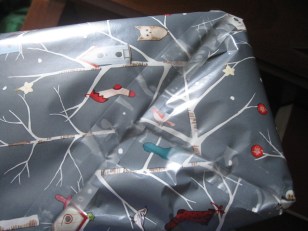
  4. This one’s more of a warning: If you tormented a child in the past by making a highly-anticipated gift very difficult to unwrap, he WILL remember and exact revenge in the future. img_2027(Yes, hubby—this is a gift for you, every edge taped down securely by your 13-year-old son who has a very long memory. And I’ve had to hide the duct tape from him.)
  5. How do you start traditions like that above? Use packing tape to wrap those gifts you want to take a verrry long time to unwrap, AND (this is the crucial part) hide all the scissors. (But if your house is like mine, the eleven pairs of scissors we own are already all missing, and to cut ribbon we’re searching for box cutters, all of which have also disappeared. We’re now chewing on the curling ribbon for that shabby/chic frayed look.)

Packing tape ensures that we can make Christmas morning last until late afternoon, and brings us one step closer to keeping Christmas going all year round which is what all of us are after anyway.

Now get back to wrapping. Here’s some sounds to give you inspiration (or to make your skin crawl):

Perrin snarled. “Why is this here?”
Peto looked at Jaytsy, who was cringing.
“It’s a gift,” she murmured.
“Who gives gifts like THIS?” Perrin bellowed.
~Book 4, The Falcon in the Barn

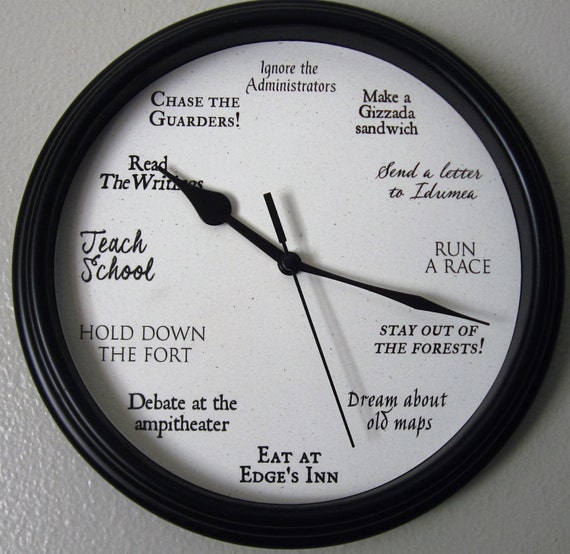
(Get your official Forest at the Edge clock here! In the comments type, “Book reader” and I’ll refund you $5.)

The Forest at the Edge official clock! Idumea clock, Administrator clock, Forest Edge clock

Have you ever considered skipping Santa and getting straight to the Savior?

A recent online debate has prompted me to repost this blog I wrote three years ago. As a child I dearly loved Santa, and was deeply pained to learn he was only a story. As a parent, I wondered if there wasn’t another way to avoid that sticky problem. Well, there is, quite a simple one, in fact:

We don’t do Santa at our house.

anti santa

Now, before you label me a killjoy, call social services because I’m a terrible mother, or weep for my children because I’ve lost the Christmas spirit and am destroying the holidays, allow me to explain myself. Then you can start sending the critical responses.

I promise this won’t be a rant such as I once experienced delivered by a woman who was fond of pointing out that the letters in Santa can be rearranged into Satan. (She was also fond of roasting the opossums that wandered into her yard; I never accepted her offer to sample her stew.) This is an explanation of how we’ve chosen to do something more.

We used to do Santa for our three oldest children (who are now in their twenties) when they were younger, but over the years we’ve distanced ourselves from the magic, tricks, and well . . . deceit. Our six younger children never hear us mention Santa, unless we happen to be talking about a town in California.

As a child I dearly wanted to believe in Santa, despite the incongruities of his origin and abilities. I went to the point of analyzing, as thoroughly as my eight-year-old brain would let me, how he did everything in one night (magic dust, with some sort of cool physics involved), who all the other guys in Santa suits were (secret agents, bugged with mikes and recording devices to send the messages to Santa), and where he lived (under the ice cap—and this was many years before “The Santa Clause” movie; they stole my idea). I also concluded that the version of his origins, as told by the claymation TV show “Santa Claus is Coming to Town” was likely the most accurate, primarily because I thought the name Burgermeister Meisterburger was genius.

Bmmb

(And I also suspected my ancestors looked like Burgermeister Meisterburger.)

I still struggled with aspects of Santa, such as why reindeer seemed a viable mode of transportation, and the fact that Santa’s handwriting looked exactly like my dad’s calligraphy. But I eventually decided that my dad simply changed the tags once the presents arrived because elf writing was illegible.

So it was with utter shock and dismay that I received this news at age nine, casually delivered by my mom: “You know Santa’s not real, right?”

No, I did not!

In fact, I’d wrestled with this so-called truth for years—since I was five, at least—to make sense of a man of magic when I knew—knew—there was no magic.
So the whole Santa-thing was really a trick?
And the entire world was in on it?
What was the point of that?!
Why did all the TV shows and movies and stores and schools and even church, of all places, perpetuate the mythology as truth only to eventually say, “Ha! Fooled you!”

I was devastated. Then I was furious.

What other cherished beliefs from my infancy would be revealed as also hoaxes? For many months I worried that something else, something far more important and vital to my happiness, would also be revealed as a scam.

Fast forward fifteen years, to when my husband and I have a child old enough to know about Santa. Suddenly all those feelings of betrayal rushed me when my husband asked, “So how should we do Santa?”

I didn’t want to! I didn’t want to expose my children to the same beloved stories only to find out later they were merely stories.

But, family and societal pressures told us our children had to have Santa, and who were we to buck tradition? So, for our first three children, we did Santa. Visited him, sent him letters, wrapped the presents “from” him in special Santa paper, and all was fine until those kids started asking legitimate questions about his veracity.

Now I had a problem. I had always vowed I would never lie to my children (that’s not the same as teasing, which is a completely different form of torture). When they asked a sincere question, I would always give an honest answer about everything, from the Tooth Fairy to what Daddy means when he waggles his eyebrows at me.
(“Um, that means we need to talk. In the bedroom. Choose a movie—any movie you want.” Ok, so my honesty is relative.)

But the Santa Really Exists (SRE) movement meant I had to lie to my children, if only to protect their innocent friends from the reality. And I hated that.

So, after a few years of this moral quandary, I told my husband I simply wanted to quit Santa at our house—who were we to buck tradition? Whoever we wanted to be!—and happily he agreed. Since then, we’ve never regretted the decision to focus on our family and friends, and not even bring up the old fat man in red with an odd laugh like garden tools.

What are the benefits of not participating in SRE?

First, Santa doesn’t come off as a jerk. Trying to explain to my children the disparagement of Santa in delivering toys made me feel like a fraud.
“Why did the neighbor kids get a lot more from Santa than you did? Uh, you see, Santa doesn’t actually make the toys; he’s like a Secret Shopper. He buys the presents, wraps and delivers them, then sends us the bill. Yeah, that’s right.”
That was the only way to explain why our budget for each child was $45, while the neighbors had a budget of $300 for each kid.

My children accepted that answer until the year we were in a position to do a Secret Santa for another family. They eagerly helped us choose and wrap presents, but then the unavoidable question arose: “Why isn’t Santa shopping for them and just donating the presents?”

“Well,” I invented wildly, “he’s asked us to help him because, um, he’s too busy—”

“What, buying presents for the rich kids?” my eight-year-old daughter asked cynically.

I didn’t have an immediate answer for that. No matter what kinds of stories and explanations I created, Santa came across as a self-serving jerk whose services were available to the highest bidder. That’s not the spirit of Santa.

Second, we don’t have to lie to our children. By not playing into the SRE game we don’t have to keep up the façade that, something that I’ve always taught my children isn’t real, suddenly is for the month of December. Don’t get me wrong, we enjoy fantasy and magic—Harry Potter, Narnia, dragons and Merlin—we’ve got all the books, movies, costumes and games, and it’s fun and serves a purpose, but just not in the real world.

In our early parenting years we frequently struggled with juggling the mythology of Santa with the story of Jesus Christ, who we hold as reality. Once one of our children even said, “My friend at school said Santa is just your parents. So what is Jesus?” The notion of magic and miracles was so confused in her first grade mind she wasn’t sure what to believe.

And that bothered me, to my core. That was precisely what worried me as a nine-year-old. I had even decided, when I still believed in Santa, that on some level Jesus and Santa were related, and shared priesthood power and magic to accomplish Christmas.

Then Santa was revealed to be pretend, and so what about Jesus Christ?

For more than a year I paid very close attention in church each Sunday (well, it’s one way to get a kid interested about religion), waiting to hear something that would suggest that Jesus Christ and priesthood power were also just convenient and “fun” little lies. In fact, an acquaintance of mine who became disenchanted with all organized religion and the notion of God, told me the seed of that was planted when he learned Santa wasn’t real. It was society’s aggressive tactics to preserve this imaginary man, and the lengths to which everyone bought into the lie, that shocked him and led him to believe that everything is, at its heart, a hoax.

But I knew, in my heart, that Jesus Christ was not a hoax. After that year of deep ten-year-old introspection I developed a testimony of my Savior. I still believe in Him, and in my Heavenly Father, and in the Holy Ghost. I have felt them too many times influencing my thoughts and decisions to pretend my conscience is that clear and forward-planning. I have experienced miracles and even seen the laws of physics altered on two occasions to prevent potentially fatal car accidents. I have heard whispers, felt nudgings, and even once encountered a gentle cosmic slap upside my head trying to knock me into awareness when I was particularly hard-hearted.
God is real and involved and intensely worried about our welfare. Santa, however, is not.

I didn’t want my children facing those same troubling questions about what is real and isn’t, especially at such tender ages, so we quietly abandoned Santa a dozen years ago. When my children ask me the hard questions, such as if the Tooth Fairy is real, I answer with, “Is the Tooth Fairy magic? Remember what I’ve told you: magic is only pretend and for fun, but the power of the priesthood in Jesus Christ is very real and very powerful.” They don’t worry about magic anymore, because they have something better.

But, you may fret, what about the Spirit of Christmas? The Spirit of Santa?

Someone once remarked that Santa is the Savior in costume. That got me thinking: why not cut out the middle man and get straight to the Savior? We don’t need to be “Secret Santas”: we can be something grander, realer.

In other words, why not let Christmas be the time that we try even harder to be . . . like Christ? It’s His birthday we’re celebrating, after all. Why not celebrate it by doing what He did?

When you think about it, much of what we do in the name of Santa is what the Savior did and taught. Want to help that single mom down the street? Do so, and in the right spirit. Think about what the Apostle James wrote in describing pure religion: to visit the fatherless and widows in their affliction. (James 1:27)

Want to bring clothing and gifts to those in need? Visit those who are ill or lonely? Go ahead, and remember who suggested it first (hint: wasn’t Santa). Naked, and ye clothed me: I was sick, and ye visited me: I was in prison, and ye came unto me. . . . Inasmuch as ye have done it unto one of the least of these my brethren, ye have done it unto me. (Matthew 25:36; 40)

Let’s donate, share, encourage, serve, and love in the name of Christ, not Santa.
Yeah, Santa’s a good guy and all, but not nearly as great as the Savior of the world. 

So don’t feel sorry for my children because they don’t have Santa. Oh, they’ll get plenty of presents on Christmas Day from their parents and siblings, along with stockings full of candy and Pringles, and there will be a few surprises snuck in after they’ve gone to bed on Christmas Eve, but if they happen to leave out a plate of cookies, they’ll know they were eaten by Mom and Dad while we put the candy canes on the tree.

Our kids don’t have Santa, but what they have instead are parents that don’t lie to them (well, not about anything important) and a truer sense about the meaning of Christmas.

After all, it’s Merry Christmas, not Happy Santa Day.

“I don’t hold with traditions just for tradition’s sake. I’m rather progressive that way.”
~Perrin Shin, “The Forest at the Edge of the World”

Your Christmas probably won’t be “traditional” this year . . .

I predict that this Christmas will be different for you in some way. Either it’ll mark a “last time” of some sort, or a “first time” of another. Perhaps this year someone significant is missing—either gone for a time or have passed away—or maybe someone new has joined your circle of family and friends. New baby, new marriage, departed grandparents or children . . .

But one thing’s for sure: this Christmas won’t be like ones in the past.

How do I know this? Because over the years I’ve discovered that it’s rare to have a “typical” or “traditional” Christmas. While each holiday tends to be happy, there are moments of sadness: sudden, unexpected, poignant sadness when you realize nothing will ever be quite the same.

And here’s how I recommend you deal with happy-sad Christmas moments: let them happen. Let the tears trickle as you remember how things can never happen again. Mourn the difference, remember how you wished it could be again, think about what a “proper” Christmas is supposed to look like (we all have those unrealistic images in our heads, don’t we?).

AND THEN move on and embrace what’s new and good, and realize that maybe these should be considered sad-happy moments.

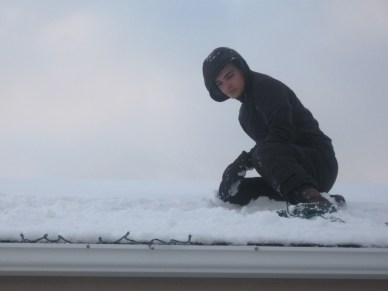
I was filled with these mournful/joyful thoughts as two of my sons attempted to put lights on the house the other evening. My oldest son, who’s 22, eagerly rooted through the Christmas bins and discovered several light strands I wasn’t going to use.

“Then I’m taking these outside!” he declared. I’d forgotten that he loved to put lights on the house, because the last time he did was five long years ago, before the army, before his LDS mission and his stint working the oil fields of North Dakota.

But this year—THIS year—he was home to make my house glow.

img_1951

And I was overwhelmed with happy sadness by that, because I know that next year—NEXT year—he won’t be putting lights on my house. He’ll be married in a few months, and then we’ll be moving 2700 miles away from him.

But today, I held on to the happy part. He dragged his reluctant 16-year-old brother to help him as the sun set and the cold grew to get lights on top of the snowy house. “Come on. Outside with you,” he ordered his brother away from his computer game.

Age 16, grumbling as he put on his snow pants, said, “Why am I doing this?”

“Because,” age 22 told him, “it’ll teach you to be a man!”  (Since he’s been in the army, age 22 has decided that everything unpleasant teaches you to be a man.)

“But this isn’t necessary,” age 16 countered.

“Yes, it is,” insisted age 22. “We have to prove our house is better than the neighbors! Up the ladder, now.”

I grabbed my camera, knowing that this would likely never happen again, my two sons squabbling as they put up lights for the first time together, for the last time together.

img_1958

(Another reason he didn’t enjoy being up there was because I was taking pictures.)

Nearly every Christmas has been something different. I realized some time ago that we don’t know how to have a “proper” Christmas. A cursory count has revealed that we have:

  • Celebrated Christmas in 12 different houses over the past 28 years;
  • Once had Christmas at the beach (that felt so wrong);
  • Twice celebrated Christmas a full week AFTER the 25th, because some family was working in other states (yes, the presents just stayed under the tree until the 31st, and I got all the Christmas candy on sale);
  • Once celebrated Christmas a full week BEFORE the 25th, because we’d be out of town during the holiday (yes, we opened everything very early);
  • Three times have had newborns at Christmas (ok, one came four days later; and yes, fully 1/3 of our nine children have been born in December. I have no sense of planning whatsoever.)
  • Three times had our lives in boxes during Christmas, and had to search a storage unit for a bin of decorations to make the temporary home feel like ours again;
  • Three times had in-laws staying with us;
  • And this year, we will have a teenage Chinese national staying with us to experience a crowded, noisy Christian Christmas (not intending to traumatize the boy, but it’ll likely happen anyway).

“Traditional” and “proper” don’t really show up to our Christmases. One of the years when we had postponed Christmas, I was hospitalized with hemorrhaging on the 28th of December. The nurse treating me said it was a good thing the emergency happened after Christmas, and I told her that we still hadn’t celebrated yet; we would open all our presents in two days. Then she gave me morphine for the pain, and I died right after that because no one knew I had a deadly reaction to morphine, and the ER staff kindly revived me again, and I spent our postponed Christmas laying on the couch at home eating steak to try to rebuild my depleted iron stores.

Not all Christmas activities are worth making into annual traditions.

We start new traditions and forget old ones, bring in new family, and say farewell to others. Bid goodbye to beloved houses, set up the tree in new places. And that’s all ok.

I took these photos eight years ago at an extended family Christmas gathering, and knew then that it’d be the last one. My sister, mother, and father in these photos have all since passed away.

1227-08-mom-and-dad  12-27-08-jenny-richard-judy-kevin

Even as I reviewed the photos that night, I began to weep, knowing that was one of the last times our family would all be together, and that Christmas would look different in the future.

Occasionally I envy some friends and neighbors whose Christmases are the same every year. They always visit grandparents, or have a cousins gathering, or spend the day with extended family doing the same things. Solid, reliable traditions . . .

But not us. One year, we skyped with my husband who was in three states away as we opened half our presents. It was like having Christmas with an Artificial Intelligence unit in the house.

047

This year we’ll hurry through opening presents in the morning, then drive two hours down to our daughter’s church to attend the service with them, and have a chili dinner at their apartment afterward. We’ll never do all of that again, either, because we’re all parting ways next year, I have no idea when I’ll celebrate Christmas with my two grandchildren again. We haven’t been grandparents long enough to establish any traditions that our moves can destroy. Happy-sad.

The other night as my sons called me to come outside for inspection, I looked up and smiled at this new tradition that would happen only once: brothers lighting the roof together. They plugged in the lights, and there was a minor Clark Griswold moment when age 22’s section over the porch didn’t come on. But age 16 smugly announced, “Yet all of my lights are working, thank you very much.”

img_1954

As he descended the ladder, loudly muttering that none of this was necessary, and age 22 went back to inspecting his dark half strand, I thought to myself, “Yes, all of this was necessary . . . for me.” Only moms know how vital it is to see our kids working together, creating a brief yet deeply felt memory that maybe only mom will remember.

img_1965

After only a minute of working on his disobedient strand, age 22 got the rest of his lights on, and I cheered.

Some traditions happen only once.

This year, remember that there’s no such thing as a “traditional” or “typical” Christmas. When you find your celebration taking an unexpected or sad turn, embrace it and feel through it. The entire reason we celebrate Christmas is to remember that Christ came as “a man of sorrows, and acquainted with grief.” He understands our joys and our sorrows, and he came to wipe away all our tears.

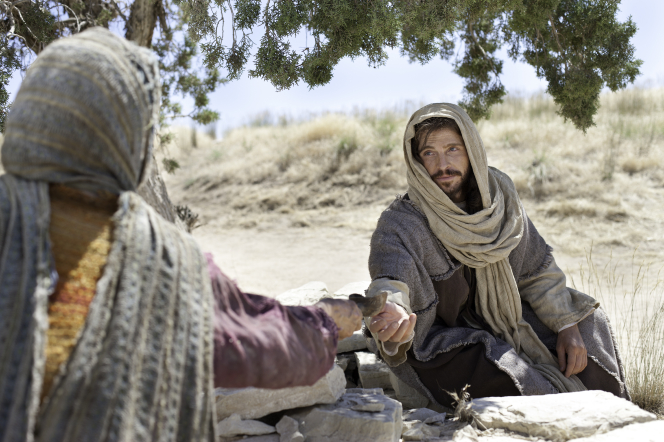
John 4:5–29, Christ accepts water from a Samaritan woman

Let him. That’s really the only proper way to celebrate Christmas.

“In the meantime, enjoy the tradition.” ~Book 5, Safety Assured Leaving East of Medicetti