“An author is speaking clearly and silently in your head, directly to you.”

Until I read this beautiful quote from Carl Sagan (thank you, Grammarly), I didn’t know how to articulate the sensation I’ve felt that I’ve snuck into a writer’s mind, and was welcomed there. But as I thought about it, I realized I’ve “experienced” a variety of authors in such a manner. Tell me if you’ve had similar impressions with these or other authors:

Plato: I approached his writing hesitantly, researching background about ancient civilizations, when about two paragraphs into the chapter I felt as if Plato himself had come into the room to have a chat. In my mind he was a small, narrow-bodied man wearing a white tunic and sitting on plain stool. He smiled as if glad to see someone else was coming “in” for a visit, and he wanted to help. He pointed out sections, waved for me to skip other parts, and cheerfully gestured to a chapter he knew I’d particularly enjoy. Then he sat back and smiled as I read, waiting to answer questions he’s known the answers to for thousands of years.

 J.K. Rowling: Reading her feels like a group activity, a sense of sitting on the floor on comfy cushions (a la the Room of Requirement) with about a dozen others of all ages and sizes—and no one cares that we seem too old to do this—while our friend Jo sits on a soft chair, but at the very edge of it, reading to us her stories and getting all of the voices just right.
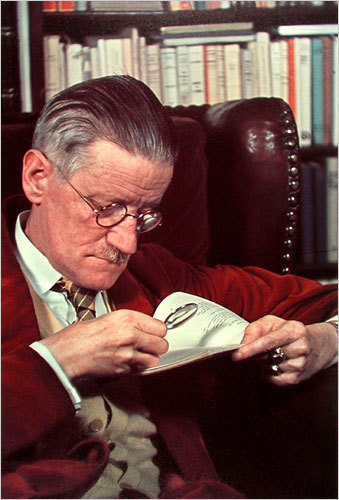
James Joyce: I’ve wandered a few times into Mrs. Dalloway to find Mr. Joyce sitting in the corner rattling on and on, only distantly recognizing I was there as he gestured to the wall and talked to the ceiling, until I quietly slinked out again and closed the door. I don’t think he ever noticed.

Hugh Nibley: This scholar and philosopher stands at a podium in a lecture hall, while I sit near the back frantically taking notes as he reads his words at break-neck speed. But I have a remote control, and every minute I zap him to pause his lecture, rewind, listen, then flip to the extensive footnotes while Professor Nibley waits, just on this side of patient. I bite my lip as I read the footnote, realize it introduces yet more names and archaic traditions I’ve never heard before, so I shrug, occasionally write down a reference to Google later, then hit “play” again, pretending all the while that even though I just sit on the surface of his topic, I understand the depths to which he’s diving. We both know I can barely tread water.

Flannery O’Connor: She tells me her stories as we wash dishes in the back kitchen of a large southern plantation home, and we snigger when the ladies with fancy hats walk past the window.

Shannon Hale: She tells me her stories as we drove up through the canyons in a big SUV to take the teenage girls from our church on a camping trip, because I met her at a book signing where she told me she also loves Terry Pratchett, and I knew right then we could be great friends.

J.R.R. Tolkien: He sits behind a grand desk, leaning back leisurely and gestures to maps on his walls and charts on the desk, while talking in an oddly lilting monotone about details and histories and peoples I’m not quite following until I fall asleep. Guiltily I shake myself awake a moment later, only to realize he never noticed I nodded off—he’s enjoying himself far too much. My daughters, however, glare at me in disgust.

Stephen King: Because he starts his stories by turning out all the lights, then shining a flashlight in his face, I slam shut the book just as he opens his mouth to speak, and I move on.

Lao Tzu: He’s a sweet, gentle man, forcing me to sit in an expanse of sand while he teaches me his verses of philosophy. Much like Oogway in “Kung Fu Panda,” he speaks slowly and repeats himself until he sees a light of understanding come in my eyes. Then he hands me a peach, and recites me another couplet about war, and fighting, and peace, and knowing.

Jane Austen: We sit primly in her parlor, with arms folded just so and skirts adjusted in just this way, and glance furtively at the door for someone wonderful or dreadful to come through it, while she tells me all the news of the town as quickly as she can before either of our mothers can interrupt us.

Jessica Day George: We sit in the back of some dull meeting gossiping quietly and giggling, hoping no one hears us, but knowing the speaker is glaring right at us.

Orson Scott Card: I actually sat in two meetings with him! At a small private college in Virginia! But I never spoke to him! And he never noticed me! And when I finally read Ender’s Game, I felt as if I was huddled in the corner of that classroom with his book, and he was watching me out of the corner of his eye as if to say, “It’s about time.”

PHOTO MISSING,

TO PROTECT THESE  NEXT TWO AUTHORS FROM SCORN                               

(because I’m sure they’re both just as lovely as can be, but create utter drivel)

Authors who will remain anonymous, but have a fondness for writing about males that turn into animals and woo silly teenage females: I gritted my teeth and cringed through these authors first books, as if I was stuck on a long bus ride behind two chatting women telling each other far too many details about their fantasy love lives. I closed my eyes periodically hoping to avoid gooey passages, only to run into other sections that not only made my eyes roll but caused me involuntary gagging. I got off the bus at the earliest possible moment.

Terry Pratchett: My all-time favorite author who I visit frequently. He lets me right into his mind, which is most intimidating and most marvelous. Every time I want to turn left, he shifts me to go right; I look down, he points me up, and I sigh and wish I could think of such turns. He takes characters, sets them in front of me, then describes them in such terms that I despair, because I’ll never come close to writing like that. But he just chuckles, grabs my arm, and drags me to yet another amazing place until suddenly I stop and say, “I just had an idea . . .” To which he smiles and waves good-bye until I come back again, because it’s not about being better than him, or even as good as him, but about discovering what I want to say.

“She knew that in a very real way, she controlled the world. At least, she controlled the way her students would see it.”

“That’s right, sweety—that’s a dog. Doggies are bad. They will always bite you, even if they look nice. Keep walking . . .”

That was the conversation I overheard between a mom and her three-year-old daughter yesterday. I was pushing my son in a stroller past them, and glanced over at the evil beast behind a massive fence.
It was a small, fluffy mixed breed dog, panting happily, not snapping at all.

Not that I’m a huge fan of dogs—I tolerate them, at best—but I worry when an adult passes along their fears, irrational or not, to their children.

I cringed, but the damage had been done.
The child shuddered obediently and gripped her mother’s hand as they rushed home. The girl had been indoctrinated.

The thing is, we all indoctrinate our children, in good ways and bad.
I’ve heard some adults argue that “religious nuts” brainwash their kids into believing in their faith, but it’s still propaganda when adults persuade children to not believe in anything at all.

As parents we literally present the world to our children—a view which they then spend the rest of their lives believing or disproving, or talking to a therapist about.
A difficult question then is, What view of the world have I given to my children?

My mother was a classic case of paranoia run amok. Suffering in Germany as a child during WWII, losing her parents, her grandmother, and several cousins to the war, seeing some of her family interred in concentration camps, then escaping from her home (now a part of Poland) to the west by herself as a 16-year-old, just one day ahead of the invading Russians, is going to leave some scars.

Unfortunately, she refused to have those scars looked at, insisting every time we tried to get her treatment for her Post Traumatic Stress Disorder that she had things under control.
She didn’t.
She feared the world. She was afraid of people in uniforms (she hated the Boy Scouts—just like Hitler Youth, she claimed), people in stores (you never know why they’re looking at you), and people just chatting in the halls at church (she knew they were gossiping about her). Every person was a potential threat to her happiness, as it were.

Sometimes she was fine, going for months being cheerful and even joining in the conversations with other women in our neighborhood.
Then suddenly something would snap again—we never knew what the trigger was—and for many months and even years she was sure everyone hated her for her German accent, and that someone was coming to get her.

All of that rubs off on a kid, and even though I learned to distance myself from her delusions and paranoia as a teenager, I still feel my chest tighten when I see a group of women and I think I’m supposed to talk to them.
But rhetoric courses I took in college demonstrated how each person views the world in a different way and, most importantly, those views can change.

In my mom’s later years, her paranoia blossomed—one of the lesser-common side effects of Parkinson’s disease is hallucinations. And she did them magnificently.

My 40th birthday will always be memorable because she called to wish me a happy birthday, then said, “Well, your father’s all but out of the family now since I discovered he’s been having affairs.” The man was 78 at the time. My mom also complained about the listening devices in the house, the person living in the attic demanding sugar, and the horrible statue garden my brother and his wife had put up in the backyard.

My older sister called me two hours later to say, “I just had Mom committed to the mental hospital to stabilize her. How’s that for a birthday present?”

Now, four years later, my mother barely knows where she is or who she is. As her life slips away, I mourn for her that she never fully knew just how wonderful it could be. The world held her hostage since she was a little girl. She never knew how to change her view of the world, nor did she fully realize that for the past sixty-plus years she had a very easy life. All she could focus on was her fear.

That’s why I cringed when I heard that mother yesterday telling her daughter to be afraid of dogs. Undoubtedly she’s had some trauma in her past that she never got over, but to pass those fears on to someone innocent?
To taint an entire collection of creatures with just one ugly color because of a bias?
To assume that we as adults truly know how everything is, and that we’re completely correct in all our assumptions?

I don’t know whether to call that prejudice, or arrogance, or ignorance.
Whatever it is, it needs to be resolved to give our kids a fair and fighting chance.
And that’s probably the toughest thing for a parent to do.

“Meme-fail” The world’s worst advice, available everywhere.

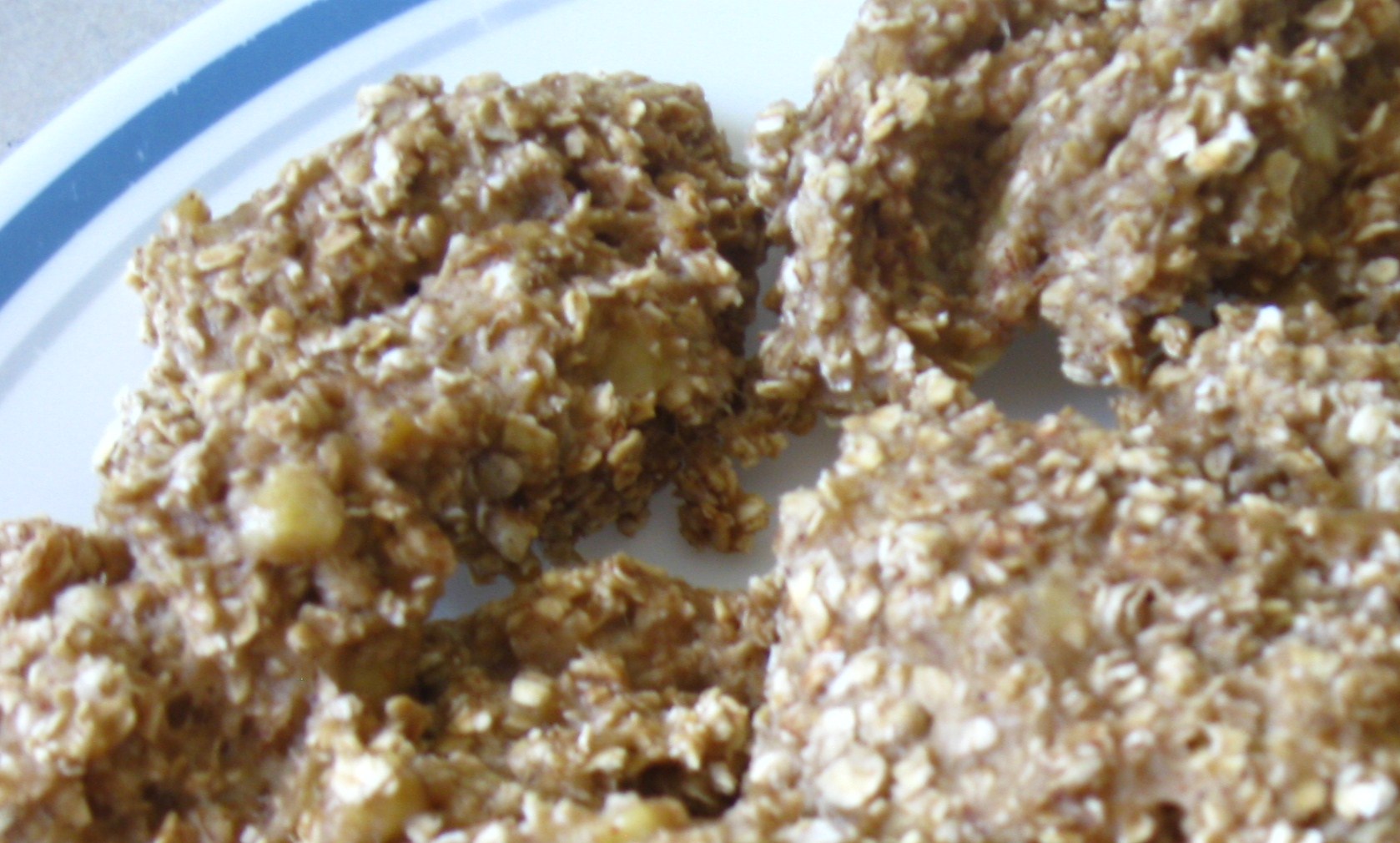
You’ve heard of “Pinfail”?  Pinterest items that look oh so good, but work out oh so bad? That’s because everyone has a fancy camera and access to photoshop. Check out my experience this morning. On the left is what these banana oatmeal cookies are supposed to look like (since when does baked banana look yellow?!). I purposely left off the recipe to keep you from making the same mistake that I did–believing a photo and text.

On the right is what I came up with. They taste much worse than they look. too. I was suckered, but no more.

banana pin fail002

I’ve decided we also need to acknowledge “Meme-fail”—those moving quotes and self-affirmation in cutesy fonts over photos that, when you really think about it, are some of the worst bits of advice out there. Unfortunately we get suckered into believing trite bits of philosophy and squishy motivations.

Memes are addicting, I know. I’ve tried my hand at a few just for fun, and something empowering happens when you see text on photos.

Suddenly it seems real, official, sanctioned, stamped-of-approval, God likes it so it MUST be true!

The problem is, nearly any idiot can create them (I submit, for your consideration, me. If I can figure it out, anyone can). Many of these idiots don’t understand punctuation or spelling, thus propagating the myth that they aren’t necessary because these “real, official, sanctioned” nuggets of crapology don’t use them correctly, therefore we don’t need to bother with grammar either.

But that’s a rant for another day. Today I present just a few of the memes I’ve collected that fail to be worth the space they hoard on Facebook and Pinterest. Not only are they potentially dangerous, they’re potentially stupid-fying.

The “Unrealistic Expectations” category

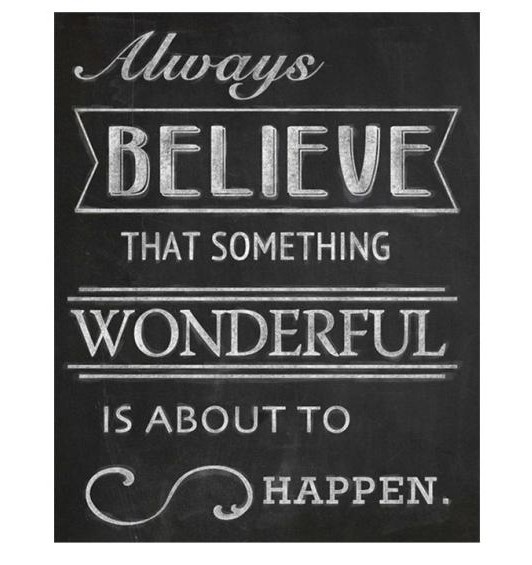
bad meme 1

The cool fake-chalk writing aside, what this really means is, “Always set yourself up to expect far too much.”

What kind of “wonderful” should I believe will happen when I go grocery shopping? That someone ahead of me will pick up my $150 tab? And when that doesn’t happen, how do I face the rest of the day?

Something “wonderful” should happen when I changed a dirty diaper? When I cook dinner? When I pull weeds? If I’m expecting something “wonderful” to happen at any moment, I’m going to be hopelessly depressed at the end of what was probably a very ordinary and perfectly lovely day.

I don’t need to throw myself into despondency, thank you. Memes in the category below do that already for me.

The “Look at me!” category, for those who never quite outgrew grade school affirmations.

bad meme 2

Ugh—the very definition of narcissism. This must have been taken from the t-shirt of a self-absorbed teenager. If you have a friend who posts this, run far away. While I can think of several ulterior meanings to this, the implication is: I’m really quite perfect as I am. You should love me for my amazingness. What, you don’t feel perfect right now? Oh dear, must be hard to feel like you have to improve yourself . . .

The “I have no idea what life is really like” category.

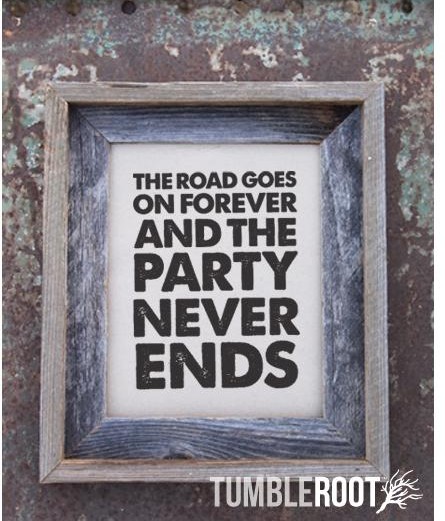
bad meme 4

I once had a freshman student from Japan. On the second day of school he informed me he was withdrawing and going back home. Why? Our small private liberal arts college was nothing like the American movies he saw in Japan. He truly expected life would be a party.

People who believe this are also the same depressed ones who think something “wonderful” is about to happen just down the road. No wonder many people start drinking in college . . .

The “Dangerous thinking” category

bad meme 5

Uh, but what if something needs to be fixed? Attended to? Resolved? Pondered over? Just let it go, dude?

Why do I picture a hippie with smoke rising faintly from different orifices when I read this?

The “Pointless philosophy” category

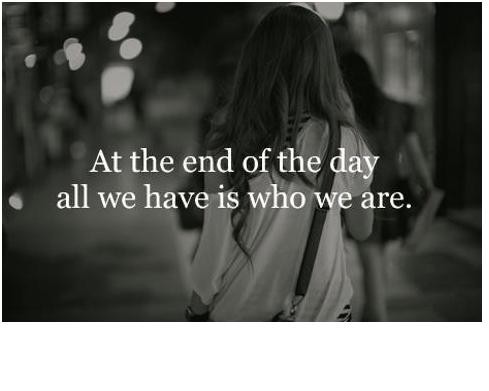
bad meme 6I still haven’t the foggiest thing as to what this is supposed to mean. And I don’t have smoke rising from any orifices, either. Some memes are just that . . . what they are at the end of the day.

The “Worst love advice” category

I have two for this one, because there are so, so many of these. Likely based on sappy love songs that never quite make any sense, the first is so schmaltzy it isn’t worth the post-it note it allegedly was written on.

bad meme 3

This second one–well, you just know she owns a t-shirt that claims she loves who she’s becoming. I doubt with this much self-love there’s little room for anyone else.

bad meme 7To be honest, I hadn’t the foggiest idea who Carrie Bradshaw is. So I Googled her. Turns out she’s been googled, along with a few other strange things, because she’s a “Sex and the City” character. I can’t think of a worse place to get one’s love advice.

Memes–the scary part of these is that people perceive these bits of advice to be true. Reality and thought don’t even enter in. We see a clever font, a charming photo, and we assume that equates TRUTH (yes, capital letters, because so many memes like those, too). This deception of text combined with image likely explains why my five-year-old loved this one:

bad lincoln meme(Sorry the image is small. It says, “The trouble with quotes on the internet is that you never know whether or not they are genuine.)
“That’s Abraham Lincoln!” my daughter squealed. “We learned about him in kindergarten! He’s a good guy. That’s why he likes Star Wars.”

Now I fear that Abraham Lincoln and Star Wars will be forever connected in her little mind, all because a meme told her so.

Got any memes that make you scratch your head? Send them to me. I still have so many, I’ll be doing another post of them, and I’d love to add yours. Remember–a meme is a terrible thing to waste.

Reading is bad for you.

Shockingly, it’s not.

Reading is a waste of time. Hazards of reading. Drawbacks of reading.

I  Googled these phrases and many others, trying to see prove reading is a bad thing. I’ve been feeling guilty lately about how much time I spend reading, and writing stuff to read, and reading about people reading, and reading about people writing . . .

(Fortunately I have an internal switch that goes off at 4:30pm and says, “Where are your children? Have you thought about dinner?” And I momentarily think, Wait—I have other responsibilities? That switch also goes off at about 11:30pm telling me to go to bed. Sometimes I get it confused with the buzzing sound my keyboard makes when I’m drooling on it.)

But I couldn’t find anything serious or thoughtful that warned against reading.

So you know what that means? There’s nothing guilty about the “guilty pleasure” of being stuck in a book!

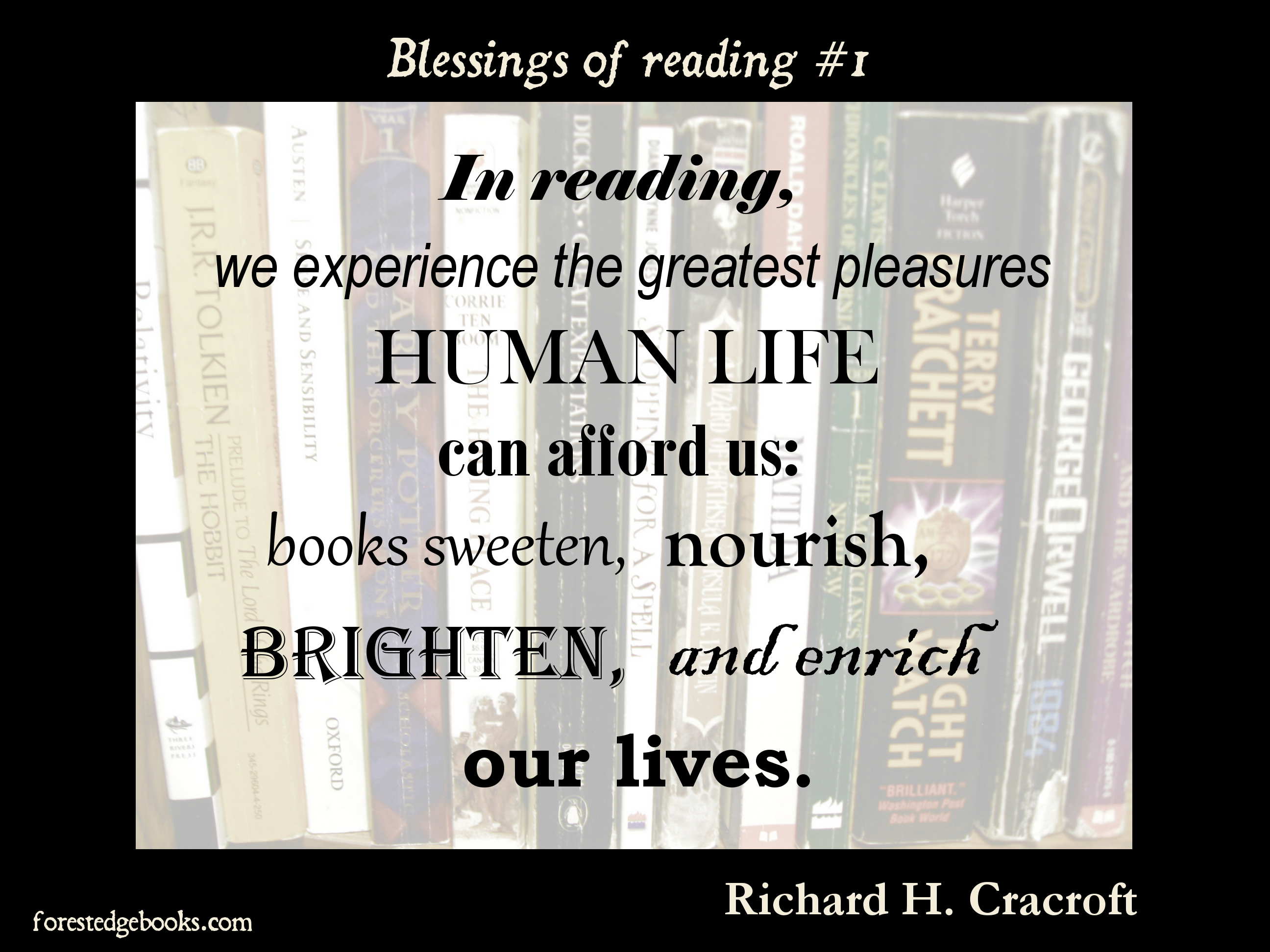
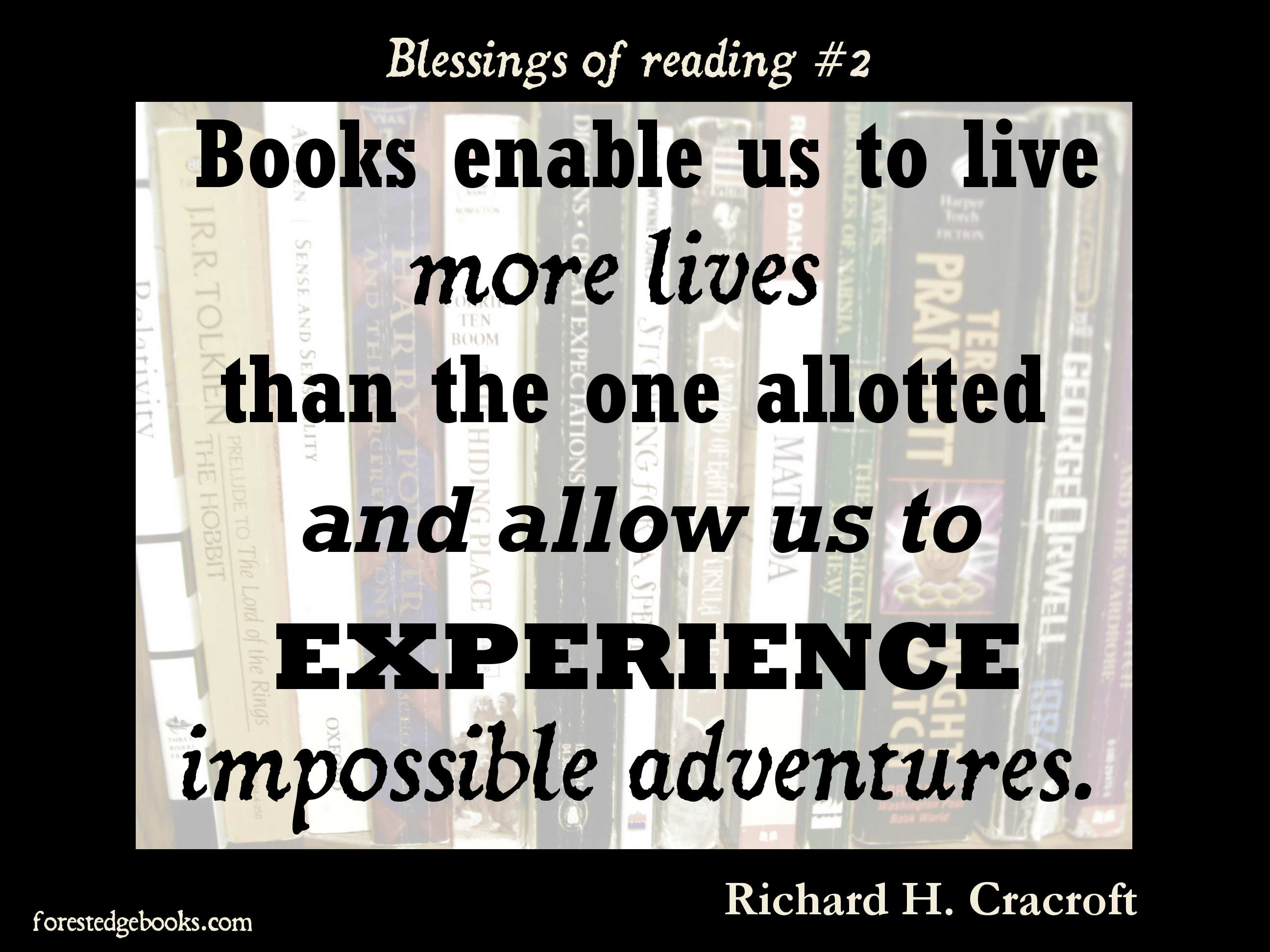
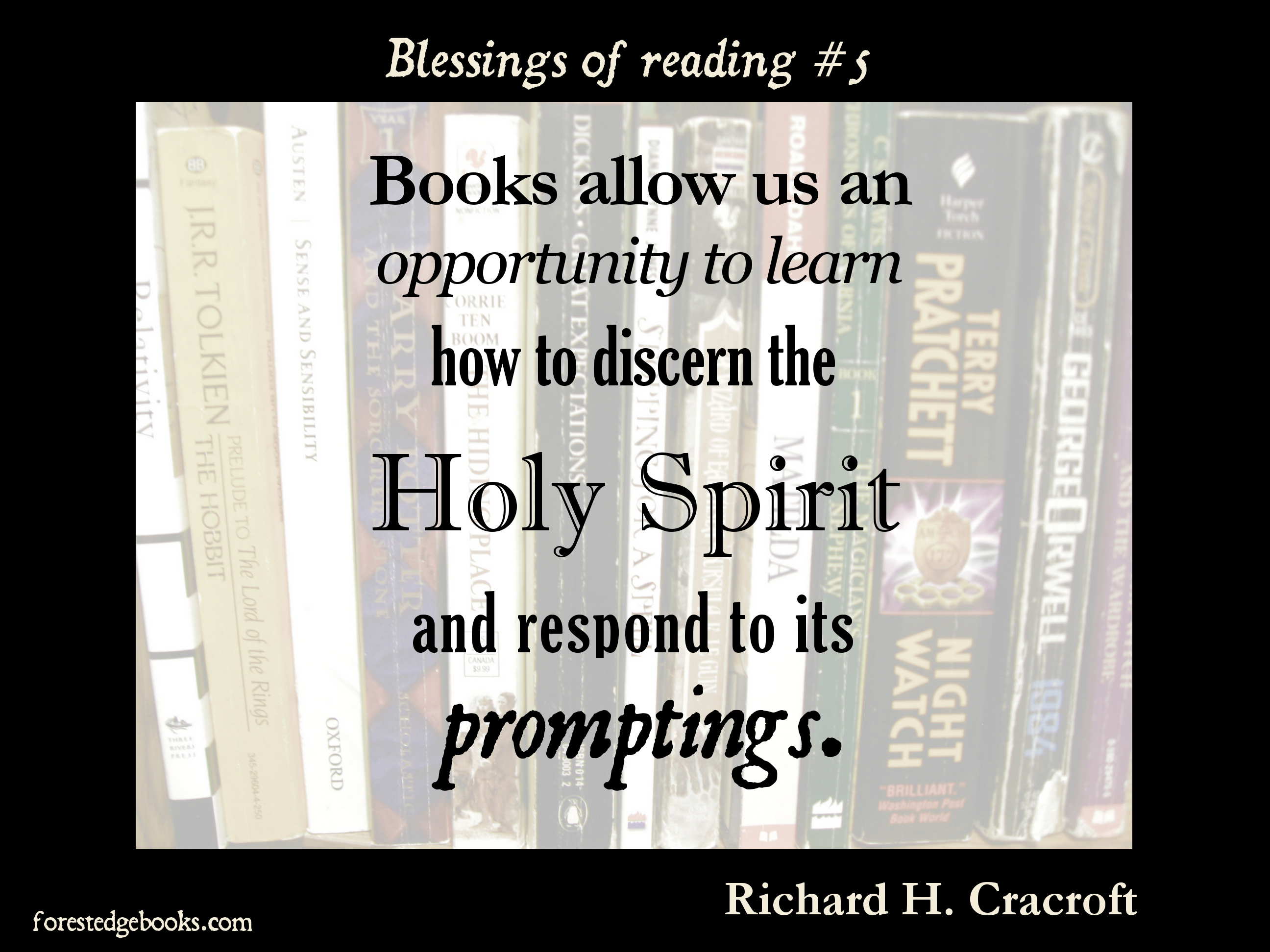
I stumbled across this wonderful piece by former BYU professor Richard H. Cracroft, giving all of us book-nerds more reasons to be anti-social. He lists 5 blessings that come from reading, so the next time you feel guilty about reading or writing, remember—you’re just getting blessings.

cracroft 1


cracroft 2


cracroft 3


cracroft 4


cracroft 5

“Just tell them that underneath it all, despite what they may see, the sky really is blue and they can count upon that fact.”

There’s no creature quite so arrogant and simultaneously so insecure as an 11-year-old. I learned this many years ago when I was asked to drive a group of 11-year-olds for a church group because I owned a station wagon. (Yes, I owned a station wagon at age 25, and was proud of it! I also owned one at 16, but that’s another post.)

So, with a carload of boys I didn’t know, I set off to deliver the group. Soon one very loud, very authoritative kid with unruly hair and far too many freckles announced, “Hey—here’s a riddle. What color is the sky?”

001Obedient, and bored, the other boys looked outside—

“HA!” shouted Hairy Freckles, “Got ya! Everyone knows the sky is blue! Suckers . . .” He added that last part with the same disdain I’d heard from his 14-year-old brother, who likely pulled the same trick on Hairy Freckles.

The other boys embarrassedly looked down at their hands. But I glared in the rearview mirror.

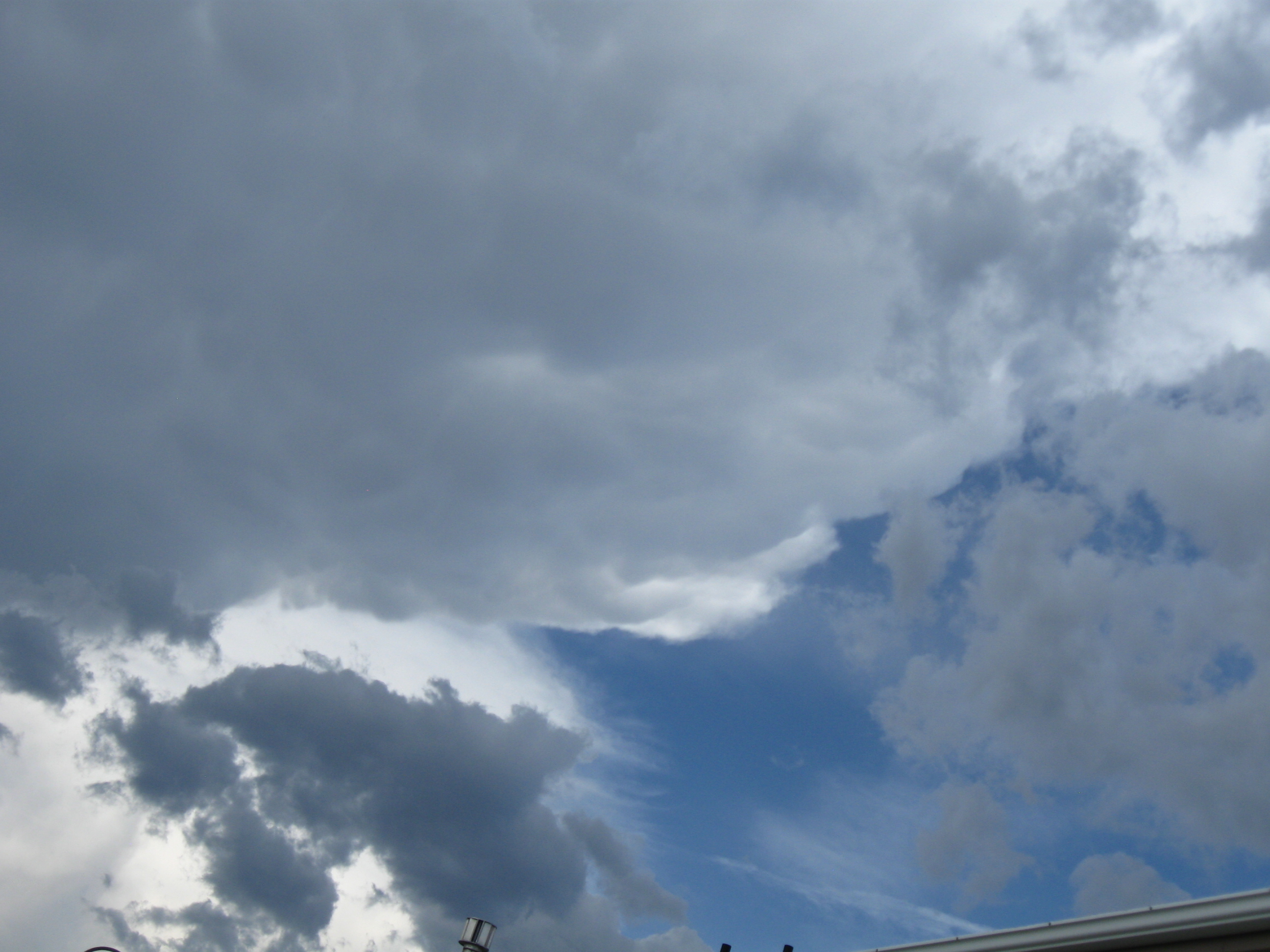
029“That’s not true,” I said plainly. “That bit—right there? That’s white.”

Hairy Freckles scowled and looked out the window, which he hadn’t done since he’d entered the car. “That’s a cloud!”

“And it’s not blue,” I nodded.

A couple of the boys, previously shamed, now hesitantly smiled.

006“That doesn’t count!” Hairy Freckles declared and gave me a look that said, If you were my mother, I’d have you put into a home.

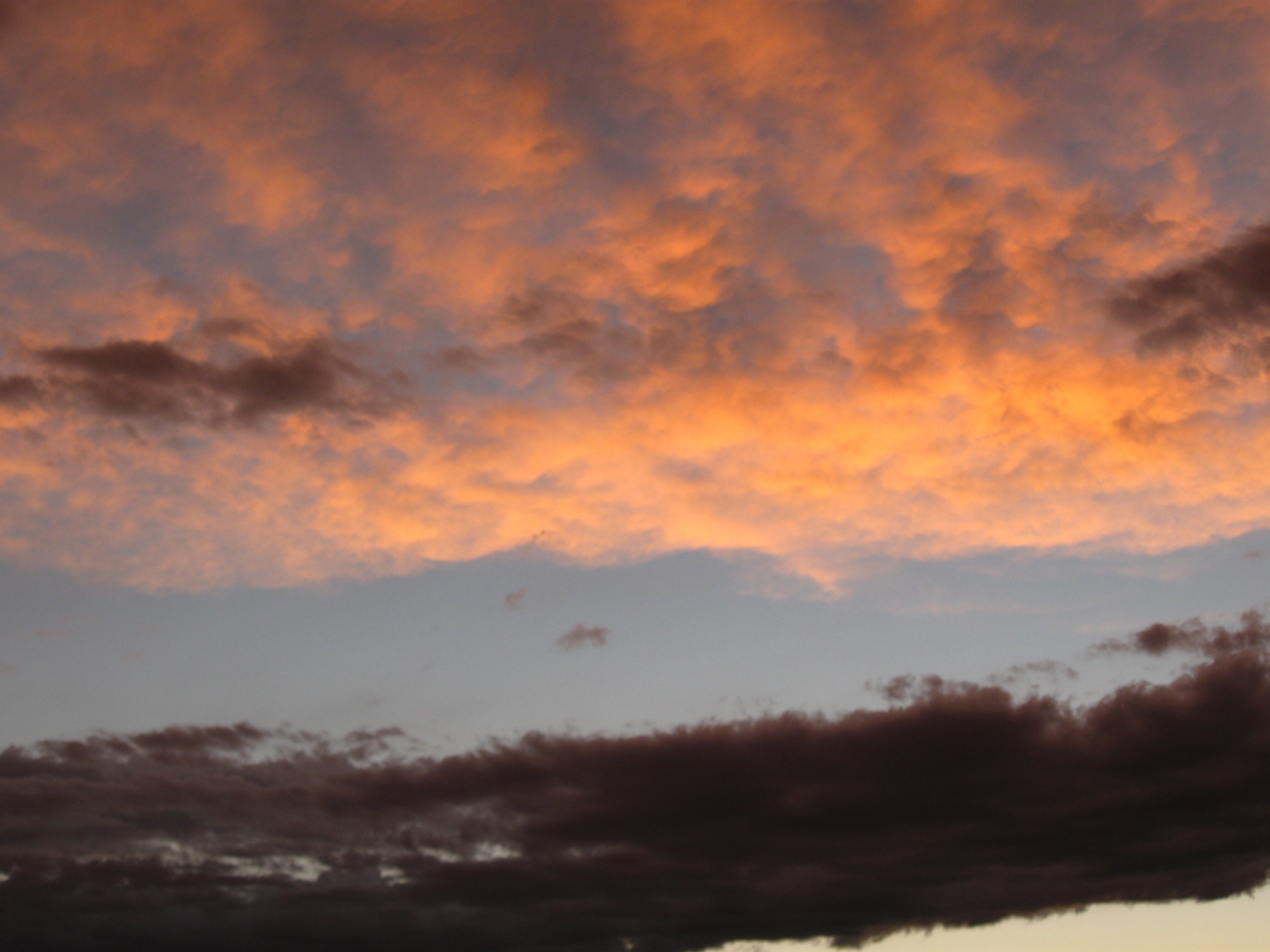
“And that, right there,” I pointed out the window, ignoring him, “that gray bit with some red? Also not blue.”

“That’s a plane!”

“And it’s in the sky, part of it, and it’s not blue,” I said.

005Now all of the boys were smirking at their friend. Nothing’s worse than being put into your place by a know-it-all 25-year-old college student. Who’s female.

“Now, when the sun sets, ooh—definitely not blue,” I continued.

019 (3)“And what about night?!” another boy finally felt brave enough to contribute. “There’s definitely no blue then!”

The rest of the boys howled as if that was the funniest joke in the world, while Hairy Freckles glared at me through the rearview mirror.

“And then there’s that big bright ball of white,” I went on.

002“That’s the sun!” Hairy Freckles pointed out. “And it’s yellow!”

“No, it’s not,” I said easily. “It’s white. They just make you use yellow crayons in school to color it because your paper is already white.”

None of the boys knew what to do with that, even though they peered at it to make sure, then blinked away the fact that they just scorched their retinas.

“Hey, I just got Donkey Kong—” and just like that, the conversation turned. Because hey, these were 11-year-olds.

I’ve always been obsessed with clouds and sunsets, and since then I’ve taken dozens of pictures as evidence that they sky is NOT only blue. Yet I never cease to be amazed at the amount of children’s books, TV shows, movies, and even textbooks that simplify the complexity of the sky to declare, “The sky is blue . . .” when anyone  can tell that it’s much, much more.

011 (2)We do this with so many things, just like the middle school textbook my oldest daughter had in science one year that said, “Ocean water is made up of two things—salt, and water.”

“Rubbish!” my 13-year-old had declared, and asked to be homeschooled.

And I wonder, why? Why do we oversimplify the world, even to the point of telling lies about it—if you want to get that direct—to our children and ourselves? Why do we ignore the multiple colors and shapes in the sky and insist that it’s one color, especially when that color is actually just an optical illusion, produced by the sun’s light rays bouncing back blue?

More importantly, what do we miss when we assume we already know the nature of something, and don’t even look out the window to see if our assumptions are correct?

I suspect we miss the true nature of the entire world.

004


“All our ideas were just as pitifully inaccurate as four year-olds arguing over what kind of baby snake a worm is. “

There are a few conversations you don’t want to hear your children having in your backyard.

“Ooh! Look at all the baby snakes!”

Yeah, that’s on top of the list.

I was in my kitchen when I heard my three-year-old son and his friend in the backyard squeal in fascination. Our house was new, the yard unfinished and bordered on a canal, which bordered on a field, which apparently bordered on the edges of Snake Heaven. And that Heaven was invading.

(It’s just a photo–calm down.)

“Those are pythons. I know. My grandpa showed me baby pythons last week,” the friend said with great authority.

I gulped and quickly made my way to the back porch to investigate the terror. Now, I’m fine with snakes—as long as they’re in a zoo, in the wild, and far, far away from my house and my children.

“I don’t know,” my son, who knows nothing of snakes, said. “I’m thinking boa ’stricker.”

Bravely I marched to where the two little boys were crouched and poking with a stick.

Please let there not be rattling! No rattling!

“Pythons. Definitely.”

I put on an overly happy face—more for my benefit than for theirs—and said with forced cheeriness, “What do we have here?”

The beamed up at me, stepped away, and—

It was NOT baby snakes.

It was FAR worse.

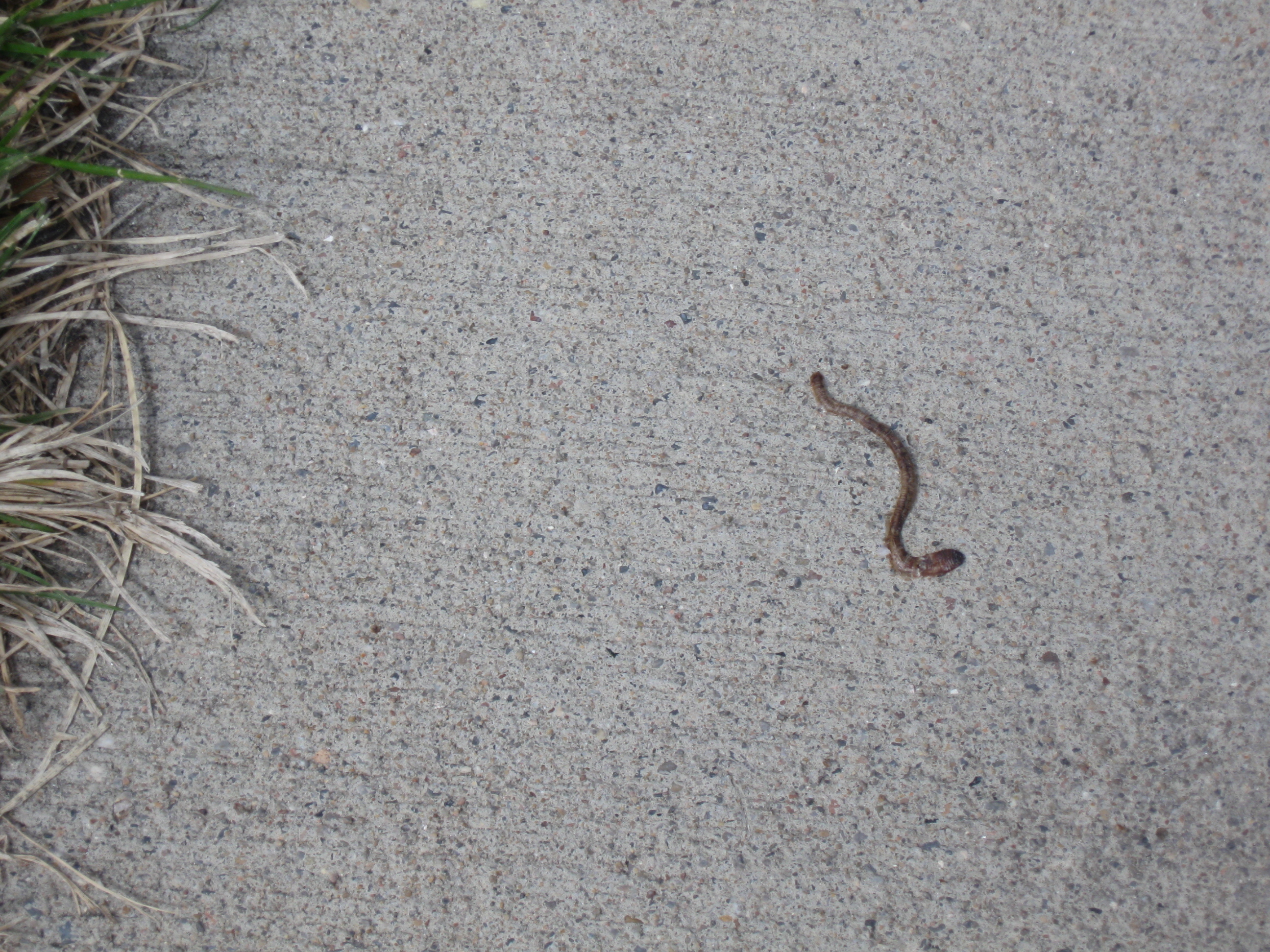
Worms!

(I know, I know–you should have seen me convulsing as I sorted through the images looking for this . . .)

Yes, all right—worms terrify me far more than snakes. The massive earthworms they had uncovered were far more disgusting, slimy, and smelly—yes, they smell!—than snakes.

Oh, how I wished for a hole of rattlers right then.

I took a step backwards.

“Cool, right Mom?” my son said happily. “Strickers, right?”

“No,” I said, fighting back the urge to wretch. “Just worms, boys.”

Worms.

The friend shook his head. “Nope. My grandpa showed me baby snakes just like these last week in his garden. Snakes,” he promised.

I knew grandfathers like that. They misrepresent the world to their grandchildren as a one-sided joke, then wonder why when their grandchildren are teenagers they never want to talk to them.

“No, those are worms. I know. I had to dissect those in 8th grade.” The most traumatic year of my life. Not as if junior high isn’t bad enough, but let’s throw in a handful of worms and make you cut them up!

And people wonder why teenage girls are so moody.

Worms.

I backed away slowly, advising the little boys to leave the snake/worms alone and come in for a popsicle (popsicles are the end-all, be-all of distraction and reward).

Back in the kitchen I tried to fight down the urge to throw up and tried not to think about the many dried up worms that must have been on the driveway. It had rained that morning. That means all cement becomes a horror show, with dried up bits that aren’t Chinese noodles. (When I see bowlfuls of those on salad bars, I feel like screaming, “Dried up worms! Everyone, run away! Dried up worms!)

Image

(Not a Chinese noodle, unfortunately.)

The odd thing is, I was more worried about worms—reportedly useful in gardens, but scientists lie all the time—than I was about the possibility of two little boys messing with a snake nursery. My own bias set me up to ignore a real danger. Snakes were seen in our backyard later in the season. Some may have even been dangerous. But I only recoiled when I saw the worms.

Now, sixteen years later, I encountered not-Chinese-noodles on the ground and again found myself doing the ooky tip-toe dance of “Don’t squish them!”

There are far greater hazards in the world, and I wonder, do I spend more time on things that don’t matter, that aren’t real threats, than I do on the things that are?