To all my high school teachers 30 years ago–I’m so very, very sorry

While I was getting fingerprinted yesterday, I realized I had a lot of apologies to make.

No, I hadn’t committed any crime, except for becoming a substitute teacher for a local high school.

Which means I remembered my high school years and the way I behaved.

No, I wasn’t smoking in the east parking lot, being a vandal, or getting into an other 1980s-teen-movie troubles.

My greatest problem: I was obnoxious, with a capital O-B.

I was sweet and charming (or so I thought) and I would never, EVER shut up.

18209039_10209367617331632_5513879372139381550_o

Gee, which one might I be?

So to all my high school teachers who I interrupted with some clever quip which derailed their excellent explanations or lectures, I am very, very sorry.

I wasn’t clever–I was annoying.

We all know it, don’t bother trying to save my feelings at this point. I’m a grownup now.

PICT0016

Yeah, that girl–the “charming” one.

I did get to apologize directly to my AP Biology teacher about a year and a half ago. I found him online and thanked Doyle Norton for his wonderful lessons (I still remember the ATP Choo-Choo train). Then I wrote, “I also want to thank you for your incredible patience, especially with students like me who never shut up, trying so hard to be funny when you were trying so hard to teach us about the circulatory system.”

Generously, he responded with, “Oh, I don’t remember you being obnoxious.” I’m sure he didn’t remember me at all out of thousands of students, but I’m sure he remembered the mouthy ones, putting them all in a category which, at the end of the day, made him rub his face in exasperation.

18238193_10209367625811844_965545072315164314_o

Dear Doyle Norton even took a busload of his biology students to southern California each Easter. Patience of a saint. Or the madness of a scientist–I’m still not sure which.

I rub MY face in exasperation just remembering what I was like 30 years ago.

So to all my teachers at Viewmont High School–I am so, so sorry. I don’t remember any of you losing patience, becoming angry, or doing anything more than smile with GREAT forbearance at me, and now that I’m your age (and older, I’m sure), I’m even more impressed with the examples you set.

I also need to apologize to my friends, particularly Heather McClure, wherever you are: you not only sat next to me in AP Biology but also AP English, the two classes where my mouth was the mouthiest. I kept up a quiet running dialogue during both classes all year long, and you so very generously, very kindly, would only smile and keep your eyes on our teachers instead of turning around and screeching at me, “SHUT UP ALREADY!”

I would have deserved it if you had.
Did you pass the AP tests?
I’ve worried about that, for 30 years now.
More apologies if you didn’t. It was completely my fault.

I’m remembering all of this as I mentally try to anticipate what substitute teaching will be like, and I’m reminded that we never fully escape our past but usually end up paying for it in some way.

I think I’m about to pay for it this fall, and now I’m praying earnestly for the same great forbearance my teachers showed to me. Because the one thing–the main thing–I remember about my teachers was their enormous kindness.

Even when there were kids mouthier than me (shock!) I remember my teachers’ patience and  . . . I guess it was love. Their concern for us was greater than their need to protect their egos. They put us first instead of themselves or their lessons.

I realize teenagers and times have changed dramatically over the past 30 years, but what hasn’t changed is that children of all ages need to feel loved, need to be treated with kindness, need to have great forbearance shown to them.

I’m praying daily now to develop those essential skills myself, and hope I’ll never have to apologize to my future students for never being kind enough. (But I probably will–I’m sorry. Again. Already.)

    Go bold, Mahrree wrote on the scrap paper late that night.
    She frowned at it.
    It should have been Go boldly, right? She got it wrong all those years ago. But that indicated going somewhere, and what she’d meant was, Be bold.
    But then it would have been, Be bold, or don’t be at all, which was far more fatalistic than she intended.
    She scowled at the paper. Things are so much simpler when one approaches them with the over-confident superiority of a teenage mind.
    Now, as an adult, she finally realized just how simplistic and incorrect her old motto had been.

~Book 1, The Forest at the Edge of the World

What if we just quit bothering with the world? The easiness of essentialism.

What if, instead of worrying about the world and its expectations, we focused on only a couple of key items and let the rest of world just . . . go on its way?

Think about that: maybe there’s only a handful of things we really need to worry about, and as for the millions of other demands the world makes upon us we just ignore them.

Wouldn’t that be amazing?

My friend clued me into “Essentialism,” which redefines minimalism and suggests that we should “discern what is absolutely essential, then eliminate everything that is not.” Greg McKeon argues that we get too caught up in the non-essentials: “non-essentialism is this idea that everything has to be done and that you have to do it all. Everything is equally important so therefore I have to try to do it all. That’s an idea — if I can do it all, I can have it all.”

But what if we don’t bother with doing it all? Why would we want it all anyway?

What if we quit following every news outlet, every fashion, every new-and-latest thing, every competition and demand for our attention, and focus instead on only a few ESSENTIAL points?

We’d be a heckuva lot happier!

Consider how simpler life would be if we:

  • stopped fretting that our houses aren’t up to date (no, you don’t have to put shiplap on every wall),
  • that our kids aren’t excelling in every sport/musical instrument/dance/karate/theatrical production (freeing up afternoons and weekends),
  • that we’re not on top of every trend (anyone remember how fast Pokemon Go came and went? Men’s rompers will go the same way, so don’t give them another thought). 
  • And what if we let the world go on its way . . . without us?

I think about life in the 1800s, how people focused on survival, their immediate family and neighbors, their little communities, and had no idea what the gossip was on the other side of the state or the world. They could think about real things, urgent things, important things.

Whereas we think about silly, petty, and divisive things.

But we don’t have to. We can center our lives on very few priorities and shut out everything else.

So what would those priorities be? How about the only thing that really matters: developing Christlike attributes.

To become like Him is the main reason we’re on this earth, going through this trial of life to see what our hearts really want, and to see how we can become more like Him. And you know what? I’m thinking more and more that being like Christ is the best and only worry I need.

And that “worry” isn’t even a concern. Look what He said in Matthew 11:

 28 Come unto me, all ye that labor [to keep up with the demands of the world] and are heavy laden [with the world’s expectations], and I will give you rest [because we set that all aside].

29 Take my yoke upon you [and throw off what the world expects of you], and learn of me [instead of the world]; for I am meek and lowly in heart: and ye shall find rest unto your souls [because I teach the peaceable things of the kingdom].

30 For my yoke is easy [way easier than anything the world demands], and my burden is light [lighter than anything the world shoves upon you].

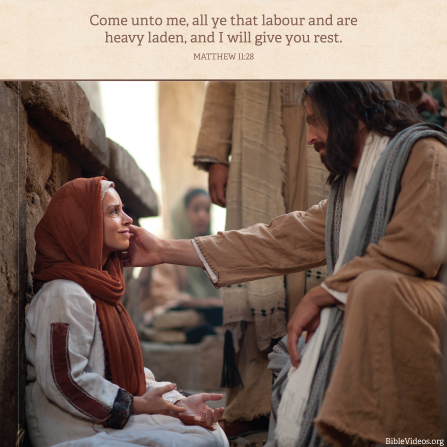
Matthew 11:28, We find rest in Christ

And that’s all there is to it.

People assume that because I have nine kids I’m constantly busy and harried. But the truth is–and sometimes I’m embarrassed to admit it–I’m not. Quite often I can spend hours each day in pursuits I enjoy–writing, reading, researching–because we don’t bother with the non-essentials.

My kids aren’t involved in many activities; we don’t run around endlessly every afternoon from one thing to another–I let them entertain themselves like some 1970s throwback mom. I don’t demand perfect grades from them (grades aren’t an indicator of future success anyway), but I let them push themselves, which they do.

My house isn’t spotless or trendy (I’ve got better things to do), I make simple meals for dinner, and, frankly, I’m pretty relaxed most of the time. I almost feel guilty about that . . . but then I decide I don’t need to bother with worldly guilt, either, and let the feeling go.

We take care of each other, study the gospel, go to church, play together, educate each other and . . . that’s about it. Easy.

I am, however, trying to increase the amount of time I spend on others, trying to find additional ways we can be of service, because that’s really the purpose of life: taking care of others as Christ did.

The apostle James put it in simple terms:

27 Pure religion and undefiled before God and the Father is this, To visit the fatherless and widows in their affliction [taking care of the vulnerable and needy around us], and to keep himself unspotted from the world [ignore the world].  ~ James 1:27

That’s it. Only two things, just like Christ said to the lawyer in Matthew 22:

37 Jesus said unto him, Thou shalt love the Lord thy God with all thy heart, and with all thy soul, and with all thy mind [not giving any of your heart, soul, or mind to the world which will treat you cruelly].

38 This is the first and great commandment [which will keep you unspotted and unburdened by the world].

39 And the second is like unto it, Thou shalt love thy neighbor as thyself [by taking care of the vulnerable and needy].

40 On these two commandments hang all the law and the prophets [and you need not bother about anything else].

Simple, sweet, and satisfying! (Unlike the world.)

We can do that. Anyone can do that.

And we should, because consider these words of Christ:

36 For what shall it profit a man, if he shall again the whole world [be accepted by it, follow its trends and demands religiously], and lose his own soul? [Worldliness kills the soul—simple as that.]  ~Mark 8:36

I’m not saying it’s easy to shut out the world. I’ve been working on doing that for quite some time now, trying to cut off more and more connections to it, especially through social media. Our family quit TV and radio some years ago (just getting rid of advertisements significantly increased peace in our lives). There are still many aspects I struggle with, and likely will my entire life. It’s hard to live in the world and not have some of it rub off on you, like trying to squeeze between muddy elephants without getting dirty.Image result for herd of muddy elephants

Purposely not doing what everyone else around you is can be a little disconcerting. Sometimes I suffer from FOMO: fear of missing out. But just because the crowd is insistent, just because you feel the need to be like everyone else, you don’t have to be. This image, which I ran across many years ago, has seared deeply into my soul. I want to be that guy.

Image result for man in crowd not heil hitler

I’m discovering that when I ask God how I can step further away from the world so that I can be closer to Him, He gives me ideas, nudges me away from distractions and gently prods me toward more important activities. He wants me and my family to be unspotted, and He wants to ease our burdens. I have full confidence that He can get us all the way where we need—and want—to be, because, awesomely, He’s already done it himself:

“These things I have spoken unto you, that in me ye might have peace [because haven’t you grown weary of keeping up with the world yet?]. In the world ye shall have tribulation: but be of good cheer; I have overcome the world [and so can you].”  ~John 16:3

     “You look so tired, Young Pere. So weary, my sweet boy. Did you ever have a day of peace in the world?”
     “No,” he sighed. “Not that I remember.”
     “Then isn’t it time to let go of the world?”
     ~Book 8 (Yes, there’s a book 8!)

The world hasn’t ended: 6 things I still get to do, even with the election results in.

  • Tomorrow, attend a lecture at the local university given by a Methodist preacher and doctor of divinity from England who researches Temple Theology, because we still have freedom of religion.
  • Teach my sons history as part of our homeschooling, because the home is still sacred and the center of all worthwhile learning.
  • Purchase online some beautiful woodwork from a woman in Ukraine, because we still have commerce with other countries.
  • Drive many miles to meet up with my daughters, see my grandchildren, and even do some shopping, because we still have the infrastructure that supports it.
  • Redo some closet doors that I’ve despised for years, because others freely share their knowledge and experience with online tutorials.
  • Take a deep breath and realize that things are still functioning in America, that I could add a hundred more things to this list, and cling to the strange emotion that surprised me this morning: cautious optimism.

Stunned, Perrin and Mahrree sat on the bed and stared.
“It might not freeze,” said Perrin, trying the new approach of optimism. ~Book 3, The Mansions of Idumea

[By the way, if you’re looking for a great Christmas gift, The Forest at the Edge of the World clock is here on Etsy! When you order, put in the comments “Book Reader” and I’ll refund you $5. That means it’s only $10! You’re welcome!]img_1890

Why there will be different answers to these questions, and why that’s ok

Each of my writing classes was subjected to the following experiment.

I’d divide the students into three groups, have all of them close their eyes, then, one group at a time, they’d open their eyes to read three words on the board.

The first group would read this:

chalkboard-fruit

After they closed their eyes, I’d erase those words and write the next three for the second group:

chalkboard-string

After they closed their eyes, the third group would open theirs to find I’d written this:

chalkboard-pain

I’d erase those words, then write the following:

chalkboard-r-pe

Once the all the students opened their eyes again, I’d ask them, group by group, what the missing letter should be to complete the word.

The first group would quickly supply, “It’s an i. The word should be ripe.”

This is when the third group would begin to squirm, feeling like they’ve missed something.

The second group would frown a little, but they weren’t too concerned as they said, “No, the letter should be o. The word is rope.

While the RIPE group would be a little surprised, their response was nothing compared to the discomfort of the third group.

Apologetically, I’d turn to them next. Always there was hesitation, until someone would offer, “The word should be rape.”

The first two groups would stare at them in shock.

“Sorry,” I’d say to the third group, “but you proved this point: all of us see the world in different ways, based upon what you’ve been exposed to. As writers—as people—we frequently don’t understand why one seemingly obvious situation presents itself in a completely different way to others. We assume our interpretation is always the clearest, but depending upon our experiences, there may be many different ‘correct’ interpretations. And, as you can also see, our responses to a benign situation are deeply affected by what’s going on in our heads.”

If my students remembered nothing else from my classes, I’m fairly certain they remembered this example.

And it’s probably the most important lesson.

What we’re exposed to creates our interpretation of the world.

How we’ve been raised, what we watch, what we fantasize about, what we believe all taints—for good, or for bad, or for indifferent—how we interpret the world around us.

Repeatedly our society screams about what’s right and wrong, just and unfair, malignant and benign.

And here’s the crazy part: everyone is right . . . in their own minds. According to their experiences, they are interpreting the world as they think it really is.

Paul discovered 2,000 years ago, that “For now we see through a glass, darkly.” Not only are our perceptions warped by glass, but it’s tinted so that what we see isn’t even cast in the correct light.

I’ve never met anyone who actively promotes ideas or beliefs that they felt are inherently wrong.

Everyone thinks they’re seeing things as they really are, pushing for what they believe is the best thing.

Everyone.

There’s no solution to this. And there doesn’t have to be. There’s no correcting those who see “rope” when you know it should be “ripe.” There’s no changing someone’s mind by telling (or shouting at) them they’re wrong. That’s never worked.

Never.

There is, however, recognizing that everyone interprets the same situation differently.

Each one of my classes did the same thing at the end of this experiment: they turned to their peers in the other groups and asked, “Why did you see that word as rope when I thought it should be rape?” In less than a minute, everyone’s answers made sense.

No one argued that someone offered the wrong solution. Everyone agreed that, based upon their exposure before, each person’s response was correct.

If you don’t understand why someone thinks the way they do, try asking. I don’t believe you have a right to argue against someone’s point of view until you fully understand it. (And when you do, you may not want to argue at all.)

Two things I’ve taken away from this experiment:

  1. People don’t HAVE to agree. I’d split up friends for the groups, and they’d be surprised to hear each other’s differing responses, but they’d still remain friends. They didn’t argue, or belittle, or shun, or mock, or condemn. They’d take a few minutes to understand each other, then they’d just let the differences be.
  2. People can choose to change their minds. The attitudes which most impressed me were those of students who said, “I don’t like the way I was thinking about those letters. I now want to see the word as RIPE instead of RAPE.” And they would. No one forced them to change their minds, but they listened, open-minded and open-hearted, to why others interpreted the letters differently, and they chose themselves to accept that new way of thinking.

So can we all.

       Perrin turned to his wife. “That’s why I married you, isn’t it? You always see the sides I can’t.”
       Mahrree reached across the table to squeeze his hand. “And you always see the sides I don’t notice. Works pretty well that way, doesn’t it?
~Book 5, Safety Assured Leaving East of Medicetti

Does this look like failure to you?

Failure comes in many shapes and forms. Like this, for instance:

IMG_0802


Horrifying, right? Last Christmas I tried to make stuffed Chewbaccas for my family. In the past I’ve successfully made Totoros and Tribbles and Adipose, but last year? Not only once, but twice I failed to make anything not terrifying.

(Seriously, my four-year-old took a startled step back when I showed them to him. He made me hide them in the closet, where I found them again as I was reorganizing recently.)

I had carefully planned these Chewbaccas, bought the perfect furry fabric, drew up the patterns, cut and stitched, but when it came to stuffing them, bizarreness ensued.

I’ve been thinking a lot about failure, how it gets us to places where we didn’t expect to be. I love what J. K. Rowling, author of Harry Potter, has said about failure:

 . . . Why do I talk about the benefits of failure? Simply because failure meant a stripping away of the inessential. I stopped pretending to myself that I was anything other than what I was, and began to direct all my energy into finishing the only work that mattered to me. Had I really succeeded at anything else, I might never have found the determination to succeed in the one arena I believed I truly belonged. I was set free, because my greatest fear had been realised, and I was still alive, and I still had a daughter whom I adored, and I had an old typewriter and a big idea. And so rock bottom became the solid foundation on which I rebuilt my life.

My botched Chewbaccas aren’t on the same level of disappointment as Ms. Rowling’s early career, but I’ve encountered failures myself, some quite epic, which I don’t feel the need to reveal here. But Rowling’s words are profound when she remarks that succeeding in one arena would have meant she wouldn’t have arrived where she really needed to be.

Think back to when you were in high school, or college: what dreams did you have? Are you anywhere near where you expected to be?

I’m not. I’m miles away.

And I’m glad of that.

To my high school self, who and where I am now would have been seen as a disappointment. But looking back, I realize that my younger self failed to see where I really should be, what I needed to accomplish.

Failure, to one person, may be a raving success to another. I’m grateful for maturity and wisdom that have helped me see that I don’t want certain “successes,” and that what seems like “failure” can actually be a profound achievement. It merely depends on our situations in life, our perspective, and what we think is important.

I’m reminded of the story of a successful scientist who created life-saving medical devices. When asked about his upbringing, he told the story of his impoverished parents, and how they encouraged him to get more than the 8th grade education they had. Someone commented that it must have been difficult to be raised by such failures. But the scientist was startled by that comment, and replied that his parents had been the greatest successes he’d ever known. Thrust into their difficult circumstances, they still raised confident, ambitious children who accomplished marvelous things. Had life been easier, he surmised, their family likely would have been very average. Their earlier “failures” paved the way for their children’s accomplishments.

Not every failure is a later success, though. And sometimes, success morphs into failure, like these recipes.

How did such dishes of terror and texture come to be? (Click here and here to see even more recipes just like Grandma used to make, if you dare.)
Realize that these combinations went through some kind of review or committee, that several people had to experiment, taste, and decide, “Yes, these are the winners! Photograph and publish them!”

Which goes to prove that even a group of people with power and authority can make horribly wrong judgments.

We now see these recipes and shudder with thoughts of, “What were they thinking?!”

Why was this considered a success back then, and an utter failure a few decades later? What set of circumstances led people with the same taste buds as us to believe that mayonnaise improves every dish, that Jell-O can be considered a salad with the right veggies thrown in, and that SPAM is edible?

For that matter, what raving “successes” do we consider now will be regarded as dismal failures in the future?

But, likewise, what catastrophes are we experiencing now will be later seen as the beginnings of marvelous triumphs?

Perhaps the message here is, don’t discount your failures too quickly. Don’t harp on yourself too much for the disappointments you encounter, or even cause. Who knows, they just may be getting you on the road to victory.

Unless it involves Jell-O, mayo, SPAM, or disfigured Chewbaccas. Sometimes, a failure is a failure.

But maybe not always.

Halloween’s coming up.

Whereas my Chewies failed as Christmas gifts, they’ll likely be fantastic as Halloween decorations.

Maybe it’s just all about timing.

     “Colonel Shin,” Captain Thorne started, “if they’re incapable of making intelligent choices—”
     “They can’t learn to make those choices if they aren’t given the opportunity, Thorne,” Perrin told him. “Give them the opportunity to learn.”
     “And fail?”
     “Failure is part of learning, Captain. It’s not to be shunned—it’s to be embraced and learned from. Would you really want someone making all your decisions for you?”
                                         ~Book Four: The Falcon in the Barn

My kids are high school dropouts, and I couldn’t be happier about it

My 17-year-old daughter has been awarded an academic scholarship to the university she’s attending this fall.

But she wasn’t mentioned in the assembly the high school held last week honoring scholarship recipients.

She’s leaving high school with a 3.9 GPA, but she won’t receive any honors.

She quietly walked away from school yesterday, and didn’t even attend graduation (she was working at Little Caesar’s to earn money for housing in September).

Why?

Because she’s not a senior in high school; she’s only a junior. And, like her two older sisters, she’s decided she’s done with the drama and tension of high school life. She’s skipping her senior year and heading straight for college.

Without a high school diploma, without even a GED.

And I love seeing the look of shock on the faces of our friends and neighbors when they hear that I now have five—FIVE—high school dropouts.

“But . . . but . . . they HAVE to have a diploma!”

No, they don’t.

“But . . . but . . . if they don’t graduate, they can’t get into college!”

Not a single university of the four that my kids have applied to has asked for a high school diploma. None of them.

“But . . . but . . .  they need transcripts showing they completed four years of schooling! How do you get around that?”

Easily. Our kids are part home-schooled, part public-schooled. I make transcripts for my children based on what they’ve studied since 9th grade, couple that with the grades they get from their high school courses, and send that to the universities. The admissions offices accept the documents, no questions.

“But . . . but . . . isn’t that illegal?”

Teaching my kids at home? Recording their scores? Nope. And there’s nothing illegal about dropping out of school.

“But . . . but . . . how do colleges accept them?”

Three little letters: ACT.

That test is designed to demonstrate how well a student may succeed in college. Four of my five kids scored in the high 20s and low 30s on their ACTs, and that was good enough for college. One child, who has struggled with some learning disabilities, didn’t score as well, but he’s been accepted to two state schools anyway.

Because college isn’t that hard to get into.

Seriously.

Every state has university systems with “open enrollment.” Essentially it means that if you have a heartbeat and a bank account, you can try a year of college. Having taught at these schools, I realized that this prevailing notion is a good one: maybe someone wasn’t top of his class in high school, but maturity, focus, and time works in favor for a lot of people. Just give them a shot at college. If they don’t succeed after a year, they’re put on probation, but most likely drop out on their own to pursue something else.

Several years ago, my oldest daughter scored the magic number on her ACT to be accepted into Brigham Young University in Provo, Utah. She had taken the test early as a 15-year-old, only so that we could gauge where her homeschooling had taken her.

I stared in shock at her score, then was surprised even more when she said, “Can’t I just go to college now? What’s the point of doing more high school?”

I had no answer for her except, “I guess you could go early . . .” She started her freshman year of college when she should have been at her senior year of high school.

My second daughter, not to be outdone by her sister in anything ever, also took the ACT early, and to her delight scored one point higher. She was attending our local high school part-time, and when her guidance counselor brought her in to choose courses for the next year, she told her, “I’m not coming back; I’m heading to college instead.”

The guidance counselor called me that day. “I don’t think that’s a good idea for your daughter to skip her final year. Most kids aren’t mature enough to move away to college at 17. Most kids really struggle.”

I answered, “Most kids aren’t my kids. I evaluate each individually, and my daughter is ready to leave, just as her older sister, who has a 4.0 at BYU right now.”

Where are my two daughters now? My oldest is completing her master’s degree in archaeology. She’s been published a few times, was the head TA for anthropology for many years, directing 20+ TAs who taught freshman anthropology, and is completing her thesis, despite having a toddler at home and another baby on the way.

my kids are high school dropouts

As my oldest daughter, Madison, received announcements of high school graduations, complete with dramatic photos, we decided to do our own photo shoot of her dropping out. (She’s holding a root beer bottle, by the way). Four years later she graduated as valedictorian of her class at BYU-Provo. Now she’s married, a mom, and finishing her master’s thesis. Not bad for a “dropout.”


My second daughter earned her associates’ degree with a 3.95, went on an LDS mission to Edmonton, Canada for eighteen months, and now is finishing her first year at BYU’s very competitive nursing program. She hopes to become a labor-and-delivery nurse, and eventually a certified midwife.

I think they were mature enough to leave high school, just as their little sister is.

Now, if you’ve done the math you’ll see I said FIVE high school dropouts, and I’ve mentioned only three so far.

I have two sons who also dropped out, but they went through their senior years. Almost.

My oldest son, who has learning disabilities and struggled like his dad to learn to read and write, took schooling slower and finished his high school courses with a 3.8 GPA. Seeing him earn As in English astonished me. Then he quit school, without a diploma.

Then he went to the oil fields of North Dakota.

Then he went on a LDS mission to Pittsburgh, PA for two years.

Then he went into the army reserves and trained in petroleum testing, where he was honored for earning the highest scores. IMG_5690

And now he’s going to college. He’s starting later than most freshmen, but with a wealth of maturity and experience behind him, and with eagerness that a lot of college freshmen, who are burned out from high school, don’t possess. 

I’ve had a few acquaintances surprised by this, too.

“But . . . but . . . he’s getting kind of late start, isn’t he?”

No. He’s only 22. I used to teach evening courses at a community college where half of my students were older than me. It’s never too late to start.

“But . . . but . . . students will be younger than him.”

So what? We’ve been programmed by our many years of public schooling to think that everyone should be the same age in the same grade. But once you get to college, you realize that your classes–if you’re lucky–are populated by a microcosm of the world: people of all ages and backgrounds and even countries.

My son’s starting college in a very smart way: with no debt. He knows he’s not getting scholarships like his sisters, but the army’s helping him pay for school, and he’ll eventually leave with money in the bank, not debts to his name. He’s learned from his parents that student loan debt is a killer.

And what about my other son? He dropped out a little bit early. He left before his third trimester of school. 050
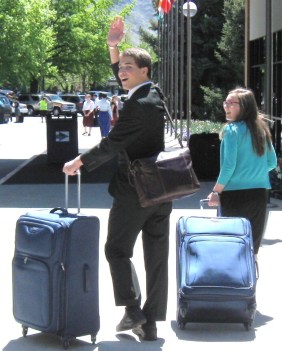
Yep, right in the middle of it all, he waved good-bye and walked away.

He figured, what more could he get out of high school in one more trimester? Nothing, really. He wanted to get to serving as a missionary for the LDS church.

While the LDS church wants its missionaries to complete high school and graduate (the minimum age to serve for boys is 18), I pointed out to our local leadership that none of my kids graduated because they are home-schooled, and my son had been 18 since the beginning of the school year.

Our congregational bishop, a teacher at the high school who had my sons in his classes, scratched his head at my argument. Then, knowing me and our family too well, said, “All right. I guess we can submit his papers and see that the church says.”

By April of his senior year, my son was already serving an LDS mission in Oklahoma City, Oklahoma. He missed all the graduation parties, just like his sister has, but he doesn’t care. He’s already moved on to real life.

I have four more children who will also likely make me proud by being high school dropouts. I’m not proud that they “dropped out,” but that they made decisions for themselves as to what they wanted to do with their lives.

My husband and I haven’t told any of them what we expect of them. I have, however, told them I want them to try at least one year of college, just to see if it’s for them. I want them to have that experience of learning from various people—even the liberally-minded, to help challenge and strengthen our conservative beliefs. When they do that year of college, and where, and how, is entirely up to them.

Back to my latest high school dropout. When she came home from high school for the last time, I asked her, “Any regrets? I heard your friends saying how much they’ll miss you next year, how they wished you’d stay.”
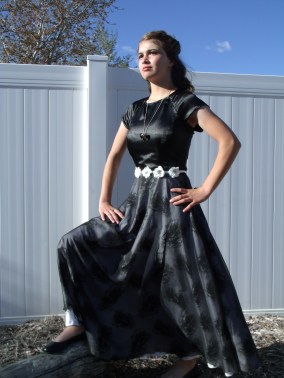
GEDSC DIGITAL CAMERA

All of my kids do things differently, like making a prom dress skirt out of storm trooper fabric.

Oh, if you could have seen her eyes rolling. Like planets falling out of orbit.

“No!” she declared. “I am done! Let’s get on to real life!” Then she pulled out her tablet, with yet another recipe on it, and headed to the kitchen where she’s been experimenting with meals she can make after a day of college classes.

She’s moving on when she’s ready to, not when some random bureaucrat declares her “mature enough.”

She, like my other children, is making choices for her life, based upon her needs.

I love having a house of rebels.

“Let’s hope there are still a few rebellious ‘teenaged’ souls out there,” Mahrree whispered to Perrin.

“Besides us, I mean.”  

~Book 2, Soldier at the Door

(Book 5 is published and available! Get Safety Assured Leaving East of Medicetti at Amazon, Smashwords, or here on “Start reading the books!“)

Hoarding your praise doesn’t make it more valuable

When I was asked to be a “responder” for a writers and artists fest our school district hosts each year at the university, I wasn’t quite sure what to expect. My daughter had participated when she was in middle school, spending five agonizing minutes reading her writing in front of two “responders,” several peers, and some of their parents.

Thirty people might as well be thirty thousand when you’re thirteen.

Knowing the fragile natures of both writers and middle schoolers—combining the two is Mentos and Diet Coke–I anxiously drove up to the campus this morning, praying that I’d say the right things to these young writers.

The purpose of the fest is to encourage budding artists and writers, to give them a forum to perform, and to receive feedback from professionals such as authors and teachers. Encouragement, not criticism, is the point, because heaven knows sixth, seventh, and eighth graders don’t need any hits to their very delicate egos.

Even love taps can shatter them.

The co-responder in my room had done this for a few years, and gave me excellent pointers as to what to say when the child was finished stammering nervously through their work. Karen Clegg pulled the most wonderful words out of the air, and bestowed them lovingly upon the trembling tweens.

I hoped I could do half so well.

I took notes as the kids read, told them what I liked, read back to them their triumphs (knowing how thrilling it is to hear someone else read your words out loud, in an appreciative way), and thanked them for their time.

After the first session, a mom came up to us during the break and said, “Are you watching the faces of those kids when you talk about their work?”

“No,” I confessed. “I try to avoid that.”

I’m not sure why or how, but quite often I get too much from someone, especially their eyes. While they tell me a few innocuous words, I perceive an onslaught of emotions, stories, experiences, and history. Hopes, fears, frustrations, and joy hit me in the face like a frozen snowball, often when someone’s only telling me something mundane. I’m one of those people who rarely look folks in the eyes, because I’m never sure when that deluge of data may suddenly hit me. It’s easier to just listen than look.

“Watch them,” this mother insisted. “Most of these kids don’t hear such words from adults they don’t know. They devour what you say. Watch them.” 

So when round two arrived, with a new batch of fresh, pimply faces, I tried to concentrate on their expressions, and for the most part it was painful.

Have you ever had the experience of reading your work in public?

Try taking your heart, placing it on a plate, then setting it in front of hungry wolves. The emotion is roughly the same.

One of the readers that round was a tiny boy who puberty has decided it’ll visit later, maybe when he’s 17. He was the scrawny kind of thing that others sit on and don’t even realize it. He could barely look over the podium to see us responders at the table in front of him. Shuffling his pages, he wore a hesitant grin of expectancy, and dove in.

Karen and I were taking turns responding, and Tiny Man was mine. He read with great feeling the beginning of a sci-fi book he was crafting at the tender age of twelve, and later my cohort told me she was relieved he wasn’t hers, because she didn’t know anything about sci-fi. But I’m a nerd.

When he finished in his five minutes, I said, “So I’m sensing themes of steampunk in your writing.” And I looked at him.

His eyes were so bright and enthusiastic that I was startled, and I realized that I was probably the first adult he’d met there who knew what steampunk was. He nodded enthusiastically.

“How much more of your story have you written?”

“I’ve got 80 more pages!” he announced proudly.

“Wow. Took me until I was 40 to get 80 pages. So where does the story go from here?”

I’m sure I went over time with him, as he happily told me the rest of the plot, forgetting about the audience in front of him and the other kids waiting their turn. The boy positively glowed with delight to tell a stranger about his book. 

I could barely look at him, he so hurt my eyes.

For my next turn, a girl stood up, the very picture of thirteen-year-old gangliness. She, too, had been neglected by the Puberty Fairy, and trembled behind the podium, her straight brown hair framing her freckled face, and she began to read. It was essentially two pages of an ode to a special young man who had rescued her from some difficulties in her life, and there I sat, knowing that in a few minutes I’d have to deliver an encouraging critique of her description of a modern-day Thor turned mortal.

When she concluded, and the audience finished applauding, she looked to me with terrified eyes.

I couldn’t look at her for long, but I did manage, “What you’ve written is essentially a thorough character analysis. Most teens wouldn’t be able to see as deeply as you have. Heck, most adults can’t either—” and that’s when I was shocked by her response.

She had teal-tinted braces. How do I know that? Because her face split into such a wide grin that I could see every last tooth.

I wasn’t expecting that reaction, especially considering how somberly she had read her piece.

Unable to watch her anymore, I looked down at my copy of her words and did as I had with the others: read the lines I liked the best, explained what was working well, and what traits as a writer I felt she was demonstrating. I glanced up a couple of times, and nearly choked up.

Have you ever seen a tween grin out of pure joy? It’ll break your heart.

The same thing happened, again and again, and while I tried to make an effort to look at the kids, as my partner did so well, I found it much easier to sift through their pages finding more examples to praise.

At the end of each session, we stood at the front and handed back our notes to their work as they filed out, the kids giving me shy smiles as I thanked them for sharing their writing.

I was nearly in tears at the end. The fact that one of the last writers wrote a poem about her mom who died last year didn’t help much. Nor did parents coming back in to thank us for our words, to tell us that a son never gets such praise from anyone outside the family, or that a daughter is terrified to speak in front of others, and would be happy for the rest of the week.

All I did was listen, intently.

All I did was give 60 seconds of approval.

All I did was make an effort—and occasionally, it really was an effort—to find something to compliment. But there was always something to appreciate.

All I did was pray, “Dear Lord, tell me what this child needs to hear,” then I said those words which came to my mind, and the child nearly exploded in glee and relief.

After, we went to the luncheon where hundreds of middle-schoolers were collecting their food and talking about their experiences, that cute kid over there, and the author Tyler Whitesides, of the Janitor series, who had addressed them.

As I made my way through the noise and gaggle, I knew instantly which kids in the crowd had been “mine.” They waved timidly, offered me careful and happy smiles, and I’d wink back or grin, as if we shared some secret. We were friends.

I admit I shed a couple of tears as I left.

I’d never before realized how just a few words could mean so much, and I worry that I’ve been too stingy with my compliments in the past, as if hoarding my praise somehow makes it more valuable.

I realized that I paid out mere pennies of compliments, but what was received were pounds of gold that those tender teens will carry with them, hopefully for the rest of their very costly teenage years. They’ll need every ounce of encouragement to make it through.

And I’ll try to keep giving them more so that they never run out. Encouragement doesn’t cost me a thing.

“Mrs. Shin’s the only teacher who actually teaches. She’s also the only one who listens.”

~Book 5, Safety Assured Leaving East of Medicetti

Book 5 Teaser–the manly art of swearing

For seventeen years I taught writing to college freshmen and high school seniors. Watching who thought swearing was mature, or cool, or the way of the world, was always fascinating.

Without fail, those who swore were the most insecure and desperate to prove something.

One semester I was asked to teach the automotive repair students at a local community college. It was an experiment to see if the very low opinion of those students might not be elevated somehow if they knew how to write a complete sentence. For some reason, the administration thought I was up to that task.

Their profanity began the first day, the moment they saw that a “girl” was teaching them (I was a mother of six children at the time—that’s how “girly” I was). Maybe each of those “boys” secretly wanted to be in the navy, judging by their level of poor language.

But in time we forged a friendship, and they related to me how everyone “dissed” them and disrespected them.

“That’s because you talk like 7th grade wusses,” I told them, hoping “wusses” was a word they could relate to. “Real grownups don’t use language like you see in the movies. Listen to people. Really listen to them. You’ll notice you’re the only ones cussing so heavily. Also watch people. Really watch them. You’ll see them wincing every time you drop the F-bomb.”

“Like you wince?”

“Yep.”

To my surprise, they were apologetic. Turns out I was the only college instructor who ever listened to them, who actually talked with them.

I told them that was hard for me to do, because while I liked them and found them entertaining (some were very funny), I felt as if they didn’t respect me because of the words they threw at me. Literally every sentence had at least one swear word in it, if it fit or not.

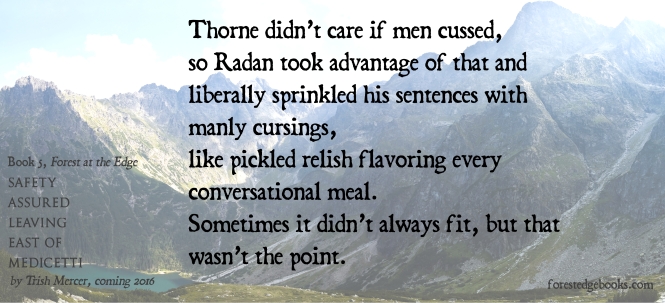
High Polish Tatra mountains

To my further surprise, they became quiet, and one of them said, “But you’re the only teacher we do respect. You’re the only one who seems to care.”

So I issued a challenge. I told them that I cared so much that I wanted them to earn the respect they desperately wanted. To do so, they had to cut back on their swearing, to four words the entire class. I wrote their names on the board, and kept tally marks as if it were 6th grade. They were also allowed only one F-bomb, and if they exceeded their limits, their peers could mete out fitting punishment.

They elected that a punch to the shoulder—one per word over the limit—was a memorable deterrent.

By the end of the first day, several boys were severely bruised.

But by the end of the semester, six weeks later, these young men reported back that something was changing in the garages where they interned. They had been listening, and watching, and learning.

They noticed that their managers weren’t as profane as they were, and saved the juiciest words for only when they dropped a car hood on their hands. And their managers never, ever, swore in front of clients.

Taking those cues, my students curtailed their swearing in the shop.

The fact that I taught them some new “swear” words also helped.

I told them that when I’m frustrated or angry, I say something random, like “fire engines!” It’s the way you say something, not necessarily what you say. My swear word always make me feel better, primarily because it sounds ridiculous in whatever context I utter it. I also know a man who said “hammer!” each time he was angry, and I suggested to these young men that they find new “swear” words.

They did. While I don’t remember all of them now, I do recall that one guy loved to shout “cheese and potatoes!” in the shop. It always elicited chuckles, and he’d find himself smiling too, alleviating his anger and allowing him to fix a carburetor without beating it first with a wrench.

Eventually my students noticed that they had more patience with themselves and their work when they didn’t swear.

I know this, because for their final paper I asked them to reflect on our experiment.

They reported that they were thinking clearer, and acting kinder, and developing self control, something they didn’t think was possible.

As a result, they were respecting other people, and wanted to demonstrate that with their language.

And best of all, they were receiving respect, for the first time in their lives.

Not a single one of them improved the sentences they wrote, but looking back, that really wasn’t the goal of the class.


Farewell to a beta reader: my life preserver and sinking anchor

Writers need beta readers because they are a mixture of life preservers and anchors; on the one hand they point out the little things we can do to fix the draft, and their enthusiasm keeps us buoyant. But on the other hand they drop anchors on us, comments that can sink us into editing despair, such as, “I really hated what you did to so-and-so. Are you sure that’s the direction you want to go?”

Well, seeing as how the next three books depend on that plot development . . . no?

Drat.

Writers value their beta readers because they do an enormous task for literally nothing: they read through our drafts which we think are near to perfection, point out how far from perfection they really are, then we thank them for their hours of work only by mentioning them in the back of the book and sending them a bookmark and a magnet or two.

But we couldn’t do it without them. I’ve burned through a few beta readers in the past years because it’s a demanding task “grading” someone’s 180,000-word essay. I understand when they say they can’t help this time around. But I’ve never lost one completely before, until last week.

Debbie Beier was an unusual beta reader because she could see things sideways, and I’d been looking for someone like that. I feel that’s how I’ve always seen the world—from odd angles. This was particularly frustrating in English classes where everyone would read a story/poem, begin to discuss it, and I’d be completely confused as to what they thought was “important.” While they were discussing the meaning of ‘walking in the wilderness,’ I’d wonder why the author kept referring to his yellow cat. In every class I’d search for that other sideways thinker who thought the reading was potentially absurd, while everyone else fixated on its deliberateness. (Seriously, I didn’t understand half the jargon I encountered in college. Still I graduated. That should give every college freshman hope.) 

But Debbie was the sideways thinker who also saw the proverbial yellow cat, and would notice that its whiskers were burnt off, and would then speculate as to what kind of mischief the animal got into. Maybe it was because she was a scientist—a geologist who loved rocks and observing nature. She liked to turn things on their sides, figuratively and literally, to see what was really going on.

I first met Debbie in Virginia about 14 years ago, where we were neighbors and I was her visiting teacher, assigned by our ward (church) to check up on her each month. That’s when she first developed breast cancer, and I brought her meals. But I don’t remember that. She did, however, and a few years ago when I put out the request for beta readers, she eagerly volunteered in order to pay me back for those meals I totally forgot about. Talk about a lopsided investment. I was returned far more than I put in.

Debbie was diligent and incredibly thorough. She commented, she corrected, she caught my proofing errors, and she gave feedback that both buoyed me up and dragged me down, in necessary ways.

Cancer came back to her with a vengeance two years ago, but still she carried on reading and editing for me. But by last autumn, it was getting to be too much. “Send me book 5,” she wrote me. “Even though its unpolished. I need a distraction from the pain and boredom of cancer. Plus, I want to know what happens.” So I did. Even in her exhaustion and pain, she took the time to royally roast me. In particular, she was upset with what the future of a minor character. “Don’t do it,” she begged. “It’s all wrong!”

In defense, I wrote up a synopsis of books 6, 7, and 8 so she could see how the series would end, and how that minor character played a significant role. But she wrote back that while she could see where I was going, and thanks for the entire series in a nutshell, still I was wrong. Fix it.

To be honest, I was a bit surprised at that. The poor woman was literally dying of cancer, and here I thought she’d write me back a “That was so wonderful, thank you for sharing” message. Something pleasant as an exit.

Nope, not Debbie. She was too pragmatic and honest for cloying niceties. I never knew her to be conventional in anything. Dying from cancer only meant that she had to be more diligent, and, if need be, even harsher.

In November she posted on Facebook that her end was coming, and in typical Debbie fashion she wrote, that “I’ll be dying sometime or other” and that she didn’t want to be hit with faith promoting rumors or wild ideas of going to foreign countries to be healed. She accepted her fate, and accepted our prayers.

I wrote to her the following:

Debbie, I hate to see you go, but you’re going on to a marvelous adventure. You’ve done great things here, and your graduation from this life to the next will be astonishing and wonderful, I have no doubt. I’ll pray that you’ll not feel pain, but that you and your family will feel peace.

And when you’re on the other side, I hope one of the first things you find out about is dinosaurs. Exactly when did they live? For how long? What, really, went on with them and the fossil records?!

Oh, the mysteries you’ll get to re-learn! The questions that will be answered! So many people you’ll get to re-meet and re-remember! I’m so sorry this is a physically painful experience, but when it’s over–ah, it will be amazing for you.

I’ll miss you–you’ve been a wonderful help and so supportive of my writing. Friends like you are rare. But I’m also just a bit jealous of what you’ll get to see next. If at all possible, come by some time and whisper just how amazing it is, and what I’m missing.

Thank you for your friendship. Until we meet again . . .

She passed away last Monday, in Oregon. Her funeral was here in Utah last Saturday, 100 miles away from my home. As I drove down to it, I thought, “Debbie, now that you’re not in pain anymore, about that ending for book 5. You’ve had some time to think about it . . . do I really need to redo everything with that character?”

I could picture her shrugging and saying, “I said what I said. It’s your book, but that’s what I think.”

Drat. Major rewrite coming.

1008151701

Debbie’s ever kind and perennial cheerful husband Mike drove her down from Oregon to Utah to visit some friends last fall, after she learned she wasn’t going to beat cancer this time. We met at a Wendy’s, shared Frostys, talked about Virginia, and family, and dying, and shared a few laughs and tears. I took this picture from my car as they slowly walked back to theirs. But first, Debbie inspected the gravel at the bottom of this photo, found a rock that looked like a heart, and picked it up for her granddaughter. I was a bit disappointed there wasn’t a pile of rocks on her coffin. Maybe they were inside, with her books.

Thank you, Debbie, for never pulling your punches, and for being utterly true and honest to the end. I’ll not only miss you as a beta reader, but also as a friend.

And if at all possible, come by and whisper what you found out about the fossil record. But don’t use your geologist words—dumb it down for me a bit. You know how I think.

What do we think about?

Over the years I’ve become more judicious in what I read, watch, and listen to. Everything I take in effects my thoughts, which in turn alters my behavior. 

Maybe it’s because in the past few years my parents and sister died, and a dear friend is losing her battle to cancer, that I’m acutely aware that life is short.

I don’t have time–nor do I want to have time–to waste. Every day needs to be focused on improving my mind and my heart.

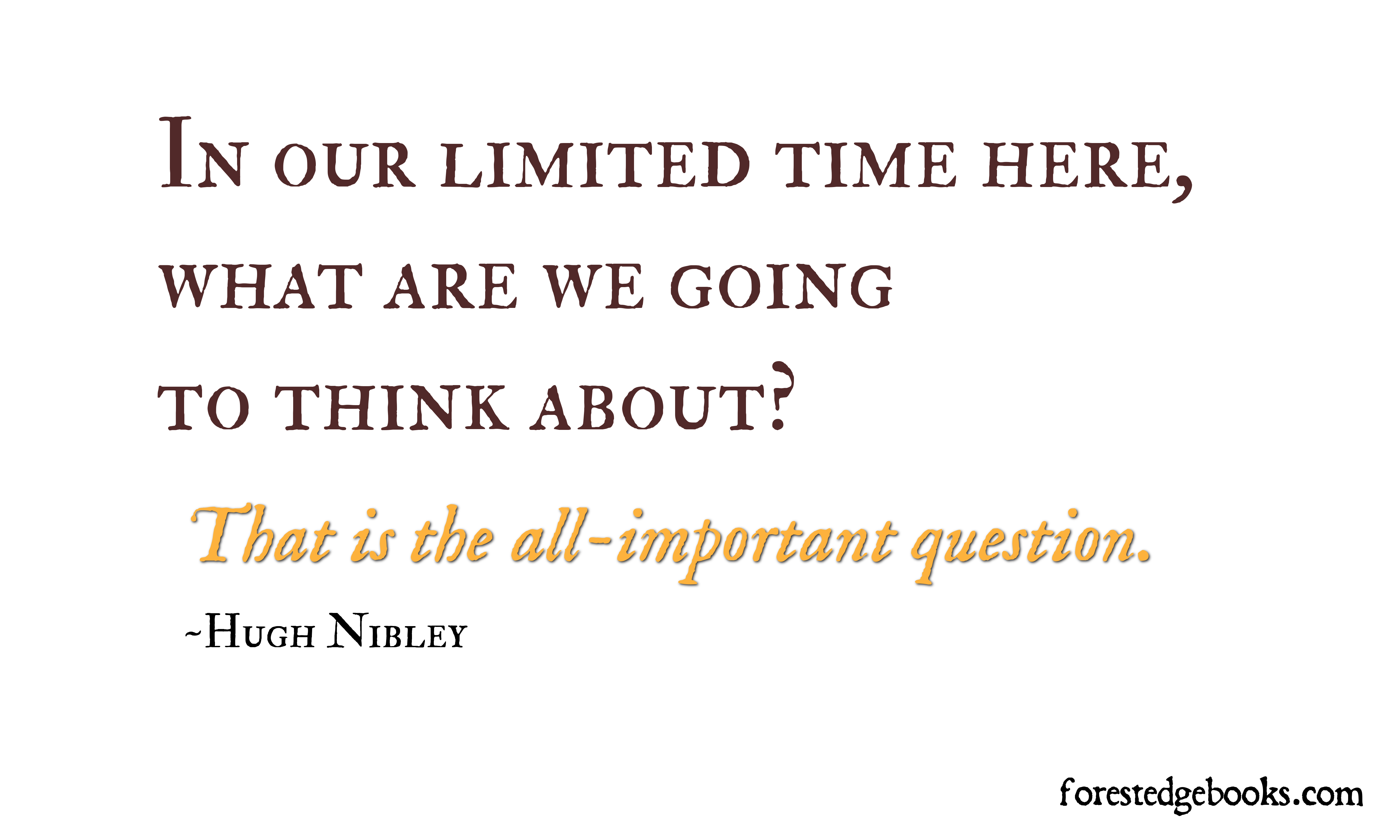
Hugh Nibley, in “Zeal without Knowledge,” summed it up best:

what do we think about

The more I’ve decluttered my mind (as I’ve been doing with my house) the simpler everything is. There really is time and space for the important stuff.

No men who Jaytsy cared about were interested in fashion or the theater. It was all fake and contrived, and unappealing.
But she knew what she did love, and it was glorious to no longer worry about the world’s opinions. She loved real things. Dirt on her hands and under her fingernails. Flicking insects off the corn. Filling wagons with potatoes. Braiding the greens of onions together. Measuring milk yields. Churning butter. Sampling cheeses. Looking into cows’ eyes.
~Book 4, The Falcon in the Barn