A student is raising a hand: brace yourself!

Students raising their hands during class? I used to think that was a good thing . . . for the first week of teaching. Since then I’ve discovered that what they say will be as relevant as dandruff shampoo is to Medusa.

We may be in the middle of comparing propaganda during WWII to modern day examples, or breaking down Katharine’s speech at the end of “Taming of the Shrew” when the hand shoots into the air as if some amazing insight has just hit a teenager.

But no.

“Mrs. Mercer! I just saw the Coke truck go by the window. That means it’s refilling the machines and I REALLY need a Mt. Dew to make it through the rest of the day. Can I PLEASE go get a Mt. Dew?”

The kid just finished chugging his Dunkin coffee. The last thing he needs is more caffeine. And if he falls asleep in class without his Mt. Dew, is that really such a bad thing?

Occasionally a student will have something interesting to share. Otherwise . . .

“Can I get my phone? I REALLY need to text my mom. It’s SUPER important! Like, I need to talk to her RIGHT NOW! She’s bringing me Subway for lunch and I want to change my order before she leaves.”

The hope is that their minds are on the topics, but . . .

“Mrs. Mercer, did you know that Joey and me got into a fight back in 5th grade?”
I grit my teeth at Joey and me. “And what does that have to do with identifying archetypes in this novel?”
“Nothing. Just thought you should know. I won the fight, by the way.”

That screeching noise you hear? My trains of thought, derailing a dozen times a day.

Even the sharper kids—ones who usually have something great to write or say—may surprise me with A Random Comment That Initiates Cringing (ARCTIC; these comments leave me cold).

“Mrs. Mercer! What you were saying reminds me—I need to run to the office for something.”
I heave a long, heavy sigh. “And how did my describing Odysseus’s consultation with Circe remind you that you need to run to the office? And for what?”
“I just remembered that I need to talk to guidance about my classes next semester.”
There is no one in guidance who is remotely like the witch Circe. “The next semester which doesn’t start for another two months?”
“Yeah. Can I go right now?”
Perhaps I’m Circe the witch they’re trying to get away from.

Train derailment, crash, explosion . . . I grip my whiteboard marker, the only thing that brings me back to focus as I glare at the student who looks at me oblivious that they’ve just tossed my entire buildup–now a fireball–into a gorge. Through my mind passes the desire to send the student past Scylla, the next monster we’re going to read about.

Image result for scylla in the odyssey

(Cat-scan of my brain when a student interrupts my lesson with an irrelevant comment.)

At that moment I pull out an oldy but a goody–so old they’ve never heard of it. “And what does your need to go to guidance have to do with the cost of tea in China?”

The entire class stares at me, dumbfounded.

See? I can do it to. Albuquerque. Snorkel.

While they, in confusion, try to figure out what I just said, I continue on with the discussion . . . and for my sanity ignore every hand that goes up for the next five minutes.

color of captain's eyesGet Book 1, Forest at the Edge of the World here. Free as a download, $9.25 as a paperback.


Books? Thinking? Are those “lit”?

[“Lit,” by the way, is the trendy way to say “cool,” or “neato, daddio.” Just typing that last one is totally not “lit”.]

These lines are what I hope none of my students will ever say about my class:

books thinking never saw before

These lines are also why I often read out loud to them, because even though they’re 10th graders, a few kids had never finished a novel until they took my class.

I worry that books and thinking are becoming as old-fashioned as typewriters and rotary phones. We rarely hear about either much anymore, and when we do it’s, “Hey, remember when we used to think about problems and read all we could before we made judgments? Or am I just remembering a time that never really existed? And am I using the word ‘lit’ correctly?”

Get Book 1, The Forest at the Edge of the World right here. It’s totally lit. (Maybe?)


“The sky is blue.” We’ve been giving our kids fake news since kindergarten, and why that’s a growing problem

“You’re sophomores now,” I told my new batch of high school students last week, “which means you’re realizing that there’s more going on than you used to think. For example, you’ve been lied to since kindergarten. Answer me this: what color is the sky?”

I’ve written about this debate in my first books, and carry the thread throughout the series, but I had never before asked it of my students. I watched to see what they did with this simple yet odd question. I was not disappointed.

A few shouted, “It’s blue!” because on the second day of school you’re still trying to impress the teacher.

A few squinted, dubious as to what the right answer was, seeing as how I’d spent the last five minutes explaining how we’d be learning to analyze and see “the bottom part of the iceberg.”

(I drew terrible pictures of icebergs on my board. The students asked, “Is that a potato floating in the ocean?” Yeah—see the “whole potato,” my friends.)

41429333_10212947688711179_2356401697774895104_o

(Imagine if icebergs were potatoes. “Titanic” would have been a very different movie.)

But in each class, a couple students glanced out the window before answering, “White and pale blue.” (It was a humid, muggy day because Maine has been thinking it’s Maryland all summer.)

I replied nothing for a few seconds, watching them process, think, and squirm in worry that I was just standing there, smiling slyly, until I finally I said, “That’s exactly what I was hoping you’d say!”

“What?” they exclaimed. “That it’s blue? Or white? Or . . .” And then more started looking out the window, as if I’d seen something they hadn’t noticed and maybe they should notice it, too.

I could barely contain my excitement—they were re-examining what they assumed was true. I love these moments when their neurons start firing!

Some kids had initially sniggered at those glancing out the window, likely thinking, So dumb—have to look out the window when everyone knows the sky is blue.

Some others had that twinkle in their eye that they were going to show me up by not giving me the standard, “Blue!” answer, which I pounced upon happily.

“So is the sky actually blue?” I pressed.

They glanced at their peers, now unsure.

“It’s only looks blue,” one 15-year-old remembered, albeit backwards, “because it’s reflecting the blue of the ocean.”

“Except,” I said, “I grew up in the deserts in the west, and the sky was very blue there.”

Rapid eye-blinking is a sign that new neurons are being created in students’ minds. That’s a fact I just made up, like the sky is blue.

Eventually I explained how the blue is merely an optical illusion and asked them what other colors the sky can be.

When they realized it can be every color, especially at night (black) and during sunsets (even green and purple) they looked simultaneously intrigued and disturbed by this “new old news”.

And when I told them the sky is different colors on other planets (and that the sun isn’t actually yellow but white, if they could steal a glance at it without hurting their eyes), a few students’ eyes bugged out (a sure sign that neurons are firing—it’s a scientific fact I also just made up).

mars skyMars, 1997, with no blue sky in sight.

Blue sky is fake news. Oh, we didn’t mean to set out feeding our kids lies when they’re little–we’re just trying to simplify their complex world, cover the essentials, and worry about the deeper details later. That’s not a problem.

Except if we neglect to later dig deeper, think harder; then we become lazy thinkers. We don’t want to analyze, to see if everything we’ve assumed is actually true, because it’s not fun or entertaining. (Ask high schoolers what makes a “good class” and they’ll answer with, “It’s fun,” “We don’t have to work hard,” “We play games and watch movies,” or “We can get away with anything.”)

We want entertainment, not enlightenment. 

That’s going to be a problem in the future, as it’s becoming a problem right now. It seems most adults won’t analyze the news, its sources, or its veracity. They’ll take whatever matches their present assumptions, rant on social media for a minute, feel they’ve done something good, then see what’s new on Netflix.

In the meantime, nothing improves, no one notices, and the sky continues to darken without anyone glancing at it to say, “I don’t think that’s a good sign . . .”

color of the sky

Rector Yung studied him. “Dormin, what color is the sky?”

“Blue,” he answered automatically. He didn’t even glance out the window at the blazing orange that leaked into the room, tingeing everything around them in a carroty hue. “Everyone knows that.”

~Book 1, The Forest at the Edge of the World


The Forest at the Edge of My Yard (or, whatever you’re asked to sacrifice will eventually be no sacrifice at all)

My past forests have been pathetic. In 2015 when we lived in Utah,  I wanted a real forest  even though we lived in a desert. I was in the middle of writing this series and it seemed wrong that I didn’t have a real Forest at the Edge of my yard.

side view of forest

This was it–our “huge” forest. (And the pine tree died the next year. Typical.)

So we created one that summer in the name of xeriscaping, and I documented it in a blog. I even slashed an aspen to see how the markings the Shins left in the forests might look, and I used that tree as the teaser for Book 6.

book 6 teaser front cover

See the lovely scars of black under the W?

Only two short years later I sold that house and mourned the loss of my little forest.

I didn’t realize that God would compensate my sacrifice, and in a grand manner. Now, this is the Forest at the Edge of My Yard in Maine:

IMG_0315

(Morning from the back porch.)

20180829_181104

(Sunset on aspens slightly larger than what I had in Utah.)

This compared to what I left behind last year? There’s no comparison.

We don’t own this land, but my husband’s job allows us to live here and wander in acres of old forests. I just need a geyser somewhere to make my life complete.

I write this as a witness to you that whatever God asks you to sacrifice, it will be only temporary. We’ve left homes we’ve built, we’ve said good-bye to friends and family, we’ve given up jobs and dreams.

Then we’ve been granted new homes, additional friends, ways to see our family, better jobs, and grander dreams.

In fact, if we hadn’t sacrificed what we thought was good, we never would have been granted what was far better. 

But first we had to be willing to give up what we didn’t want to, without knowing what might come later.

That’s immensely difficult: to have enough faith in a different future to walk away from a good present; to find enough hope to believe that what comes next will be worth the current loss. But as someone who has “given up” a few houses, a couple of careers, a lot of friends (but thanks to Facebook they’re not entirely gone), and some big dreams, I have seen–time and time again–that what I’m eventually given in return was well worth the sacrifice.

No real sacrifice HORIZONTAL

In fact, all of our sacrifices have turned out not to be sacrifices at all, but instead were the means to leading us to far richer lives.

“I won’t do it!” said another man in the crowd. “I won’t leave behind everything we’ve worked so hard to build. And not just for me, but for my congregation, my family, my neighbors—I can’t just abandon all that we have.”

“Why not?” Mahrree said.

A man in the middle shouted, “Why not? Do you have any idea how hard it is to start again?”

“As a matter of fact, I do!” Mahrree told him, and nearly grinned as she realized how perfectly the Creator had prepared her for this moment. “I know exactly what it’s like to leave a home I love, to leave books that I considered my closest friends, to say good-bye to memories, possessions, the graves of all those I loved, and to have nothing more than the clothing on my back to walk to a future that I knew nothing about.”

The crowd was silent as she continued. They’d heard her story before in her class, but not told quite like this. Today, it was more than just history.

“Twenty-seven years ago I came to Salem, nervous and at times terrified as to what I would find. All I knew was that the Creator told us to go, and in faith I went. Not blindly, because every previous time I followed His plan, He was right.

“I ran through the forest in the darkest night I’ve ever seen, with hazards on either side, the army right behind me, and a lightning storm before me. But I came out of it safely and my faith stronger than ever. And then I came to Salem, which was a far greater life than I could’ve ever imagined. Now, none of that would have happened if I had said to the Creator, ‘No thanks—I think I’ll just handle the army on my own.’ I realize you’re worried, but staying here and fighting is far more terrifying than trusting in the Creator!

“Soon I’ll be making that journey again,” Mahrree’s voice threatened to quaver but she held it strong. “But I know that whatever sacrifice the Creator asks of me, He will reward me again a hundred times over.

“So what if you lose your homes? Your flocks and property which you don’t even own? Isn’t the risk of losing your souls worse? There’s a saying in the world: It doesn’t matter how you begin the race but how you end it. How tragic it’d be if you’ve spent your entire lives living as the Creator wanted you to, then now, at the very end of the race, you jump off the path and ignore all that you’ve been taught? Why fail the Plan now?”

Mahrree knew she was saying the right things. Her chest burned and she felt such energy she could have flown right off the small tower. She watched their eyes as she spoke. So many were hardened and impenetrable, but others’ eyes were softening.

“How do you know this isn’t His plan?” one man demanded. “This can’t be it—”

“How can it NOT be it?” Mahrree shouted, throwing her hands in the air. “Have all of you missed the signs? Land tremors! Deceit awakened! Famine in the world! Now the army marching upon the Creator’s chosen? THIS IS IT, PEOPLE!”

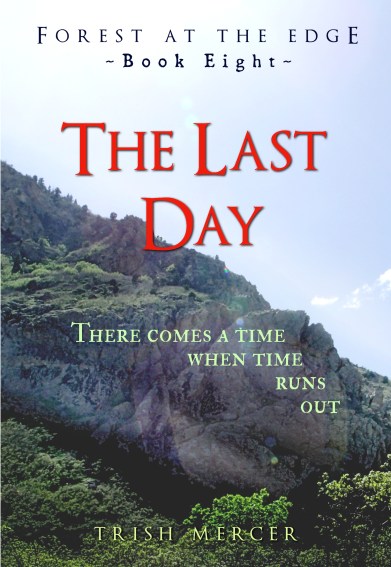
~Book 8, The Last Day, available HERE on Amazon, or HERE as a pdf. download, or HERE on Smashwords.

Book 8 FRONT COVER

We spend so much in anger and it buys us nothing (Plus a HUGE sneak peek to Book 8, “The Last Day”)

They got into a fight in the cafeteria yesterday, the two boys. One was calling another a derogatory name until the victim finally punched the bully in the head during dinner.

“Did you see any problems with them yesterday? You have both of them,” my husband asked me. They are in one of my American Lit summer classes, but my students generally stare blankly at me because even though I speak English slowly and write all the words on the board, they don’t understand enough English and I don’t understand any Chinese. (I’m afraid it’s been a long three weeks for all of us.) There could have been all kinds of conversations and even threats that I missed out.

Today I observed the two boys, now sitting on opposite sides of the room when they used to sit next to each other. Supposedly one is better off than the other, one has a greater social standing than the other . . .

But I can’t tell.

Not by their clothing, not by their gadgets, not by their faces, or hair, or words.

All I see are two teenagers, and I scratch my head as to what caused one of them to have a swollen eye today.

Was it worth it? If I can’t tell any difference between them, should there be anything to fight over? Even if I could see a difference, why should that be a reason to fight?

I remember reading about a conflict in a tiny country I didn’t even know existed, and how many thousands of people over the years had died fighting over a piece of land and a notion of pride.

How tragic, I thought, that people who live and breathe and love and create and bake and laugh have to die because someone thinks something is more important than something else.

In the world-wide scheme of things, their civil war improves nothing. No one else in the world even knows about their battles, and even if they did, their war is meaningless to the rest of us.

How petty and foolish and tragic.

Then again, the majority of our battles are equally as unnecessary and as inconsequential to the world at large. We spend so much angry effort, and it buys us nothing.

It’s taken me decades to realize that I don’t have to fight. If someone insults me, my family, my heritage, my religion, my friends . . . I can walk away. The few times that I did take the bait and battled for hours or even days, I came away with nothing but more fury and frustration, and a lot of wasted time.

Perhaps there’s something enjoyable about fighting that I don’t understand. Some perverse sense of accomplishment or security or self-righteousness in being able to stomp someone into the ground, either physically or online. But what kind of accomplishment is that, to be the best bully?

I had two American students fist-fight last year, but afterward they became great friends, sitting next to each other in class and frequently writing about their “epic battle” in the rain. They both agreed it was dumb (especially since they were suspended), and that they’d never do it again, but in a strange way, it worked: they got out their aggression and an alliance was formed. They bonded by bashing each other. (I think this may only work with males because most females I know will hold a grudge forever.)

So perhaps occasionallyt a fight does work. But if that were the case all the time, our society would be the friendliest ever in history and social media wouldn’t be a war zone.

I’d rather just walk away. I’ve never once regretted leaving a fight, but I always beat myself up for joining in one, which means I suffered twice.

A voice near the front called, “Guide, what if we fight them off? Defend our lands? Why should we just let them take it all?”

Guide Zenos held his breath as many more calls of, “Let us defend ourselves!” rose up in the arena.

Several of his twelve assistants, seated on chairs to the side of the podium, looked around, startled at the sudden aggressiveness of the Salemites.

But Shem wasn’t surprised. He had long suspected this would happen. Salem had never before faced a direct threat, nor did they know how to deal with the idea of someone simply taking something. That never happened in Salem, so the natural impulse was to fight back.

But the Creator expected more from Salem.

Guide Zenos leaned forward and said, loudly, “NO.”

The arena fell into silent befuddlement.

He let his answer settle in before continuing.

“I know your desire is to not allow anyone to take your homes, but this is not the Creator’s will. Nor, you will remember, are these your homes, or your farms, or your livestock. All of it belongs to the Creator, as it always has. It is His will that you voluntarily leave Salem and retreat to safety. We’ve known this would be our fate for the past one hundred-sixty-five years, ever since Guide Pax saw this time coming. This shouldn’t be a surprise. We also know that Guide Gleace saw that no weapons of any kind should be taken—”

He couldn’t complete his sentence for the outcry that arose.

“No weapons?!” was the only phrase he could distinguish before the din grew too loud. Many were demanding to be armed, while many others were just as adamantly reminding them that was against the prophecy.

Another voice near the front shouted, “But what if this isn’t the Last Day? What if it’s just a preliminary attack? What if we have to rebuild once they leave or we destroy them?”

Shem sighed. He’d hesitated making any declaration that the Last Day was near, or ‘around the corner,’ as Mahrree had begged him to know just that morning. He didn’t feel that was his announcement to make.

But as he watched tens of thousands of Salemites, who he’d always known to be a peaceful and obedient people suddenly become agitated and even irate, he knew it was because of the spirit that came before the army of Idumea.

The Refuser’s influence was already there, stirring up those whose faith wasn’t quite as strong.

Shem said a silent prayer, asking if—

The answer came too forcefully to deny, and he had to grip the podium to remain upright. Staring down at his notes, he could no longer find his place because the words he needed to say were repeating in his head and would continue until he spoke them.

He swallowed hard and said, “The Last Day is coming. It will be upon us shortly. Very shortly.”

He didn’t shout or raise his voice. Yet the feeling of his words carried over the entire arena and stopped every tongue. The sudden silence was profound.

Just to be sure they heard him correctly, Guide Zenos said in the same clear voice, “The Last Day is coming. It will be upon us shortly. Very shortly. Defending ourselves is contrary to the Creator’s will. If we follow the admonitions of our past guides, we will be preserved to see the hand of the Creator fight this battle for us.

But,” he continued in a sharper tone, “if we insist on fighting, we will fall before the army. What’s the point of losing your lives trying to keep a house or preserve a farm? The ancient temple site is and will remain a secure site. Should any danger approach it, I have full confidence the Creator will send a way to secure it again. He has promised us, through the words of many guides, that He’ll fight our battle. The Deliverer will come before the Creator’s Destroyer. I think we’ve all heard that before, haven’t we?”

Before him on the benches, thousands of men, women, and children squirmed worriedly, restlessly.

“My dear Salemites, I’ve been in battle. It’s not romantic nor heroic. It’s terrifying. Tragic. Painful. If the Creator says He will do my fighting for me, then I happily accept His offer. Each of you would be wise to do so as well.”

A man rose to his feet. “And what if we don’t? What if we choose to fight instead?”

“Then you fight alone,” Shem warned him. “Now, I’ll do nothing to prevent you. Salem is still a free land. You may choose what you’ll do, but I promise now that those who stay to fight the army will die. You simply cannot win. Idumeans are more powerful and more desperate, and they care nothing for anyone’s lives but their own. The Creator will not help you, because if you choose to fight, you choose against His will and you forfeit His protection.”

There was considerably more squirming in his audience.

“But I also promise,” he changed his tone yet again, “that if you follow the words of the guides, if you go with your families to the ancient site, you will be in the Creator’s care. I’m not advising you to surrender to Lemuel Thorne; I’m advising you to surrender your will to the Creator. Let Him finish this for us.”

He thought it would be enough, that the choice was obvious.

But apparently several hundred Salemites, mostly men, didn’t agree.

The hardest, toughest, scariest, best year I’ve ever endured: my first year as a 10th grade teacher (plus another sneak peek into Book 8)

“You’re gonna miss me, aren’t you, Mrs. Mercer?” a student asked me yesterday.

“You big goober, of course I’m going to miss you.” But I didn’t say the first three words out loud. (At least I don’t think I did.)

But I meant I would miss him, to my surprise. Back in autumn when I thought about this last week of school, I imagined myself dancing triumphantly out the doors having conquered my first year of teaching high school.

But I don’t think I’m going to be dancing tomorrow.

I started teaching the last week of September 2017, three weeks into the year. I had no training, no prep, no syllabus, and no real idea what I was in for. I’d taught college writing for a dozen years, but that is NOT the same as 10th grade high school. Not at all.

I knew the school was desperate, or else why would they have hired me and said, “They’ve had a rough three weeks. Just . . . mom them.”

Oh, I can do that. No problem.

But these weren’t my kids—

No, scratch that.

They were MY kids.

Last summer I had the weirdest sensation that I was going to find “MY kids.” That feeling emerged between moments of despair that I was leaving the greatest neighborhood in the state of Utah, and the greatest LDS ward (church congregation) in the world, and would be driving 2700 miles to a place I didn’t know, leaving behind half my kids and all of my friends.

I shed tears daily that summer, packing up our house, driving for six days cross country, settling in an unfamiliar rental house in Maine at the end of June, trying to find new work since I shut down my Etsy shop . . .

I’d read the job listings at the high school where my husband worked and saw the posting for an English 10 teacher. I’d quit teaching college a few years ago and was looking for a new career path, but that post gnawed at me. I knew they had already hired someone, but unexpectedly the words drifted in my head, “He had better be good to MY kids. Why did they give MY kids to him?

But they’re not my kids!

Then the teacher was fired two weeks in, and an emergency substitute brought in. “She’d better be good to MY kids . . .”

But they’re not my kids!

Then I got a phone call from the school. Would I be interested in taking over as Permanent Substitute?

Finally, I get to take care of MY kids–

Who keeps saying that?!

It’s a good thing I was so naïve, because knowing what I know now, I would have turned down the offer in September. Except that I needed to find MY kids.

The first morning that I stood in front of my first English 10 class, I thought, “Ah, here are MY kids!

I knew them. Already. Names would come later, but their faces were familiar. And as I learned their stories over the course of the year, I’d think, “I already knew that somehow. Because you’re MY kids.”

The same thing happened with the next classes, and creative writing, and advisor, and AP Lit—I knew them.

And man, were they ready for me.

I mean, they were ready to push and pull and yank and try me in ways I’ve never before been tried. This has been, hands down, THE hardest, toughest, scariest, best year I’ve ever endured.

I’ve never worked so hard, read so much, researched so deeply, looked so near and far for what to do and teach and say. I’d come home at 3pm and would usually put in another 5 hours of work each night and spend my weekends trying to learn how to teach high schoolers.

Some days were great—lessons and discussions took off better than I could have hoped. (I discovered my kids really like to write on the white-board with colored markers. And get treats. They’re just big 1st graders.)

20180608_121256

Ok, more talented than mere 1st graders. I left this 10th grader’s work up for a couple of days because it was so beautiful. “On thin ice.”

But a lot of days were discouraging, and I’d think, “So I totally botched that. Why in the world did I think I could do this? Wait, wasn’t I going to find a new career besides teaching?” I had “one of those days” just last week, a they-need-to-hire-someone-else moment.

There were days when I knew I wouldn’t make it to June. The entire month of October my guts were in a knot of anxiety. I was going to fail MY kids, I just knew it.

Administrators would call me occasionally, asking how things were going. “Fine!” I’d chirrup, even though I had students much larger than me insisting I couldn’t make them work. That never happened when I taught college.

I still remember the new faculty meeting we had in November, when Mr. R. said, “We want each of you to wake up in the morning excited about teaching here!”

I don’t know if he could read the anguish in my eyes—I had just sent my first student to the office, and he was suspended for a week. I had failed MY kid.

But I smiled back, although I felt akin to drowning in the ocean, and Mr. R. was in a lifeboat peering over the edge and asking, “Doing all right?”
And I answered, “Swimmingly! No problems!”

My thumbs up would be the last anyone ever saw of me.

But somehow I got through it with the belligerent and mean and vulgar students, and the depressive boys, and the moody girls, and the ones who just wanted to hang out and talk, and the boys who showed me pictures of their trucks and lobster boats and the gadgets they were buying for the upcoming season, and the girls who told me about their horses and kittens and farms and lambs, and the kids who wrote about families breaking up, and drugs ruining lives, and alcohol wrecking another day, and all I could think was, “Oh, MY kids. Oh, my heart.”

20180613_113035

Kids, be nice! How many times I have said, “Be nice”? (And Marilyn, you ARE amazing. Can I erase this now?)

They don’t know that I prayed for them, daily. Always as a group, but frequently by name. I’d ask God how to help this boy, or that girl, or that parent. Sometimes I had such a long list to go through at night that I’d fall asleep before I finished, and would wake up thinking, “Who’d I stop on? Whoever I didn’t get to, can You help me say the right thing to them?”

One of my classes is taking a final right now, some staring glumly at the page, others writing frantically, and here I sit typing this up and trying not to get misty-eyed as I realize that after this they won’t be MY kids anymore.

20180613_095747

(Mr. R,just ignore that a certain student is wearing his baseball hat in class–again.)

They’ll be someone else’s kids in 11th grade. (Because they darn well better not fail so we’re stuck with each other again next year.) Some may still come by my room to give me updates about their lives, and maybe some will return for AP Lit (I’ve been hired to teach next year, so I guess I found my career after all). A couple even call me Mama Mercer, so task #1 is complete.

My kids will move on.

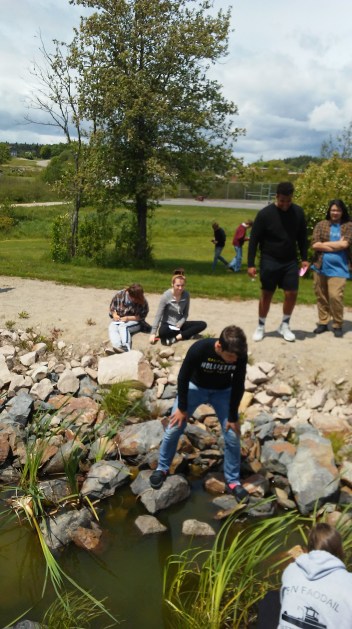
20180607_113557

Guys, you’re supposed to be WRITING about the pond, not going INTO it. Guys?

20180607_115118

Please nobody ask about the frogs. Just don’t.

Surely next year’s sophomores could never become MY kids. I mean, how many kids can I have? (Don’t answer that, because already I’m planning how to do things better for MY new kids next year.)

And yes, I’ll miss MY kids, because I had no idea how badly I wanted to be their teacher. God knew, and He’s probably smiling smugly down on me because, once again, He knows me better than I know myself. He shoved me clear across the country to fulfill a dream I forgot I had: to teach high school English. Now I just need to get a whole lot better at it.

I doubt I’ll dance out of here tomorrow once my grades are submitted. I’ll walk through silent hallways and empty parking lots, hoping I didn’t fail my kids too badly or too often, and probably quietly crying as I did last June, but for entirely different reasons.

Because, dang it, I am going to miss those goobers.

20180613_113001

You have AN awesome summer, too! (See? I failed to teach her “AN awesome”. Crud.)

SNEAK PEEK into Book 8:

Lemuel concluded that falling asleep was impossible. His mind was haunted with visions of Perrin Shin in a general’s uniform. He stood with his arms folded and that one menacing eyebrow, arched.

Behind him stood her, with her head tilted in that annoying and admonishing manner all teachers possessed that indicated, Now you’ve gone and done it.

~Book 8, The Last Day, coming Summer 2018


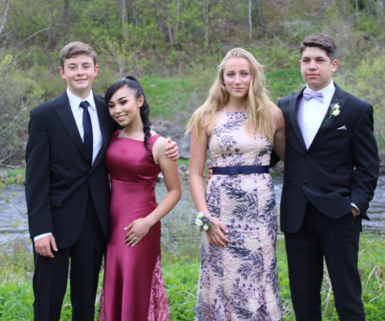
I used to think prom was a waste of time and money, but last weekend I realized why we need it (and a sneak peek to book 8)

My inner anthropologist compelled me on Saturday night to go to our high school and witness a cultural phenomenon called “walking out.” At proms in the west, this doesn’t occur. But here in Downeast Maine it’s the event of the year.

Before the prom begins, the juniors (even though all grades were invited) link arms with a friend or date and march out on a catwalk to pose for pictures. In the audience seated below, their family and friends whoop and cheer as the music plays.

It was fun to see my students all dressed up: the muck boots and hoodies swapped out for buttoned shirts and jackets. The stretchy pants and plaid tops traded for beaded gowns and updos.

prom WA taylor and kistin

And the beautifully decorated gym never smelled better—the combination of perfumes and colognes replaced the usual waves of B.O. (Then again, the dancing hadn’t yet started.)

prom picture carissa

But, according to the comments I heard around me before I left, it was all very painful.

“Seventy bobby pins! That’s what’s holding this hair up—seventy. My head’s killing me.”

“Are dresses supposed to feel like your [bahonkas] are going to fall out of them every five minutes?” (If I had my sewing machine with me, I would have taken her to my classroom and made her straps, if only to get her date to stop staring.)

“I already kicked off my shoes. I don’t care what my mom says, I know I should have worn my moccasins.” (Still the dancing hadn’t started.)

PRom pictures madelyn and andersen

“Dude, I spent an hour with a Youtube video trying to figure how to tie this tie.”
“Why didn’t you just order a clip-on from Amazon like the rest of us?”
“What’s a clip-on? Man, that would have been WAY easier.”

prommikaila and friends

“No, I can’t eat anything. My mom rented this tux from Bangor [a two-hour drive away]. She said she’d kill me if I got anything on it.”

(There was a lot of “killing me,” and my inner English teacher was chanting, Hyperbole, Hyperbole.)

Overall, the kids looked great. Girls squealed in delight at each other and their dresses and hair, boys guffawed at their friends, punched them in the shoulder, and told them they looked “sick.” (That’s a compliment, by the way. Took me only a few months to figure that out.)

Another teacher murmured to me on our way out before the dancing began, “They clean up pretty well, don’t they?”

They really did.

A few boys who barely seem awake in my class were bright-eyed and dashing. I almost didn’t recognize a few others without their trademark baseball hats (oh wait–there they are, proving anything can go with a baseball hat if you’re a Mainer boy).

Image may contain: 6 people, people smiling, people standing

Then there was the girls who usually wear torn jeans and apathetic expressions, but were instead smiling shyly with smoky eyes and in gorgeous gowns. There were a few girls I didn’t even recognize in their glamour gear and huge grins.
(And occasional winces, because of shoes. And because of hairdos. And because of dresses which threatened to pop out strategic parts of their anatomy.)

I always thought the school had a lot of pretty girls, but that night all of them had progressed to “stunning.” And the boys were so close to “debonair” it was jarring.

I was surprised at my pride in all of them, especially when I recognized a few of my students strutting on the catwalk. (But calling out “AP LIT POWER!” would have sounded ridiculous.)

prom karli

prom isaac

I have a terrible confession to make: for years I’ve thought prom was a waste of time and money. I seconded the griping of one of my students about his date. “Her mom’s taking her all the way to Bangor to get her hair done. It’s gonna cost $200. For what?”

Exactly. All this effort, expense, fanciness—for what? Some of my own children went to prom, and I made dresses (less than $100) and helped (sort of) with hair, and hoped the dates didn’t spend too much money.

But why bother at all?

Saturday night, I knew why: to let these newly-emerging adults see what they can become.

Image may contain: 1 person, smiling, standing, ocean and outdoor

No, not some glamorous model on a magazine (but pink mermaid above certainly could be). But that with some effort, care, and attention, they can shine and dazzle.

Sometimes I’m given insights into people—glimpses into who they were before they were born and who they can become later in life. And it’s a good thing those glimpses are rare, because they overwhelm me. C. S. Lewis was right in that we never talk to “mere mortals:”

“There are no ordinary people. It is immortals whom we joke with, work with, marry, snub and exploit—immortal horrors or everlasting splendors.”

Image may contain: 2 people, people smiling, people standing

I sometimes see who my students were, and who they can become. It’s staggering. So much strength. So much potential. So much power, wrapped up in these tense bodies of anxiety and worry and worldliness. It’s good for them to see themselves—and each other—at their “best” that none of them knew existed.

To feel, just for one night, the grandeur of what may be.

No wonder their parents were there, proudly taking pictures and cheering. They have glimpses, too, I’m sure. At least they have hope. They sigh and think, “Almost there . . . almost there . . .”

prom nevin

(Uh, Nevin? It’s not “hoodie optional.”)

And as their teacher, it was good for me to see them, too. These are the moments when I think, “There’s still hope for the future. Look at these kids. Don’t despair just yet. Give them a chance to shine like this all the time.”

(NOTE: I didn’t take any of these amazing photos, but gleaned them from Facebook and emails, and my students agreed I could use them.)

[Sneak peek to Book 8: The Last Day]

Cloud Man smiled as he wiped Young Pere’s face, as if he were washing up a toddler. “Chin up. Up, up. Too bad there’s no time for a shave. You grow the most ridiculously splotchy beard. Now, behind your ears . . . And over to your forehead . . .”

Sergeant Beaved, observing the cleaning up of his prisoner, rolled his eyes and turned around in embarrassment.

Young Pere struggled to keep his face from contorting. Cloud Man was the best.

“Now close your eyes. We need to get all that dust off. Why, you’re not as tan as I thought you were. Most of that coloring is dirt. Tsk, tsk. What would you mother say? Oh, I guess we’ll find out soon enough, won’t we?”

Young Pere snorted.

“Now your hair . . . hmm. I think I have a comb somewhere. Ah, here it is! I don’t think I’ve even used this. Let me comb through this . . . It’s as if you haven’t bathed in days, Young Pere.”

“Because I haven’t, Cloudy. None of us have. We’ve been invading Salem, remember?”

“Tsk, tsk. Your hair would be better if it was shorter. Guess there was no time for a decent cut after they released you from the dungeon. We’ll just comb it up and over your ears. Now, let me look at you. Hmm. Guess we need a woman’s opinion. Do they generally consider you handsome?’

“Generally.”

“You might pass for handsome. Ruggedly handsome, since you’re not cleaned up properly—”

“Are you about finished?” Sergeant Beaved interrupted hotly. “Because I’m supposed to bringing him at any moment!”

Cloud Man nodded and patted Young Pere’s hand which still held the unlocked chain together. “I think we’re almost ready.”

~Book 8, The Last Day, coming Summer 2018

They can keep changing the rules, but we don’t have to be obedient. (Plus 3 sneak peeks into Book 8)

My 6-year-old tried to play chess with me at their school’s STEM night last week. I didn’t realize he knew the rules, and it turns out he doesn’t, because he produced a secret weapon: a 6-legged spider he’d made out of clay in his class earlier.

“This is spider-guy,” he announced. “And he can eat all of your little white guys there.”

Before I knew it, the clay creature had wiped a handful of my “white guys” off the board.20180501_182939.
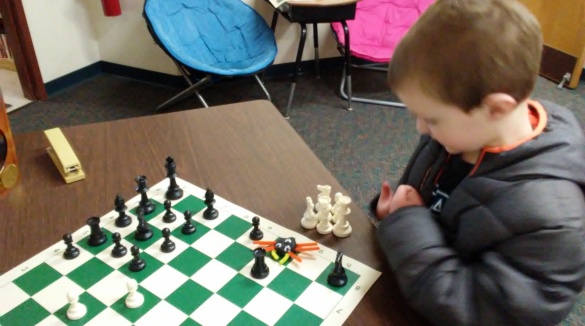
So that’s how this was going to be played.

“Fine,” I said, and looked around for my secret weapon. “This is Stapler Man, and he can chomp your spider-guy.”

“Good job, Mom!” he cheered as I nudged his spider off the board, but then he plunked spider-guy back into play. “But my guy has 175 lives.”

“I see,” I said, and if he was going to change all the rules every minute, like a game of Calvin Ball in Calvin and Hobbes, so could I. “Stapler Man has 180 lives, and he’s coming after your king.”

My son sighed and said, “You can’t change the rules like that, Mom.”

“But you just did.”

He hesitated, seeing that if he turned things unfairly to his advantage, I might too. (Yeah, I’m that kind of mom.) “Let’s go see the salmon babies,” he said, and the game was over as we headed to the fish tanks.

In my sophomore English classes we’re reading All But My Life, about a 15-year-old Jewish girl who is forced into the Nazi labor camps and is one of the few who survives. Last week we read about the ever-changing rules in regards to Jews; they can’t own phones, or cars, or bikes, or even fountain pens. They have to turn over the gold, their goods, their houses. Signs go up: “Gardens only for Germans,” and “No dogs or Jews allowed.”

The rules change daily, to the advantage of the Nazis, but the Jews aren’t able to play that game back at them or they’re shot.

My students, while fascinated by the story, have asked why this “history” book is in our English curriculum. We talk about language—euphemisms, propaganda, etc.—but the class is also about thinking and analyzing.

So I’ll tell them, “This memoir isn’t only about history, but about language, about control, about the direction we’re going right now. How are you going to survive in a country where the rules are changing daily?”

We all see this—it’s no secret: the elite, in various organizations, are manipulating situations to fit what they want to have happen. It’s not about the good of the country, but the selfishness of a handful. The rest of us struggle to know if we can shift those rules again, or somehow subvert them.

In the book we’re reading, Gerda Weissmann begins to learn English on the sly, and even though she’s denied an education, her father teachers her out of the textbooks they still own in the privacy of their house. (Proving that homeschooling is for subversives.)

My parents grew up in Nazi Germany. Their families–not Jews and certainly not Nazis—realized early on Hitler was going to be disastrous for Germany. Quietly, privately, they tried to subvert the changing rules the elite imposed upon them. They had more chickens than allotted and hid them when the inspectors came; they had doctors write notes excusing their children from attending Hitler Youth; they traded cigarette and coffee rations (Mormons don’t use those) on the black market for more flour and sugar; and my great-grandfather blackmailed a Nazi recruiter who tried to secure his money for their cause. The Nazis never bothered him again.

In the Book of Mormon is a story about a group of followers of God who are oppressed by their government (Mosiah 24). They’re told they can’t pray or they’ll be executed. The people simply didn’t pray out loud, but in secret, knowing that God would still hear them. Quiet subversiveness when the rules are purposely stacked against them.

It seems almost daily that the rules are changing, that more and more laws are purposely designed to hold down one group while elevating another.

Unfair? Absolutely.

But the question is, how do we respond—individually and collectively—to the oppressive elite?

Maybe a situation is benign enough that we can pull out our own “stapler guy” and change the rules once again for more even odds.

Or maybe a problem is so grave that our defiance equates our death—politically, mentally, spiritually, or literally. That’s a much more difficult situation to manage.

But there seem to be many opportunities for outward obedience yet inward rebellion.
However, there should never, ever be quiet acceptance.

Because if we don’t even try to fight, then we’ve already given up and they win.

(Because I’m so eager to get you Book 8 “The Last Day” this summer, I’m giving you THREE sneak peeks!)

#1 Sneak Peek

“Oh yes, General.” Young Pere squinted with disdain. “That makes me want to call you ‘father.’ Hit me all you want, Thorne, but you can never change who I am or what you are. So choose the slagging canyon yourself.”

From the corner of his eye, Young Pere could see Hili beaming. But Thorne stood shocked, not used to such flagrant insubordination, and evidently didn’t know how to proceed.

Finally Thorne whispered, in as sinister a voice as he could muster, “I have one more thing to do with you, Shin. Then I will kill you myself. Nothing will give me greater pleasure. Your days are numbered, make no mistake about that!”

Young Pere nodded once, not at all intimidated. Thorne was full of unmet promises; just ask anyone he’d told he’d give a medal. He still owed Young Pere a few.

#2 Sneak Peek

Shin frowned at Sergeant Beaved. “So I’m supposed to go along with all of this?” 

“If you want to live, yes!”

“Is that what all of you do?” Shin exclaimed. “Just go along with whatever unbelievable and unlikely story preserves you for another day?”

“Yes,” Beaved said shortly. “Why not?”

“Living in lies? That doesn’t bother you?”

Beaved leaned in. “What bothers me is the idea of dying, Shin.”

“Doesn’t bother me,” he said, almost believably.

“Look, Shin, just . . .” Beaved groaned quietly. “I don’t know what the truth is myself, but I do know this: you have a chance to survive this. A small chance, getting smaller each time you open that big mouth of yours. But if I were you I’d cling to that chance, do whatever it takes to preserve your life. You can fix the lies later, if necessary, but you can’t if you’re dead.”

#3 Sneak Peek

“I’m as helpful as I know to be, Teach,” Shin said down to the man following him on the slope of the mountain.

“But one could be more helpful, Shin. Considering that Thorne has repeatedly threatened one of your security detail if you fail.”

Below him, Cloud Man bounced his head, oblivious that Thorne had threatened to bounce the vial head down the mountain if the private wouldn’t be more cooperative.

“Interesting,” Shin said as he searched for better footing. “Thorne’s so ‘noble’ as to force us to seek out Salem, and he’s so ‘noble’ that he’s also threatening one of his own soldier’s lives to do so. Perhaps I’m not that familiar with the definition of nobility. Enlighten me, Teach.”

He heard Teach moan below him again, maybe because of the question or because he was smacked by another tree branch. Hopefully both.

“Nobility. Doing that which the circumstances demand.”

“That’s it?”

“Language usage wasn’t my specialty in the university,” Teach admitted.

“What was your specialty?”

“I specialized in it all.”

Shin stifled a snort. “But not language usage?”

“Why bother? Everyone knows how to talk, don’t they?”

Shin reached for another scrubby brush. “So who decides ‘what circumstances demand’? When someone is acting in everyone’s best interests and not just out of his own selfishness?”

“Are you suggesting General Thorne is selfish?” Teach asked.

“Yes.”

The scoff behind him made Shin glance down.

Teach was aghast. “You actually admit that?”

“I said only what you’re thinking, Teach. What everyone on this hill is thinking but is too afraid to say.”

A surprising perspective of Godliness I’ve learned from teaching high school (yes, He’s still there)

They come into my room with complaints, always. It’s the nature of teenagers, and because I sit behind the desk I hear it all.

Usually they march right up to me and express how annoying, or rude, or fake, or awful someone is. It’s more important than lunch, more important than study hall, more important than catching the bus after school that I know just how wronged they were.

Sometimes they sit at a desk and vent to another student about so-and-so’s inhumanity, and because teenagers are notoriously loud, I hear all of that too.

Later, more come in and I hear the other sides of the stories—because these students are friends of the horribly offensive one or might even be the offender themselves.

And then I put together the picture based on the selected pieces dropped in front of me, and a new image emerges.

I understand many new angles, a variety of aspects.

Who’s at fault?
Well, all of them.

Who deserves retribution?
None of them.

Who deserves mercy and another chance?
Each and every last one of them.

Sometimes the students demand that I take a side, that I assure them that their anger is justified. I can’t do that, because I’ve seen the backside and know that there is plenty of blame to go around. I’ve never seen anyone wholly innocent.

I think deep down all of them see that too.

Instead, I commiserate with them, tell them I’m sorry they’re dealing with this, then . . . I leave it.

Because I realize they’re not as far apart from their enemy as they think they are. Actually, they’re so close they’re nearly side-by-side, except for this sliver of animosity wedged between them. I’m not going to try to remove that wedge because I see how close they are to resolving it themselves, and the knowledge and growth they get as they do so will be the best learning they’ll have in school.

So I watch, and on a rare occasion call an authority because a law’s being broken, but for 99% of the time I pray silently these silly teenagers get over themselves and move on.

And so far, they have been. Grudges melt away. Enemies share a pencil. Students put on suspension come back with sly smiles and ask, “I’m still your favorite student, right?” (I hesitate to answer that one, every time.)

And this, I’ve discovered, is a tiny glimpse of how God works. We wander into His heavenly room full of complaining prayers, demanding He wreak vengeance for us, tell Him how unfair and unjust life is. He smiles consolingly, wraps His comfort around us, then because He sees just how close we are to solving the problem ourselves, He steps back and lets us flail and muck about, giving us words of encouragement, but not interfering 99% of the time. He knows we’ve got this, if we’ll just calm down enough to hear His words.

Image result for god at his computer

If we accept His perspective and insights, our hearts soften, our anger dissolves, and we leave with our enemies not so enemy-ish (and grateful that God didn’t smite them with a falling piano as we earlier requested).

Then He smiles and hopes that next time we’ll remember to first show a little more mercy, a little more patience, a little more love, a little more Godliness.

“He was very easy to talk to,” Versa said. “He listened to my long descriptions without any expression of surprise or dismay, as if he’d heard it all before. No judgments, no criticisms, just patient listening. Much like I imagine the Creator would listen.”

~Book 8, coming Summer 2018

weekly meme Creater easy to talk to

How an invasion of ladybugs brought down this pacifist and is making her rethink her stance on guns.

See this photo of our latest snowstorm?

IMG_0126

Look closer—see all the spots on the image when I turn on my camera’s flash?

IMG_0127

Ladybugs.

No, no, no—don’t start saying, “Oh, how sweet!” because they aren’t. Not one bit.

They are everywhere. Hundreds, every single day, springing up in the oddest of places. Usually I find them my bedroom and in kitchen–literally IN the butter dish and in the refrigerator (under the veggie drawer, trying to get to my lime).


They don’t respect anything or care where they die. My curtains seem to be their favorite death spot. And our cat is useless against them.


Did you know that when you step on them with bare feet, they have the softest crunch? Not as bad as cockroaches, but still very unsettling when, in the middle of the night, you pad clumsily to the bathroom and feel tiny “crunch . . . crunch . . . crunch” under your feet.

This has been problematic for me because I’ve gone on the offensive, vacuuming up these creatures every day—hundreds a day–and every morning the window looks again like this:

IMG_0129

I like to believe I’m a pacifist. I don’t destroy spiders, but back away respectfully and let them have the room until they feel like leaving. I’ve caught mice in past houses and released them into the wild. I have a “live-and-let-live” philosophy: everything deserves life, as much as I do.

Except for hornets. Just the other day I followed a disoriented one who must have come out of hibernation early in my classroom. It landed on the floor and I whacked it repeatedly with a binder, to the cheers of my students. Hornets serve no purpose except to sting me and make my hands swell up.

And ants. They can do anything they want outside, but if they invade the house, they’ll meet my can of Raid and my cries of “DIE! DIE!”

Ok, so I’m a pretty bad pacifist, with a “live-but-not-in-my-house” philosophy.

Funny how circumstances can make you rethink your philosophies, how something hitting close to home—or invading your home—can shift everything.

For example, I hate guns. Always have. I recoil when I see one nearby, and the desire to run for cover overwhelms me.

Until recently, when I realized that as a “permanent substitute teacher” I have a responsibility beyond myself.

Our school has recently been discussing ways to improve safety. New measures began this week, and as I explained them to my students, we naturally joked about how to deal with real threats. (These are teenagers—the only way to deal with heavy issues is to make them lighter.) We talked about the door, and how I might be rearranging the classroom to put me nearest the door, in to open it first whenever someone knocks.

A student said, “So that means you get to die first? Mrs. Mercer, how’s THAT supposed to help us?”

Before I could answer with, “Gee, I really don’t know. I hadn’t considered that,” another student suggested, “Seeing her get shot gives us half a second to realize what’s happening so we can hide under our non-bulletproof desks.”

“But if Mrs. Mercer had a gun,” someone said, “she could take out the shooter and save us all!”

Shockingly, I found myself smiling at that.

Wait, what?!

No. No, no, no I hate guns. I don’t even like their shapes. But suddenly, looking at all of my students who daily test and try me, but who I love far more than I ever thought I would, I wavered.

Would I try to take out their shooter? I like to think I’d rush him, like a manic mama bear, screaming and flailing and maybe doing some good before I was cut down.

But if a gun appeared in my hands at that moment—and I knew what to do with it—would I use it in a situation where I thought my students were in danger?

Shockingly, I just might.

Oh, I know all of the arguments against guns—I’ve written them all in my head. Every time I read about an accidental shooting, or another child finding a loaded gun, or someone else being careless and causing injury or death, I point it out to my husband and say, “Again, THIS is why I insist you keep the ammo and guns separate.” He does. It took him years to convince me to let him have any weapons at all.

I’ve always maintained that I would rather lay down and die in front of a gunman, instead of risking taking someone else’s life. Especially if there was the possibility of my misreading the situation and using a weapon on an innocent bystander. Judging a life-or-death situation accurately in a moment’s notice is difficult for highly trained soldiers and police. They sometimes get it wrong, despite all their experience.

But someone like me? Untrained and emotional and terrified? I wouldn’t trust myself to make the right decision. That’s why I’d prefer to lay down and let happen whatever would happen. God will sort it all in the end.

But as a teacher—even a mere permanent substitute—it’s not just my life in that classroom. I’m a pseudo parent for every child in that room, and I have to consider, “What would each of those parents expect me to do for their child?” I still hate guns. I never want to hold one, but . . .

I’m wrestling with that idea as I vacuum up yet another batch of invading ladybugs.

Only a year ago, I would have carefully rescued the stray ladybug I found in the house and escorted it outside, not unceremoniously suck them up and throw them into 22 inches of new snow.

Circumstances have changed, and I’m changing too.

And I’m still debating if that’s a good thing or not.

Mrs. Yordin chased after Mahrree. “Don’t you dare interfere with my soldiers!”

Mahrree stopped. “Your soldiers? Eltana, no one in Salem owns anything, especially soldiers! But this is what it’s about for you, isn’t it? Revenge for Gari? You don’t care one bit for these people. You never really tried to live the Salem way. You harbored resentment and anger all this time, and now you’re using these gullible people to try to, what, kill Lemuel Thorne? Is that your goal?”

“Yes!” Mrs. Yordin declared. “For me AND for all these people, and even for you, Mahrree! We kill Thorne, we change the world.”

“Change it to what? Not all change is for the best, Eltana, I promise you. The kind of place where bitter old women like you get their way and peace-loving people suddenly want to know how to bleed a man to death is not a place I’d want to live in!”

Mrs. Yordin folded her arms. “You were always so self-righteous,” she announced smugly. “Always had to tell everyone else what they were doing wrong and why nothing was ever right. No wonder the world forced you from it. They were sick of listening to you. Everyone in Edge was. And now you’re breathing your sanctimonious ranting here.”

“Yes, I am.”

~Book 8, The Last Day, coming Summer 2018