12 reasons why I want to be a better Grown-up

A young mother who was recently put into leadership of our church women’s group told me she was worried that she didn’t “adult” properly on her first Sunday in charge, but I assured her that she displayed a great deal of “adultery” at church. (She’s still hesitant to speak to me.)

I was proud of her worry, though. She understands that being an adult, or a “Grown-up,” is a good thing, and she wanted to do it right. Too many people, however, are content to remain “Children”: they don’t want responsibility, they expect to be handed everything as if they were still babies, and they’re easily offended if the world doesn’t go their way. 

But being a Grown-up is a great thing. Here are 12 ways that Grown-ups make the world a better place, and why I’m resolving to be a better one. First, some definitions:

“Grown-ups” can be any age, and they’ve discovered that life isn’t about satisfying themselves: it’s about serving others. And when you take care of others, most of your problems take care of themselves.

“Children” are adults of any age who still think life is about getting all they can for themselves, and whose single-minded selfishness causes frustration to just about everyone they come in contact with.

Here’s why being a Grown-up is better:

  1. Grown-ups are modest. While they’re proud of their spouses and family’s accomplishments, they aren’t Children who brag incessantly about perfect grades, or post college acceptance letters online, or post a hundred photos of their latest and expensive vacation. Grown-ups will discreetly mention a promotion or a child going to college to let friends know that a change is occurring, but they also know that many of their friends are struggling, and that boasting about successes frequently make others feel inadequate and discouraged about their own failures.
  2. Grown-ups are discreet. They’re careful with what they reveal, especially on social media. While Children air out all of their dirty laundry about family, work, or awkward personal problems, Grown-ups think before posting, pause before venting, and consider if they really want the entire world knowing their troubles. Grown-ups realize that most people don’t want to know, and that unloading your troubles to only a couple of people who can really help resolves their problems much faster.
  3. Grown-ups build up others. They are concerned about making everyone around them feel comfortable and loved, and when they ask how someone’s doing, they really want to know. Children, on the other hand, are concerned only that everyone notices they are in the room. And they want to be The Most Important Person, too, so they frequently insult or tear down others, then claim they are only “teasing” when they go too far. Grown-ups, however, go out of their way to lift those who are flailing, encourage those who are discouraged, and be genuinely kind to everyone, everywhere. It’s rare when someone notices that a Grown-up has a problem; they won’t advertise it or draw any attention to themselves.
  4. Grown-ups are secure. They don’t need expensive cars, fancy clothes, remodeled homes, or any other status symbol because they are confident in who they are. Children, however, are easy to spot because they make sure you see they have the latest, biggest, and most expensive of everything, because that’s how they feel important. They excessively post selfies of themselves desperately searching for praise and approval. Their possessions define them, whereas Grown-ups are defined by what they know, who they love, and what causes they worry about. Grown-ups never create drama, but Children always do. Children crave drama, and never realize that everyone else hates it. 
  5. Grown-ups are selfless. They care more about others than themselves. Among Grown-ups is the company president who stays after the holiday party to vacuum so the janitorial staff doesn’t have too much extra work; the grandmother who’s absent from the big family party because she’s in a back bedroom with an overwhelmed four-year-old, reading him a book; the popular teenager who decides each day at lunch to sit with the loner kid because he needs a friend. Children, on the other hand, steer every conversation to themselves, don’t listen to anyone else, and sulk when not enough attention is given them. A Child may be the grandfather who pouts because he thinks he’s been disrespected by a clueless grandchild, the employee who feels her accomplishments should have been publicly acknowledged at the boss’s luncheon, and the college student who complains no one is his friend when he does nothing but play games on his computer all day.
  6. Grown-ups make life easier. They step in when a problem arises. They clean up the messes, they offer the jobs, they pick up your kids, and they spend their Saturdays helping you move. Children cause problems, and when their family/coworkers/friends see them coming, people tense up and tell each other to brace themselves. But when the Grown-ups arrive, people relax, smile, and know that everything’s going to work out. 
  7. Grown-ups are responsible. They pay the bills, balance the checkbook, clean up the house, cook the meals, go to work on time, and check the air pressure in the tires, even when—especially when—they don’t want to. Grown-ups work first and play later. Children reverse that, and as a result their lives are more chaotic than they need be. Children have to be prodded and nagged to do nearly everything, and are resentful when someone doesn’t swoop in and rescue them from their consistently poor choices. When a financial windfall comes to Children, they blow it on vacations and toys. When Grown-ups come into money, they pay off debts, donate some to charity, save the rest, and blow maybe only a hundred bucks on dinner out for the family.
  8. Grown-ups are generally happy. That doesn’t mean they don’t have problems. But because they are mature, they seek solutions to their problems and humbly change their behavior when they see their faults. They realize that everyone has struggles, and they don’t see that as something to resent, but to transcend. Problems become challenges, which become triumphs. Children, on the other hand, are generally miserable. Because they expect the world to conform to their desires, they are frequently disappointed and rarely see that they are the root of their problems. Children demand others make them happy, without realizing that happiness is cultivated from within. 
  9. Grown-ups are tolerant. They don’t feel threatened by others’ ideas, but allow all people to make their own choices and believe what they want to. Grown-ups don’t need everyone to approve of them, nor do they need constant reassurance that what they do or want is perfect. Grown-ups are content with themselves and with who they are, so they aren’t easily brought down by dissenting opinions or nasty barbs. Children, however, feel threatened by everyone and everything, if insults are intended or not, because they have no sense of self outside of public approval. They demand everyone to conform to their views and desires, and feel terrified of the world at large because it doesn’t acknowledge them as the center of it.
  10. Grown-ups take care of themselves. They get proper amounts of sleep and exercise, they pick up new skills, they learn how to use new technology, they read books and newspapers, and they pay attention to their health. Grown-ups realize that hot dogs and soda hasn’t been an acceptable lunch since they were eleven years old, and that their physical and emotional health is something they can—and should—take control of. But Children want to follow every impulse, and balk when someone suggests they eat better, or exercise more, or go to bed at a reasonable hour. They want to live like irresponsible teenagers as long as they can, but then are resentful when they need a handful of pills each day just to function. Children rationalize and whine they have no control over their situations, that genetics or family expectations hold them back, but Grown-ups accept that nothing, really, is out of one’s control.

    Image result for ron swanson eating a banana gif

    Ron Swanson eats the occasional banana, although he hates it, because he’s doing it for his wife and children. Ron’s a Grown-up.

  11. Grown-ups ‘fess up. They are honest—with themselves and with others. When they make a mistake, they own up to it, apologize, and try to make amends. But Children will rarely admit their errors, and will pretend, in the face of all evidence, that they didn’t do anything wrong. They’ll even try to shift the blame to someone else, even when everyone else can see they are at fault. Children think that admitting faults makes them smaller, but in reality confessing mistakes and rectifying them like a Grown-up is what earns people’s respect.
  12. 23 Times Ron Swanson Was Inarguably Right About The World

And finally,

  1. Grown-ups sacrifice, without telling you the cost. They will give you their time, their money, and their love without ever letting you know how much it may inconvenience them. They give whole-heartedly, because they’re more concerned about you than themselves. Children may give those same things, but they’ll remind you—even years later—about the cost of their sacrifice. Their concern is not with your well-being, but with getting acknowledgement for their service, which then is no service whatsoever.

People love and admire Grown-ups.
They barely tolerate Adult Children.
I want to be a better Grown-up.

   “Perrin, I don’t know of another family that would give up as much as you have. Shem told me that you and Mahrree had amassed a fortune in your cellar. You were by far the richest family in all of Edge.”
   “Wait,” Peto frowned, “we were even richer than Trum?!”
   Mahrree waved him off, but shrugged. “Well, I suppose . . .”
   “When you saw people in need,” Gleace continued, ignoring Peto’s slack-jaw and Jaytsy’s rapid blinking, “you gave every last slip of gold and silver, along with the jewelry you inherited, to pay off everyone’s losses in Edge. You also took that caravan of supplies from Idumea, despite the fact that you could have lost your position in the army, because you felt it the correct thing to do. You and Mahrree don’t care for possessions or status, but for people. Already you understand.”
   “How much did all of that cost?” Peto demanded, still shocked to realize his parents had given away a true fortune.
   “We never counted the cost,” Perrin said. “Never count the cost.”

~ Book 5 (releasing in 2016) Safety Assured Leaving East of Medicetti

We adults have ruined the world for our kids

Once again someone has sent me a trite old email about “How great things were in the past!” and “How awful things are today!”

Surely you’ve seen these before, the less-than-subtle comparison that when we were kids we knew how to be kids, unlike kids today who are pathetic pansies.

However, there are two major problems with such grossly inaccurate nostalgia trips: 

1) Life was never as good as we remember it, and;

2) If we don’t like the way life is for our kids, we—their parents and grandparents—are to blame.

First, let’s look objectively to some of the ridiculous claims about how we “survived” and are somehow inherently “better” than the younger generation.  Many pieces like this one detailed below float around, but since this is the most comprehensive, we’ll use it to demonstrate the selective memory problems so many in the older generations suffer from. This one is called:

TO ALL THE KIDS WHO SURVIVED
The 1930’s 40’s, 50’s, 60’s and 70’s

(From: http://www.corsinet.com/braincandy/hage5.html)

First, we survived being born to mothers who smoked and/or drank while they carried us. So there’s no problem with mothers smoking and drinking during pregnancy? Or are you willing to admit that no, not everyone emerged as “good” as you?

They took aspirin, ate blue cheese dressing, tuna from a can, and didn’t get tested for diabetes. And they also had a lot more problems during childbirth as a result. But you don’t remember your birth, so obviously this detail doesn’t matter.

Then after that trauma, our baby cribs were covered with bright colored lead-based paints. Lead-based paint causes problems in mental acuity, which the author of this piece of propaganda demonstrates all too well.

We had no childproof lids on medicine bottles, doors or cabinets and when we rode our bikes, we had no helmets, not to mention, the risks we took hitchhiking. And the author also doesn’t remember that children died from poisonings at higher rates than they do now, and that many children suffered from brain damage or worse when they crashed on their bikes. There were consequences. Although brain damage causes us to forget . . . 

As children, we would ride in cars with no seat belts or air bags. And the families who died in car accidents back then aren’t around to explain how seat belts and air bags would have saved their lives.  

Riding in the back of a pick up on a warm day was always a special treat. Stupid, but special. Again, loss of memory=brain damage. (Or marijuana use. Go ahead–ask Grandpa about the drug culture of the 60s and 70s.)

We drank water from the garden hose and NOT from a bottle. So why don’t you let your grandkids drink from the hose?

We shared one soft drink with four friends, from one bottle and NO ONE actually died from this. No one dies now, either. It’s usually kids’ parents and grandparents who freak out about them sharing. 

We ate cupcakes, white bread and real butter and drank soda pop with sugar in it, but we weren’t overweight because WE WERE ALWAYS OUTSIDE PLAYING! But an enormous amount of the adult population is overweight now, because you never outgrew drinking soda and eating sugar. Type 2 diabetes, anyone? Everyone?

We would leave home in the morning and play all day, as long as we were back when the streetlights came on. So why did you create a society where your kids and grandkids can’t have such freedom? Why do you call social services when you see kids walking by themselves to a nearby park?

No one was able to reach us all day. And we were O.K. It’s not kids who buy cell phones to carry around; it’s their parents.

We would spend hours building our go-carts out of scraps and then ride down the hill, only to find out we forgot the brakes. After running into the bushes a few times, we learned to solve the problem. But when your kids/grandkids ask to use supplies in the shed, you yell at them to not make a mess, not make any noise, and go to their rooms and be quiet. So they turn to their games . . .

We did not have Playstations, Nintendo’s, X-boxes, no video games at all, no 99 channels on cable, no video tape movies, no surround sound, no cell phones, no personal computers, no Internet or Internet chat rooms……….WE HAD FRIENDS and we went outside and found them! So why do you now yell at the neighbor kids when they’re outside running around and making noise? Why do you call their parents and threaten to sic the cops on them for accidentally running across your lawn?

We fell out of trees, got cut, broke bones and teeth and there were no lawsuits from these accidents. Kids don’t file lawsuits; their parents file lawsuits. Why are you doing this now?

We ate worms and mud pies made from dirt, and the worms did not live in us forever. So why do you not let your own kids/grandkids explore this way?

We were given BB guns for our 10th birthdays, made up games with sticks and tennis balls and although we were told it would happen, we did not put out very many eyes. Kids don’t call the cops on other kids with BB guns. Adults do that. Why did you change?

We rode bikes or walked to a friend’s house and knocked on the door or rang the bell, or just walked in and talked to them! So stop accompanying your children, or telling them to use a phone, or tell them that you don’t want them out on their own.  

Little League had tryouts and not everyone made the team. Those who didn’t had to learn to deal with disappointment. Imagine that!! So now that you’re coaching these teams and have put your kids in these sports, why have you changed the rules?  

The idea of a parent bailing us out if we broke the law was unheard of. They actually sided with the law! So why don’t you respect the law anymore, and defend your precious “innocent” babies instead?

This generation has produced some of the best risk-takers, problem solvers and inventors ever! And has also produced adults that over-parent their children and limit their development. Why is that?

The past 50 years have been an explosion of innovation and new ideas. Surely you don’t think YOU’VE accomplished all of that, do you? Millions take credit for the work of just a few thousand. 

We had freedom, failure, success and responsibility, and we learned HOW TO DEAL WITH IT ALL! And yet you’re afraid to let your children and grandchildren have that same experience?

You might want to share this with others who have had the luck to grow up as kids, before the lawyers and the government regulated our lives for our own good. Ah, I see! Individuals don’t have any responsibility—it’s all the lawyers government’s fault!? You just claimed earlier to have “responsibility,” but only when it’s convenient? No, I’m sorry. You can’t pin all of these changes on the government. And how many of you are lawyers? We all have to take responsibility for how our children turn out.

And while you are at it, forward it to your kids so they will know how brave their parents were. And just how dramatically they changed the world you now live in. Yes, your parents and grandparents destroyed everything when they became grownups. Remember that when you choose their nursing home.

How many of us have naively imagined Thanksgiving looking like this? How often have we actually achieved it? Everyone smiling? Yeah, me too.

The problem is the “good ole days” never really existed. Even in the 1950s—a classical age many of our older generations hark back to—we knew this.

Morris Wright in 1957, wrote this about the beloved Norman Rockwell paintings that I’ve used in this blog:

“We might say that Mr. Rockwell’s special triumph is in the conviction his countrymen share that the mythical world he evokes actually exists. This cloudland of nostalgia seems to loom higher and higher on the horizon . . . and disappears from view . . . leaving the drab world of common place facts and sensations behind.” [emphasis added] (Approaching Zion, Hugh Nibley (1989), page 523. )

Here’s another plug for “Those were the good ole days” that never were.  https://www.facebook.com/1035wimz/photos/a.180388971978038.49555.121975634486039/871131596237102/?type=1

And another that touts many poor decisions as “ok” and “Hey, we survived.” However, I appreciate that she prefaced her list with this:

Now, as a parent myself, my own parents like to tell me I’m too overprotective.
“Really?”
“Well, you survived,” they say.
“Yep, but it seems like the odds were against me.” http://thestir.cafemom.com/big_kid/165499/21_Things_80s_Kids_Did

Another “We had it so tough but we also had it so great, so we’ll just ignore all the other bits.” https://amyunjaded.files.wordpress.com/2012/03/70s-80s.jpg

This one’s more balanced, with an interesting comparison of a few decades ago with today. There are advantages and disadvantages to both times, and let’s remember that. http://preventdisease.com/news/15/020515_10-Differences-Child-Grew-Up-70s-Compared-To-Today.shtml

Check out this video by Nature Valley Granola, and ask yourself: who bought all the gadgets for their kids and grandkids? Who’s responsible for teaching them how to really play outside? It seems that some adults are realizing that hey—all of this is our fault. And we’re also the solution. https://www.youtube.com/watch?v=is5W6GxAI3c

The next time someone older than 30 (yes, don’t trust anyone over 30!) sends you a nostalgic turn of the belly via email or social media, challenge them with this: Prove that life really was better “back then.” And don’t let them use only their hazy and selective memories. Make them use real data. 

Don’t worry. They won’t. They can’t. They’re still not sure what “Google it” means.

In many ways our society is far better than it ever was. Yes, we have huge and glaring problems—I rant about those enough, so I won’t do so here—but we’ve also done a few things right. For example:

We’re far more compassionate.

  • Many decades ago a relative of mine committed suicide. His grieving family was shunned, and even a basic burial was denied him. Today, we’re far more helpful to those suffering from mental illness, and we open our arms to love those left behind when someone loses the fight.
  • To those of various religions. Only fifty years ago this was a very Protestant country. Catholics and Jews were commonly snubbed. Ask your grandma about the fear of a Catholic John F. Kennedy running for president. Although we still have far to go, we tolerate others’ beliefs far better than we ever have. Mormons like me haven’t been run out of a state since the 19th century.

We’re far more accepting. 

  • Of different races. Seriously, we are. Ask anyone who grew up in the south in the 1940s and 1950s. Ask them what they remember about where the blacks and whites lived, and where they got drinks of water, and where they worshipped. We’ve made HUGE strides. The problems we have now are frequently manufactured and piddly in comparison.
  • Of homosexuals. The closet door has been open for a long time now.
  • Of different lifestyles. Just a decade ago anyone who was a vegetarian was snickered at. Now, a lot more people are looking to eat healthier, smarter, cleaner. “Alternative” is becoming “mainstream.” We’re less worried about “fitting in,” which is marvelous progress.

We’re far better about acknowledging and fixing problems.

  • Not so long ago, alcoholism was ignored. It was a condition whispered about, but rarely helped. Just ignore it and the problems will go away, was the shallow hope.
  • Oh, and advertisements used to feature doctors, babies, and even Santa to sell cigarettes. Admirable, very admirable.
  • Abuse in the home was also another “Don’t talk about” issue. Kids would come to school bruised and battered, wives (or worse, husbands) would have black eyes from “accidents,” and it was very rare that anyone ever stepped in to help.
  • Same with sexual abuse. We tend to think that’s a recent problem, but it’s not. Kids who were sexually abused in the 1970s were told to just “forget about it,” and their parents would as well. Employ the trusty, “Ignore it, and it’ll go away,” like that giant elephant in the living room which grows bigger and stinks more horrendously every day.

We’re far better at talking. 

About all those issues above, and many, many more. Some senior citizens think we talk too much—they derisively call it “gossip”—but frankly, I wouldn’t want to live in any other generation. Yes, we’ve got problems far worse than many of our ancestors faced, but we also are tackling them in ways they never dared.

“But the older generation, with its propensity to remember everything far better than it ever was, will be a harder sell.”  ~Chairman Nicko Mal, Book 3, The Mansions of Idumea

My Year of Living Deliberately

I don’t have enough time. Or money. Or control of my life.
And I’ve realized that’s all my fault.

For quite some time I’ve been living in survival mode. I think we all hit that sometimes, when we’re just holding on, trying to keep lives and spouses and children together, barely squeaking by month-to-month, existing with an underlying anxiousness that at any moment, something may fly off and send the precarious balance of our lives in a tailspin.

I’ve also realized that’s a stupid way to live, and I can actually do something about it.

I’ve realized I can live Deliberately. (Yes, with a capital D.)

Some weeks ago I read these words by Quentin L. Cook, and apostle in The Church of Jesus Christ of Latter-day Saints:

We need to recognize that there is a seriousness of purpose that must undergird our approach to life and all our choices. Distractions and rationalizations limit our progress.

This has become my mantra for 2015.

My life is more than halfway over.
At age 45, I suppose I’ve hit some kind of midlife crisis.
Where I work I see many people in their 60s, 70s, and 80s, and I’ve noticed two different groups.

 One group is always in survival mode, and rationalizing that way of life. “I can’t lose weight. I can’t be better. I’ve always had bad genes. I’m going back to the doctor for another prescription. I need more help. ” They whine, they complain, and they age rapidly.

The second group—and I work directly with several in this group—are living Deliberately. “I’ve given up sugar and soda, and I feel so much better. I’m exercising more now than ever. Yes, I have some aches and pains, but that’s not going to stop me from working today. I’ve got babysitting my great-grandkids today after work.” They smile, they tackle their challenges, and they’re aging hardly at all.

In Falcon in the Barn (yes, it’s still on track to come out in early spring!) Perrin is thrown into a level of depression he’s never before encountered. He no longer acts, but is acted upon. Not too give too much away, he becomes a shadow of the man he used to be, and he hates it.

At some point in editing those chapters, I realized I had fallen into the same slump as Perrin, frustrated with my feeble attempts to reduce our debt, to improve our home, to make some progress in my life. Nothing was happening as I wished, because I was letting our circumstances work on me, instead of the other way around.

I’ve observed that successful people have Deliberateness in their lives, a seriousness of purpose, an attitude of I refuse to be the victim. As Cook said, 

My concern is not only about the big tipping-point decisions but also the middle ground—the workaday world and seemingly ordinary decisions where we spend most of our time. In these areas, we need to emphasize moderation, balance, and especially wisdom. It is important to rise above rationalizations and make the best choices.

So, tired of limping along, I have decided 2015 will be my year of Deliberateness—my year of making every choice one of careful examination, and wasting nothing. I’ve distinctly felt God nudging me in this direction for the past few weeks, and I’ve learned that it’s never a good idea to ignore the promptings from the Almighty. And to hold myself accountable (because accountability is the essence of life) I’m proclaiming my goals here.

First, I’m Deliberately trying to write neater, which may not sound like much, but I haven’t been able to decipher my own penmanship for a decade now. I pulled out a leather journal given to me eight years ago which I never before dared to use, bought myself a mechanical pencil, and have already filled three pages with completely legible writing.
I had no idea I was capable of that.

Second, I’m Deliberately eating better. I have issues with gluten, and at Thanksgiving realized I needed to limit my diet again. It was either my brain, or my bread. Since I’m a bit on the zombie side, I decided BRAINS! I Deliberately chose better foods, tried some vegan dishes, and limited my intake of sweets, all in an effort to improve my health.

Something shocking happened. From Thanksgiving to New Year’s I LOST 8 pounds! The last time I lost weight over the holidays, I had to give birth to a baby. Eating healthier was SO much easier. I’ve discovered that I like cilantro, brown rice, and quinoa. (I even know how to pronounce quinoa properly, too.) At this rate, I might actually become the weight I’m supposed to be by the end of summer.
I had no idea I could do that.

Third, I’m Deliberately reducing my time in frivolousness. That means that although I’m a reading junking, I’m refusing to read every little post, link, or meme on Facebook, and I will no longer waste time on silly quizzes that tell me the color of my wind (I’m suspecting it’s brown).
Before I started writing my book series, I gave up watching TV (never miss it), gave up my magazine subscriptions (never miss those, either) and deleted Scrabble and Free Cell from my computer (the only games I ever played). Suddenly, I had enough time to pursue my real goals. I Deliberately follow only two blogs, and when I go to Pinterest, I’ve vowed it will now be ONLY to find a new vegan recipe.

I’m also now writing a tongue-in-cheek pregnancy and baby care book, and reducing my dawdling on Facebook and Pinterest gives me the time to do that as well.
I didn’t realize such a small change could make such a big difference.

I love how Cook puts this:

Sometimes it feels like we are drowning in frivolous foolishness, nonsensical noise, and continuous contention. When we turn down the volume and examine the substance, there is very little that will assist us in our eternal quest toward righteous goals. One father wisely responds to his children with their numerous requests to participate in these distractions. He simply asks them, “Will this make you a better person?”

I desperately want to be a better person.

So I’m also Deliberately going to bed earlier and Deliberately getting up the first time my alarm blares.

I’m Deliberately scheduling time to write and study, and I’m Deliberately watching my bank account every day. I will Deliberately pay an extra $5 here and there to chip away at the debt that plagues us, and will keep track to prove to myself that every little bit really does help. I may be chipping away at an iceberg with a butter knife, but it’s better than pretending that iceberg isn’t about to engulf me.

Yeah, that’s a big list. I’m going to fail at all of those points at some time or another, but so what? I’ll Deliberately begin again. And again. And again. Because at some point when I was writing about Perrin’s struggles (don’t worry—no spoilers here) I realized that if he could make some changes, certainly I could as well.

Because I’m running out of life.
I’ve got less than half of it left, and I want to be healthy enough to play with my three-year-old’s children when he eventually has them.
I want to be mentally, physically, and spiritually strong enough to help all of my nine children when they need it.
I want to write another dozen books.
I want to work long enough to drag us completely out of debt.
I want to be the one pushing that friend’s wheelchair in thirty-five years, not the one riding in it.
I want to look back on my life with few regrets, and I want to feel that I took charge of my circumstances, and lived a Deliberately full life.

When Perrin woke up, he wanted that morning to be significant, to be the day he was truly a new man. He could no longer allow himself to be consumed by himself. There were too many other people needing him, and he could no longer remain indulgently weak. . . .
What was his goal today? Not to be the kind of man the world wanted, but to be the kind of leader the Creator wanted him to be. 

~Falcon in the Barn

We don’t do Santa

We don’t do Santa at our house.

anti santa

Now, before you label me a killjoy, call social services because I’m a terrible mother, or weep for my children because I’ve lost the Christmas spirit and am destroying the holidays, allow me to explain myself. Then you can start sending the critical responses.

I promise this won’t be a rant such as I once experienced delivered by a woman who was fond of pointing out that the letters in Santa can be rearranged into Satan. (She was also fond of roasting the opossums that wandered into her yard; I never accepted her offer to sample her stew.) This is an explanation of how we’ve chosen to do something more.

We used to do Santa for our three oldest children (who are now in their twenties) when they were younger, but over the years we’ve distanced ourselves from the magic, tricks, and well . . . deceit. Our six younger children never hear us mention Santa, unless we happen to be talking about a town in California.

As a child I dearly wanted to believe in Santa, despite the incongruities of his origin and abilities. I went to the point of analyzing, as thoroughly as my eight-year-old brain would let me, how he did everything in one night (magic dust, with some sort of cool physics involved), who all the other guys in Santa suits were (secret agents, bugged with mikes and recording devices to send the messages to Santa), and where he lived (under the ice cap—and this was many years before “The Santa Clause” movie; they stole my idea). I also concluded that the version of his origins, as told by the claymation TV show “Santa Claus is Coming to Town” was likely the most accurate, primarily because I thought the name Burgermeister Meisterburger was genius.

Bmmb

(And I also suspected my ancestors looked like Burgermeister Meisterburger.)

I still struggled with aspects of Santa, such as why reindeer seemed a viable mode of transportation, and the fact that Santa’s handwriting looked exactly like my dad’s calligraphy. But I eventually decided that my dad simply changed the tags once the presents arrived because elf writing was illegible.

So it was with utter shock and dismay that I received this news at age nine, casually delivered by my mom: “You know Santa’s not real, right?”

No, I did not!

In fact, I’d wrestled with this so-called truth for years—since I was five, at least—to make sense of a man of magic when I knew—knew—there was no magic.
So the whole Santa-thing was really a trick?
And the entire world was in on it?
What was the point of that?!
Why did all the TV shows and movies and stores and schools and even church, of all places, perpetuate the mythology as truth only to eventually say, “Ha! Fooled you!”

I was devastated. Then I was furious.

What other cherished beliefs from my infancy would be revealed as also hoaxes? For many months I worried that something else, something far more important and vital to my happiness, would also be revealed as a scam.

Fast forward fifteen years, to when my husband and I have a child old enough to know about Santa. Suddenly all those feelings of betrayal rushed me when my husband asked, “So how should we do Santa?”

I didn’t want to! I didn’t want to expose my children to the same beloved stories only to find out later they were merely stories.

But, family and societal pressures told us our children had to have Santa, and who were we to buck tradition? So, for our first three children, we did Santa. Visited him, sent him letters, wrapped the presents “from” him in special Santa paper, and all was fine until those kids started asking legitimate questions about his veracity.

Now I had a problem. I had always vowed I would never lie to my children (that’s not the same as teasing, which is a completely different form of torture). When they asked a sincere question, I would always give an honest answer about everything, from the Tooth Fairy to what Daddy means when he waggles his eyebrows at me.
(“Um, that means we need to talk. In the bedroom. Choose a movie—any movie you want.” Ok, so my honesty is relative.)

But the Santa Really Exists (SRE) movement meant I had to lie to my children, if only to protect their innocent friends from the reality. And I hated that.

So, after a few years of this moral quandary, I told my husband I simply wanted to quit Santa at our house—who were we to buck tradition? Whoever we wanted to be!—and happily he agreed. Since then, we’ve never regretted the decision to focus on our family and friends, and not even bring up the old fat man in red with an odd laugh like garden tools.

What are the benefits of not participating in SRE?

First, Santa doesn’t come off as a jerk. Trying to explain to my children the disparagement of Santa in delivering toys made me feel like a fraud.
“Why did the neighbor kids get a lot more from Santa than you did? Uh, you see, Santa doesn’t actually make the toys; he’s like a Secret Shopper. He buys the presents, wraps and delivers them, then sends us the bill. Yeah, that’s right.”
That was the only way to explain why our budget for each child was $45, while the neighbors had a budget of $300 for each kid.

My children accepted that answer until the year we were in a position to do a Secret Santa for another family. They eagerly helped us choose and wrap presents, but then the unavoidable question arose: “Why isn’t Santa shopping for them and just donating the presents?”

“Well,” I invented wildly, “he’s asked us to help him because, um, he’s too busy—”

“What, buying presents for the rich kids?” my eight-year-old daughter asked cynically.

I didn’t have an immediate answer for that. No matter what kinds of stories and explanations I created, Santa came across as a self-serving jerk whose services were available to the highest bidder. That’s not the spirit of Santa.

Second, we don’t have to lie to our children. By not playing into the SRE game we don’t have to keep up the façade that, something that I’ve always taught my children isn’t real, suddenly is for the month of December. Don’t get me wrong, we enjoy fantasy and magic—Harry Potter, Narnia, dragons and Merlin—we’ve got all the books, movies, costumes and games, and it’s fun and serves a purpose, but just not in the real world.

In our early parenting years we frequently struggled with juggling the mythology of Santa with the story of Jesus Christ, who we hold as reality. Once one of our children even said, “My friend at school said Santa is just your parents. So what is Jesus?” The notion of magic and miracles was so confused in her first grade mind she wasn’t sure what to believe.

And that bothered me, to my core. That was precisely what worried me as a nine-year-old. I had even decided, when I still believed in Santa, that on some level Jesus and Santa were related, and shared priesthood power and magic to accomplish Christmas.

Then Santa was revealed to be pretend, and so what about Jesus Christ?

For more than a year I paid very close attention in church each Sunday (well, it’s one way to get a kid interested about religion), waiting to hear something that would suggest that Jesus Christ and priesthood power were also just convenient and “fun” little lies. In fact, an acquaintance of mine who became disenchanted with all organized religion and the notion of God, told me the seed of that was planted when he learned Santa wasn’t real. It was society’s aggressive tactics to preserve this imaginary man, and the lengths to which everyone bought into the lie, that shocked him and led him to believe that everything is, at its heart, a hoax.

But I knew, in my heart, that Jesus Christ was not a hoax. After that year of deep ten-year-old introspection I developed a testimony of my Savior. I still believe in Him, and in my Heavenly Father, and in the Holy Ghost. I have felt them too many times influencing my thoughts and decisions to pretend my conscience is that clear and forward-planning. I have experienced miracles and even seen the laws of physics altered on two occasions to prevent potentially fatal car accidents. I have heard whispers, felt nudgings, and even once encountered a gentle cosmic slap upside my head trying to knock me into awareness when I was particularly hard-hearted.
God is real and involved and intensely worried about our welfare. Santa, however, is not.

I didn’t want my children facing those same troubling questions about what is real and isn’t, especially at such tender ages, so we quietly abandoned Santa a dozen years ago. When my children ask me the hard questions, such as if the Tooth Fairy is real, I answer with, “Is the Tooth Fairy magic? Remember what I’ve told you: magic is only pretend and for fun, but the power of the priesthood in Jesus Christ is very real and very powerful.” They don’t worry about magic anymore, because they have something better.

But, you may fret, what about the Spirit of Christmas? The Spirit of Santa?

Someone once remarked that Santa is the Savior in costume. That got me thinking: why not cut out the middle man and get straight to the Savior? We don’t need to be “Secret Santas”: we can be something grander, realer.

In other words, why not let Christmas be the time that we try even harder to be . . . like Christ? It’s His birthday we’re celebrating, after all. Why not celebrate it by doing what He did?

When you think about it, much of what we do in the name of Santa is what the Savior did and taught. Want to help that single mom down the street? Do so, and in the right spirit. Think about what the Apostle James wrote in describing pure religion: to visit the fatherless and widows in their affliction. (James 1:27)

Want to bring clothing and gifts to those in need? Visit those who are ill or lonely? Go ahead, and remember who suggested it first (hint: wasn’t Santa). Naked, and ye clothed me: I was sick, and ye visited me: I was in prison, and ye came unto me. . . . Inasmuch as ye have done it unto one of the least of these my brethren, ye have done it unto me. (Matthew 25:36; 40)

Let’s donate, share, encourage, serve, and love in the name of Christ, not Santa.
Yeah, Santa’s a good guy and all, but not nearly as great as the Savior of the world. 

So don’t feel sorry for my children because they don’t have Santa. Oh, they’ll get plenty of presents on Christmas Day from their parents and siblings, along with stockings full of candy and Pringles, and there will be a few surprises snuck in after they’ve gone to bed on Christmas Eve, but if they happen to leave out a plate of cookies, they’ll know they were eaten by Mom and Dad while we put the candy canes on the tree.

Our kids don’t have Santa, but what they have instead are parents that don’t lie to them (well, not about anything important) and a truer sense about the meaning of Christmas.

After all, it’s Merry Christmas, not Happy Santa Day.

“I don’t hold with traditions just for tradition’s sake. I’m rather progressive that way.”
~Perrin Shin, “The Forest at the Edge of the World”

Why we quit Common Core

“Why is it considered a burden for parents to select what’s best for their children to learn? That’s the parents’ duty. My job is to help the parents provide that teaching.”
~Mahrree Peto, The Forest at the Edge of the World

I drafted those words—the question of a school teacher in a different time and in another world—over four years ago, before I knew anything about Common Core Curriculum. As a homeschooling mom since 2002, and a college composition instructor, I’d developed my own concerns about public education long before I was forced to confront Common Core head on. But the worries I had then about schooling have now festered into an ulcerous wound.

Education used to care about the children; now the system serves only itself.

I remember reading about Laura Ingalls Wilder, and how the parents were the school board, the parents chose the teachers, and the parents decided how they wanted their children educated.
I don’t need to tell any of you how far we’ve run away from that idea.

Not so long ago most children in elementary enjoyed school, their natural curiosity still remaining intact despite the introduction of bubble-sheet testing which I remember with lingering trauma in the 1970s. While it certainly wasn’t perfect, school was more about doing the times tables, spelling tests, listening to the teacher read from a novel out loud for an hour after lunch (yes, really), enjoying three (yes—three) recesses, spending time in music, and doing weekly art projects that frequently took quite a bit of time but resulted in rather amazing things. And this manner of education—again, while not perfect—still produced from my school many doctors, professors, scientists, and humanitarians.

For those of you don’t know, that’s now how school is anymore.

When I first pulled my children out in 2002, my then-first-grader’s teacher told me, “I’m so glad to see you doing this. When I first started teaching thirty years ago, my purpose was to show children the joy in learning about the world. Now we can’t do that. We teach coding, we teach filling in bubbles—heaven forbid I should try to make anything, especially reading, fun.”

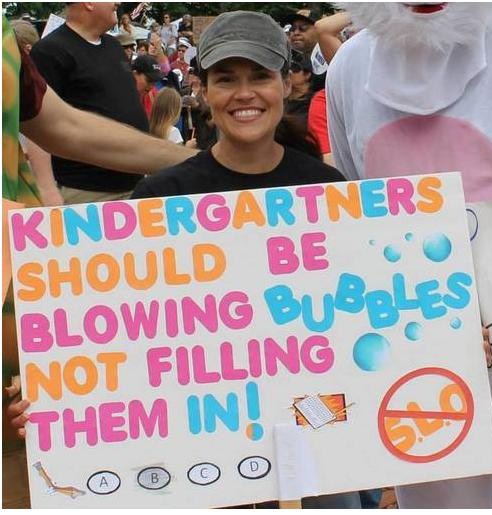
Now, it’s not the idea of a universal core of knowledge that’s disappointing, but the application of it. In frenetic attempts to follow the Common Core Curriculum standards sold to schools—along with the bribe of funding—teachers have been forced to impose lessons and practices that leave the parents scratching their heads. My kindergartner last year spent a great deal of time filling out answers on bubble sheets, a not-so-subtle intimation that her ability to properly color in the little circles will be crucial to evaluating her future.

bubble sheets

No, I don’t know who this is, but I concur with the sentiment.

Her first grade is proving to be more of the same, and now with timed reading tests designed to push six-year-olds to read random words faster and faster. Comprehension doesn’t seem to be a concern; only speed. My daughter is slowly beginning to lose heart.

At back-to-school night last month I heard many mothers express how, in kindergarten, their children were so excited for school, but now some of their fifth graders dread each day.
“What happened?” I heard one genuinely confused young mother say to her friend. “And does it get worse when she hits middle school?”
I was cringing so hard I’m surprised she didn’t hear it.
What happened?
We’re killing our children’s natural curiosity.
Will it get worse?
Uh, yes. Sorry.
How did this happen?

Through the same old nonsense we’ve always been dealing with in public education: the out-dated notion that all children are inherently the same, and can be “programmed” in the same ways to create the same output, namely an adult that will become an industrious worker.

The model doesn’t work; in fact, it has never worked for more than a fraction of the population. For as many doctors and professors my schools churned out, there were just as many who dropped out of college, failed to complete any kind of professional training, and never rose above being a checker at the grocery store. There are always children that fall through the cracks because they can’t fit the inflexible mold.

And Common Core, which is merely the same model in an updated website with a heavier hand and a stiffer mold, won’t succeed either.

First, anyone who’s had more than one child will tell you they are NOT all the same. I have nine, and you’d think that with so many kids we’d start recycling some DNA combinations. But mystifying each child is different, despite coming from the same gene pool, being raised in the same house, and eating the same food.

Half of my kids figured out reading at age 4. The other half couldn’t grasp it until age 9. One third of my children love math—one doesn’t even write down the formulas when he does algebra—while another third of my children tremble in terror when approached by a number attached to a letter. The other third are blissfully in the middle. Some of my kids find science dull, but others try to actively blow up the house while others try to put everything back together again. Some read nonstop all day long. Others grumble at the sight of the book.

Every child is unique, but years ago educators decided to shove them all into an assembly line of education where the same information is fed to them in the same way, NOT because it was the best way to teach, but because it was the cheapest way to process the greatest amount of students per teacher.

With all respect to John Locke, the tabula rasa notion of seeing humans as “blank slates” waiting for their minds to be filled with knowledge—a theory which has been debunked for generations, except among some educators with influence—ignores the fact that humans are born with personalities, with various learning styles, even with unique ways of perceiving the world. Ask any parent with more than one child: they come different.

Yet altering education to truly teach individuals, instead of groups, requires vast changes that education boards, university education departments, and most of all the government does not want to do, even though we see effective models in Europe and Asia. (And perhaps that’s why we don’t want to change; we resent the idea that someone else innovated something first.)

It’s simply too hard to change, argue those entrenched in the old traditions. Simply too hard to do the right thing.

So instead we take the outdated assembly line, add bells and whistles and unproven theories, and shove more kids through it hoping to disprove Einstein’s platitude that doing the same thing over and over, and expecting different results, is the definition of insanity.

Well, public education has gone insane.

And now, forcing Common Core—a method of teaching and an application of curriculum which has NOT even been fully tested—has dealt yet another great blow to children.
It’s making them hate school.

Now, I acknowledge that in every class there are those who will thrive. My 1st grader is like that: she loves school. However, already the love is fading. As I mentioned before, she’s growing discouraged. Despite reading at a 2nd grade level, she’s perplexed by reading rows of nonsense words and random sentences as quickly as possible in a minute, and math, which comes to her naturally, is becoming unnecessarily confusing. This frustration with education rarely occurred when we homeschooled.

I’m in a unique situation to compare the differences because I exclusively homeschooled my kids for nearly a decade, then put them into public school over two years ago when a pregnancy at age 42 scared me into thinking I wouldn’t be able to keep up with my kids’ needs. I had a 6th grader and a 7th grader thrust into the middle school, and they had never spent a day of school in their lives. We were all terrified. They adjusted and, to my great relief, they were not only on track but a little bit ahead, manifested by their straight A’s.

I also, with great trepidation, put my then 7-year-old high functioning autistic son into 2nd grade, and braced for impact. He had a very sweet teacher, concerned resource instructors, and eventually learned to read and deal with the crowd.
Still, he begged to come home for third grade, as did his older brother in 6th grade who found the math class too slow and the science too shallow.

Fast forward to this year; my now 9-year-old autistic son wanted to try 4th grade, hearing about how great the teachers were, and wanting to spend more time making friends. So we eagerly prepared him making sure his was on target academically and as socially as an autistic boy can be. He was ready!

It took only one week for him to beg to come back home.

At three weeks, he started clenching his fists when trying to complete math pages that were filled with several methods of doing multiplication our trusty Saxon math didn’t cover. And then, faced with the option to complete a problem such as 49 x 28 = ? in any of the three ways he’d learned, he’d freeze, unable to know how to proceed. (For examples of the multiplication confusion some of our children are exposed to, watch this video.)

At four weeks he started clutching the sides of his head every night as he looked at his homework and whimpered, “I’m too stupid!”

That’s when I started getting mad.

He’s not stupid. Want to know about pyroclastic flows? Tectonic plates? The theories behind black holes? Ask him, but then make yourself comfortable because you’re going to hear everything. He’s read all he can on the subjects and knows the documentary section of Netflix as intimately as some kids know the starting lineup of a basketball team. Ask him about ecology, and get ready to hear a dissertation about saving the environment, misconceptions about global warming, and his opinion on the big bang theory. Remember, this kid just turned 10-years-old.

But because he can’t conform to the Common Core Curriculum he thinks he’s stupid and he hates school.

At his parent-teacher conference I learned that academically, he’s right on track.
But at his nightly parent-child conferences, I’ve learned that his anxiety is through the roof.
So Friday was his last day of school. We’ve quit Common Core, and starting Monday he’s schooling at home.

His frustration is not just because he’s autistic, either. I have a junior in high school taking math who asks me every night for assistance. Not even his teachers can fully understand the homework, tell their students to skip certain problems, and the photocopied pages they use have so many errors it likely doesn’t even matter what the real answers are.

My 9th grader is also expressing similar frustrations, and asked to be homeschooled part-time this year because Common Core was so focused on filling in the right bubbles for the tests that she anxiously felt she wasn’t learning anything useful.

Anxiety and stress do not improve education; they strangle it. Learning can be a joy, but oddly our society has adopted the notion that if there isn’t suffering, there isn’t progress.

If you think junior high kids are moody now, just watch what will happen to our elementary kids over the next few years. I fear that by the time they become teenagers, their teachers will be permanently on valium. common core meme

There are many other arguments about the insufficiencies of Common Core, about how it was foisted upon states by dangling the lure of money in front of them, and how its main purpose is to produce good workers, when, for years, many of us thought education was about producing a populace that could think for themselves and identify was is truth and what is error.

But what’s really baffled me for many years is why the government has decided parents are inadequate in knowing what’s best for their children. I started writing my books in an effort to puzzle it out.

“Miss Peto, why do you find it disturbing that the Administrators select what’s most important for our children to learn?”

She really wasn’t sure, but it sat on her strangely. “Captain, what if the Administrators choose to teach that which is against the beliefs of the parents?”

“I can’t imagine any situation where the Administrators would recommend teaching anything that would be contrary to the welfare of the world,” the captain said. “If anyone would be out of line, it would be misguided parents.”

Exactly who would be deciding what was best for the world, Mahrree wondered, and what was best for an individual? (The Forest at the Edge of the World)

Why have we removed the curriculum decisions from the parents?
Could it be because our government has ceased to see us as someone they serve, and instead see us as a means to their own ends? My school teacher protagonist thinks so.

“You said the other day that I needed to get to the bottom of this!” she said fiercely. “Well, here it is: Parents are stupid, Administrators are smart. Hand over your children to the Administrators with no questions debated so they can pour their own ideas into the children’s minds, while parents worry about nothing else except getting more gold! Gold which they then hand over to the Administrators in higher taxes. Ooh, very clever! The Administrators get richer while families fall apart!”

Perrin’s mouth opened and shut several times, but he knew that when his wife was on a rant, there was no safe way to interrupt her.

“And then what happens to the children?” she gestured wildly. “Give the government a few years, and I’m sure they’ll be telling the children what jobs they can have, so they make sure our children make them enough gold and silver!”

Perrin lifted a finger, likely to try to interject that she had an intriguing point, but he pulled it back a moment later when she began to froth. His contribution could wait.

“Well, I’ve had enough. I’m going to give them a piece of my mind so they can see how intelligent mine really is!” (Soldier at the Door)

Yes, the nature of this character is to get a bit overwrought, but for what other purpose is there for the government to feel the need to take over the education of our children?

“Parents feel stupid because their government tells them they are, so they’re humbly—and even willingly—allowing someone else to guide their children’s teaching. But there’s another reason,” her husband hesitated. “This way the Administrators get to pick and choose what the growing generation learns, and anything that’s not supporting the Administrators simply isn’t covered. In one generation, the entire population should be as loyal to the Administrators as they are—or were—to their parents’ beliefs. Whatever they say, the people will believe.

“And that’s precisely what the Administrators want: the only authority influencing the world will be theirs.” (Soldier at the Door)

I submit that the federal government, in mandating what we teach our children, is attempting to influence the development of the rising generation so as to meet the financial and political needs of the government, not the needs of our children to become intelligent, thoughtful adults. No, this isn’t about mind control, but it’s a form of manipulation, of getting what they want out of us because they have all the power, and we have less every year.

Don’t believe the government is manipulative? As I write this the federal government has imposed a shut-down (or convenient slimdown, as some would argue) because of a budget impasse.
But the nature of the shut-down, and those areas that have been affected, is very subjective: subject to causing the most ire and discomfort among citizens. The randomness of road and park closures (outdoor monuments on the Mall in DC are suddenly inaccessible?), websites that are down (only because someone pushed a button to deny access), and services that are suspended (WIC’s been closed! Starving babies!) have all been carefully orchestrated to twang the most heartstrings with the least amount of effort.

Manipulation of the public, at its finest.

Just out of curiosity, I looked up “Ways to tell if you’re in an abusive relationship.” Read this list from Dr. Phil, and think of it in terms of the federal government and you. My friends, we ARE trapped in an unhealthy relationship.

I support my local school and the teachers—many of my friends are teachers—but I realize they have no power to stop this level of manipulation of public education. They, too, are stuck in an abusive relationship and are doing the best they miserably can in a bad situation.

But I’m fortunate in that I work only part-time, so I can, starting next week, teach my son at home again. He’ll learn tried and true math principles thanks to Saxon 54, he’ll learn to spell, and spell again, and spell yet again until he gets all his words right without the pressure of a ticking clock (which, autistics will tell you, can be quite maddening) and he’ll explore science and history without the fear that he’s hopelessly stupid.

I’m also not going to time how long it takes him to read something, because the boy doesn’t read; he savors. He analyzes diagrams and concentrates on charts. Pondering has become a lost skill, one that I refuse to deny my son. The point isn’t the volume of pages being read, it’s the depth of understanding he gets from the reading.  As an English teacher, I’ve encountered many students who have read quickly through the texts, but remembered very little, so they have to reread, and reread yet again.  Skimming isn’t the same as absorbing, but don’t tell Common Core that.

So today we quit Common Core, abandoned this one-sided relationship that doesn’t care one bit about my son but yet is obsessed with the data he produces.

But what about everyone else who can’t commit such a quiet act of pseudo-civil disobedience such as homeschooling in protest of Common Core? I wished we could band together and overthrow this nonsense, but that’s a bit vague.

What we can do is talk with our kids and let them know what we feel and think, how we believe and understand, and let them know that what they learn out there may not necessarily be what they should believe in here.

“There’s one thing we can do,” Perrin said. “We can make sure we’re not touched by whatever may be coming. In our house we will discuss and believe whatever we want. We can recognize for ourselves that the sky is dark and threatening with a storm obviously on the way, and explain to our children that the rest of the world has been conditioned to believe the sky is blue, despite all evidence to the contrary.” (Soldier at the Door)

My friend, a single mother who works full time and has two kids, wrote this: “I’ve come to the conclusion that school is where my kids go to be babysat while I’m at work, and they actually start learning when they get home. I have noticed that school seems to teach them WHAT to think, but not really HOW to think. I have to say that worries me the most. I try really hard not to browbeat my kids into agreeing with me, but I do want them to be able to back up their arguments logically.
“If I think of the schools as being responsible for educating the kids, I get very stressed out at the things they don’t know, and then get to stress again over the crap they ARE being taught. Some of the crap they come home spouting is just plain nuts, and it’s hard to stay calm sometimes during our little ‘debunking’ sessions. Makes for a really busy day for me, but sadly that’s how it is I guess.”

Yes, sadly for now, that’s how it is. But at least we still have the freedom to talk to and educate our children whenever and however is possible for us. And we better exercise that freedom for as long as we still can.

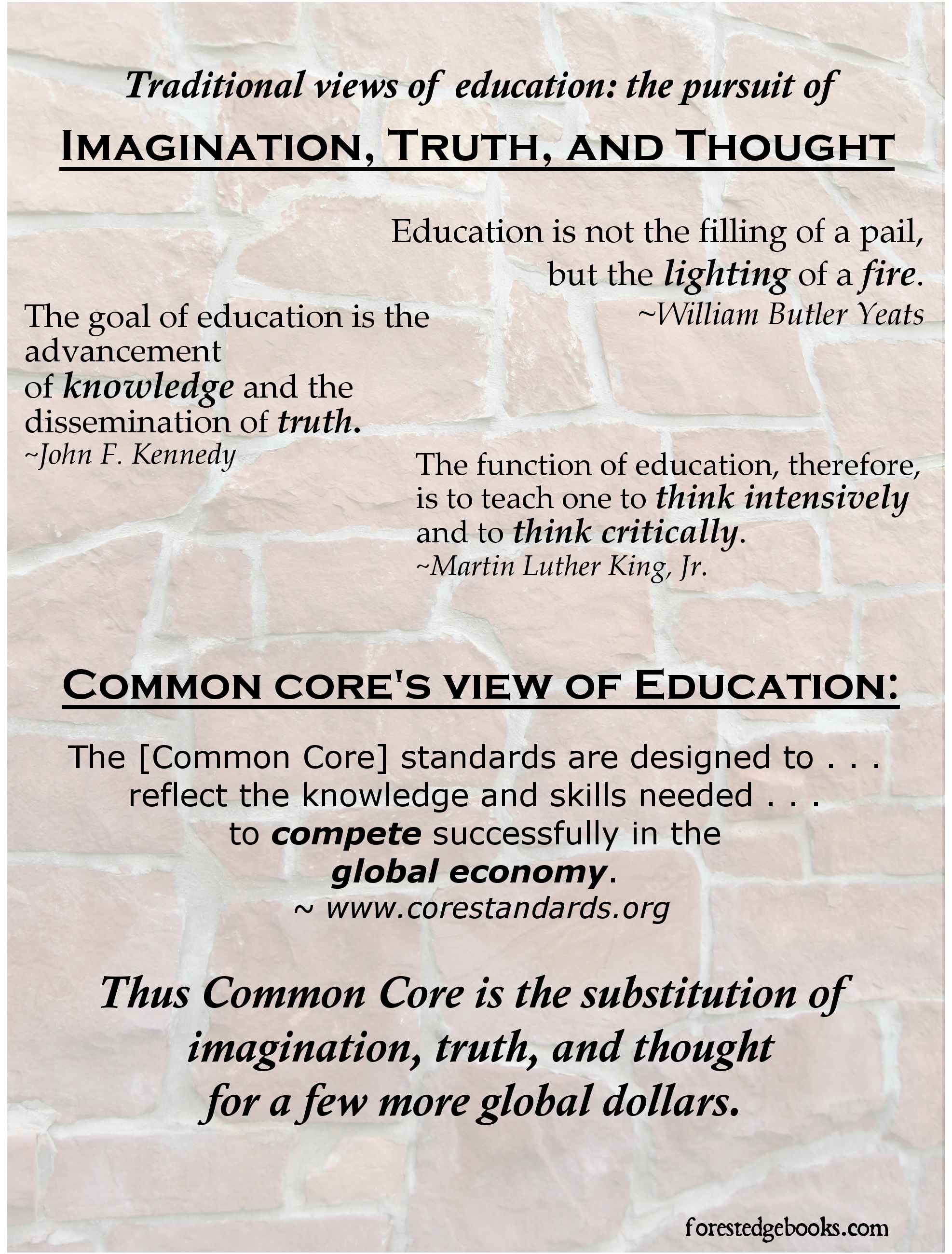
In the meantime, if you’re still unconvinced that the direction Common Core is taking us is not our children’s best interests, consider the changing opinion of the purpose of education. We used to be concerned about lighting the imagination, pursuing the truth, and developing critical thought, but no longer. Take a look at this statement from the Common Core website (emphasis mine):

The standards are designed to be robust and relevant to the real world, reflecting the knowledge and skills that our young people need for success in college and careers. With American students fully prepared for the future, our communities will be best positioned to compete successfully in the global economy. http://www.corestandards.org/

In other words, the purpose of education is to make money in the world. Common Core is demoting our children from thinking, creative beings, into busy little worker bees that make more honey for the governmental hive.

So if you think the purpose of life is to capitalize on the global economy, then surprise—Common Core is the route for you.

But I personally believe humans are destined for higher purposes and greater things. I’ve already discovered there’s much more to life than just money, and that’s what I want my children to discover as well.

common core meme

“All our ideas were just as pitifully inaccurate as four year-olds arguing over what kind of baby snake a worm is. “

There are a few conversations you don’t want to hear your children having in your backyard.

“Ooh! Look at all the baby snakes!”

Yeah, that’s on top of the list.

I was in my kitchen when I heard my three-year-old son and his friend in the backyard squeal in fascination. Our house was new, the yard unfinished and bordered on a canal, which bordered on a field, which apparently bordered on the edges of Snake Heaven. And that Heaven was invading.

(It’s just a photo–calm down.)

“Those are pythons. I know. My grandpa showed me baby pythons last week,” the friend said with great authority.

I gulped and quickly made my way to the back porch to investigate the terror. Now, I’m fine with snakes—as long as they’re in a zoo, in the wild, and far, far away from my house and my children.

“I don’t know,” my son, who knows nothing of snakes, said. “I’m thinking boa ’stricker.”

Bravely I marched to where the two little boys were crouched and poking with a stick.

Please let there not be rattling! No rattling!

“Pythons. Definitely.”

I put on an overly happy face—more for my benefit than for theirs—and said with forced cheeriness, “What do we have here?”

The beamed up at me, stepped away, and—

It was NOT baby snakes.

It was FAR worse.

Worms!

(I know, I know–you should have seen me convulsing as I sorted through the images looking for this . . .)

Yes, all right—worms terrify me far more than snakes. The massive earthworms they had uncovered were far more disgusting, slimy, and smelly—yes, they smell!—than snakes.

Oh, how I wished for a hole of rattlers right then.

I took a step backwards.

“Cool, right Mom?” my son said happily. “Strickers, right?”

“No,” I said, fighting back the urge to wretch. “Just worms, boys.”

Worms.

The friend shook his head. “Nope. My grandpa showed me baby snakes just like these last week in his garden. Snakes,” he promised.

I knew grandfathers like that. They misrepresent the world to their grandchildren as a one-sided joke, then wonder why when their grandchildren are teenagers they never want to talk to them.

“No, those are worms. I know. I had to dissect those in 8th grade.” The most traumatic year of my life. Not as if junior high isn’t bad enough, but let’s throw in a handful of worms and make you cut them up!

And people wonder why teenage girls are so moody.

Worms.

I backed away slowly, advising the little boys to leave the snake/worms alone and come in for a popsicle (popsicles are the end-all, be-all of distraction and reward).

Back in the kitchen I tried to fight down the urge to throw up and tried not to think about the many dried up worms that must have been on the driveway. It had rained that morning. That means all cement becomes a horror show, with dried up bits that aren’t Chinese noodles. (When I see bowlfuls of those on salad bars, I feel like screaming, “Dried up worms! Everyone, run away! Dried up worms!)

Image

(Not a Chinese noodle, unfortunately.)

The odd thing is, I was more worried about worms—reportedly useful in gardens, but scientists lie all the time—than I was about the possibility of two little boys messing with a snake nursery. My own bias set me up to ignore a real danger. Snakes were seen in our backyard later in the season. Some may have even been dangerous. But I only recoiled when I saw the worms.

Now, sixteen years later, I encountered not-Chinese-noodles on the ground and again found myself doing the ooky tip-toe dance of “Don’t squish them!”

There are far greater hazards in the world, and I wonder, do I spend more time on things that don’t matter, that aren’t real threats, than I do on the things that are?