Free Downloads! All four books!

This will probably be the very last free download I’ll host. After this I’ll be publishing in other venues, and Amazon’s policy is one of exclusivity in order to offer free downloads. I feel like I’ve gotten as much as I can out of this, but I wanted to offer the books for free one last time before moving on.
So enjoy!
Share!
My last free downloads garnered more than 15,000 downloads, and I’d love to top that!

Click on the books in the column (scroll down a few inches) to go directly to Amazon for your free downloads. =====>

Remember, you can download to your computer, phone, and tablet. Not just for Kindles anymore!

free download ad

I still have a couple sets of magnets left, too, so let me know if you want some for FREE!

← Back

Thank you for your response. ✨


Supporting Religious Freedom, everywhere

(I recently updated my About page to reflect what’s below, but I feel so strongly about this that I wanted to share it here as well.)

Astronomers estimate there are 160 billion (yes, with a “b”) alien planets in the universe.

I assert that God created all of them, the entire universe, and that we’re not the only ones floating around in this massive existence knowing about our Creator. (See Hebrews 11:3 or Moses 1:33)

So what might life be like on just one of those 160 billion worlds? What might God’s Plan of Salvation look like on another planet?

universe picture

(In the summer I look up into the night sky, slightly northeast from my position, and I’ve pinpointed a star which I think may be Edge’s sun. But please don’t ask me to map it.)

That idea is what drove me to write the “Forest at the Edge” series, to explore how God’s gospel might be manifested in another part of the universe.

So far I haven’t found any genre of literature which tackles this point of view, so I’ve struggled finding the correct niche for my books.

The books are “fantasy,” but there’s no magic or mythical creatures;
The books are “Christian,” but Christ isn’t overtly mentioned because He didn’t live on their planet;
The books are not, however, “sci-fi” because there’s no speculative science in them, although exploring life on another world seems to fit the bill.

See my problem?

I’ve always been intrigued by the notion of different cultures and different worlds. My kids will tell you I’m a Trekkie at heart. (Some years ago I made all of them matching Star Trek uniforms for Halloween.) But I’ve always been a bit disappointed that no sci-fi/fantasy world I’ve encountered ever has God. Yes, they have “god(s)” created by their culture, but I have to find a sci-fi/fantasy series or show which dares to touch the real God with a 10-foot-planet. (C. S. Lewis’s The Chronicles of Narnia is the only one I know of that comes close.)

So I’m out here writing about a Christian society which originates, lives, and dies on a planet somewhere else than earth. And oh, is it fun!

What would a God-directed creation look like on another planet? How would He populate another world? What kinds of limits, terrain, people would be there? What would their belief systems look like?

I think they’d look a lot like ours.

I wholly trust that there is life on other planets, but aliens aren’t creepy blobs or elongated masses with telepathy, or even possessing Spock-like ears. “Aliens” look just like us: human beings made in the image of our shared Father in Heaven. (Animals, however, may likely be very different than our earth’s, but I’m not creative enough to come up with those so I stole earth’s animals for my series).

I think our spiritual siblings on other worlds experience trials and tests, frustrations and fears, happiness and holiness quite the same as us. That’s because God’s plan of salvation is the same everywhere in the universe, because He is the same everywhere. As philosopher Pierre Teilhard de Chardin has famously said,

“We are not human beings having a spiritual experience. We are spiritual beings having a human experience.” (I would add, either on this world or one of millions others.)

At the heart of that human experience is the test of our wills. What do we want more: to follow God and His will for us, or to follow after our own impulses? And at the root of that is our ability to choose what we worship, how we live, and what we pursue.

But as I’ve been writing this series, something fascinating has happened: each year those choices become more restricted by those who would control us.

When I started drafting this series back in 2010 I couldn’t have comprehended how much American society would change in the following five years. Future books seven and eight describe a world which frankly terrifies me, and it seems we’re running headlong to that end in our world. (I’m not pretending to be a prophet; I’ve merely read the book of Revelation a dozen times for ideas. That John the Beloved really knows what he’s talking about.)

As a result, much of the “Forest at the Edge” series pivots upon this declaration:

“Make your decisions as to what to embrace, but let me embrace my belief.” ~Perrin Shin, The Forest at the Edge of the World, Book 1

In 1836 a prophetic man wrote the following words: “We claim the privilege of worshiping Almighty God according to the dictates of our own conscience, and allow all men the same privilege: let them worship how, where, or what they may.” (emphasis added)

Suddenly I realize that what I’m writing is about supporting religious freedom. Today, in 2015, I declare that our freedom to “worship how, where, or what [we] may” will soon be under hot and direct fire. Denying people their ability to worship is the first step to imposing a tyranny. Tyrants, being merely well-funded bullies, are stealing away our ability to control our lives one little liberty at a time.

tyrants

I don’t like bullies. I had my share of them in gradeschool. Sometimes it’d be nice to retreat to the very edge of the world and hide from them. But now’s not the time to run away. Now’s the time to take a stand. I only wished I were as brave as Mahrree who declares without reservation:

“I will defend the right for any one to question any thing. Each person has the right to find her own answers and believe as she wishes!”
~Mahrree Shin, Falcon in the Barn, Book 4

I’m warning you right now, the world truly is out to get you.

Excuse me, but your ignorance is showing

Recently a mother of an autistic son in the Salt Lake Valley found the following stickers on her car around her Autistic Child sign:

autism stickers car

Love the random capitalization on the stickers. Hey, let’s make this letter big, just for fun!

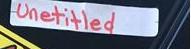
What caught my eye, however, was this sticker. Exactly what’s this supposed to mean?

entitled

Uhh . . . what?

It means that the perpetrator is embarrassingly ignorant, on many levels.
Ignorant of autism.
Ignorant of appropriate behavior. (Stickering someone’s car? Really? That may be considered vandalism unless it’s a wedding.)
Ignorant of the English language.

There are marvelous and cringe-worthy examples of ignorance everywhere. A few samples I gleaned from the Internet:

asia

I guess “euthanasia” was too hard to spell?

Image result for bad protest signs

What we call “irony.”

Image result for bad protest signs

So they’re hoping for many years of the same thing?

Image result for bad protest signs

Strange, I haven’t seen “half-breed muslin” at my fabric store. (And does it look like that “d” was an afterthought?)

I’m trying to decide what causes such public ignorance. Does passion for the movement cause one to forget how to punctuate, or even spell?

Or does one protest because they are ignorant?

Of course, ignorance isn’t confined merely to those who protest, nor are all protestors ignorant. Some actually know what they’re talking about.

nazi

Ok, maybe not.

But some people, it seems, never know what they’re talking about. Back in the 1980s we were newlyweds, and my husband whisked me back to “the east.” I was worried, because I had this ignorant notion that all east coast people were sophisticated, smart, and sharp. I, however, was just a little doofus from the west. How would I ever communicate?

Then I met a young man who asked what my maiden name was. When I told him Strebel, and that my parents were immigrants from Germany after WWII, he developed this odd smirk and said, “So your family were Nazis?”

I was shocked.
Worse than that, I was livid! The Nazis had ruined my families’ lives. My ancestors fought the Nazis!

I started explain that, but the young man just waved me off and said, “Yeah, you’re all Nazis.”

My new husband pulled me away, knowing there was no reasoning with ignorance.

Image result for bad protest signs

Look at her face. This is not a happy woman. Probably because she’s outraged that she doesn’t know what “you’re” means.

I’ve thought frequently about that incident over the years, and subsequent others. Back in the 1980s when I was working at a trendy clothing shop on the “sophisticated” east coast, one of my coworkers, upon learning I was LDS (a Mormon), said, “Oh, my dad said your husband can have all the wives he wants, that you belong to a cult, and that you drive horses. How come they let you out to work here?”

Oh, where to start! After an hour’s discussion trying to dispell all of that, she still regarded me suspiciously. She knew the truth, or at least liked her ignorance more than she liked my explanations.

Sounds like hell will be pretty full. I know Mormons like me are doomed, but sports nuts are damnable? I was ignorant of that.

Finding the truth was harder 25+ years ago. We didn’t have the Internet. We had to make some effort to visit libraries, read newspapers, or watch the TV news or a documentary. (Really, I’m not trying to sound sarcastic here.)

But today there’s no excuse for ignorance. We have so many resources about anything and everything, and all for free.

And maybe that’s the problem: for every drop of credible information out there, you can find a flood of rumor and nonsense. There are no fact finders on meme generators, our society’s new bumper stickers of truth. Anyone can create anything, and those who “think” they know won’t bother to research the truth.

Actually, these pyramids were built by paid workers, and by farmers and villagers who volunteered during the off season believing that their labor would help ensure their own afterlife. No slaves were harmed in the building of these pyramids. http://www.pbs.org/wgbh/nova/ancient/who-built-the-pyramids.html

I’ve discovered something about the ignorant: they’re afraid.
Afraid they may be wrong.
Afraid they won’t recognize the truth when they see it.
Afraid to change their attitudes.
Afraid to be humble.

Back to my “You’re all Nazis” man. The more I learned about him, the more I realized he was truly ignorant.

He didn’t read, which is the hallmark of ignorance. Not the news, not books, not anything more than bumper stickers, which constituted the bulk of his education.

His little smirk was his signal of fear. I’ve seen this odd trait in many scared people. Either they’re lashing out in a full, terrifying rage, or they’re trying to pretend they’re more confident than they are, hence the smirk. Watch for that, the next time you’re confronted with someone who’s particularly unpleasant. You’ll see their terror cowering behind the smirk. 

prop_8_protest%20women.jpg

Oh, they’re protesting the CHURH. Whew. For a minute there, I thought they were protesting my church.

I feel badly for these people, I really do. There’s no need to be fearful, there’s no reason to remain in ignorance. There’s such a wealth of information in the world, and many good, kind people who would be willing to share what they know with you. 

But that takes humility: recognizing that we don’t know everything, and that we still have much to learn.

Unfortunately, ignorance is exceptionally prideful.

I may be a “mavrik” if I knew what it was. Perhaps you could also explain what a “socialest” is?

New website, free downloads, and still a couple of freebie magnets

3 Really Awesome Things! (Aka, RATs. Oh, wait . . . that’s not looking as appealing as I initially thought. Well, here it is anyway.)

1–She‘s been begging, so I’ve broken down and made Hycymum her own website. She’s been helping me with my gluten-free baking, so I had to oblige her! Click below for her first recipe, and more will be on the way.

NEW header HycymumFLATTENED

2–FREE DOWNLOADS ARE COMING AGAIN! All four books, for five days beginning next week. 

3–I still have a couple sets of magnets to give away. Fill out the form below and I’ll keep sending them out till they’re gone. Tell me “I want magnets!” 

033

← Back

Thank you for your response. ✨

(And yes, I’m happily tapping away and editing Book 5.)

The South Deserves Better than the Confederate Flag

I understand that, not being a native southerner, my opinion about the Confederate flag likely isn’t worth a slice of pecan pie. I was told by the Wal-Mart greeter, when I first moved to rural Virginia, that I was a “Yankee.” There was a slight sneer in her accent when she didn’t hear any drawling from me, and I naively replied, “But I’m from Utah,” a state which wasn’t even officially in existence during the Civil War.

But, as I learned during my six years in the south, “Yankee is Yankee”, so you can discount my opinion, but here’s how one “outsider” sees the Rebel flag.

I don’t understand what it means.
Really, I don’t. My dear husband, who lived in the south for some time, tried to explain that it represented “southern pride” and “states’ rights.” But I grew up where Confederate flags were seen mostly in history books, with the caption “Symbol of the losers of the Civil War,” so I don’t understand the purpose of holding on to it. After I moved, a native Virginian told me, “Southerners, at least once a day, still lament that they lost the War.”

So I asked several of them, “Do you really still resent losing the war? Isn’t it good that the slaves were freed?” I always got a response like this:
“You see, it’s not really about slavery, but . . .” And that’s when all the responses went predictably vague.
“Because the north was forcing things on us, and we didn’t like that,” or, “Because the south has its own kind of pride.”
So then I’d ask, “Why do you still embrace the Confederate flag?”
“Because it represents all we Southerners hold dear.”

When I push for more specific answers—what exactly does it represent, what do southerns hold dear—I was told something like this:
“Pride. It’s a southern thing. You Yanks just don’t understand.”

No matter how many times I explained I was from Utah, and therefore not a “Yank,” I still never got anything more.

And I think I know why: most people don’t ask themselves those hard questions. The flag has just always been there, a tradition. To question a tradition is like questioning if your Grammy really loved you. You don’t do that.

I understand wanting to be proud of one’s heritage, but can’t that be done through any other symbols rather than the Rebel flag? I think Southerners can do much better. In fact, I think they deserve better than that old symbol of a bygone era.

I lived for six years in Virginia and South Carolina, and I met many marvelous people of different faiths, backgrounds, and races. I grew to understand and be grateful for the meaning of “Southern Hospitality,” and I even learned to decipher some of the deeper accents. (Although our excellent hillbilly mechanic was forever unintelligible to me, nor could he understand us. Fortunately he had excellent handwriting.) I made lasting friendships and realized why so many people love the south.

But I never could understand why such good, kind, generous people wanted to be associated with a flag that, for me and likely many others, represented slavery.

Symbols are tricky, tricky things. No one can control how another views a symbol, nor what it may mean to them. I’ll be the first to acknowledge that we frequently misinterpret symbols, and often we become offended when no offense is meant.

But the Rebel Flag is just as its name implies: a symbol of rebellion. Why is rebellion something to celebrate?

Up until my thirties the only exposure I had to the Confederate Flag was in history books and the occasional stickers on trucks out here in the west. The drivers of those vehicles were always . . . shall we say, “unsavory” at best. Usually the trucks were jacked up, rusted out, and filled with what I would describe as angry rednecks wearing baseball hats which look like they were rescued from the dump. These weren’t happy people. They scowled. Always. Or leered, and then they showed a considerable lack of dental hygiene. I’m not trying to fall into a stereotype, but I never saw someone driving such a vehicle and with such a symbol who struck me as having passed the 7th grade.

And so my association of the Confederate flag was always with men who I tried to get away from as quickly as possible in case they asked me a complicated math problem, such as how much change they should give me back at the gas station.

While this is clearly a very narrow evaluation, I also learned to distrust the Confederate flag and what it may represent from my parents.

I’ve mentioned before in this blog that they grew up in Nazi Germany as children, and even in their later years they literally shrank back in fear whenever they saw a swastika or a Nazi flag. Once when I was about twelve we pulled up to a store, and next to us pulled in a couple of bikers with miniature Nazi flags waving from their back seats.

My parents froze.
My mom, suffering at times from PTSD, whispered frantically, “What do they want?”
I was used to my mom escalating quickly to panic, but I was surprised at my dad’s reaction. He, too, refused to leave the car. “I don’t know,” and his voice was shaky as he stared at the flags.
“You don’t think they know we’re German, do you?” my mom asked.
“Nah, of course not.” But still my dad locked the doors at the motorcycle gang guys went into the store.
“But what do they mean by the flags?” my mom worried. “What do they mean?”

Needless to say we didn’t go into that store that day.

Years later I realized that these bikers likely meant nothing more than, “Oh, hey. Here’s a pretty flag that scares people and maybe makes us look tougher. Let’s use it!” without realizing the vast history behind the flag, nor the horrors that the symbol represented.

Interestingly, the swastika is a very old symbol, appearing in for thousands of years in architecture. It’s of sacred importance in Hinduism, Buddhism, and Jainism, almost like a lucky charm.

Until the Third Reich appropriated it in 1920.
Now, for the past 95 years the swastika been the symbol of tyranny and death. My parents regarded it as a symbol of those who tried to control them.

It was my parents who taught me to be equally wary of anyone who embraced the Confederate flag, which they thought was a similar symbol. They had never been to the south, never even met any black people as far as I know, but to them, the Confederate flag was just as tyrannical as the Nazi flag. Out of respect for those who had suffered under slavery, my parents shunned it. They were stunned that many Americans openly displayed the flag.

When my parents came to visit us in Virginia, they were alarmed at the number of rebel flags they saw. “Are you safe here?” they asked repeatedly. I assured them we were, but didn’t tell them that their latest grandson was born in Stonewall Jackson Hospital, where the Confederate Flag was well represented.

On another visit we took them to Charleston, SC for a trip, and my dad wrote in his journal that we toured “the quarters where the slaves were being held before they were sold . . . and it made a deep impression on us. Today these five buildings are occupied by souvenir shops, and people meander through these old structures without giving much thought of their historic significance. We personally felt it would have been better to tear them down!”

You can imagine just how worried they were when we moved to South Carolina for a few months, where once again a child was born in a hospital where that flag flew. Quite honestly, I never felt comfortable in South Carolina. I never could wrap my head around that flag flying proudly, because I was never sure what it really meant. After several years in the south, it still struck me as incongruous compared to the people I knew.

I still remember the very first parade we attended shortly after moving to Virginia. Cadets from nearby Virginia Military Institute presented the colors at the beginning of it, but were soon followed by an entry which shocked our kids.

Confederate and Civil War re-enactors, proudly waving a large Rebel flag.

Immediately my gaze fell upon a black family directly across the street, and I wondered how they felt about what was paraded in front of them.
What did it mean to them? What did it really mean? What did that flag mean to those waving it?
Part of me wanted to run across the road and shield that family’s view, because I thought of the quiet alarm my parents always experienced every time they saw a swastika.

My ten-year-old said, “Dad, why do they have that flag? Don’t they know they lost the war? Slavery was bad.”
My husband once again tried valiantly to explain, “Well, they see it as a symbol of southern pride—”
“Well, pride’s bad, too!” our nine-year-old son said.
My husband gave up trying to explain.

I watched the family across the street deliberately focus elsewhere. Later I realized that they were the only black family there, and while the town had a few minorities, I never saw any of them participating or attending those parades. I didn’t blame them. We quit going after a while, too.

Now that flag is coming down in South Carolina, I breathe a sigh of relief for many who I suspect wondered exactly what it really meant as well.

Southerners deserve to be represented by something better, something that reflects the kindness, generosity, and spirit that all races there exhibit. Therefore, I propose to replace the Rebel flag with something as sweet and rich and good as the south.
I propose . . . the pecan pie flag!

New Southern Flag

I threw this together in five minutes. Surely someone with some skills could come up with an even grander version. And if you think that’s an odd statement for a flag, check out some of the phrases on state flags. This is much, much better.

Here’s something everyone in the south can rally around. But you don’t have to listen to me. I’m only a Utah Yankee.

I worry that America is dying

This is my father’s coffin, July 2, 2015. These are the soldiers folding the flag that covered him.050

And while I watched the ceremony yesterday, I was struck that not only had my father died, but my country is dying, too.

I worry deeply about America. I agree with so many others who have written more eloquently, and angrily, that America is no longer the greatest country in the world.

And that would have broken my father’s heart. It’s odd to put it this way, but I’m grateful that Alzheimer’s took away his mind these past few years so that he couldn’t understand what was happening to the country he proudly became a citizen of 60 years ago. He loved America, but he wouldn’t recognize it today, and I worry about what it will be like in another 60, or even 6, years.

I worry because we are not united.
I’m not naïve; I doubt that this country has ever truly been “united,” aside from a couple of occasions. Once would have been during WWII when outside enemies provided us something to fight against instead of each other.
The second would have been a brief second honeymoon after 9/11 when we realized that our land was under no special protection, that we could be attacked like any old place, and that scared us.
But only for a time.

I worry because we all want to be victims.  
The notion of “freedom” has expanded and contracted in bizarre ways, granting to one segment of society the ability to act and demand anything they wish, while another segment is berated and demonized for nearly anything they express.
The fascinating thing is that every segment of society will claim to have been the one persecuted against. We scramble to cry foul and demand vindication and, hopefully, a huge payoff from a lawsuit.
No one wants to be independent anymore.

I worry because we want revenge.
In the past, in any quest for rights, the group feeling oppression marched and protested and demanded equality. And when they achieved it, they rejoiced.
But not anymore.
Many now want to punish those who they believed oppressed them (whether real or imagined), and drag up old wounds to make new ones. We don’t seem to believe in cooperation, or friendship, or forgiveness, or anything else we should have picked up from Sesame Street (I hesitate to say “church” because that may be deemed “offensive”.) We want to hurt those we believe have–or may in the future–hurt us.
None of us seem to want to break the vengeance cycle that could truly unite and free us.

I worry because we really aren’t free anymore.
Not free in choice of health care, school lunch, minimum wage, or even soda consumption.
Some of us aren’t free to choose to do a job, or to reject that job.
Some of us aren’t allowed to speak our conscience without being labeled or libeled. Many of us worry that our liberties will soon be our liabilities, especially if we express what we believe concerning God and His laws.
Soon what passes as “free speech” may be so tightly constrained that there will be nothing free in any speech anywhere.

I worry because we have become a country of selfish children.
Read stories of our ancestors during the Great Depression, or either of the World Wars. They sacrificed for their families and their neighbors. They knew true poverty. Millions of families–not just a few thousand, but literally millions–sent off husbands and sons to WWII, and over a million were wounded or killed. Food was rationed, as was clothing and shoes and gasoline, and Americans labored willingly to help their country succeed.
Today “sacrifice” is an ugly word, and we whine if we lose wi-fi. Even those who the government has deemed impoverished live with luxuries our grandparents didn’t dare dream of. We insist on being indulged, and “I’m entitled” is the phrase that pays. We’ve become soft and wimpy, and I think our ancestors would be ashamed.

050 cropped

Are we becoming only a reflection of what we used to be?

As I watched the flag suspended over my father’s coffin, the silhouette of it reflecting on the stainless steel (my mother chose their coffins; she loved the glint of silver), I felt that shiver of worry that not only had my father passed from this world, but so also had much of this country which he had loved.

He had emigrated from Germany at the end of WWII. He knew an oppressive society where the leadership demanded complete obedience, where freedoms were restricted, where children were forced into a near worship of the government, and where anyone who spoke against it was carted away to a “work camp” never to be heard from again.

I worry that as the so-called Greatest Generation passes away, so too will our memory of what they endured in totalitarian regimes, and why they fought so hard against them.

And mostly I worry that we’re running headlong into repeating the history we no longer remember.

Don’t be afraid of my opinion, because I’m not afraid of yours

I’m fascinated by how many people are terrified to allow someone else an opinion contrary to their own.

If someone says/writes/believes something differently than we do, we’re struck with an almost primal need to purge that difference.
For some reason which I can’t figure out yet, we’re terrified by differences.

The obvious examples are terrorists and racists and any other form of negative “–ist”.
But I’m not talking about the obvious bullies who are acting out of what they believe is “righteous condemnation,” disguising their cowardice.
No, I’m talking about you and me, our neighbors, families, coworkers, students who, when presented with an attitude different than our own, shrink back in worry.

Perhaps we strike out fearful that maybe we’re the ones in the wrong, but we don’t want to change, so we better smack down the opposition. (But that’s only my opinion.)

But here’s a radical notion: What if there’s room for all of us to have our own opinions, and we don’t have to fight every different idea, but simply . . . let them be?

Aristotle said thousands of years ago that the mark of an educated mind is to entertain an idea without accepting it. 

Are we yet evolved enough to follow the Ancient Greek’s advice?
Recent evidence would suggest no.

Think about how many articles you’ve read where an opinion is stated, and commenters rage that the authors are wrong. I’ve frequently published letters to the editor (opinions) and recently published a longer piece expressing my reasons (opinion) why I don’t cry when I send an adult child away on a mission for two years. I was explaining my experiences, yet some commenters said they felt “judged.”

Judged? By MY experience?
What an odd way to think.
(Uh-oh—someone’s going to judge my opinion on that, I just know it . . .)

But here’s the thing: we all express OPINIONS, and we should. These are not statements of fact, not insistences for policies, not movements to obliterate all other opinions.

Opinions are merely interpretations of life based on one’s experience.

And they are all different. And that’s ok. (In my opinion, that is.)

Yet I’ve seen people squirm in discomfort, scowl in surprise, and even rage in fury when someone else’s experience runs counter to theirs, as if their lives have been suddenly invalidated.

But every person feels and interprets differently, and here’s the marvelous truth: the world IS big enough for all of us to have different opinions.
Here are some opinions I’ve heard recently which turned into actual—and unnecessary—arguments:
–Taking trip to Disneyland/Yellowstone/New York City is stupid/dull/overrated and a waste of time and money.
–Home schooling/public schooling/private schooling shows you don’t have any faith in the system/yourself/the world in general.
–Going to college/not going to college is the biggest mistake you’ll ever make.
–Having one/three/ten children is an excellent/irresponsible decision.
–Letting your kids play/not play on the computer/watch TV/not watch TV is a sure way to ruin/help your children.
–Starting a business/working for someone else is the only way to be sure of your future security.

And, fascinatingly, all of these opinions are ACCURATE.

Because these opinions are based upon individual’s circumstances, and if that circumstance is evaluated honestly, then that opinion is correct, even if it runs counter to what someone else believes.
 (But that’s my opinion.) opinion definition

I think vacationing at the beach is dreadfully dull. My in-laws think it’s ultimately relaxing. We’re both correct.

When I taught critical writing, I’d spend weeks trying to explain that various opinions can all be correct, but even by the end of the semester many college students still struggled with that idea.

I had an excellent test of this early in my teaching career. Before Salt Lake City hosted the Winter Olympics in 2002, there was controversy among Utahns about the impact of the games. I had a student who absolutely opposed the Olympics, while I thought their coming was the greatest thing ever. The assignment for the semester was to write an extensive research paper supporting an opinion, and guess what this guy chose for his subject?
The Damaging Effects of the Winter Olympics.
I didn’t like his topic, as you might imagine. While I am a conservationist at heart, living in a host city of the Olympics had been a dream of mine since I was a little kid. (Ironically, we were living in Virginia in 2002, and I confess I went to my bedroom during the Opening Ceremonies and wept because I wasn’t there.)

Anyway, Olympics-Hating-Student was smart. Each day he’d ask me my opinion about an aspect of the Olympics—traffic, recontouring of ski slopes, building of ice rinks, etc.—and then he’d take careful notes of what I said. He’d smile gratefully, smugly even, and would leave me stewing as to what he was up to.
It turns out his research paper became a carefully orchestrated opinion argument to prove my opinion wrong in every paragraph.

It was absolutely brilliant.

Oh, I didn’t agree with a word of it, but I gave him the highest grade I ever awarded: a 198/200 (he had a few comma issues). While I didn’t agree with his opinions, I had to agree that his ideas had merit and value, and while there were not ideas I wanted to embrace, I would allow him to embrace his opinions.

When he got back his paper, I watched as he nervously opened to the last page of evaluation. The grin which broke out across his face was priceless.
His peers, who knew I opposed all of his arguments, glanced at his grade and were astonished.
“We thought you’d hate his paper!” one of them exclaimed.
“I disagree with his ideas,” I told them, “but he’s entitled to his opinions, especially when he’s so carefully researched them and presented them. He did an excellent job. Who said I have to agree with his premise and conclusions?”
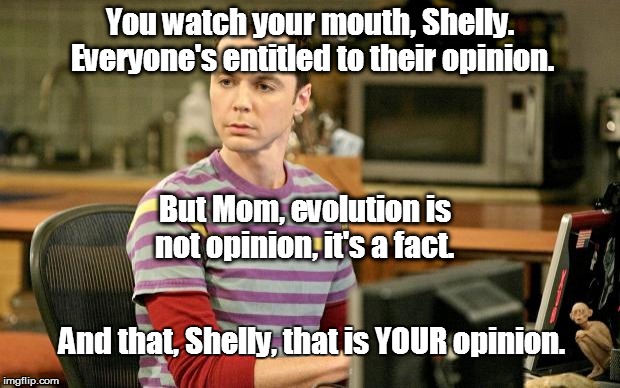
Sheldon Big Bang Theory  | You watch your mouth, Shelly. Everyone's entitled to their opinion. But Mom, evolution is not opinion, it's a fact. And that, Shelly, that i | image tagged in sheldon big bang theory  | made w/ Imgflip meme makerMay I submit the following: We balk at others’ opinions because we’re afraid they may be right.
We feel the need to fight back because we aren’t entirely secure in our own opinions.

May I also submit this: We don’t have to.

If you don’t like what you’re reading, stop reading.
If you don’t agree with someone else, agree to disagree and LEAVE IT ALONE.
Stop fighting. Nothing good comes from a fight. Ever.

I believe that God gave us our agency—our ability to choose—to allow us a full range of experiences in this life. When we, for any reason, try to shut down or deny another person of their opinions, we are essentially taking away their agency. That’s a devilish attitude, and one we need to avoid at all costs, or we become devilish—controlling, angry, and overbearing—ourselves.

HOWEVER . . .
There’s a time to push against another’s opinion, and that’s when YOUR opinion intends to change MY way of:

  • Living
  • Eating
  • Dressing
  • Worshipping
  • Teaching my children
  • Living according to the dictates of MY conscience

Then I will fight back.

There are many obvious examples of this in the world, but let me give you a more local one: A friend of mine recently took her daughter to a musical camp where kids could be trained by professional musicians. The camp fell on my friend’s daughter’s 12th birthday, and to celebrate my friend splurged and bought a store-made cake. She placed it on the food table where other parents had brought snacks, intent upon letting everyone share in her daughter’s birthday celebration.

Except one mother didn’t agree. Putting herself in charge of the table (no one’s sure if she was asked to, but she set herself there anyway), she announced to the children that sugar would make them hyper, and she wouldn’t allow anyone to have any cake, since she didn’t allow it for her own children.

This woman decided—based on her opinion and rather poor science (sugar does NOT cause hyperactivity in children–read this)—that no one should have the opportunity to choose for themselves if they wanted cake.
One person’s mere opinion overruled everyone else’s choices.
That’s wrong.
(In my opinion, that is.)

In our homes we have the right (for now) to impose standards as to what will be allowed and what won’t. In my house I won’t allow abuse, or vulgarity, or pornography, or music and/or entertainment that promote anything like that. In your house, those rules may be different.

But it is NOT my prerogative to barge into your house and force my standards—be they more relaxed or more stringent—upon your family. However, if you come to my house, I expect you to respect how we do things, as I will respect how you do things in your home.

As long as your opinions don’t threaten to take away my freedoms, I’ll keep my mouth shut, and I’ll even be your friend.
But if that line is crossed, if someone’s opinions try to change the way my family lives, then I will push back.

You can live and think and worship and behave differently than me—I have no problem with that, really. We should afford a level of respect to everyone we love. I don’t agree with every opinion of my husband’s, but I won’t detail those differences here right now because we’ve made it 27 years by agreeing to disagree, and I’m not about to disrupt that cart.

We make these kinds of “opinion accommodations” with many people we love.
So why do we not always do so with strangers? With other nationalities, religions, cultures, genders? Why do we feel the urge—even the sanctimonious right—to blast online the opinions and experiences of people we don’t know simply because we can?

Here’s a radical thought (and this is just my opinion): if you don’t like what you’re reading, stop reading it and move on.  

Don’t attack, don’t claim to be judged, don’t cry foul, don’t do anything. Just step away and do something constructive and useful instead.

I tend to clean the kitchen now instead of lashing out with unexplained venom, crying, “What an idiot! Who does he think he is, writing that?!”
“He” probably thinks he’s a person—just like yourself—who feels the desire to share his opinion to help others of like minds realize their experiences are valid. He’s not forcing his way of life upon you, so calm down already and go scrub something!

But then again, that’s only MY opinion, and I’m frankly, I’m entitled to it, as you are entitled to your own.

“What’s wrong with having opinions?” Mahrree said, her voice rising to the pitch of a trapped cat. “What’s more frightening are people with no opinions at all. ‘Oh, that sounds nice, let’s do it! It just feels good!’ What’s wrong with thinking?” 
~Book 3, The Mansions of Idumea

4 reasons to purge the phrase “I’m so busy!”

It’s the battle cry of our generation: “Oh, I am sooo busy!”

Find someone who isn’t busy. I dare you.
Everyone is.
And I’ve come to the conclusion that it’s a terrible line. 

We pull out this phrase for a variety of reasons–maybe proudly or in an attempt to garner sympathy. Maybe as an excuse for some failure, or maybe even as a proclamation of our worth.
But all of these reasons are, to be brutally honest, quite lame.
We wear our busyness as a crown of self-imposed honor, and it’s time to chuck that crown.

  1. We’re not as busy as we think we are.

“Too busy” is a relative term, just like “a great bargain” and “delicious tofu.” What one person claims as “busy” may be another person’s “slow” day.

Our lives, while often very cluttered, are actually simpler than we realize once we get some perspective. For example, watch an episode of “Call the Midwife” to see just how labor-intensive—and even terrifying—life used to be in the “idyllic” 1950s, or read this account of a pioneer woman in the 1840s:

“Drusilla Hendricks had most of the responsibility for taking care of the family, including her husband who was left an invalid after being wounded in the Battle at Crooked River. ‘I had to lift [my husband] at least fifty times a day, and in doing so I had to strain every nerve,’ she recalled. With five children under the age of ten, this young mother tried to survive . . . by taking in boarders, tending a garden, milking cows, feeding livestock, maintaining her home, and preparing the family’s daily need for food and clothing.”
(Women of Nauvoo, Holzapfel and Holzapfel: Bookcraft, 1992; pg. 35)

(I read that passage while sitting on my cozy bed nibbling on a chocolate gluten-free cupcake which I had been “busy” baking earlier.)

Drusilla wasn’t an exception. Read this about “typical” frontier life:

“In the frontier community of Nauvoo, women made soap and candles, both long and tiring chores. They spun thread and weaved cloth to make clothing and even worked at shoe making. A wringer and a washboard always stood nearby. For clothing to be very clean, the white things were boiled with homemade soap, making wash day a day-long affair. Care of animals often fell to women; they built fences, took care of the ‘kitchen garden,’ and helped in the fields, all this while pregnant about thirty percent of the time.” (Ibid. pg. 36)

(After reading this, I guiltily tossed in another load of laundry, dropped in some store-bought detergent, turned a few buttons, and walked away.)

  1. No one likes a martyr.

Sorry, but whining about busyness is terribly uncomfortable to listen to. Claiming to be “too busy” sets you squarely in martyr territory, and while friends and family may croon and say, “Oh, you really are!” inside they’re anxious for the conversation to be over so they can get away from you.

Or so they can ruminate internally that their lives are so much busier than yours, you little sissy.

Think about this uncomfortable question: why do we feel the need to brag /complain about our busyness? What are hoping to get out of it?

These words, spoken by a dear old man back in 2002, have haunted me for over a decade:

Sometimes we feel that the busier we are, the more important we are—as though our busyness defines our worth.
We can spend a lifetime whirling about at a feverish pace, checking off list after list of things that in the end really don’t matter.
~Joseph B. Wirthlin

Are we claiming “busyness” because we’re desperate to prove our worth? Maybe.

Consider these words:

Isn’t it true that we often get so busy? And, sad to say, we even wear our busyness as a badge of honor, as though being busy, by itself, was an accomplishment or sign of a superior life.
Is it?
I think of our Lord and Exemplar, Jesus Christ, and His short life among the people of Galilee and Jerusalem. I have tried to imagine Him bustling between meetings or multitasking to get a list of urgent things accomplished.
I can’t see it.
Instead I see the compassionate and caring Son of God purposefully living each day.
~Dieter F. Uchtdorf

Ouch.

If even Jesus Christ was never “too busy,” I shouldn’t be either.

  1. “Too busy” is a lame excuse. 

Yes, this suggestion is even more uncomfortable than accusing one of playing the martyr, but claiming that we’re “just too busy” may be a way of rationalizing away why we didn’t do something we knew we should.

I confess I’m guilty of this, because it’s just so darn easy to get away with it. I’m frequently “too busy” to drive an hour and a half to visit my parents in their assisted living center more than a few times a year. (They both have dementia and Alzheimer’s so what was the point, anyway?) Yet when my mother suffered a series of strokes last year, and was slowly dying, somehow I found the time to drive down and sit by her side every day and/or night for five days until she finally passed.

I wasn’t too busy to watch her die, and that week alone made me re-analyze my every claim of “too busy.”

  1. “Too busy” suggests we have lost control of our lives.

Being too busy—if  we really are (seriously, watch “Call the Midwife”!)—means that we’ve let too many activities, or obligations, or hobbies, or distractions clutter our days.
It may mean that we can’t prioritize what’s most important each day.
It may mean we don’t have the bravery or honesty to say, “I am unable or I don’t want to do x, y, or z.”
It may mean we don’t have the discipline to shut off whatever electronic gadget is sucking away our time.

What we think is a reasonable, viable excuse may actually be a confession of immaturity.

Now, I’m not saying that we don’t have a lot to do in our lives—we do. There are constant demands on our attention. Why, even as I’m typing this up I’ve stopped twice to change my 3-year-old’s clothes (mysteriously, he keeps getting wet by his 11-year-old brother innocently holding a hose, and is now wearing his fourth set of clothes since this morning), chatted half a dozen times with my kids, discussed weekend plans with my husband three times, gave permission to a teenager to make popcorn, filled my 3-year-old’s cuppy, and that was in the space of maybe an hour.

However, I’m trying to strike from my vocabulary the phrase, “I’m so busy,” although I likely let it slip once or twice as in, “Sweety, I’m a bit busy right now . . .”

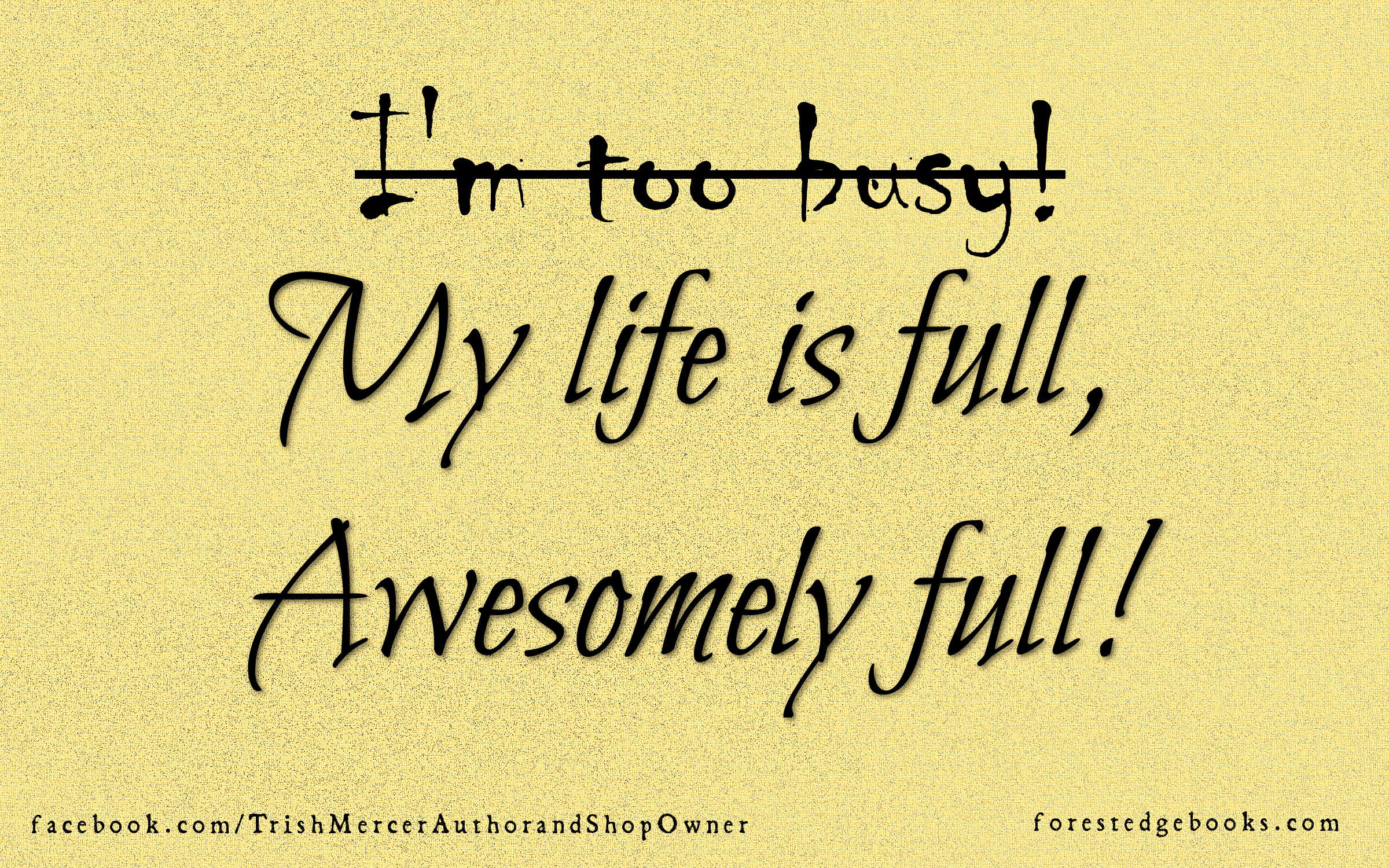
Instead, I’m trying this, (at least on everyone else): “My life is so full! Awesomely full!” im too busy

Notice the shift in tone and attitude?

Fullness is completeness.

Being full is usually a good thing (except in the water balloon that my three-year-old brought in the house. Clothing change #5. Another load of laundry which will take me all of five minutes to run.).

Having a full life suggests that nearly every element in my life is there because of my choice. I have CHOSEN this life.

All of us, unless we’re slaves (and I’m not being flippant here: I mean true, cruel slavery, and not something you claim you are to your preteens’ many activities) have chosen our lives to be as they are. Even in the most difficult of circumstances, we still have choices. Rarely are we ever forced into one course of action, and while the options before us may not be ideal, we still have a choice.

For example, at one point last year I was busy working two part-time jobs and running a small Etsy shop. I could have quit one of the jobs, but that would have meant finding another way to pay the power bill which would have meant . . . getting yet another job.

I was tempted to grumble at how hard my husband and I were both working for what felt like only a couple of bucks an hour, but we were working, and slowly improving our circumstances. Instead of complaining that my life was “too busy” to do what I really wanted to do—edit my books or get maybe six hours of sleep—I chose instead to be grateful that I wasn’t just sitting on the couch reading movie descriptions on Netflix (and wondering when the next season of “Call the Midwife” will finally arrive).

I had things to do, obligations to fulfill, people who needed me, and I realized how much I appreciated being needed.

However, I’m not advocating taking on more than we can reasonably handle. That’s where we need to be mature enough to objectively evaluate our lives and say, when necessary, “No, I’m sorry. I can’t organize the Little League luncheon or make party favors for fifty people.” Otherwise we still become martyrs who have taken on too much and eventually have a total breakdown.

Additionally, we frequently have several good things we need to do at the same time, and that’s where prioritizing comes in. Deciding which to do can be difficult, and who to tell “I just can’t do that for you.” But someone once told me that “Other people’s needs should always come first.”

I knew a man who told his son that he had to skip watching him play ball that evening because their neighbor’s sprinkler system was geysering into the neighbor’s basement, and the dad wanted to go help. He said, “It was good for my son to see that I was putting aside something that I thought was important–watching him play ball–for something which really was.” While his son was initially disappointed that his dad was “too busy,” when he saw the flooding mess he offered to skip his game and help as well. Suddenly he was “too busy” to play ball, because he was doing something better.

Living a “busy” life is frequently drudgery. But living a “full” life is marvelous. The sense of I’ve accomplished something good for my family and others is, I think, the purpose of life. What would be worse than no one wanting my help, my advice, or my labor?

So don’t complain/brag about being “too busy.” It’s an awesomely full life!

And really, what would be worse than an awesomely full life?
An awfully empty life.

“Being offended” is not as admirable a trait as you may think it is

Taking offense and being insulted have elevated into national pastimes. Find any article posted online anywhere and read (if you dare) the comments. You’ll find a flurry of, “I’m so offended at . . .” or “I can’t believe someone would write . . .” or “Once again, another insulting article has been published by . . .”

Everyone, it seems, has reason to complain about their feelings being hurt.
Either we’ve become a nation of martyrs, or we’ve never matured beyond 7th grade.

I’m inclined to believe the latter. Even if no offense is intended, someone’s bound to twist another’s words and intents like a pipe cleaner into some hurtful shape, then complain loudly that they’ve been hurt.

This weekend I read about a high school which sent home a funny-yet-instructive letter explaining how graduates should dress for graduation (sadly, such direction is necessary because many people don’t understand the word “appropriate”) and naturally there were many students and parents who found it “offensive,” “insulting,” and “shocking.”

Clearly the attempt at humor—written by a teacher who had since retired, suggesting that this letter had been sent out many times before and was never met with such anger—was meant to lighten the mood of what could be an awkward explanation as to why boys should keep their pants pulled up and girls should keep their “girls” contained at the graduation ceremonies. Why people should choose to be offended at reminders to be appropriately dressed truly baffles me.

I also read a post by a man who was overwhelmed by the effort some moms put into craftiness, and how other women feel they have to compete with often over-the-top productions. “Just. Stop. It.” wrote Scott Dannemiller, because he had observed his wife struggling with her assignment for the treat bags of the 1st graders. (Since when do 1st graders need elaborate and decorated end-of-school treat bags?)

And what did women write in response? Oh, I’m sure you can guess: “He’s openly sneering crafty moms . . .” and “Why is it acceptable to openly mock people?” and “What an ungrateful, hateful rant!”

Personally, I thought the article was hilarious. Yes, some women believe everything they see on Pinterest and feel obliged to conform. And yes, I’m a “crafty person,” but the author made excellent points—

Ah, there’s the rub, I think: We simply can’t abide another person’s point of view, especially if it may border on pricking our conscience.

The idea that maybe we might be wrong about something is . . . hurtful?

Or are we too prideful?

The opposite of pride is humility, and while people give that a negative connotation, what “humble” really means is “teachable”: recognizing that we don’t know everything yet, that we aren’t perfect yet, and that we’re WILLING to be open to correction and suggestions on how to improve.

Oh yes—that’s not ANYTHING our society wants inflicted on it: humility? Blech!

Instead we throw a fit when someone suggests we (or our children) are dressing, acting, or saying anything inappropriate.

Instead of checking ourselves to see if we need to improve, we whine and whimper that someone’s being “judgmental” and “offensive” and “hurtful.”

Instead of allowing someone their own points-of-view, on any matter (we are a free-speech society, in theory anyway), we cry foul and proclaim “They hate us!” and in turn become bullies to those whose opinions we refuse to allow.

Aristotle once wrote, “It is the mark of an educated mind to be able to entertain a thought without accepting it.”

What he means is, let people have their opinions; you don’t have to affected by them at all.
But instead we choose to take offense at ideas that we fear threaten ours.
We don’t have to.

Look at that phrase: “Choose to take offense.”

First, it is a choice to be offended. I’ve known a few people who can manipulate the most innocuous statement to insinuate offense.

“She complimented me on my shirt today. Does that mean she thinks my shirt yesterday was hideous?”

“He said I could borrow his new lawnmower. Clearly he thinks my yard isn’t as good as his and I need his help.”

“She said I looked tired. What did she mean by that?!”

Probably nothing!

No one thinks as much about us as we think they do. Many of us learn that back in junior high when our natural narcissism makes us believe everything in the world really is only all about us. And unfortunately a lot of people get stuck at that phase, even as adults.

That’s the problem with “taking” offense; when we actively take (an action on our part) offense, we get stuck. All forward progress in our day, our week, our lives comes to a grinding halt because we stop and decide to fight what we choose to see as a personal attack on something we love to do or believe.  Quite often that “attack” is nothing more than a weak perception on our parts that we overinflate to gargantuan sizes, and we lose traction and time pouting that someone hurt our feelings when 99% of the time no such thing actually occurred.

But occasionally a very personal, very sharp attack does come at us, fully intending to wound or even destroy us.

There are times when offense is clearly meant, and the aggressor stands there waiting for us to fight back.

Still, we can choose to take offense, or not.

Years ago I heard someone say, “Go ahead. Try to offend me. You can’t, because I simply won’t accept offense.

The idea was astonishing to me, and one that I’ve tried to adopt myself. I’ve lived around people who chose to take offense at every little thing, and their lives were needlessly exhausting as they perceived attacks on every side.

However, not taking offense at anything—letting people say and do and imply whatever they want, and letting that mud fling past me instead of stepping into its path—has made my life abundantly easier.

On many occasions people have nervously said to me, “I hope I’m not offending you, but . . .” and what followed was nothing anywhere near offensive. (Usually they’re offering me and my large family their hand-me-down clothes. As a woman who hates shopping and spending money, it’s Christmas Day when those garbage bags are deposited at my front door!)

I smile and say, “I’ve chosen to never be offended by anything, so you’ve got to try a lot harder than that.”

But back to the deliberate offenses, the calculated attacks: Even then, we do NOT need to take offense.

The best example of this to me is that demonstrated by the musical “The Book of Mormon.” Yes, it’s won numerous awards, has grossed millions of dollars, has been received worldwide, and yes—it’s a deliberate attack on the beliefs and ideals of The Church of Jesus Christ of Latter-day Saints (LDS). We’re also known by the name “Mormons,” the name of the ancient author of the compiled book which is lampooned and mocked in the musical. The whole notion of missionaries and morality is parodied by writers who openly hate the Church and brazenly stole copyright names to turn all which we hold sacred into the profane.

Yet the Church has chosen not to be offended.
They’ve chosen not to fight.

They’ve chosen to step away from the mud flinging and simply go on with doing what they believe is right.

There are no lawsuits over the copyright infringements. There are no organized protests. There is no money or time or effort expended in wrestling in this muddy bath. Mormons have been persecuted before, to the point of theft and rape and murder. Compared to the horrors early members faced in the 19th century, a blasphemous little musical is nothing.

There are too many far more important tasks at hand, so the Church continues to focus on building its humanitarian efforts, churches, temples, and going about business as usual. I see the attitude of, “We’ll leave the judgments to God, and be about doing His work in the meantime.”

Well, I confess that wasn’t my initial reaction to the musical. When I first read about the production, I was furious. As a mother of missionaries, future missionaries, and married to a returned missionary, I panicked that such an outright mockery would damage the efforts of tens of thousands of sincere people.

That hasn’t happened. In fact, I’ve read of several accounts of people who attended the musical, decided to contact missionaries to make fun of them, but ended up joining the Church instead. In every major market there have been critical reviews commenting that the musical is abrasive, offensive, and vulgar, and if it were directed toward Muslims instead of Mormons, jihad would have been declared on all fronts.

But all the Church said about the musical was this:

The production may attempt to entertain audiences for an evening, but the Book of Mormon as a volume of scripture will change people’s lives forever by bringing them closer to Christ.

And that was it.
The producers of the musical state the Church is being a “good sport” about it, and blah, blah, blah, because what more can they do about someone who refuses to fight?

Frankly, I still hate the idea that the musical exists, and that people willingly pay ridiculous amounts to see Mormons and missionaries mocked. But I refuse to take offense.

In a fight, the one with the most power is the one who walks away from it.

“No one’s ever successfully insulted Rector Yung, because he refuses to be insulted. People do their best, but Yung won’t even acknowledge the attempt of an affront.”

The Falcon in the Barn, Book 4

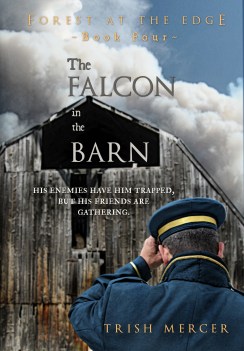
“The Falcon in the Barn” is here, and so are free magnets!

Here it is! Live and available on Amazon for $2.99. Just click below:

Book 4 Front Cover

The paperback will also be available by this weekend for $15.99. (And, in a few more days, here as a full .pdf under “Start Reading the Books!”)

And to thank you for your patience and support, I’ve got a freebie for once! Magnets!

magnet chairman stamp red stamped flattened

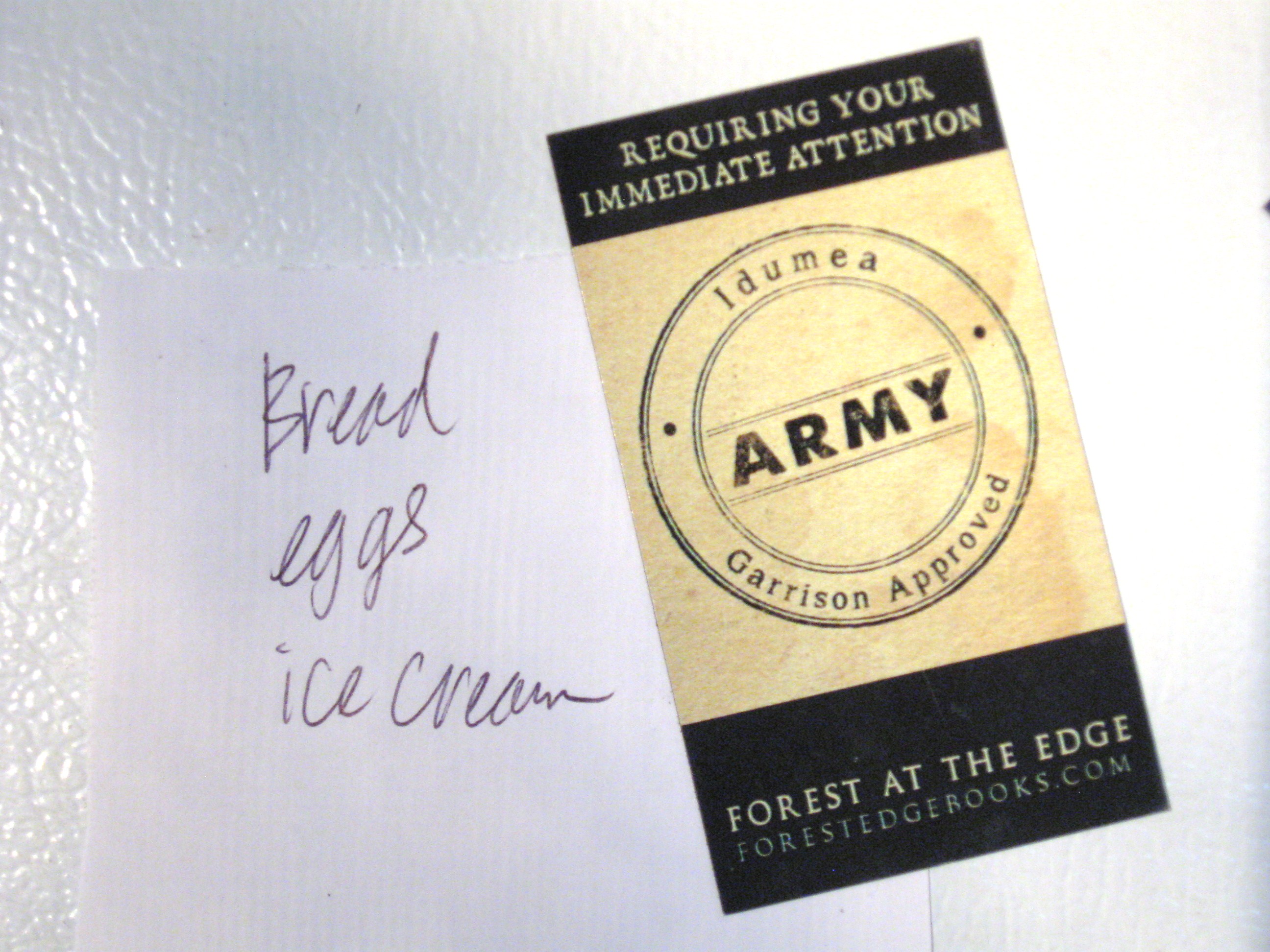
Each measure 2 inches by 3 inches. Not big enough to cover your entire fridge, sorry. magnet army black flattened

(This is the extent of my marketing techniques; revel in it.)

039

I HAVE to get ice creaml The Army of Idumea requires it!

I’m the practical sort, always needing new magnets for important messages on my fridge, and thought it’d be fun to have the Administrators or the Army of Idumea reminding me that I needed bread.

I’ve got several pairs to give away–you get one of each–and all you have to do is let me know. Fill out the contact form below telling me “Want magnets!” and I’ll get them into the mail to the first 20 people requesting them. 

← Back

Thank you for your response. ✨

Look how stylish they are on my fridge. They can be on yours, too. 033

Again, THANK YOU!

And now, to get to work on Book 5 . . .