Flood the earth–or my basement and bedrooms–with service: #LIGHTtheWORLD

The most horrible sounds to wake up to are someone vomiting, something shattering, some cat hacking, or some water running. Early yesterday morning, I was awakened by the last item. I was planning to publish a piece here about my sons putting up Christmas lights, but I didn’t get to finishing it because at 4 a.m. I woke up to hear that doomsday sound of water trickling. As I put my feet on the floor, I immediately felt the squelch, and realized my carpet was soaked through. Frantically, I jumped to the bathroom to find the toilet was overflowing, and likely had been for about five hours.

As I was desperately trying to mop up the mess on the floor with all of the towels, my 16-year-old son came upstairs. “It’s happening in my room, too.”

Not sure what that cryptic, drowsy message was, but knowing it wasn’t good, I rushed downstairs to hear the nauseating sound of pouring water. Apparently the heat duct in the bathroom had served as overflow and channeled the water into the ceiling, closet, and carpeting of my son’s bedroom.

By 5 a.m. every towel we owned was wet and in the dryer, and I sent my son back to bed (or rather, the couch) because there was nothing more we could do.

By 7 a.m. I was slightly despondent as I tried again to start drying the mess, realizing that everything would have to come out of my bedroom/office in order to pull up enough carpet to dry it.
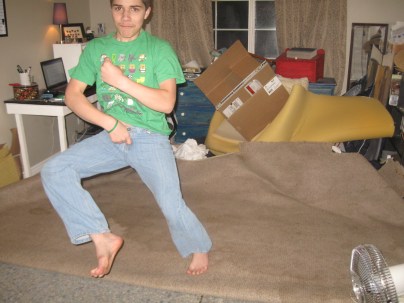
img_1973

(My thirteen-year-old thinks my flooded bedroom is worth dancing about. He’s not my favorite child today.)

At 9 a.m. I borrowed a wet vac from my neighbor and started sucking up the water, knowing already that it was far more than I could handle. Still, I was determined to try to solve this problem on my own.

But by 10 a.m. I sat down, exhausted, on the floor in my son’s room only to realize my bottom was wet (like my feet, my knees, and my arms) because the water had leaked much further than I’d expected.

That’s when my eyes started leaking. I hate crying. But having had only five hours of sleep, and realizing that not only would my bedroom have to be evacuated, but so too would this bedroom and its heavy loft beds, all I could do was weep.

My husband called then to check on the situation (I had Facebook messaged him at 5 a.m. with the news because I had nothing else I could do) and I said, sniffling, “I think I’m a little overwhelmed.”

He knows I rarely cry, and I think that’s why he took to the computer. Because he’s nearly three thousand miles away, he did all that he could: he messaged one of our neighbors, who called his wife, who called another neighbor, who called our ward’s bishop (similar to a pastor or rector), who came by at noon on his lunch break and said, “I heard you have a little water problem?”

I wasn’t going to cry in front of him, but I knew it wasn’t just the water; it was all the furniture I had to move, and all the work that faced me repairing the damage. While insurance will help, we have a very high deductible. By then I was feeling more than a little overwhelmed. Bishop Stevenson took a look at my mushy bedroom, went downstairs to evaluate my sons’ room, and poked around in the rafters looking for more problems, then said, “Well, the hard part is over.”

I scoffed at him. “It’s just started!”

“No, it’s ended. Now you have help. I’ll be back at three when I get off of work, with some movers.”

“No, Bishop, I think we can handle it . . .”

Fortunately he didn’t believe my lies.

At 3 p.m. two young husbands and a teenage boy arrived with him to help my sons and me move everything to dry ground. Another neighbor brought more fans, another retrieved my youngest from preschool, and while I talked on the phone with the insurance company, everything got moved and placed, Tetris-like, in the family room, my daughter’s bedroom, and living room.
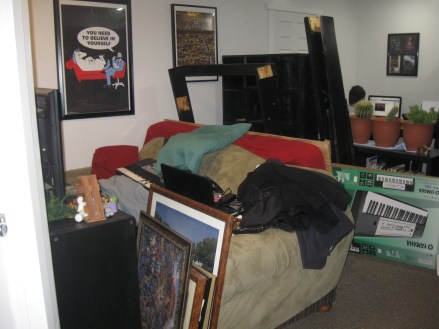
img_1977

(Our family room-now-storage room. Yes, the poster in the background is of a psychiatrist saying to a unicorn, “You need to believe in yourself.”)

Another neighbor brought over two bars of very dark chocolate (like alcohol for middle-aged Mormon women), and someone else brought us pizza for dinner. And while my living room will be my bedroom’s storage for a week . . .img_1979

. . . I realize Bishop Stevenson was right: the hard part is over. I’ve got help on every side.

I freely admit it’s tough for me to accept help. I think it’s that way for a lot of us. A part of me feels guilty for the mess, thinking that if I’d just looked at the toilet before I went to bed (my four-year-old has a knack for plugging it), or hadn’t slept so deeply, that I would have noticed and even prevented the mess that a dozen people have now had to help me with.

I also wouldn’t have had to swallow my pride and let strange men see what’s under my bed as they moved it to the living room. (Go ahead—look under your bed right now, and imagine your neighbors seeing that. Horrifying, isn’t it? Oh, come on—please tell me I’m not the only one with a disaster under her bed!)

Interestingly, today, Dec. 1 is “Worldwide Day of Service,” and it marks the beginning of the “Light the World” initiative—an idea to get everyone giving service throughout the month of December. Here’s a guide of daily suggestions, too. (Tomorrow, Dec. 2, for example, is “Honor your parents” day. Call [not text] your parents, write a note to your parents or in-laws, or learn about an ancestor.)

Dec. 1st is “Jesus Lifted Others’ Burdens and So Can You.” But my kind neighbors didn’t need any initiative or any prodding. Service is what they do all the time, anyway. They merely started a day early, on Nov. 30, which will always be for me, “Relieve the Flooded Day.”

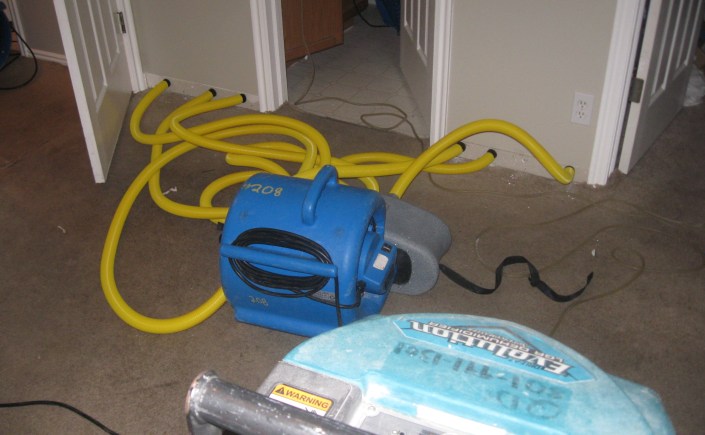
When the water extraction crew arrived in the evening  (I finally admitted I needed professional carpet drying help), they were astonished at how much work had been accomplished. They praised me for getting everything moved out and putting fans where I could, but I told them, “It wasn’t me; it was my neighbors.”

“You have some awesome neighbors, then,” they said. Yep.

img_1982

(I feel like our bedrooms are having surgery.)

So to all of you who may serve this month, who will be that “awesome neighbor” who will lift other’s burdens, who will notice the blinking back of tears when someone’s too prideful to whimper, “Help?” I say, “THANK YOU!” You may not hear those words from those you serve, but they’re being sent your way.

Your service is needed, every day and everywhere. Something small to you may be something huge to those in need. So go out there and light the world.

And thank you in advance.

“I don’t know of another family—there or perhaps even here—that would give up as much as you have for those you see in need . . . You and Mahrree don’t care for possessions or status, but for people. Already you understand.”
~Book 5, Safety Assured Leaving East of Medicetti
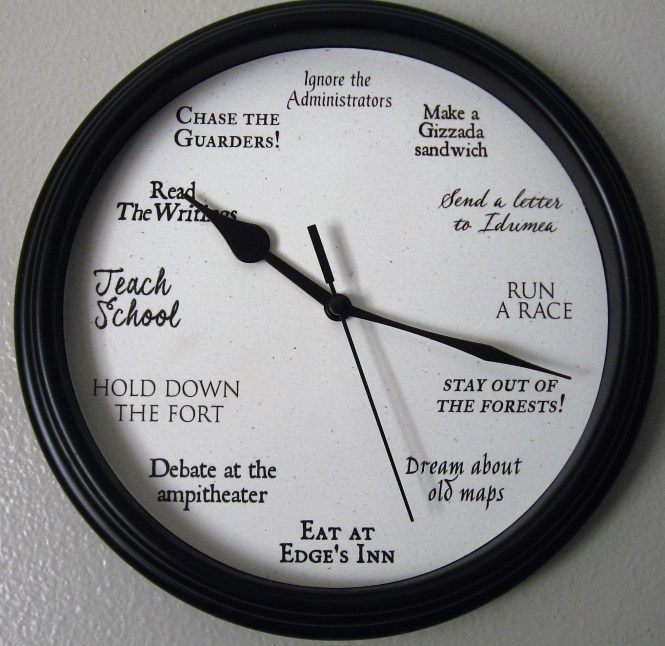
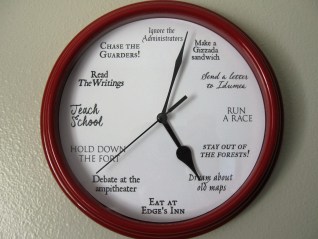
Get your clock for Christmas, and $5 off!

Get your Forest at the Edge official clock ordered soon to ensure delivery by Christmas. Remember to put “Book Reader” in the message section, and I can refund you back $5. That way, the clock will be only $10, and with shipping (about $3.70 in the US) that’s less than $15 for a gift. 

img_1890

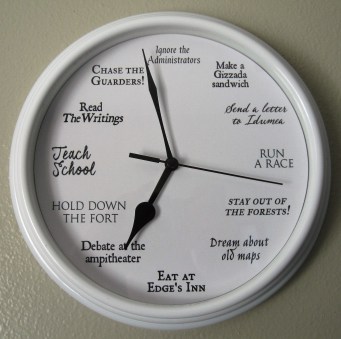
Also comes in white and red:

img_1885 img_1886

I can customize it, too! Tell me what you want it to say, and I can modify up to three entries, so yours is absolutely unique. (Just get one for yourself; you know you want one.) Order here!

Barn pantry doors, in 85 mistakes (or more!)

I’ve written before why I don’t do a diy blog. Below is more evidence why:

#1 mistake—going on to Pinterest and typing, “Remodel bifold doors,” because for eight years I’ve hated my pantry doors which never closed properly. Pinterest is almost always a mistake, one that I usually try to avoid, but I fell in a moment of weakness.

Fie you, Pinterest! 

This is what inspired me: Builder basic bifold door makeover, into stylish French doors - tutorial from Sawdust2Stitches on Remodelaholic.com

This is not what I ended up with.

#2 mistake—assuming this was going to be different from the rest of my remodeling attempts, that I would need only one trip to the store (it was four), that I’d measure everything correctly for once (nope) and that the project would turn out exactly as I expected (wrong again).

#3–not telling my husband, who lives and works in another state, what I was about to do. (Actually, that was probably a good thing; always easier to get sympathy than a lecture on how it’ll be harder than I expect. And he would have been right, fie him!)

I’ll give you only the highlights of the rest of my mistakes, ones I remembered to document.

#23—losing control of the drill while trying to use mending plates to turn the 20-year-old bifold doors into unfolding doors.

img_1898

I’ll give you one guess as to what kind of drill bit I was using.

(Wound’s healing nicely, thank you for asking.)

#35—Transposing the wrong measurement numbers, so that the guy at Home Depot cut my luan boards seven inches shorter than he should have. (Fie him, not knowing I wrote the wrong numbers!) Which meant I had to put in a middle 1×3” (#36) because I had to cut the luan board in half to compensate for the mistake so that it’d cover enough door (#37) . . .

img_1901

. . .which also meant I didn’t have enough 1×3’s (#38) so I had to go back to the store for another one because I had to change my original design (#39). (Come to think of it, yes–I DO want barn doors!)

#40—not living closer than ten miles to the nearest good home improvement store.

img_1904#41—Yes, I ALWAYS measure twice and cut once! I don’t know WHY everything ends up shorter than I measured! And yes, I do KNOW the blade eats away at measurements! That’s why I plug in bits of wood to compensate (#42) then have to get wood filler at the store (another trip to the store–#43) to “smooth” it all in.

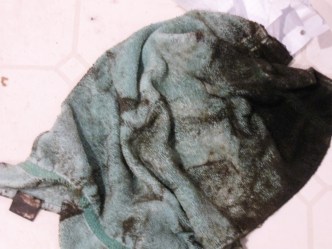
#56—staining the doors on the kitchen floor. But this isn’t entirely a mistake. I’m hoping that if I destroy this old linoleum sufficiently enough that I can magically afford to replace it. img_1906

img_1907

(#57—believing in magical “Laminate Flooring Fairies” who leave gifts during a full moon. The Supermoon came and went, and not one box of flooring was left on my front doorstep. I must admit, I’m beginning to fear that the “Laminate Flooring Installation Fairies” may also be a figment of my very particular imagination. Fie, you fairies!)

img_1911

#58 I always hated that towel.

#60—not using gloves on my hands.

img_1910

#61—not having any paint remover in the house for my hands. (On the bright side, that Minwax stain is quite wash resistant!)

#63—bracing the doors against the side door that leads to the garbage cans to dry overnight.

img_1908

(#64—believing there’s nothing wrong with letting the trash overflow for the night, forgetting there was raw chicken fat in there, creating a lovely smell by morning, especially combined with the scent of oil-based stain.)

#65—buying too small a can of stain and running out during the second coat.

img_1912

#78—getting the wrong door handles, and #80—assuming four hinges would be enough because those doors got HEAVY. (Another trip to the hardware store.)

And many more . . .

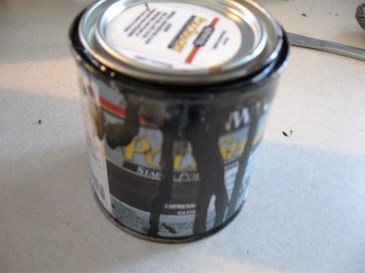
But the project wasn’t all disaster—nothing really ever is, when you get honest with yourself. While I did run out of stain, I remembered an old quart in the basement. To my relief, it was the same color (I guess I really love Minwax’s Espresso Gloss) that I’d used on computer desks, and there was just enough to touch up the doors.

img_1913

Eventually, after two days of work, I finished. The design of the doors wasn’t what I at first intended (it wasn’t going to be this “busy”), but once I got up the doors, I was astonished.

img_1917

(Boys, get out of the picture!)

 . . . Because while it was nothing like I had intended, it was still beautiful.

There are still errors I won’t bother to point out, sections to fix and finish, walls to repaint (you can see color tests on the left side), moulding to resolve . . . but all in all, it worked.

In the middle of this project I realized life is pretty much the same way. (Here’s my Forrest Gump moment.) We see something we want, make our plans, then muck it all up in our pursuit—despite our best efforts—and hope to fix it all before anyone sees just how wrong it all went. (But here I am, confessing some of those parts that did go wrong . . .)

We fix, we revise, we rethink, we adjust, and we keep going. 

It’s never going to turn out exactly as we planned, but in the end I hope we will all look back on our lives and think, “Wow–that all turned out better than I expected!”

img_1915

Just don’t give up when your hands are filthy, your wounds throb, and everything stinks. It’ll get better, eventually, as long as you don’t give up.

(By the way, that stain is REALLY good—going on day five, and it’s still coating my hands.)

“Well?” Perrin asked as he beamed in pride at his creation.

“I have to admit, it’s not too bad.” Mahrree eyed the massive timbers turned into simple furniture. Apparently the blood of the High Generals had never been tainted by craftsmen with artistic leanings. She wondered if, left to their own devices, the Shin men would have opted for clubs torn off of trees instead of elegant swords with ornate hilts. ~Book 1, The Forest at the Edge of the World

The world hasn’t ended: 6 things I still get to do, even with the election results in.

  • Tomorrow, attend a lecture at the local university given by a Methodist preacher and doctor of divinity from England who researches Temple Theology, because we still have freedom of religion.
  • Teach my sons history as part of our homeschooling, because the home is still sacred and the center of all worthwhile learning.
  • Purchase online some beautiful woodwork from a woman in Ukraine, because we still have commerce with other countries.
  • Drive many miles to meet up with my daughters, see my grandchildren, and even do some shopping, because we still have the infrastructure that supports it.
  • Redo some closet doors that I’ve despised for years, because others freely share their knowledge and experience with online tutorials.
  • Take a deep breath and realize that things are still functioning in America, that I could add a hundred more things to this list, and cling to the strange emotion that surprised me this morning: cautious optimism.

Stunned, Perrin and Mahrree sat on the bed and stared.
“It might not freeze,” said Perrin, trying the new approach of optimism. ~Book 3, The Mansions of Idumea

[By the way, if you’re looking for a great Christmas gift, The Forest at the Edge of the World clock is here on Etsy! When you order, put in the comments “Book Reader” and I’ll refund you $5. That means it’s only $10! You’re welcome!]img_1890

Official Forest at the Edge clock is here–just in time for Christmas!

I’ll be honest: I made this for me.

img_1890

I love unique clocks, and while I’ve made clocks for other genres, I never made one based on my own books.

The other day I thought, “Why not? I wrote the kind of books I want to read, because I couldn’t find them. Why not make the kind of clock I want, too?”

Then I thought, maybe a few of you might like one, too. On my Etsy site they’re listed for $15 (plus shipping: USA is about $3.60, international about $21.00).

BUT, if when you order you put in the comments, “Book reader” I’ll refund you $5.00. 

So your total cost for this fun clock, straight from my house, will be less than $15.00. Pretty good deal for a fun gift!

They come in black, white, or red. The black can have either parchment-like paper (scroll down to see close up of parchment-like paper) or plain white.

img_1886

img_1885

img_1893

Detail of parchment-like paper option on black clock.

I ship usually within three days of receiving an order, and clocks arrive about three days after that. If you want this for Christmas, make sure you order by the middle of December, because I get a bit backed up with other orders. Click here to order!

Two logical reasons why I bizarrely thank canning jars . . . and everything else

I didn’t realize until I was older that we had a weird tradition in our house. It was mandatory that when a canning jar popped, no matter what part of the house my mother was in, she’d shout, “Thank you!”

If she wasn’t home, that duty fell to me, and I didn’t always want to do it.

My mother, a refugee from Germany after WWII, learned how to can after she came to America. But she was always worried about sealing the jars properly, so she’d watch the jars, waiting for the lid to pop up indicating that it had sealed. Relieved, my mother would exclaim, “Oh, thank you!”

Over the years, it became a habit to thank each jar for sealing properly, and I grew up knowing that when the jars popped in the kitchen, “Thank you!” needed to be shouted. Otherwise, who knew what evil would transpire?

I thought the tradition was ridiculous, especially when I discovered that no one else did this.

When I was twelve, Mom pulled out a batch of pears, then went outside to pick strawberries. It was then that a cooling jar popped, and . . .  I was the only one to hear it.

I knew what was expected—that I should thank it, but how stupid was that? Thanking an inanimate object?

The house became very quiet and still, as if waiting for me to thank the jar for its kindness in sealing, but I wasn’t going to do it, not going to—

“Thank you,” I finally whispered, because the cosmos seemed to demand it.

Two more jars popped cheerfully after that, and I thanked each of them. Fortunately my mom came back into the house and asked urgently, “Did any pop?”

“Yes, and I thanked them,” I said sheepishly.

She thanked each of the jars herself anyway, just to be sure.

It wasn’t until about ten years later, when I tried canning for the first time, that I eagerly and worriedly watched for my first can of tomatoes to signal its sealing. When it did, I cried out, “Oh, thank you!”

And immediately I understood. And immediately I was hooked.

You see, I began to thank all kinds of things; our old vans when they start without spluttering (I frequently pat them on the dashboard, telling them what good vehicles they are); the driver’s side window of my minivan when it decides to go up when I push the button—especially when it starts raining; my printer when it communicates with my laptop and actually prints something; when the traffic light stays green for a second longer; when there’s a 2-for-1 sale on my favorite bagged salad—all of that gets an audible, “Thank you!”

Yes, even in the grocery store.

I’ve found myself saying “Thank you!” when:
my sons’ favorite t-shirts are on sale;
that 50% off coupon is still good at the fabric store;
the berries produce;
the bread rises;
I get to the pot just before it boils over; and
when the stain comes out in the laundry.

Because everything deserves thanks, animate or inanimate.

It’s contagious. My oldest daughter confessed that when she cans, she also calls out “Thank you!” each time a jar pops; another child thanks the scooter when it starts up; and the other day I heard my four-year-old thank his Legos for going together.

There are numerous studies showing the spiritual/psychological/emotional improvements when we count our blessings, but here are the reasons why I became hooked on thanking the world:

  • It immediately makes me happy. Think of every time you say thank you, or someone says it to you. There is always—always—a hint of a smile (or maybe a huge one, depending upon the situation).

I have yet to witness a sincere expression of thanks without accompanying happiness.

  • I feel in harmony with the world when I thank it, and that makes me peaceful. So what if it’s weird to thank the automatic door for opening; I do so anyway. It might not have opened, and that may have made me grumpy as I wrestled with doors, trying to leave the store.

But something kind and helpful happened for me, as it does every day, so I show gratitude. It does nothing for the item I thank, but it does ME a world of good: I see the world as a kind and helpful place, which in many,  many ways it still is.

I need to remind myself that there is peace, even during horrific times, or I’ll hide in my closet terrified of the world.

My mom told me once of fleeing the Soviets when they were taking over her hometown of Neisse (Nysa), now in Poland. She was a teenager, fleeing all alone to the west, and had only a sausage in her backpack for food. She found a mother and her child willing to shelter her for the night, and she shared her sausage with them. She thanked the woman for safety from the Soviets, and the woman thanked her for giving them something to eat when she had literally nothing left.

And for that evening, for them, the world was at peace. I don’t know about you, but I desperately want that kind of peace in a world growing more hostile. My mom always remembered that night fondly, when she realized that kindness still existed, and so did God.

Yvonne N Strebel 1

(My  mom, a few years later, in happier times in Munich.)

So really, it’s not so much thanking the world as an inanimate object, either; it’s thanking, in many different ways, the Creator of it all.

“Thank you,” Perrin said again to the forest, wondering if anyone was there to hear it.

Back behind a clump of pines, a man in white and gray mottled clothing nodded. “You’re welcome, sir. My pleasure and honor.” ~Book One: The Forest at the Edge of the World

why-i-thank-the-jars


Five steps to surviving a termite infestation and the 2016 Presidential Election

First, termites. Because they’re more pleasant.

Some years ago our family was staying temporarily in an older townhouse in South Carolina. On a sweltering July afternoon, my husband Dave and I were evaluating the paneling on the screened back porch.

“It’s rotting,” Dave noticed, and he tugged on a brittle board. “I think we should pull out this panel to see how far the damage goes.”

While it wasn’t the best time to start a home improvement project—I was within two weeks of delivering baby #8—we just couldn’t resist those loose boards. I didn’t feel like working, but watching my husband flex his muscles in manual labor is always a pleasant way to pass the afternoon.

He went in the townhouse and came out again with a screwdriver and a hammer.

“Maybe you should put on some shoes,” I suggested, worried about nails dropping to the ground that he’d step on.

He waved that off, always preferring to be barefoot. He pried the screwdriver in a crack, whacked it with a hammer, and the crumbling panel came loose. With one quick tug, it came off—

And so did thousands—literally thousands—of termites!

You should have heard me screaming as they poured out in a frenzy, swarming the ground like a white, flowing carpet. Frantically, I scrambled into a nearby hammock, heaving my huge belly and my puffy feet to safety as the termites spread out rapidly from the panel.

But points for bravery for my husband: Dave didn’t move. Somehow, despite the horrifying scene, he kept enough of his wits about him to realize that if he did the frantic stomping dance I did to get to the hammock, he’d be crushing termites under his bare feet. Hundreds flowed over his feet, and he shouted and exclaimed, but within ten seconds they were past him, streaming out to the abandoned golf course behind us.

Our kids, hearing our shouts and screams, tried to come outside to see why, and we yelled at them to “CLOSE THE DOORS! CLOSE THE DOORS!” Fortunately, the termites weren’t flowing into the house, and about a minute later all evidence of the awful insects were gone.

I was barely catching my breath when Dave was already tapping at the next panel. “Don’t do it!” I cried. “At least get some shoes on first!”

“Not a bad idea,” he agreed. He ran into the house, telling the kids to stay put, and came out a moment later. “We have to get them all out,” he explained, and whacked off the next panel, ready to run.

There were only a few hundred behind that panel, and again I squealed and squirmed as they rushed under my hammock, and Dave, with more warning this time, sprinted out of the way. Two more panels and a few hundred insects later, the horror film was over.

“You can get out of the hammock now,” Dave said. But I wasn’t about to move. Filled with the heebie-jeebies—a sensation that stayed with me for many weeks—I was terrified to leave the safety of the hammock.

“Well,” I said as he examined the damage our curiosity had revealed, “what do we do now?” I grew up in the dry west, where we never had termites.

“We go to the home improvement store, buy a case of termite killer, spray every inch of the house, and get some new panels,” Dave said simply.

And so we did, once he was able to coax me out of the hammock. We told our kids what happened—none one of them wanted to crack open the door for days afterward—and we headed out to buy bug killer and new panels.

So how is this like the upcoming presidential election? Because it’s an invasion of termites: ugly, nasty bugs set out to terrify us all. However, there are five steps we can take in the next few days to deal with it, the same way to deal with termites.

Step One: accept that it’s happening, and that there’s nothing we can do to stop it. The termites are here, and they’re going to flow all over us with the press and social media, especially on and around November 8th. We have a couple ways to respond:

  1. My method, of screaming and running for higher ground. That worked, actually. I’m going into hiding soon: I will suspend my regular Facebook page for the days surrounding the election, and stay away from all news outlets in order to avoid the pestilence. I’m already “hiding” contacts and pages I normally follow, because I can’t deal with the bluster anymore. I’ll probably still do some screaming, because I can see in a distance what’s happening, but I don’t have to be a part of it.
  2. My husband’s braver method of wading through it. He let the nasty little buggers crawl right over him, without panicking, without stomping, without covering his bare soles in bug guts. Sure he yelled variations of, “Oh—gross! Get away! Shoo! Go!” And you know what? It worked. He wasn’t bitten or devoured.

Step Two: keep your cool. It’s going to get ugly out there (more than it has been), but that’s no reason to lose control over your language and behavior. I’m proud of my husband for not swearing; that’s simply not his style, and he wasn’t about to lower his integrity because of a few insects. So in a moment of infestation, don’t do or write or say anything that, once you’re clear-headed again, you’ll be ashamed of.

Step Three: realize it is going to stop. Eventually, the ground will clear, we’ll all catch our breaths, and once we’re calm and collected again, it’s time for the next step;

Step Four: clean up. There’s going to be a huge mess after this, and likely more messes later. No, we didn’t cause this, but still a mess remains. And even though it’s not our responsibility (“I hate this place! I don’t even want to live here!”) it does no good to complain or point fingers. All we can do is start picking up the pieces and begin rebuilding.

Step Five: don’t expect the termites to come back and help. They won’t even apologize. It’s not in their nature. They’re already moving on, searching for a new target to destroy. We’ll probably need to go help with that clean up later as well. Just be prepared, and don’t expect anything from them.

Good luck out there in the next few weeks. I’ll see you again on the other side.

If Gadiman were an animal, his appearance would cause people to instinctively yelp, then proceed to stomp on him with their boots. ~Book 1, The Forest at the Edge of the World

How a Pepperidge Farms cake revealed that everyone is obedient to something, if they realize it or not

My friend “Sally” has a brother who openly belittles her for being “blindly obedient” to her religion. Privately, Sally struggles to think more charitably of “John” who she thinks is a jerk.

One summer their parents invited Sally’s family and John’s family to share their condo at the beach. They agreed until they found out—too late—that each other’s family would be there. So Sally, her husband, and three kids decided to try to be cordial to Jon, his wife and two kids.

But things started off rocky, because while John and his family arrived at the condo on Saturday, Sally and her husband has responsibilities at their church and didn’t want to miss it. Normally they avoided travel on Sundays, but to keep the family peace, they left after church and arrived at the condo that evening.

It wasn’t good enough. John greeted them with, “You and that stupid church of yours. I swear, you’re so blindly obedient to it that you fear to miss even one day? Check-in to the condo was yesterday, you know. You were supposed to be here then.”

Sally was determined to be kind, even though it was silently eating her gut. She had called the condo earlier and they told her check-in started on Saturday, but they could check in at any time that week.

However, Sally gritted her teeth and said, “Thank you for getting the place for us.” She decided not to further ruin her Sabbath by getting in an argument about her “blind obedience.” Jon had quit religion when he was a teenager, and thought Sally was ridiculous for giving up her Sundays.

The next morning, Sally got up to make her kids their favorite muffins. She dumped the mixes in the bowl and proceeded to whip the contents into a froth.

“Whoa!” John exclaimed as he came in the kitchen. “That’s not how you make muffins!” He snatched the bowl out of her hands, picked up the box with instructions, and said, “Look—it clearly says, ‘Mix gently until just moistened.’ Can’t you follow directions?”

She grabbed the bowl back, trying not to feel like a twelve-year-old again. “I know what the box says, but some months ago one of my kids made muffins, overmixed the batter, and we discovered that we much prefer that texture. Whipping improves the recipe, and this is how we like it!” She purposely whipped the batter even more, just to shock her brother who stormed out of the kitchen mumbling, “She can’t ever get things right . . .”

The muffins turned out exactly how Sally and her family liked them.

That day the weather was rough, so instead of spending it at the beach, the families hit the shops. Sally and John took their kids in different directions. One store on the boardwalk was particularly aggressive in trying to get parents to buy their children an overpriced stuffed animal they “made” themselves, then paying an extra $10 for that animal to wear a t-shirt from the beach. They advertised loudly that the bears were the item to have that year, and the employees went so far as to herd families into the store.

Sally and her husband purposely steered their kids away. They had a budget for the trip, and told each of the kids how much they could spend on them. “That bear, all by itself,” Sally’s husband told their kids, “would take all of your souvenir money. One toy for all of you? But instead of a bear that wears a t-shirt, how about each of you get a t-shirt for school? The shop over there has a deal, and you could each get three shirts and still have money left over for churros.”

The decision was easily made, because churros are the best, and when they went back to the condo at dinner time they had a dozen t-shirts for the whole family. They’d stopped at the grocery store to buy supplies for dinner—grilled cheese sandwiches, carrots with dip, and a favorite cake for dessert.

Sally wasn’t surprised when they entered the condo and found John and his family already there, each of his kids with one of those bears, each with the extra $10 t-shirt.

One of Sally’s kids said to her cousins, “My parents said those were too expensive. We bought us t-shirts instead.”

As the cousins examined each other’s purchases, John smirked at Sally. “Too cheap to buy them stuffed animals?”

“Not at $50 each,” Sally scoffed. “Our kids would stick them on a shelf then never play with them. I thought it was a useless purchase for us.”

John scoffed back. “But it’s what you do at the beach! You buy them expensive souvenirs. That’s what credit cards are for.” Sally and her husband didn’t believe in using credit cards.

John also predictably made fun of their grilled cheese sandwich dinner, (“But it’s our favorite!” Sally defended) and when someone knocked at the door, John announced, “There’s our dinner from the ‘Happy Harbor’.”

John’s kids frowned as his wife paid the delivery boy. “But we hate seafood,” they complained.

“Seafood is what you eat at the beach,” John told them, and set out their elaborate dinner of shellfish on the table on the back porch, so that any passers-by at the condo could see the bags advertising the most expensive restaurant in the area.

Sally quietly made two more grilled cheese sandwiches and slipped them to John’s kids who wolfed them down before their parents announced that their seafood feast was laid out and ready.

Sally’s family sat at the table indoors, not needing to show off their sandwiches, and perfectly satisfied to not have to dig their dinner out of shells like their cousins, whose complaints could be heard from outside.

When it was time for dessert, Sally pulled out of the freezer their favorite: two frozen Pepperidge Farms cakes. John came in from the porch and frowned at the cakes she was removing from the boxes. “You’re not cutting those up frozen, are you?”

“Of course I am,” Sally said. “They taste like ice-cream cake like this.”

He grabbed the box and pointed at the words. “Look, right here. You’re supposed to defrost it in the fridge, first. Man, you can’t get anything right, can you? I’m taking my family out to the Ice Cream Shack for a proper dessert.”

“But that place is pricey!” Sally exclaimed. “One scoop of ice-cream costs more than an entire cake.”

“It’s supposed to be pricey. It’s the beach and it’s supposed to be the best! And don’t cut that cake while it’s frozen!” Enraged, he took his family—and his credit card—out for the evening.

That’s when it hit Sally, and she told me later, “I realized at that moment that John belittled me not for my ‘blind obedience’ but because I wasn’t obedient to what he thought was important. His fury at my cutting a frozen cake was only a hint at a much bigger problem:

He, too, was exceptionally obedient—to what the world expects of him.
His insistence that I follow the directions on the boxes?
Obey the boxes.
His buying those expensive bears because everyone else was?
Obey the crowds.
The ice-cream?
Obey the marketing.

“The trip became easier after that, because I finally understood my brother; he was scared of what people would think of him if it found out his sister wasn’t obedient to the world he worshiped, and he was terrified to not be seen what he thought it demanded he be doing.

“I realized that all of us are obedient—wholly devoted—to something: maybe it’s a team, or a political party, or a religious organization, or a movement, or even ourselves that we set on a pedestal and worship.

cake

That’s not necessarily wrong or bad. But it is if we don’t realize it, or if we didn’t make that choice consciously.

“John didn’t recognize how blindly he followed the trends of the world, and worried that everyone was watching to make sure he did everything he was ‘supposed’ to do at the beach. But I doubt anyone even noticed him and his family’s ‘obedience.’

“Yes, I’m obedient to my church, because I’ve researched and lived by its teachings, and have discovered for myself that it’s the best way for me to live my life. That’s how we’ve done everything, from muffin mixes to how we spend our Sundays.  There’s nothing blind about my obedience. Nothing blind at all. I’ve chosen what I’m obedient to, and it’s brought meaning and peace to my life.

“Unfortunately, I’m not sure my brother can say the same thing.”

But Jaytsy knew what she did love, and it was glorious to no longer worry about the world’s opinions. ~Book 4, The Falcon in the Barn

Why God won’t always let the door open when you pound on it, and why that’s a good thing

I have a distinct memory of being five years old and walking home at lunch time from kindergarten. (Walking two blocks to home was still acceptable in the 1970s.) My teacher, Mrs. Madrin, was a bitter woman who never smiled and yelled at us for the full three hours we had to endure her. After a morning of kindergarten, I deserved a break! Waiting at home for me would be my peanut-butter-and-jelly sandwich and some serious downtime with “Sesame Street.”

I trudged up the front steps of my house and went to the door, sure I’d find my mother waiting anxiously for me; her life had no meaning until I was in it again, after all.

But, shockingly, the door was locked!

Dismayed, I kicked it, banged on it, jiggled the handle—how could this be?! It’s supposed to be open, and I should get my lunch and TV time NOW!

And where was my derelict mother?

Quietly, softly into my mind came the words, She’s in the backyard.  Go there.

Was I relieved by that news? Comforted?
Heck, no—I was furious! She was supposed to be in the house, with the door unlocked!

This was NOT how I imagined things should be!

She’s in the backyard. Go there.

I kicked again, sobbed loudly for being so insulted, and finally sulked and slumped against the door. Things were supposed to go exactly as I thought they should, because the world revolved around me.
How dare it turn another direction without my permission?

Amazingly, none of my tantrums changed my situation. If my mother really was in the backyard, she wouldn’t hear me. No one was on the street to notice my despair. And still I heard the promptings to go to the backyard.

Oh, I was a prideful, vain child. I wouldn’t relent, I wouldn’t go out of my way to do what was suggested. I sat there, probably for only a minute, but I was sure it was a full hour of protesting.

Eventually, furious and hungry, I got up and trudged to the backyard—an entire forty feet—to find my mom weeding in the garden. Oblivious to the anguish and heartache she’d caused me, she said, “Oh, there you are. Ready for lunch?”

Affronted, I said, “Where were you?! Why was the door locked?”

She stood up and brushed off her clothes. “I told you this morning that I’d be in the garden when you came home, so you should come back here.”

I have no idea if she said that or not. She may have, and I likely ignored her in my dread to go to school. Startled by the news that I may have been wrong in my tantrum, I followed her inside to find my waiting sandwich and the opening credits of “Sesame Street.”

I’ve often wondered why this incident from my early childhood has remained so vivid in my head, and I know it’s because I need this reminder:

The world will not go the way I think it should.

Not every door I pound on will open. Not every tantrum I throw will give me my way. Not every fist shaking to the sky will change my predicament.

Because I’m just not that special.

It does, however, take a special kind of arrogance to believe that every whim and desire should be granted, simply because of who I am.

I possessed that kind of arrogance, I’m ashamed to say. When I was six, my friends happily announced their mom was going to have another baby, and I was stunned. Wait—people still have babies? But I thought I was the last and the best baby in the world! My mom probably told me something like that, and since I was her last, I assumed I was the last for the entire world.

It was an earth-shattering day for me to realize that other people were still inhabiting this planet, and that maybe I wasn’t the end-all of creation.

I like to think I’ve improved over the years, although my arrogance still rears its childish head at times and wails, “Gimme what I want!” I’ve learned in the forty-two years since my door-pounding episode that rarely will the world drop everything to tend to me, because there are seven billion other people, and you know what? All of them are important, too.

There have been only a handful of times when strangers have dropped everything to wait on me hand and foot, and each of those times involved me at the hospital battling for my life because a baby’s delivery developed complications, or we discovered the hard way that I have a deadly allergic reaction to morphine. (They revived me, kindly.)

Otherwise, I don’t get special treatment. Doors don’t always open when I’ve worked so hard to get to them; houses I’ve searched for and wanted go to others; jobs owed to us are given to someone else; and I have to acknowledge this important fact: there are others in the world who also needed those doors opened, those houses, those jobs. More than I do.

I’ve learned over the years to try to the door once, and if it doesn’t open, find another way. We’ve moved more than a dozen times (cross country twice), rented dingy and moldy houses, bought and sold homes we loved, got jobs, lost jobs, got and lost jobs again, have said good-byes to friends and family, and have experienced “stability” for maybe a total of fourteen out of twenty-eight years of marriage. Facing yet another cross-country move in a few months, I find myself pulling out what’s become my mantra: We can make this work.

If that door won’t open when we pound on it, then don’t pout and don’t throw a fit. Find another door. And another. And another.
And if those don’t open, how about a window?
Got a rock?

harrison-pounding-on-the-door

Maybe—maybe it’s the wrong house entirely. So let’s find another set of doors!

I’ve imagined myself going back to that old house on Edith Avenue in Salt Lake City, finding that petulant five-year-old, taking her hand, and saying cheerfully, “Let’s go on an adventure and find a way in!”

I know I would have given my older self nasty glares, but I would only laugh it off, because there’s something else I’ve remembered over the years:

The lunch is waiting.

It always was, as I pounded uselessly on that door. Mom had made my sandwich and set it on the table; I simply had to be more resourceful about getting to it. Eventually, we do get a job, a house, an opportunity, and that’s best one for us at the time. Not the most luxurious or fantastic, but the best, meaning the situation to provide us the learning and growth we needed  . . . and wanted, but didn’t realize that at the time.

The life I hoped for still happens, but in different places, in different ways, and—I have to admit—with better plot twists than I initially planned. That PB&J tastes a whole lot better once I get to it again, having “labored” so hard to reach it.

And one more thing I’ve always remembered: That quiet, calm voice will never lead me astray. It knows how to get in the right doors, it knows where my lunch is, and it’ll make my life a whole lot easier if I skip my useless, prideful tantrums and just follow its promptings.

Because He cares for me–deeply, sincerely, earnestly. So much so that He told a five-year-old how to get her lunch, and always let her remember how that came to be.

And here’s the best part: He cares for  you that deeply, sincerely, and earnestly too. Because to Him, we are all that special.

“Expectations? I didn’t expect this!” Shin shouted. ~Book One: The Forest at the Edge of the World

(In another example of “We’ll make it work,” I used my almost-five-year-old as a model for this picture below. But too delighted he was by my request that he pound with his fists on the door, that he laughed and giggled endlessly as I snapped pictures. Out of the dozen shots, I captured only one where he wasn’t demonstrating having a great time. See? We can make anything work . . .)

harrison-pounding-on-the-door

Why General Conference fell flat for me–I’m not in “sucking in” mode

Twice a year my church (LDS–Mormons) holds what’s called General Conference. No one goes to church, but watches on TV or the internet the broadcast from Salt Lake City. For Saturday and Sunday we get to listen to five sessions of prophets, apostles, and auxiliary presidencies teaching us how to live more spiritually in the secular world around us. Normally it’s uplifting, and even a fun time at our house to sit in the living room eating snacks and making crafts while “going to church” on TV.

Image result

Except for this year. General Conference occurred this last weekend, and it totally fell flat. The speakers weren’t engaging, the music was predictable, and I couldn’t focus on anything for long. In fact, I slept through most of the talks, only to wake up to hear something else bland and uninspiring, so I’d drift off again.

Why did I not find church interesting last weekend? What did they do wrong?

Nothing.

Church wasn’t the problem; the problem was me. I was sick. I’m on day five of fighting what I’m sure is strep throat (but I’m too cheap to go to the doctor’s to find out, so I’m trying to tough it out, which means whimpering every few minutes, “I can’t swallow.”).

(I hope this also explains why this week’s post is even more disjointed than usual.)

In my achy, miserable condition, I couldn’t pay attention, couldn’t feel the spirit, couldn’t become engaged in what I normally enjoy.

The problem wasn’t the source; it was me. This happens a lot, I’m afraid to admit.

For example, I remember reading The Scarlet Letter as a high school junior. I found it dull and strange—why was this minister carving into his own chest? Why couldn’t these people just be nice to this poor, unmarried mother? Like, whatever, dudes . . .

Then, some years later as a senior in college, I read it again for a class. This time I was married and expecting my first child, and the book made me weep. I ached for Hester Prynne, for Arthur Dimmesdale, even for Roger Chillingworth. I could scarcely write my essay about it because the story panged me so deeply.

Why the difference in responses? The book hadn’t changed, I had. My thoughts, my experiences, my heart were all much more prepared to take in what Nathaniel Hawthorne was trying to convey. (Pregnancy hormones likely played a part in amplifying the narrative in my head.)

I’ve seen people come away from movies, books, and speeches with a wide range of responses. “That was wonderful!” “That was stupid.” “That was dull.” “That was inspiring!” They all experienced the same thing, so why the different reactions?

More and more I’m convinced that people’s reactions say far more about themselves than about the activity they just completed.

This is one of the many reasons why I don’t rely too much on reviews about anything, or I read about a dozen reviews before I decide to take a chance on something. Objectivity is pretty much impossible for us biased, human creatures. And the more we insist that we are objective, it seems the more we demonstrate that we aren’t. We should just admit it: we react emotionally to everything around us because we aren’t robots.

During the past few days I’ve seen my friends put up posts of what they enjoyed most about General Conference, and I’m a bit jealous that I missed it all. The talks are available online, and once I’m finally over this gunk, I’ll rewatch or read them.

But this experience has made me understand something painful: if I’m not open-minded and open-hearted, I will miss things. Not just activities or fun stuff, but important emotional things.

Victor Weisskopf, a professor of physics, said this: “People cannot learn by having information pressed into their brains. Knowledge must be sucked into the brain, not pushed in.”

If I want to be uplifted, I need to prepare my mind for that “sucking in” experience. Conversely, if I’m not in the correct mindset, nothing—no matter how marvelous and majestic the experience—will let me see anything more than I’m willing to.

I’m reminded of the city-dweller who was used to vacationing at the beach. One year his wife dragged him instead to Yellowstone. When asked about the magnificent landscapes, the volcanic wonders, the plethora of wild animals, he said, still resentful about missing out on eating seafood and playing mini golf, “There were too many bison and I couldn’t get any wi-fi.”

His mind and heart weren’t in the correct “sucking in” mode.

This weekend has made me wonder how often I’m not in proper “sucking in” mode.

How often do I come to a situation with the “ailing” mindset of cynicism, resentment, unrealistic expectations, or just plain callousness?

How often has my head been acting as if it’s on too much DayQuil—too fogged to pay attention to the important details?

How often am I too light-headed to sink into deep thoughts?

How often do I sleep through moments that would astonish me?

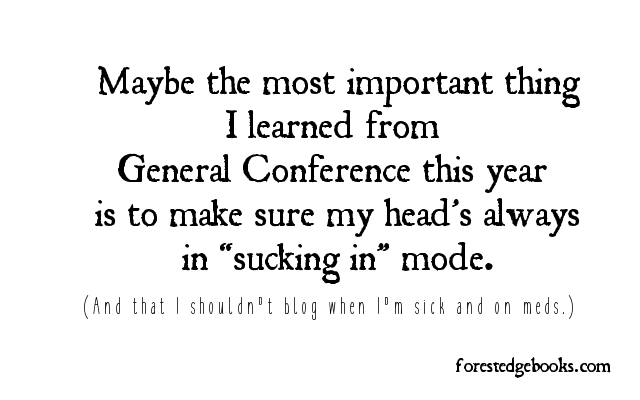
Maybe the most important thing I learned from General Conference this year is to make sure my head’s always in “sucking in” mode. That doesn’t make for a great meme, I know. I tried:

blogging-when-sick

I can’t wait to get better, to escape this oppressive fog, and to once again “suck in” the world more clearly.

(My apologies–no matter how many times I write it, “suck in” just doesn’t sound right, so I’m going to go lay down now . . .)

“She thinks she’s got something relevant from her books for her blog this week?” Mahrree asked Perrin in surprise. “What are we supposed to say?”

He just looked at her with furrowed brows. “What’s DayQuil?”

~Book #nothing, The Writer Needs to Take a Nap