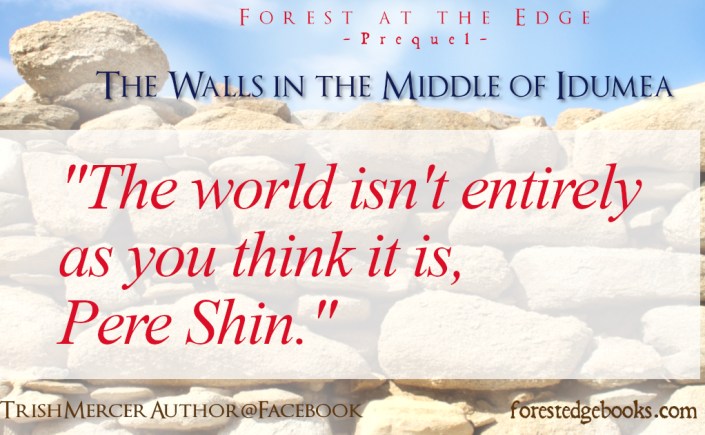
The world isn’t what you think it is, and why should it be?

I feel stupid confessing this, but I was slightly freaked out by Europe. We came back last month from eleven days in Rome and Greece, and while I was prepared for the trip, many silly things deeply worried me.

For example, the electrical outlets–two little holes? And their electricity is “different” than American/Canadian electricity? Isn’t it all the same zippity-zappity stuff that streaks across a stormy sky?

And no ice in drinks, anywhere. And water is served lukewarm, even when it’s 95 degrees outside (Fahrenheit; don’t get me started on trying to convert in my head from Celsius). And the grocery stores had little-to-no selection: only four cereals to choose from? What do these poor people eat for breakfast?! And a lot of roads didn’t have painted lines. The cars and pedestrians just winged it and hoped for the best.

IMG_2069.JPG

How many lanes is this? And yes, there’s soon to be a car going up the other direction.

And you have to pay one euro just to enter a bathroom, and there’s no guarantee there’ll be toilet paper or even soap.

IMG_3390.JPG

I bailed out fellow American women, twice, who danced frantically before these asking, “Wait, what?!”

And our hotel in Rome didn’t even have a sign above it, just a tiny typed piece of paper at a little bell on a stucco wall that we wouldn’t have noticed if the owner hadn’t been waiting for us. And why was he WAITING for us? And shop owners were very aggressive, and taxi drivers were practically shoving us into the back of their cars, despite our exclaiming, “But we have train tickets!” And there was no Dr. Pepper, anywhere, except at an expensive import shop.

IMG_3460

And at two euros each. And of course they’re not cold.

You get the idea.

Naive American traveler, that was me.

64739952_2354559224600330_3400368347462762496_o

Along with the donkeys of Santorini who smelled lovely on a hot, muggy evening.

Of course I’ve chuckled at naive travelers myself. We went to Yellowstone National Park many times when we lived in the west and shook our heads when we overheard people say, “That smell–can’t they do something about the sulfur? Why are there so many bison? They should build a fence to keep them off the roads. Are those really wolves out there, eating something that was alive? Should kids be seeing this? Why won’t they show us where the bears live? I want to pet a bear.”

Each of us has an idea of how the world is, and it’s narrow, distorted, and unrealistic. No two people will see the same sight the same way, but that’s how we learn, how we grow, how we realize that the world is not what we imagined it would be, and how we teach our imagination to become even broader.

And why should the world conform to our naive expectations? I see many entitled people complaining in the news and social media how the world is “disappointing” them in one way or another. This isn’t right, or that isn’t what they expected, and somehow they feel cheated. In this immense planet with unlimited options and glories around every corner, they bizarrely feel ripped off.

Strangely, it doesn’t occur to them that maybe they, with their selfishness and arrogance, are the real disappointment.

The adventure of life is discovering how diverse it is, being startled to realize that it’s not behaving the way we expect it to, and that it’s never going to be precisely as we demand. Often there are no painted lines, no obvious signs, no clear crossings, so just wing and hope for the best. You’ll survive the vast majority of the time, until you don’t. Life it just that simple, and that complicated.

Walls meme horizontalWorld

You can’t manipulate the educated, which is why they don’t want us educated

The entire reason for my attending a class as a grad student was to argue with the professor. She was on one side politically, I was on the other. I respected the woman immensely, but daggum, did she know how to push my buttons every week! It was like she was TRYING to make me angry!

Realizing that I was monopolizing each class by pointing out how she was wrong and debating with her for the next hour,  I shut up after the third meeting. Someone else needed to take her on, but strangely no one did.

She pulled me aside after that class and said, “What are you doing to me?! Look at the other students–they’re terrified and complacent. None of them  will ever make a peep. Don’t you realize that I pick subjects I know will rile you up? Come on! Show the rest of the class how it’s done! It’s you and me carrying this class!” Once I realized she was intentionally setting me up, the class was VERY entertaining. I remember thinking, “This is what universities are supposed to be about: an informed debate of ideas.” We rarely came to a consensus, but always realized just how close we were on so many issues.

That was 25 years ago. Ancient history. The world’s not like that anymore, sadly. Debate is stifled and opposing ideas are quashed in the name of “safety” for our fragile feelings. (

I told my college experience to my high school students this week. We’ve been talking about propaganda and logical fallacies, and I presented the quote from the most famous propagandist, Joseph Goebbels:

“If you tell a lie big enough and keep repeating it, people will eventually come to believe it . . . It thus becomes vitally important . . . to repress dissent, for the truth is the mortal enemy of the lie.”

I was pleased to see that my students were intrigued that people could debate issues and still be friends without agreeing. My professor years ago wrote me glowing letters of recommendation when I graduated, even though we disagreed on nearly everything. We respected each other and I am still grateful to her for making me analyze everything I believed.

But today there’s no more debate, no more respect for different ideas, no more desire to discover knowledge for ourselves. If someone disagrees with us, we cut off all discourse and cry “oppression!”

We’ve stopped thinking and asking and debating, which makes us very vulnerable to those who want to do the thinking for us.  In the end, the elite will repress us. It’s happened too many times before.cant manipulate the educated

Get Book 3, The Mansions of Idumea, downloaded for free.


Quit protesting and start doing; it’s not the government’s job but ours

This week in school I taught about the rescuers during the Holocaust and WWII. (We’re reading a Holocaust memoir and I like to give my students historical context.)

We learned about Irena Sendler, who smuggled out 2,500 babies and children from the Warsaw Ghetto, and about Oskar Schindler whose list preserved the lives of 1,200 Jews.

And about Sir Nicholas Winton, who arranged for 669 children to leave Czechoslovakia for new lives in England as the Nazis closed in on Prague.

And about Gail Halvorsen, the Candy Bomber, who started a movement to bring chocolate and gum to the Germans being starved by the Soviets in Berlin in 1948.

Each of these people did something similar: They saw a problem and they INDIVIDUALLY took action. They realized that–all on their own–they could provide relief.

None of them said, “The government really should . . .” because in most of these cases, it was the government CAUSING the problems.

None of them protested or chanted slogans: they went to work instead. The same thing happen in the Civil Rights movement: yes, there were protests, but there were also many individuals taking action on their own to begin with. For example, Rosa Parks set so much in motion by deciding she was no longer going to give up her bus seat.

Also this week my 11-year-old brought home a national publication teaching elementary students about current events. As I helped her answer the questions, she could feel me bristling when I read, “There are many solutions to the problem. First, the government should . . .” My daughter got a lesson she wasn’t expecting: I spouted off for ten minutes on how the government shouldn’t do anything. It was established to keep America safe–and that was ALL it was established to do–so that everyone else could get to the business of solving each others problems.

But it seems we prefer to have someone force what we want for us, instead of doing the work ourselves.

Governments have NEVER solved problems; only individuals have. So what suffering can you alleviate, what wrong can you right, and what work can you do today? Go!

whose responsibility

Get Book 4 and the rest of the series here.

The purpose of politics: not what we, the people, think.

Ideally, our elected politicians solve the problems WE, THE PEOPLE assign them.

Ideally, politicians are OUR employees, working for OUR communities’ greater good.

Invariably, politicians forget that when they get a little power, and will do whatever serves their futures, not ours. There’s no wound they won’t reopen, no minor issue they won’t distort, and no real problem they won’t ignore to ensure their personal success. 

We need the return of true statesmen, and the departure of politicians. As James Freeman Clark once wrote: “The difference between a politician and a statesman is that a politician thinks about the next election while the statesman think about the next generation.”

politics makes threats

Get Book 4: The Falcon in the Barn, here. (And the rest of the series here.)

“We have learned by sad experience that it is the nature and disposition of almost all [people], as soon as they get a little authority, as they suppose, they will immediately begin to exercise unrighteous dominion.” Doctrine and Covenants 121: 39

You already have the power to balance your corner of the world

With so many in the US calling for “fairness” and for the government to ensure (enforce?) that fairness, we have forgotten that creating equity and caring for the poor is already within our power.

We each can balance the world correctly. In fact, we’re the only ones who can. There’s nothing stopping me or you. Change has always been grassroots. It never works from the top down. If we wait for someone to force us to do what they think is right, then we’ve agreed to a dictatorship.

Then it’s all over, for everyone.

corner of the world fair

Download the entire “Forest at the Edge” book series for less than $4 here.

It’s always been individuals who fixed the world; it’s never been a government

I know of many generous people who quietly go about doing great things for their neighbors. They donate money, they create opportunities, they sacrifice their time, talents, and everything they’ve been blessed with to help others through rough patches, to get job training, to give them a boost up to self-sufficiency.

And they do it anonymously. They choose to live well below their means so that those means can lift those around them. 

I know about these generous people only because they’ve helped us, or because a mutual friend revealed to me the lengths of their care for those around them.

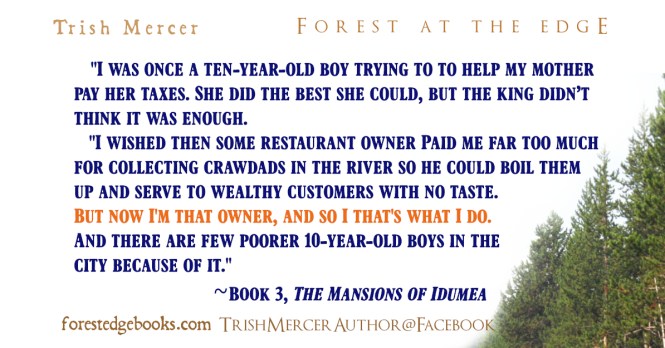
I stand in awe of them, because no one told them or forced them to do it. And that’s why it works. Only individuals can care for each other properly; governments have never got it right.crawdads taxes and help


Download the full series for less than $4 here.

Socialism and the greed of citizens: what happens when they want more?

The biggest problem with socialism that no one seems to be addressing is the insatiability of people who believe they deserve freebies–free income, housing, food, health care, education, etc. The problem is greed knows no bounds. Those who espouse “free everything” are underestimating the selfishness of millions.

And then what happens when the freebies run out, which they always will?

buying loyalty

Download the entire “Forest at the Edge” book series for less than $4 here.

When we stop thinking for ourselves, we’ll be far easier to conquer

Almost every day I want to leave social media, frustrated with the snarl of words and growls of dissension I see every day. But I can’t; I shouldn’t. I need to know what’s happening, how people are reacting, and what new monster is looming on the horizon needing to be addressed.

As much as I’d love to hide in the corner of my closet (and the house I’m in currently has no closets, so that would be quite a feat) I need to know each day what’s going on. It’s the only hope I have to keep my family safe, because the monsters will come, if I notice them or not.people stop thinking


Books? Thinking? Are those “lit”?

[“Lit,” by the way, is the trendy way to say “cool,” or “neato, daddio.” Just typing that last one is totally not “lit”.]

These lines are what I hope none of my students will ever say about my class:

books thinking never saw before

These lines are also why I often read out loud to them, because even though they’re 10th graders, a few kids had never finished a novel until they took my class.

I worry that books and thinking are becoming as old-fashioned as typewriters and rotary phones. We rarely hear about either much anymore, and when we do it’s, “Hey, remember when we used to think about problems and read all we could before we made judgments? Or am I just remembering a time that never really existed? And am I using the word ‘lit’ correctly?”

Get Book 1, The Forest at the Edge of the World right here. It’s totally lit. (Maybe?)


Tight Christmas budget? Buy 8 books for $3.96 which is only…umm (someone help me with the math) pretty darn cheap for books!

So it’s barely December and already my Christmas budget is looking slim. If you’re in the same boat, I’ve got a great deal for you: ALL of my books--THE ENTIRE SERIES OF 8–for only $3.96 for the download. That’s . . . (*she pulls up her calculator on the laptop*) .495 cents per book! (really not sure what to do with that .005 there, and this is why I teach English and not math).


Since I hate coming up with reasons to buy my books, here’s what readers have said after finishing the series:

This series is totally worth your time. I’ve read them through several times now and they are still very interesting, thought provoking, entertaining and enjoyable. Nothing nasty, don’t have to worry about nasty images or language. (I love the comment about “nothing nasty.” Although there is a moment in Book 2 where a very large dog coughs up something that I personally found rather nasty.)

Wow pretty well covers it. “Hope is everything.” The previous seven books all led to this amazing finale . . . It is exciting, thought provoking, insightful, and can be spiritual. One needs to read this with an open mind. (Because sometimes I go waaaay out there. I admit it. It’s fun waaaay out there. Try it!)

It does not fit neatly into a niche category or genre such as: dystopian, science fiction, fantasy, young adult etc. and the whole series is in a class of its own. So sit down, open the book, enjoy the ride , and keep the “hope”.  (I appreciate that they can’t figure out the genre, either. People ask me, “What kind of books do you write?” and I just shrug. I’m not the best promoter of my work.)

  . . . intense moments, heartbreaking moments, glorious moments, and hilarious moments . . . often all within a page or two. Even in this final stretch of the series, the character growth and intricate plot development is phenomenal. It is brutal, magnificent, powerful, and perfect.  (No one’s ever called me brutal before. At least, not to my face. They know better than that. *smacks fist into palm*)

This book has a problem… It’s too hard to put down!😊 I love the characters and love the story line. It’s intense and made me cry and laugh!  (I really hope she cried and laughed at the right places. One never knows.)

So give this super cheap, not nasty, out there, brutal, undefinable, laughing/crying book series to someone you love.

Or hate. I’m not judging.

I won’t tell them how cheaply you got the series if you won’t.