They put me on TV because they think I’m Santa Claus?!

Well, at least the pen of Santa. Or the keyboard . . .

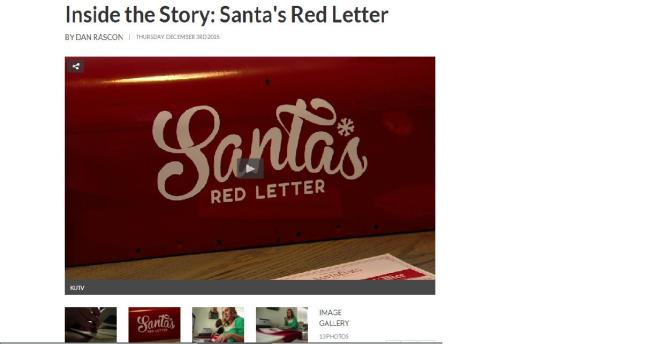
My friends the Stapleys came up with Santa’s Red Letter a few years ago, letting Santa write back to kids (and adults, groups, etc.). Last year they asked me to compose the letter templates customers could choose from, and I wrote them more this year. Here, check it out for yourself by clicking on the image for the TV clip:

Red Letter video

I’ve written before that we personally don’t do Santa at our house, but I agreed to help the Stapleys because of something that’s left out of this piece: for every letter the Stapleys sell and send, they donate $1 to Toys for Tots.

Last year they sold thousands of letters, and this year they’re on track to exceed last year’s total. That means that they’re spending thousands of dollars on Toys for Tots in a couple of weeks, all funded through YOUR Santa Letter requests. 

Craig and Crystal take their five kids with them to find the best and most appealing toys for boys and girls of all ages, then their kids put them in the Toys for Tots boxes and have that memory of giving for rest of their lives.

About us  

That example’s inspired me to take some of the profits from my Etsy shop to do the same thing with our kids in a few weeks–go shopping for Toys for Tots. While my success isn’t nearly as big as the Stapleys, we’re doing much better than we have in years past (as I wrote about in my last blog entry).

So start a new tradition this year–a lot of the Stapleys’ customers are returning ones–add some magic to someone’s year, and help Toys for Tots all at the same time. 

I decided that since the reporter and photographer had taken a lot of pictures of us, we could turn around and do the same thing to them. Here the reporter is talking to Crystal’s mail box. No word on if it answered.

Whew! I’m so glad that TV bit is over. I was sick to my stomach the entire morning before I went over for the interview, then when Crystal told me yesterday it was going to air, I was sick all over again.

My teenage daughter said she could feel my stress radiating from me as I sat in the dining room–the living room was too close to the TV–to watch my very first time on the screen.

It went ok, it went ok, it went ok . . .

This is why I’m not a huge movie star. I can’t take the pressure, no matter how lightly applied.

I’m nothing like confident Mahrree. I tried her routine below, but it didn’t work. I just wanted to vomit instead.

Mahrree went through her pre-debate routine: she stood back up, shook out her hands, rubbed her cheeks with her fingers, tucked her hair behind her ears again, smoothed down her skirt, and waited for the rector to introduce her. When she heard her name called she marched confidently up the steps and on to the platform, to the applause of the crowd. She waved genially to them as she had dozens of times before and waited for the next introduction. ~Book One, The Forest at the Edge of the World

Thanks, Etsy shoppers, for my inability to sleep!

Last year we were dragging ourselves out of a financial mess. After many months of being severely underemployed, our situation was slowing improving with new jobs. But we didn’t yet have any funds for Christmas. I wondered if I could generate a few dollars to provide Christmas for our family of eleven—nine children, plus an in-law and a grandchild. We’ve never spent a lot at Christmas—about $50 a person—but our budget by October was literally nothing. (Writing novels and giving them away for free doesn’t produce much income; go figure.)

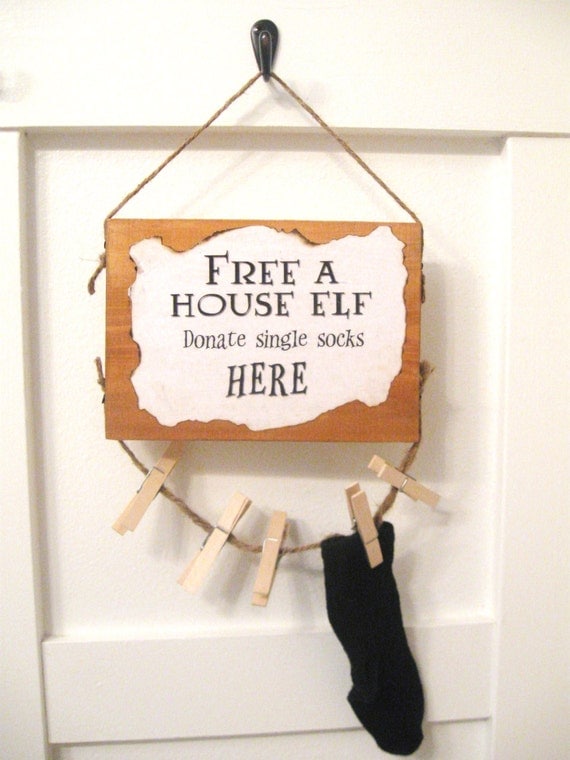
I’ve always been crafty, had read about successes on Etsy, and wondered if I any success could be mine. So after several prototypes and a few failures, I came up with this:

House Elf (Dobby) Laundry Room Sign--A fun place to store those single socks

I liked it, wanted one, and hoped maybe someone else would, too. Nervously I put it up for sale.

About a week later someone bravely took a chance on my new shop and . . .

 . . . bought one!

In my head I thought, “That’s enough profit to buy one paperback for a child!”
Then another one sold.
“I can buy a used DVD!”
Then another, and another.
“A handful of matchbox cars! A Minion t-shirt!”

And then the avalanche hit, mid-November. One week, the payment that went into my bank account on Monday was in the triple digits—over $100.

I was ecstatic. And stunned. And overwhelmed. I needed to get cutting more wood and painting and packaging, quick! Get the kids to help—it’s their Christmas we’re buying, after all.

The avalanche grew, and by the second week of December I realized something astonishing: we had earned enough to have a regular Christmas.

I was both humbled and thrilled. My faith in the free market system was also restored as I realized that people all over America were buying my little sock holder, and giving my family a Christmas.

My oldest daughter, whose birthday was in December, said, “Mom, years ago you tried making a Harry Potter/Mrs. Weasly clock. I think you should try it again. I really want one for my birthday.”

I hesitated. What I had made as prototypes were beautiful, but since there were out of solid wood they were heavy, bulky, and ridiculously expensive.

“So try something else,” my daughter was persistent. (Oldest children tend to be the naggiest.) “See what’s out there now. I really want a Harry Potter clock for my apartment.”

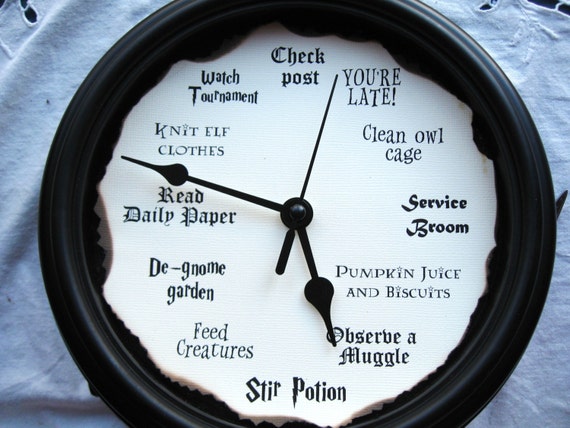
My husband and I searched all the hobby stores looking for ideas, but nothing that was reasonably priced. Finally I decided to try a trick I’d done years ago for Mother’s Day gifts: I purchased a clock, dismantled it, made a new face, and reassembled it again. I showed the prototype to my daughter who said, “Very good. Now start selling these on Etsy.”

Harry Potter Clock, 8.75 inches

Why would anyone want this? I mean, I loved, loved coming up with the fonts, designing the face, creating the sayings, but would anyone want it?

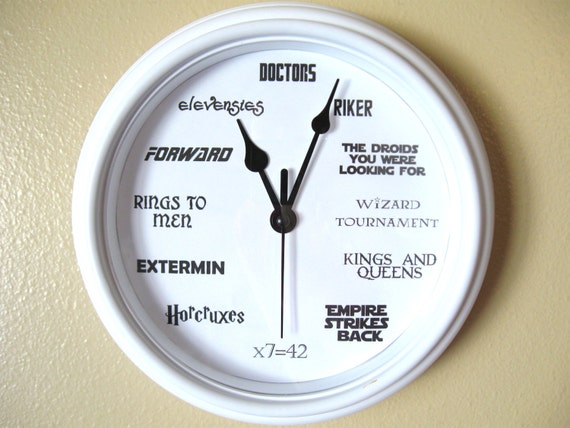
I also made the Geek/Nerd clock for fun. For years I’d thought such a clock needed to exist, so I designed it and listed it just in case.

Geek Nerd Clock, 8.75 inches

I got an order here, another one there. But it was January, and things were normally slow. I ran into shipping problems, packaging problems, other worries, and stressed about my ability to make something consistently good enough. I almost, almost pulled the clocks from Etsy.

Why was I so arrogant as to assume someone would find my tinkering worth $21?

Someone was, in Australia. Would I ship a Harry Potter clock internationally? Uh, I guess I could . . . and I realized that international shipping wasn’t that tough.

I also hadn’t understood before the power of websites like Buzzfeed and ThinkGeek and other sites that stroll around the web looking for something mildly interesting, then posting about it.

Someone thought my Harry Potter clock was mildly interesting, put it on a piece about decorating with Harry Potter decor, and within one day I was sold out. An avalanche of orders and requests came, half of them internationally. Gee, people still love Harry Potter as much as we did?

The next month that happened again, with my Geek/Nerd clocks. Several websites picked those up, and in one day I had over 50 requests for those clocks. And the next day, and the next. Every time I opened my email I cringed in worry about how many more requests there would be. It took me three weeks to catch up to the demand. I’d never been afraid of my email before.

etsyshop header

(I realize the name of the shop isn’t too representative of what I sell. I initially was going to sell something completely different, for which the name made sense, but that didn’t pan out. With no idea of what else to name my shop, and not thinking I’d sell more than 30 items, I just kept the old name. In a way, it works. At least, that’s what I tell myself.)

Overwhelmed, I stared at my Etsy stats as they reached numbers I’d never seen before. And when a weekly payments went into my bank account that month sporting four figures, I could do nothing but stare at it.

The timing (ha!) was perfect. We had some major financial needs to fill, and the sales—and my working about 40 hours a week to make all of the products—filled it.

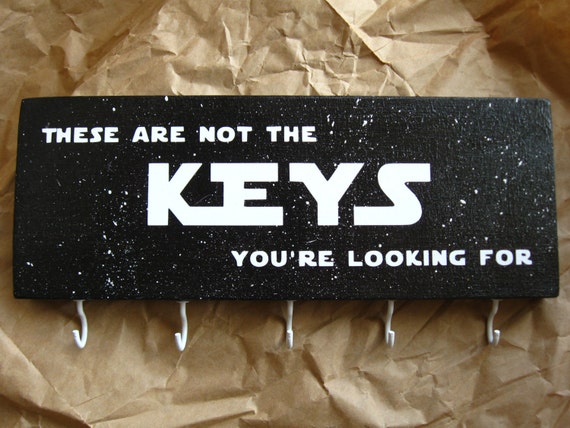
Then another website posted about my sock signs, and someone found out I made Star Wars key signs. More avalanches.

Star Wars key holder

By June my sales had leveled off, but I realized I could quit my part-time job and work from home, never leaving the house to earn money, but always being available for my kids. Another welcomed, wonderful miracle. Etsy buyers were consistently paying for our groceries each month. And for a family of eight, that’s a few dollars. I’ve added a Disc World clock (my personal favorite), a Lord of the Rings clock, a Disney Princess activity clock, and two Star Wars clocks–Light Side and Dark Side, whatever your preference may be.

Have I ever mentioned before that we’re a bit geeky at our house?

Now, a little over a year since I started, I’m once again overwhelmed—happily—with orders for Christmas. There’s no time to work on my books, or keep my blog updated (except for this). Our Christmas is already paid for this year, and now we’re hoping to pay for someone else’s. This bounty is also letting me donate $1 from every DiscWorld/Terry Pratchett clock I sell to the Alzheimer’s Association, and much of our proceeds from last week and this week will be donated to help the Syrian refugees via the LDS Church’s humanitarian organization.

002

It’s tough to be three years old and see giant rolls of bubble wrap in your mom’s room, just waiting to be used. Even tougher when you sneak in her room and start popping the rolls when you think she can’t see you. Amazing how she still hears it, though . . .

A year ago, I never would have suspected I’d sell over one thousand products, a number I hit a week or so ago. I realize that for a lot of Etsy sellers that’s not a big number. But I’m not used to success. This feels huge! I’ve sold to every state in the union, and sent orders to a dozen other countries. My kids enjoy seeing the places where our little ditties fly off to.

But there are some disadvantages to working from home. Try this: go to your place of work or business, get your pillow and blanket, then have a good night’s sleep there.

Yeah, not too easy, is it? My storage and packaging room is also my bedroom. We have a small house and a large family, and while we’re down to only 5/6 kids (depending who’s home from college/army), every room is filled with kids, so my bedroom is also where I keep my orders chart, my shipping boxes, etc. When I lay down at night, I stare at the shelves crammed with work that needs to go out in the morning. Not the most restful.

Nor can I get away from it. When you work out of the house, you can leave your job and relax at home. But even as I sit here happily typing away and “relaxing”, I see out of the corner of my eye the stack of shipping labels that will be taped to packages tomorrow, and while I never work on Sundays (I desperately need a day of rest and renewal) my job sits there, watching me, waiting for early Monday morning . . .

But that’s ok—I don’t mind. I’m fine losing a bit of sleep because of success.
It’s a lot tougher to lose sleep because of failures.
I’ve been down that road.
This one’s a lot better. Thank you for this sleepless journey!

A thought as we enter the Christmas season . . .

As Christmas approaches, we’ll be inundated with ways we can spend our few dollars.

For some reason this year, my heart is particularly tender as I see how many people in the world–nearby and half-way around it–are suffering. I’m reminded of these attitudes, and I pray that I’ll maintain the correct one:

god and tragedies


Do writers have agendas? Well, duh . . .

Recently I was accused of having “an agenda” in my books.

My very mature response to that was, “Well, DUH!”

Writers ALWAYS write with an agenda—a purpose. It’s WHY we write!

If you ever took a composition course in college, the first chapter in the textbook is all about “Writing With Purpose.” If you hated your English 1010 course, it was because you didn’t care; you didn’t want to write, you just wanted a grade.

But writers? We care. A LOT. That’s why we write. We don’t care about a grade; we care about getting out the word.

So when I was accused of having “an agenda,” I scratched my head a bit and thought, “Well, yeah!”

Doesn’t everyone?

Suzanne Collins didn’t crank The Hunger Games during a weekend because she was bored.
J.K. Rolling didn’t handwrite the Harry Potter series only because she was out of work and had nothing better to do.
E. L. James didn’t write 50 Shades of Grey because . . . You know, I really don’t want to go there. Scratch that.

My point is, EVERYONE who writes, creates, composes, produces, directs, sings—whatever, EVERYONE has an agenda. Creating art—especially a book series—takes months, but more likely years. We don’t do it because it’s only for fun. We do it because we want to make A STATEMENT.

Subtle or obvious; outrageous or timid; traditional or unconventional. I don’t care what writers or artists may say, we ALL have an agenda behind our work, which is the impetus that shoves us to create. writer agenda

You may not like certain entertainment because that “agenda” or “statement” doesn’t fit your mindset. I personally don’t like horror movies, hard rock music, or romance novels. None of them fit my mindset. But that doesn’t mean they’re wrong. They’re just not my cup of cocoa (because I don’t like tea, either).

Which leads to the next puzzler about my critic: they didn’t like my “agenda” for one of my characters. This character is a young woman who rejects an overbearing potential suitor in order to spend time with a young man she admires. They work together, they  fall in love, and they get married. They continue to work side-by-side in their business, and are thrilled when they discover they are expecting a baby.

Yeah, brutal stuff.

The critic stated that this wasn’t something they’d want their daughter to read.

Uh-huh.

Still scratching my head about that one.

For the world these characters inhabit, their behavior is completely acceptable and timely. [WARNING–POTENTIAL SPOILERS AHEAD!] If my agenda-fearing-complainer is worried that the characters are young, the character’s parents were 28 years old when they married. It’s all balanced.

  • But maybe it’s because the young woman is still a teenager, but a very mature one who cares nothing about the world’s trends and fashions, but has been through hardship, knows her mind, and demonstrates that quite well.  (How many teenage girls in our world fit this description? Not enough, yet.)
  • Maybe it’s because her belief in the Creator, and her devotion to The Writings, help her deal with the disappointments she’s experienced. (God? Scriptures? In a novel? Isn’t that illegal or something?)
  • Maybe it’s because she, with her love interest, runs a farm and dairy which, again in the culture of the book, is a respectable and important job.  (I kind of thought growing food was a noble occupation in our world as well, but maybe not?)
  • Maybe it’s because the idea of having children makes her happy, because in the book’s culture women are allowed only two children and they are treasured. (Believe it or not, there are still people in our world who want to have babies, and nothing’s “wrong” with them.)

Really, all of THIS is “an agenda”?

Love and marriage and family and religion and working together are all somehow . . . wrong?

Well then, yes: I have an agenda. As I’ve stated before (especially here), I believe in love.
I believe in marriage between a man and a woman.
I believe in growing together as a family, in having children, in working and learning together.
I believe all these things are good and important, and I’m not going to apologize or back down.

Instead, I sit here shaking my head in astonishment that the world has gotten to a point that I have to defend such a radical way of life. And I always will, trust me.

In the meantime, here’s an abbreviated passage from late in Book 4, The Falcon in the Barn, which was likely deemed so offensive. (I’ve tried to eliminate spoilers, leaving instead only “hinters”.)

“I guess I’m just surprised,” Mahrree murmured as another two women whose children she used to teach took a circular route around her. “This has always been such a nice village—”

“A nice village?!” Jaytsy nearly wailed.

A dozen people trying to get around them moved even faster.

Mahrree stared at her daughter in surprise.

“A nice village!” Jaytsy announced sarcastically, glaring at a few more dozen who stopped in their tracks to see what Shin was erupting this time.

“That’s what my mother just declared: Edge has always been such a nice village. And I wonder,” Jaytsy said, her voice booming as far as her father’s as she addressed everyone who had ears, “exactly what village is Mahrree Shin remembering?”

People leaked out of market fronts to cluster in whispering groups.

Now Mahrree knew how her family must have felt when she stood up at the amphitheater: complete dread.

“Jaytsy, I really don’t think—”

Mrs. Briter gently but firmly brushed her mother’s hand away. “Surely Mahrree Shin remembers this village before it turned on itself to steal goods from those who died from the pox! Surely she remembers a village that appreciated its commander—”

Mahrree bit her lower lip and took a step back from her daughter. She’d seen that look before, in Perrin’s face. Jaytsy Shin Briter had something to say, and everyone was going to hear it.

Mahrree hadn’t realized before how much Jaytsy favored Perrin. Her dark brown eyes were wide with fury and her voice developed an authoritative quality that insisted everyone stop what they were doing and listen. Jaytsy carried the blood of the greatest officers the world had ever seen. Couple that with the fact that the generals’ descendant was also in the throes of expecting a baby, and it was a very dangerous combination indeed.

Mahrree took another protective step back. “Oh, dear . . .”

“—A commander who, on more occasions than you will ever know, put his life on the line to defend each one of you!” Jaytsy bellowed to the rapt and growing audience.

A few women broke away from the crowd and trotted purposefully down an alley.

Mahrree noticed, but Jaytsy didn’t, or she didn’t care.

“And this is how you repay the Shins for their years of sacrifice and dedication? By ignoring them? . . . A nice village? I’m looking but I’m just   . . . not . . . seeing . . . it!

Mahrree’s fists were clutched near her face in nervous fascination. . . . [As Jaytsy continued her rant, Mahrree kept] an eye on the growing crowd that was stunned silent. Villagers had subtly rearranged themselves, men in some groups, women in others. A few more women had slinked away and now Mahrree saw why: Chief Barnie was being reluctantly led to the market by a gaggle of outraged women. . . .

“Jaytsy, well said,” Mahrree hinted. “I think you’re done—”

Mrs. Briter’s chest heaved furiously as she turned her glare on Chief Barnie. Two women were pushing him into the open space, and his stuttering steps made it obvious he would rather have been anywhere else in the world right then.

“Mrs. Briter?” He cleared his throat and firmed his stance.

Jaytsy folded her arms defiantly in a Perrin-like manner, and Mahrree massaged her cheeks. If she weren’t so worried as to what might happen next she would’ve been bursting with pride.

“Yes?” Jaytsy said with so much malice that Mahrree marveled how Barnie still stood erect.

“Do we have a problem?” Barnie timidly asked.

“She’s debating!” a woman shouted from the concealing safety of the crowd. “There’s laws against that!”

Mahrree watched her daughter, praying her response would be appropriate.

Jaytsy’s hands moved to her hips. “A debate?” she shouted. “Barnie, do you see anyone challenging me? Talking back?”

The crowd couldn’t get any flatter as Barnie obediently glanced around. He shook his head.

“That’s right. Two people are needed for a debate. I’m just . . . delivering a free history lesson!”

That did it. Mahrree couldn’t hold it in anymore. She burst into a grin which she quickly covered with her hand.

None of the villagers dared move a muscle. Even the angry knot of women glanced at each other hoping one of them could think of what to say next.

“Now,” Jaytsy began as she bent down to pick up her bread bag from the ground. She didn’t move like an expecting woman but more like a general retrieving his dropped sword. “My mother and I will be shopping here twice a week when the shops open, and if anyone here has a problem with that, I suggest you arrive after we leave. Mother? We need to start dinner.”

DISCLAIMER~ This very offensive, agenda-laden excerpt is from Book 4, The Falcon in the Barn. Read at your own risk.

We adults have ruined the world for our kids

Once again someone has sent me a trite old email about “How great things were in the past!” and “How awful things are today!”

Surely you’ve seen these before, the less-than-subtle comparison that when we were kids we knew how to be kids, unlike kids today who are pathetic pansies.

However, there are two major problems with such grossly inaccurate nostalgia trips: 

1) Life was never as good as we remember it, and;

2) If we don’t like the way life is for our kids, we—their parents and grandparents—are to blame.

First, let’s look objectively to some of the ridiculous claims about how we “survived” and are somehow inherently “better” than the younger generation.  Many pieces like this one detailed below float around, but since this is the most comprehensive, we’ll use it to demonstrate the selective memory problems so many in the older generations suffer from. This one is called:

TO ALL THE KIDS WHO SURVIVED
The 1930’s 40’s, 50’s, 60’s and 70’s

(From: http://www.corsinet.com/braincandy/hage5.html)

First, we survived being born to mothers who smoked and/or drank while they carried us. So there’s no problem with mothers smoking and drinking during pregnancy? Or are you willing to admit that no, not everyone emerged as “good” as you?

They took aspirin, ate blue cheese dressing, tuna from a can, and didn’t get tested for diabetes. And they also had a lot more problems during childbirth as a result. But you don’t remember your birth, so obviously this detail doesn’t matter.

Then after that trauma, our baby cribs were covered with bright colored lead-based paints. Lead-based paint causes problems in mental acuity, which the author of this piece of propaganda demonstrates all too well.

We had no childproof lids on medicine bottles, doors or cabinets and when we rode our bikes, we had no helmets, not to mention, the risks we took hitchhiking. And the author also doesn’t remember that children died from poisonings at higher rates than they do now, and that many children suffered from brain damage or worse when they crashed on their bikes. There were consequences. Although brain damage causes us to forget . . . 

As children, we would ride in cars with no seat belts or air bags. And the families who died in car accidents back then aren’t around to explain how seat belts and air bags would have saved their lives.  

Riding in the back of a pick up on a warm day was always a special treat. Stupid, but special. Again, loss of memory=brain damage. (Or marijuana use. Go ahead–ask Grandpa about the drug culture of the 60s and 70s.)

We drank water from the garden hose and NOT from a bottle. So why don’t you let your grandkids drink from the hose?

We shared one soft drink with four friends, from one bottle and NO ONE actually died from this. No one dies now, either. It’s usually kids’ parents and grandparents who freak out about them sharing. 

We ate cupcakes, white bread and real butter and drank soda pop with sugar in it, but we weren’t overweight because WE WERE ALWAYS OUTSIDE PLAYING! But an enormous amount of the adult population is overweight now, because you never outgrew drinking soda and eating sugar. Type 2 diabetes, anyone? Everyone?

We would leave home in the morning and play all day, as long as we were back when the streetlights came on. So why did you create a society where your kids and grandkids can’t have such freedom? Why do you call social services when you see kids walking by themselves to a nearby park?

No one was able to reach us all day. And we were O.K. It’s not kids who buy cell phones to carry around; it’s their parents.

We would spend hours building our go-carts out of scraps and then ride down the hill, only to find out we forgot the brakes. After running into the bushes a few times, we learned to solve the problem. But when your kids/grandkids ask to use supplies in the shed, you yell at them to not make a mess, not make any noise, and go to their rooms and be quiet. So they turn to their games . . .

We did not have Playstations, Nintendo’s, X-boxes, no video games at all, no 99 channels on cable, no video tape movies, no surround sound, no cell phones, no personal computers, no Internet or Internet chat rooms……….WE HAD FRIENDS and we went outside and found them! So why do you now yell at the neighbor kids when they’re outside running around and making noise? Why do you call their parents and threaten to sic the cops on them for accidentally running across your lawn?

We fell out of trees, got cut, broke bones and teeth and there were no lawsuits from these accidents. Kids don’t file lawsuits; their parents file lawsuits. Why are you doing this now?

We ate worms and mud pies made from dirt, and the worms did not live in us forever. So why do you not let your own kids/grandkids explore this way?

We were given BB guns for our 10th birthdays, made up games with sticks and tennis balls and although we were told it would happen, we did not put out very many eyes. Kids don’t call the cops on other kids with BB guns. Adults do that. Why did you change?

We rode bikes or walked to a friend’s house and knocked on the door or rang the bell, or just walked in and talked to them! So stop accompanying your children, or telling them to use a phone, or tell them that you don’t want them out on their own.  

Little League had tryouts and not everyone made the team. Those who didn’t had to learn to deal with disappointment. Imagine that!! So now that you’re coaching these teams and have put your kids in these sports, why have you changed the rules?  

The idea of a parent bailing us out if we broke the law was unheard of. They actually sided with the law! So why don’t you respect the law anymore, and defend your precious “innocent” babies instead?

This generation has produced some of the best risk-takers, problem solvers and inventors ever! And has also produced adults that over-parent their children and limit their development. Why is that?

The past 50 years have been an explosion of innovation and new ideas. Surely you don’t think YOU’VE accomplished all of that, do you? Millions take credit for the work of just a few thousand. 

We had freedom, failure, success and responsibility, and we learned HOW TO DEAL WITH IT ALL! And yet you’re afraid to let your children and grandchildren have that same experience?

You might want to share this with others who have had the luck to grow up as kids, before the lawyers and the government regulated our lives for our own good. Ah, I see! Individuals don’t have any responsibility—it’s all the lawyers government’s fault!? You just claimed earlier to have “responsibility,” but only when it’s convenient? No, I’m sorry. You can’t pin all of these changes on the government. And how many of you are lawyers? We all have to take responsibility for how our children turn out.

And while you are at it, forward it to your kids so they will know how brave their parents were. And just how dramatically they changed the world you now live in. Yes, your parents and grandparents destroyed everything when they became grownups. Remember that when you choose their nursing home.

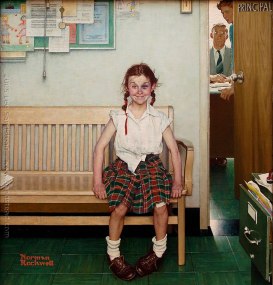
How many of us have naively imagined Thanksgiving looking like this? How often have we actually achieved it? Everyone smiling? Yeah, me too.

The problem is the “good ole days” never really existed. Even in the 1950s—a classical age many of our older generations hark back to—we knew this.

Morris Wright in 1957, wrote this about the beloved Norman Rockwell paintings that I’ve used in this blog:

“We might say that Mr. Rockwell’s special triumph is in the conviction his countrymen share that the mythical world he evokes actually exists. This cloudland of nostalgia seems to loom higher and higher on the horizon . . . and disappears from view . . . leaving the drab world of common place facts and sensations behind.” [emphasis added] (Approaching Zion, Hugh Nibley (1989), page 523. )

Here’s another plug for “Those were the good ole days” that never were.  https://www.facebook.com/1035wimz/photos/a.180388971978038.49555.121975634486039/871131596237102/?type=1

And another that touts many poor decisions as “ok” and “Hey, we survived.” However, I appreciate that she prefaced her list with this:

Now, as a parent myself, my own parents like to tell me I’m too overprotective.
“Really?”
“Well, you survived,” they say.
“Yep, but it seems like the odds were against me.” http://thestir.cafemom.com/big_kid/165499/21_Things_80s_Kids_Did

Another “We had it so tough but we also had it so great, so we’ll just ignore all the other bits.” https://amyunjaded.files.wordpress.com/2012/03/70s-80s.jpg

This one’s more balanced, with an interesting comparison of a few decades ago with today. There are advantages and disadvantages to both times, and let’s remember that. http://preventdisease.com/news/15/020515_10-Differences-Child-Grew-Up-70s-Compared-To-Today.shtml

Check out this video by Nature Valley Granola, and ask yourself: who bought all the gadgets for their kids and grandkids? Who’s responsible for teaching them how to really play outside? It seems that some adults are realizing that hey—all of this is our fault. And we’re also the solution. https://www.youtube.com/watch?v=is5W6GxAI3c

The next time someone older than 30 (yes, don’t trust anyone over 30!) sends you a nostalgic turn of the belly via email or social media, challenge them with this: Prove that life really was better “back then.” And don’t let them use only their hazy and selective memories. Make them use real data. 

Don’t worry. They won’t. They can’t. They’re still not sure what “Google it” means.

In many ways our society is far better than it ever was. Yes, we have huge and glaring problems—I rant about those enough, so I won’t do so here—but we’ve also done a few things right. For example:

We’re far more compassionate.

  • Many decades ago a relative of mine committed suicide. His grieving family was shunned, and even a basic burial was denied him. Today, we’re far more helpful to those suffering from mental illness, and we open our arms to love those left behind when someone loses the fight.
  • To those of various religions. Only fifty years ago this was a very Protestant country. Catholics and Jews were commonly snubbed. Ask your grandma about the fear of a Catholic John F. Kennedy running for president. Although we still have far to go, we tolerate others’ beliefs far better than we ever have. Mormons like me haven’t been run out of a state since the 19th century.

We’re far more accepting. 

  • Of different races. Seriously, we are. Ask anyone who grew up in the south in the 1940s and 1950s. Ask them what they remember about where the blacks and whites lived, and where they got drinks of water, and where they worshipped. We’ve made HUGE strides. The problems we have now are frequently manufactured and piddly in comparison.
  • Of homosexuals. The closet door has been open for a long time now.
  • Of different lifestyles. Just a decade ago anyone who was a vegetarian was snickered at. Now, a lot more people are looking to eat healthier, smarter, cleaner. “Alternative” is becoming “mainstream.” We’re less worried about “fitting in,” which is marvelous progress.

We’re far better about acknowledging and fixing problems.

  • Not so long ago, alcoholism was ignored. It was a condition whispered about, but rarely helped. Just ignore it and the problems will go away, was the shallow hope.
  • Oh, and advertisements used to feature doctors, babies, and even Santa to sell cigarettes. Admirable, very admirable.
  • Abuse in the home was also another “Don’t talk about” issue. Kids would come to school bruised and battered, wives (or worse, husbands) would have black eyes from “accidents,” and it was very rare that anyone ever stepped in to help.
  • Same with sexual abuse. We tend to think that’s a recent problem, but it’s not. Kids who were sexually abused in the 1970s were told to just “forget about it,” and their parents would as well. Employ the trusty, “Ignore it, and it’ll go away,” like that giant elephant in the living room which grows bigger and stinks more horrendously every day.

We’re far better at talking. 

About all those issues above, and many, many more. Some senior citizens think we talk too much—they derisively call it “gossip”—but frankly, I wouldn’t want to live in any other generation. Yes, we’ve got problems far worse than many of our ancestors faced, but we also are tackling them in ways they never dared.

“But the older generation, with its propensity to remember everything far better than it ever was, will be a harder sell.”  ~Chairman Nicko Mal, Book 3, The Mansions of Idumea

I nearly gave up because of half an ounce.

“Half an ounce?! No!!!”

I’m normally an up-beat person. My mantra over the past 15 years has been, “I will make this work!” It’s become a challenge to take whatever fragments I’ve been given and put them together into something I really didn’t think would function, but does.

But every once in a while too many of those fragments pile up. For some reason, it’s the little things that get me down, not the big ones.

etsy business card

My business card. Just print, cut out, stick in your wallet.

I have an Etsy shop, and because various websites have highlighted my Harry Potter clock and sock sign, and my Geek/Nerd clock, I’ve been successful enough to quit my part-time job. Now I stay home making products, devoting more time to homeschooling, cooking healthier, ghostwriting a biography on the side, and—oh, yes—editing book 5.

Several times a week I bring my labeled packages to my local post office, but last weekend the postal worker said, “Hold on a moment. We recently noticed a problem.” She put my package on the scale and it read one pound and barely half an ounce. “You’re just a tiny bit over. Anything over one pound puts your packages in the next price range.”

I was stunned. “But they’ve always weighed just under a pound!”

007

The digits of doom and despair . . .

She shrugged in sympathy. “Something’s changed, though. You’d be amazed how little things can add up.” She suggested I rework my shipping, and I went home worried and embarrassed. Had I been cheating the US postal service lately with packages suddenly too heavy?

And that’s when the spiral hit. Maybe you never do this, but a perfect storm of scenarios can make me sink rapidly. My despair spin looked like this:

  1. I’m done for.
  2. Because the packages are too heavy,
  3. my shipping charges will skyrocket, and,
  4. my profits will be cut dramatically, so
  5. I won’t make the money we need for the bills, and
  6. I’ll have to get another job again,
  7. because I’ll have to shut down my Etsy shop!

Those seven steps took me all of about 20 seconds.
It was just one of those days, when the weight of a tiny pebble hit me like a boulder.  By the time I got home four minutes later, I was utterly dejected. Having little hope, still I borrowed a scale from a neighbor (I have since bought my own) and, remembering my mantra, mumbled, “I’ll make this work.”

I came up with that phrase 15 years ago when we had our sixth baby and a foreclosure notice. Several months of little to no work meant we could no longer afford the house we thought we’d live in for the rest of our lives. No matter what we tried, we failed at. It felt like God didn’t want us to succeed, at least not there.

In desperation, I agreed to follow my husband who thought we should move to the other side of the country and try a different kind of life. We packed up whatever would fit in a U-haul truck, my little children said good-bye to their friends, we gave away some of our pets, said farewell to all of my family, and, with only a few dollars and a humble job awaiting us, we trekked to the east coast and moved in with his family who could offer us three bedrooms for our clan of eight.

Struggling with post-partum depression (my baby wasn’t yet two months old), financial disaster, and living in a state I didn’t know and with zero friends for our family, I miserably decided, “Somehow I have to make this work.”

And so for the next few months we tried. Because we were in a suburb of Washington DC, I took my kids as often as I could to the Mall and the museums, and tried to find ways to enjoy our new environment. But it was tough. Housing was impossibly expensive which meant we couldn’t find a place of our own, my husband’s commute was over an hour, and there wasn’t a mountain to be seen anywhere. But still I kept thinking, “I have to make this work. God sent us here for a reason, so I have to make this work.”

After a few months my husband was offered another job in a much cheaper area. He moved into the heart of Virginia, and five months later we were able to join him. That was possible because someone miraculously bought our former home the day before it was to be auctioned off. That same week an old house became available for us to rent, across the street from my husband’s work.

Commute time, one minute by foot.

virginia house

Our rental house in Buena Vista, VA. We were the last occupants of this magnificent home.

There were some catches, though. The house was officially condemned, to be torn down in a few months to make way for new construction. But until then, the owners agreed to let us live with mice in the attic, skunks in the crawl space, roaches in the kitchen, and vines growing through the siding into the house. When it rained, we set up buckets to catch the water. But, at $350/month, I knew we “had to make this work.”

And we did. I was so happy to be together as a family again, and in the dingiest house I’d ever lived in.

Miraculously, another five months later we moved into a brand new house which we loved for five years, and when we sold it we were miraculously able to pay off the debt we still carried from the old house we had lost.

Those were heavy weights to wield, but we made them work.

So why, several years later, did I freak out over less than an ounce of weight?

Sometimes the smallest things feel insurmountable, like the brick in my path which makes me fall to my knees and weep. But strangely, if someone were to throw a brick wall in front of me, I’d rub my hands together and say, “I’m gonna tear down that wall!”

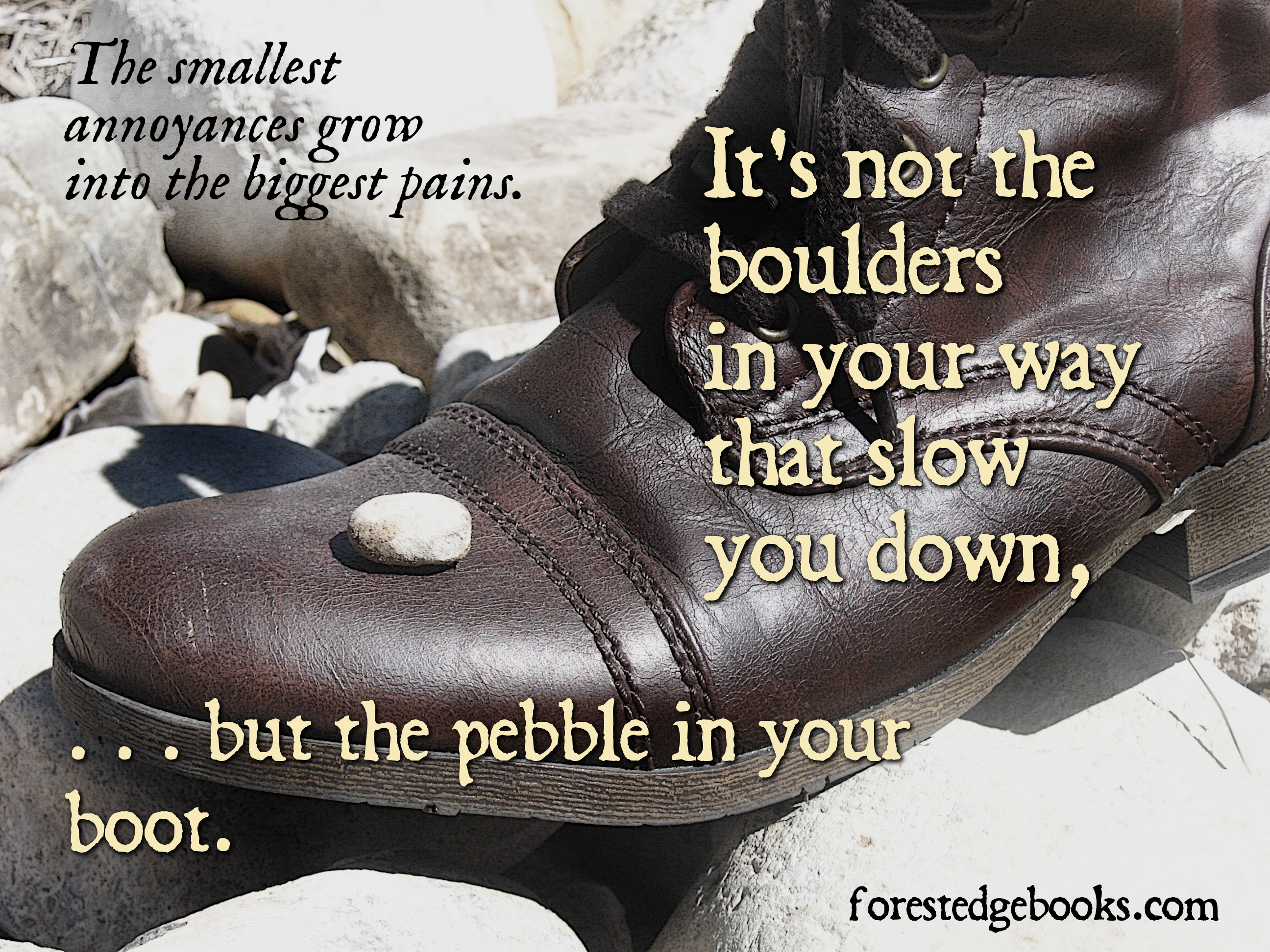
Maybe it’s the niggling smallness of it, the constant tiny bits that just wear us down. A pebble in a shoe bumping against the toes is much more annoying than a rock one has to climb over. Day after day after day, it’s the little things that just get to you. pebble and boot

I had a few dozen of those niggling issues last weekend, so hearing that I had “a weight problem” pushed me ridiculously to tears. “I don’t know how I’ll ever fix this! It’s all over!”

But still I worked it, because I just can’t bear to quit. I bought new packing supplies and weighed all of my products (identical items had different weights!) but still couldn’t find the problem. Aggravated, I thought, Fine! I quit! Which I really didn’t mean, but the words came clearly to my mind, “You’re going to quit over half an ounce? That’s not like you.”

No, it wasn’t like me, but I was being petty and indulging in a little pity party. I’d been working on major projects for other people, and hadn’t had time to spend on my own work. (Not regularly visiting Edge leaves me edgy.)

My next thought was, “You’re treating this like a ton, but you know it’s only half an ounce. You can beat half an ounce.”

Yes, losing our house and moving 2,000 miles away—that was a ton.

So was moving back west, which we did when our 8th baby was just four weeks old, and I drove our 15-passenger van all the way from South Carolina to Idaho in four days, and the U-haul my husband drove broke down every single day.

IMG_0728

The fuel gauge was also broken (along with the braking system), and this is where the truck stopped one day, out of fuel. Yes, just that close to the gas pump.

We’ve also again faced the crushing weight of under-employment, and the medium bone-breaking weight of medical bills, of debt, and of major appliances dying.

But here’s the weird thing: as I look back on those problems that fairly crushed or merely bruised me, I see that weight as only a few hundred pounds: difficult, but not impossible. We made it work! No big deal!

My perception has changed not just because of hindsight, but because we didn’t carry that weight alone.

Fifteen years ago I began to finally learn what Christ meant when he said “Take my yoke upon you, and learn of me; . . . For my yoke is easy, and my burden is light.” One day, about two months after we had moved to the east coast, I was so discouraged by our plight that I finally said out loud, “Dear Father, we moved, but we’re still in a mess. We can’t have a home of our own, my kids can’t find friends, and I really hate so many trees that make it impossible to see where I’m going! I give up. What do you want me to do?”

The moment that I said, “I give up,” something clicked. What I was “giving up” was having things my own way, and insisting upon my will.

That day I gave up all my expectations of what I thought my life should be, and I handed it all over to God.

Things began to change. I found myself praying for ways we could serve others, and a few problems quickly arose where all of us needed to help. While we were focused on helping others, we were much more satisfied with our situation.

Since that miserable-yet-important year, I’ve discovered that we can get by on much less than we expected. For example, our family of 10 once lived in another rental house for four months without a couch. We survived with three camp chairs in the living room and a few blankets on the throw rug which covered a wooden floor. It was far from comfortable, but we made it work.

I have to remember those days when the weight wasn’t as terrible as I thought. I especially needed to remember that last weekend when, after several hours of experimenting, I stared dumbfounded at my clocks and wondered how I could reduce packaging without increasing risk of breakage.

I kept reminding myself, “It’s only half an ounce. How dare I give up over half an ounce!” I felt like that scene in “Apollo 13” where they try various configurations to start-up part of the spacecraft without it going over a certain voltage, but they failed again and again.

Finally I headed into my bathroom to brush my teeth (somehow that always clears my mind) and as I did so I prayed, “Dear Father, this may sound silly, but I’m so frustrated. Why are my packages overweight now? How can I fix this?”

As I reached for my toothbrush the thought came clearly, “The boxes are overweight. They were made differently, and now they’re too heavy.” In my mind I saw myself cutting off part of one flap—enough to reduce the weight, but not too much as to compromise the structural integrity.

004

It’s embarrassing how many hours it took me to come up with this solution.

I ran back to the boxes (brushing teeth could wait), cut off half a flap, weighed it with my product and packaging and—yes! Removed all the weight I needed!

002

Magic numbers! Under 16 ounces!

“Really?! That was the problem? That’s the solution? We made it work!”

006

Ship ’em all out, Ethel–we’re good to go!

As I did a bizarre little dance celebrating that my business-which-was-never-out-of business was back in business again, I sent up a few prayers of gratitude as well.

I felt as if the heavens answered back, “You’re welcome, again. But you didn’t have to fret or despair. Why do you take upon you these burdens, then decide to heap on a few more just to make yourself fully miserable? No one’s asking you to do that. In fact, how many times have you read, Take my yoke upon you, and learn of me; . . . For my yoke is easy, and my burden is light?

Oh. Yeah.

Someday I just may remember that God can easily handle half an ounce, and also a full ton. And I’ll skip the part where I make myself miserable. Some day I’ll just instantly “ . . . drop my burden at his feet, and bear a song away.”

“Remember the saying, ‘The smallest annoyances—”

“—grow into the biggest pains.’” Perrin sighed and finished the familiar phrase. “‘It’s not the boulders in your way that slow you down, but the pebble in your boot.’”
~Book One, “The Forest at the Edge of the World”

Planned Parenthood and its Very Care-ful Language

[Warning: this post contains graphic–yet accurate–language. Discretion is advised.] You probably don’t want to know about any of this, and may have even avoided all discussion about the Planned Parenthood videos.

But you can’t.

You MUST to know what’s going on, and more importantly, why Planned Parenthood has gotten away with so much for so many years.

“It’s all in how you say it.”

That’s one of the many rules of rhetoric: the art of using language to manipulate your audience and hide what’s really going on. Ok, that’s not an “official” definition of rhetoric, but during my graduate coursework in rhetorical theory, that’s one of the conclusions I came to.

Words are not only great illuminators, but also great disguisers of the truth, shining light over here to hide in shadows something over there. Connotations are “the emotional impact” of a word, and Planned Parenthood chooses their words oh so carefully.

Look at “Planned” and “Parenthood.” Both are innocuous, even positive, words.  We’re taught at a young age to “plan for the future,” and “make a plan,” and “plan to succeed!” Planning is something thoughtful and deliberate. How could “planning” ever be negative?

Same for “Parenthood.” Throughout the centuries “parenthood” invoked notions of family, of responsibility, of maturity.

Stick them together, and the emotional feel of the name creates a sense of “thoughtful maturity.”

That, my friends, is the art of rhetoric. The phrase “Pro-Choice” is also deliberate. Logically, the opposite of “Pro-Life” would be “Pro-Death” (of the growing baby), but no one’s callous enough to claim they are “Pro-Death.” Instead, “Pro-Choice” becomes a harmless, yet highly deceitful, phrase. Because what Planned Parenthood does is destroy babies and potential parents.

While we could go into an extensive debate about the emotional effects of abortion on women (and even men), or the moral implications of abortion, for today we’re going to stick to the analysis of language used to describe the procedure itself.

I’ve watched all of the recently released videos concerning Planned Parenthood’s techniques and methods for selling body parts, and my first thought was, “This can’t be real.” Then later, to my horror, I realized that it was as I heard Planned Parenthood defending their actions in harvesting tissue (carefully chosen words).

As a mother of nine children (most not planned, but still happily welcomed) I was at first sickened by what I witnessed, but then the inner rhetorician in me was fascinated by the deliberate use of language by Planned Parenthood.

Planned Parenthood not only chooses their words based on connotations, but also employs many euphemisms. This is “softer language,” designed to lessen an impact.

For example, it’s rare to hear anyone say that a loved one “died.” Rather, we say that they “passed away,” or “are no longer suffering”; something gentle and careful, and maybe even a bit distracting or deceitful. Hospitals rarely have patients who die; instead, they may “code,” or “have coded,” meaning that a “code blue” had to be called for personnel to rush to resuscitate a patient because they . . . um . . . died.

We’re afraid to use the real and sharp words, because the emotional connotation can devastate those who hear and use them. Euphemisms are found everywhere—business, education, science, medicine (see an exhaustive list here http://www.euphemismlist.com/ ). Often euphemisms are needed to soften a blow and, sometimes, they’re even kind. But there’s always a component of misleading—subtle or obvious—and occasionally outright deceit.

Enter the “careful language” of Planned Parenthood. The hours that I’ve spent watching and analyzing the videos released to date were the most gruesome I’ve ever spent, and far more disturbing than any horror/slasher movie because all of this is real. (The only other time I’ve felt this appalled was when I studied the Holocaust in depth.) I have chosen only a few words and phrases to dissect—I mean, break down—for you to see Careful Language at work.

Phrases you may have seen/heard associated with the Planned Parenthood videos:

Words used by Planned Parenthood Connotation (emotional feel) Denotation (actual meaning, in terms of Planned Parenthood)
Procedure Very vague term: can be anything from open-heart surgery to save a life, to trimming one’s toenails Aborting a baby by forcing open a woman’s cervix, using forceps to grab the baby, then pulling it out to kill it and end the pregnancy.
Procurement Services Getting something for someone, perhaps even as a kindness (service) Giving (selling) dead babies for people to cut up and study
tissue Any random part of a body (or perhaps something you blow your nose into) Baby body parts
tissue donation Donation has a “charitable” feel, making anything that’s “donated” sound noble Giving (selling) dead babies to researchers
fetus (also specimen) Medical term for an undeveloped growth Very young baby, still growing, may even be able to survive if born as early as 22 weeks
calvarium Most of us have never encountered this word before The baby’s head
evacuation Generally, an urgent sense of “need to leave! There’s danger! Get out!” Pulling the unborn baby out of the mother’s body in order to cause its death and end the pregnancy
vacuum aspiration (which “gently empties your uterus” according the Planned Parenthood website) Oh, so a vacuum had hopes of becoming a Dyson? The method of literally sucking the baby out from the womb
“change the presentation” Some approach to explaining information isn’t adequate, so changing the presentation means replacing slides, etc. Twisting the position of the baby so that it can be pulled out more fully intact for the benefit of those buying its body parts
“intact fetal cadavers” Well, cadavers are dead bodies, so something about whole dead bodies? Whole, dead babies
“changes in technique to increase your success” everyone “changes techniques,” to improve their jumpshot or their piano playing or their piece quilting . . . Changing the way the forceps crush and pull out the baby so that more of its parts are usable by researchers
“induce fetal demise” Cause something to happen? Deliberately kill the unborn baby
“heart is still beating on aborted fetus” Umm . . . that can’t mean what we think it might . . . Yes, it does.
The baby was “aborted” but was born alive.
Then it was killed.
Outside of the mother.
Otherwise known as murder.

One more example which I took directly from a video: “If you maintain enough dialogue with the person who’s actually doing the procedure, so they understand what the end-game is, there are little things, changes they can make in their technique to increase your success”

Now translate that slew of jargon, clichés, and euphemisms into the hard language of the truth: “Tell us what body parts you want, and the person killing and pulling out the baby can give you what you want.”

Planned parenthood language

You get the idea. I apologize for the graphic nature of this post—wait, no I don’t. If we don’t fully understand what’s happening, then we’ll continue to be complicit and willfully naïve.

I refuse to apply gentle terms to something truly horrific.

That’s exactly what employees of Planned Parenthood do: immerse themselves in euphemistic connotations, and surround themselves with ideologies of “helping women” with “Care. No matter what.”

Does anyone else find those squishy words of their slogan, “No matter what,” just as chilling as I do? Fascinatingly, it’s also deliberately vague. Who receives the “Care”? And in defiance of “what”?

planned parenthood logo

Seriously, it’s the worst slogan ever because it means nothing, yet it’s also the most devious because it can mean anything.

But soft words do not hide the sharp truth of, “No matter what.”

While I am Pro-Life, I agree that there are very, very rare instances when an abortion is needed to save the life of a mother, or in the instance of rape resulting in conception. The entire premise of legalizing abortion decades ago was that it would be “rare.” Yet the Planned Parenthood website says, I assume to assuage the potential guilt of those looking into one, that “Abortions are very common. In fact, 3 out of 10 women in the U.S. have an abortion by the time they are 45 years old.“

We’ve conceived some of our nine kids at astonishingly bad times: when we were in college and had literally no money; when we were jobless; when we were losing our house to foreclosure; and when had no insurance and were essentially homeless and living with family. I admit I wept at times to realize I was pregnant yet again. But the idea of aborting that child never once occurred to me. In fact, I frequently look back and say, “Thank God that He sent us that child in the middle of the trials.” Life gets better.

Perhaps what amazes me most of all is that the vast majority of Planned Parenthood employees are women. Potential—and maybe even actual—mothers. Their coldness as they chatted about body parts over lunch stunned me. Their callousness at throwing around monetary figures, or referring to “patients” and “donations,” was dumbfounding.

The words of the apostle Paul to the Romans as he describes those who have denied God reverberates in my mind:
“Without understanding , covenantbreakers, without natural affection, implacable, unmerciful:” (Romans 1:31) [emphasis added]

These women no long have “natural affection” for babies. They are also “without understanding” and “implacable” [ruthless] and “unmerciful.” Abortion is all of those.

At least Paul didn’t bother with “soft words.”

There are no “soft words” for preying upon the most innocent and helpless.

Mahrree kept mulling over Perrin’s reasons for the garbled language: to keep the wrong sets of eyes from fully understanding. ~ “Soldier at the Door” Book 2

4 reasons to purge the phrase “I’m so busy!”

It’s the battle cry of our generation: “Oh, I am sooo busy!”

Find someone who isn’t busy. I dare you.
Everyone is.
And I’ve come to the conclusion that it’s a terrible line. 

We pull out this phrase for a variety of reasons–maybe proudly or in an attempt to garner sympathy. Maybe as an excuse for some failure, or maybe even as a proclamation of our worth.
But all of these reasons are, to be brutally honest, quite lame.
We wear our busyness as a crown of self-imposed honor, and it’s time to chuck that crown.

  1. We’re not as busy as we think we are.

“Too busy” is a relative term, just like “a great bargain” and “delicious tofu.” What one person claims as “busy” may be another person’s “slow” day.

Our lives, while often very cluttered, are actually simpler than we realize once we get some perspective. For example, watch an episode of “Call the Midwife” to see just how labor-intensive—and even terrifying—life used to be in the “idyllic” 1950s, or read this account of a pioneer woman in the 1840s:

“Drusilla Hendricks had most of the responsibility for taking care of the family, including her husband who was left an invalid after being wounded in the Battle at Crooked River. ‘I had to lift [my husband] at least fifty times a day, and in doing so I had to strain every nerve,’ she recalled. With five children under the age of ten, this young mother tried to survive . . . by taking in boarders, tending a garden, milking cows, feeding livestock, maintaining her home, and preparing the family’s daily need for food and clothing.”
(Women of Nauvoo, Holzapfel and Holzapfel: Bookcraft, 1992; pg. 35)

(I read that passage while sitting on my cozy bed nibbling on a chocolate gluten-free cupcake which I had been “busy” baking earlier.)

Drusilla wasn’t an exception. Read this about “typical” frontier life:

“In the frontier community of Nauvoo, women made soap and candles, both long and tiring chores. They spun thread and weaved cloth to make clothing and even worked at shoe making. A wringer and a washboard always stood nearby. For clothing to be very clean, the white things were boiled with homemade soap, making wash day a day-long affair. Care of animals often fell to women; they built fences, took care of the ‘kitchen garden,’ and helped in the fields, all this while pregnant about thirty percent of the time.” (Ibid. pg. 36)

(After reading this, I guiltily tossed in another load of laundry, dropped in some store-bought detergent, turned a few buttons, and walked away.)

  1. No one likes a martyr.

Sorry, but whining about busyness is terribly uncomfortable to listen to. Claiming to be “too busy” sets you squarely in martyr territory, and while friends and family may croon and say, “Oh, you really are!” inside they’re anxious for the conversation to be over so they can get away from you.

Or so they can ruminate internally that their lives are so much busier than yours, you little sissy.

Think about this uncomfortable question: why do we feel the need to brag /complain about our busyness? What are hoping to get out of it?

These words, spoken by a dear old man back in 2002, have haunted me for over a decade:

Sometimes we feel that the busier we are, the more important we are—as though our busyness defines our worth.
We can spend a lifetime whirling about at a feverish pace, checking off list after list of things that in the end really don’t matter.
~Joseph B. Wirthlin

Are we claiming “busyness” because we’re desperate to prove our worth? Maybe.

Consider these words:

Isn’t it true that we often get so busy? And, sad to say, we even wear our busyness as a badge of honor, as though being busy, by itself, was an accomplishment or sign of a superior life.
Is it?
I think of our Lord and Exemplar, Jesus Christ, and His short life among the people of Galilee and Jerusalem. I have tried to imagine Him bustling between meetings or multitasking to get a list of urgent things accomplished.
I can’t see it.
Instead I see the compassionate and caring Son of God purposefully living each day.
~Dieter F. Uchtdorf

Ouch.

If even Jesus Christ was never “too busy,” I shouldn’t be either.

  1. “Too busy” is a lame excuse. 

Yes, this suggestion is even more uncomfortable than accusing one of playing the martyr, but claiming that we’re “just too busy” may be a way of rationalizing away why we didn’t do something we knew we should.

I confess I’m guilty of this, because it’s just so darn easy to get away with it. I’m frequently “too busy” to drive an hour and a half to visit my parents in their assisted living center more than a few times a year. (They both have dementia and Alzheimer’s so what was the point, anyway?) Yet when my mother suffered a series of strokes last year, and was slowly dying, somehow I found the time to drive down and sit by her side every day and/or night for five days until she finally passed.

I wasn’t too busy to watch her die, and that week alone made me re-analyze my every claim of “too busy.”

  1. “Too busy” suggests we have lost control of our lives.

Being too busy—if  we really are (seriously, watch “Call the Midwife”!)—means that we’ve let too many activities, or obligations, or hobbies, or distractions clutter our days.
It may mean that we can’t prioritize what’s most important each day.
It may mean we don’t have the bravery or honesty to say, “I am unable or I don’t want to do x, y, or z.”
It may mean we don’t have the discipline to shut off whatever electronic gadget is sucking away our time.

What we think is a reasonable, viable excuse may actually be a confession of immaturity.

Now, I’m not saying that we don’t have a lot to do in our lives—we do. There are constant demands on our attention. Why, even as I’m typing this up I’ve stopped twice to change my 3-year-old’s clothes (mysteriously, he keeps getting wet by his 11-year-old brother innocently holding a hose, and is now wearing his fourth set of clothes since this morning), chatted half a dozen times with my kids, discussed weekend plans with my husband three times, gave permission to a teenager to make popcorn, filled my 3-year-old’s cuppy, and that was in the space of maybe an hour.

However, I’m trying to strike from my vocabulary the phrase, “I’m so busy,” although I likely let it slip once or twice as in, “Sweety, I’m a bit busy right now . . .”

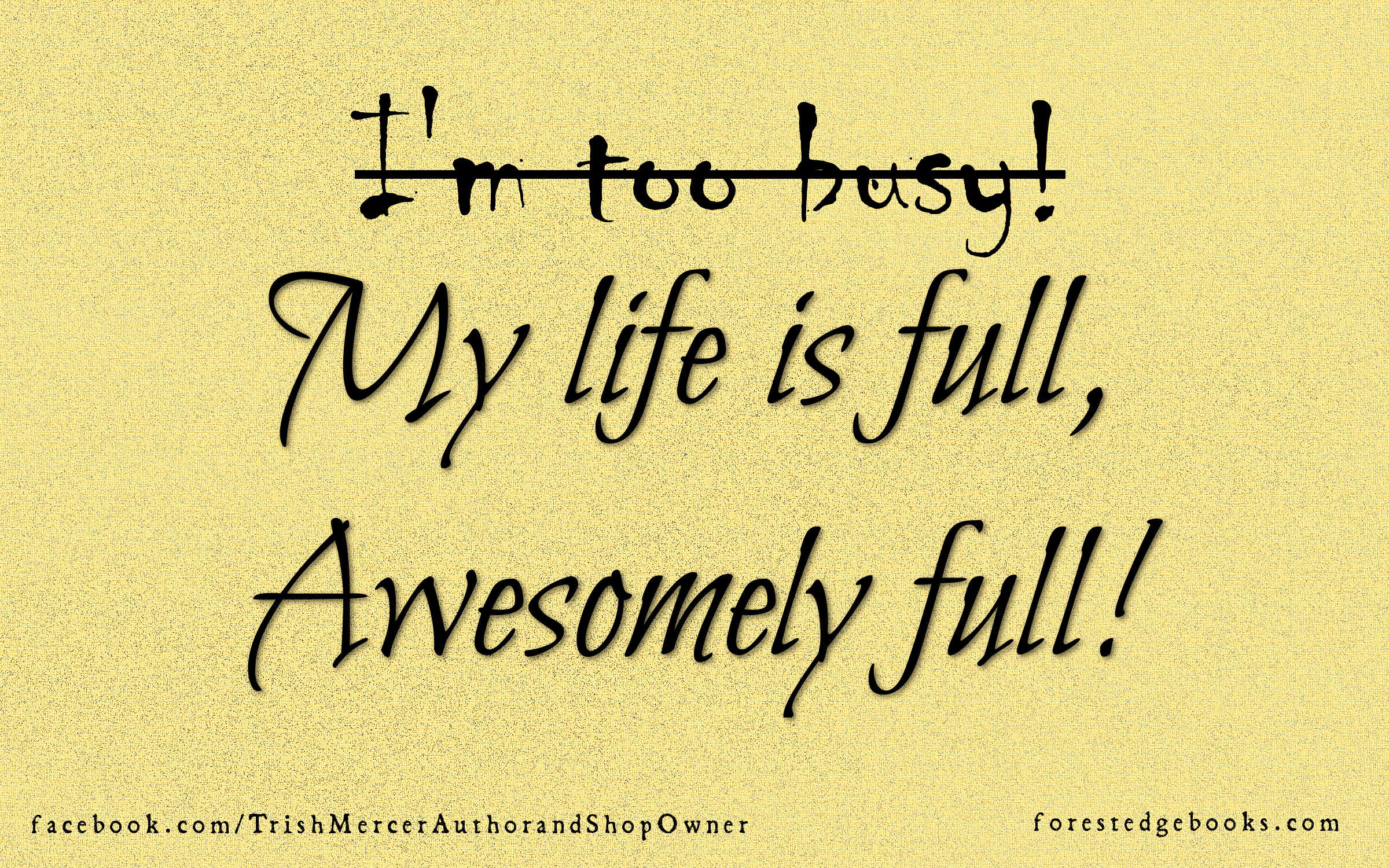
Instead, I’m trying this, (at least on everyone else): “My life is so full! Awesomely full!” im too busy

Notice the shift in tone and attitude?

Fullness is completeness.

Being full is usually a good thing (except in the water balloon that my three-year-old brought in the house. Clothing change #5. Another load of laundry which will take me all of five minutes to run.).

Having a full life suggests that nearly every element in my life is there because of my choice. I have CHOSEN this life.

All of us, unless we’re slaves (and I’m not being flippant here: I mean true, cruel slavery, and not something you claim you are to your preteens’ many activities) have chosen our lives to be as they are. Even in the most difficult of circumstances, we still have choices. Rarely are we ever forced into one course of action, and while the options before us may not be ideal, we still have a choice.

For example, at one point last year I was busy working two part-time jobs and running a small Etsy shop. I could have quit one of the jobs, but that would have meant finding another way to pay the power bill which would have meant . . . getting yet another job.

I was tempted to grumble at how hard my husband and I were both working for what felt like only a couple of bucks an hour, but we were working, and slowly improving our circumstances. Instead of complaining that my life was “too busy” to do what I really wanted to do—edit my books or get maybe six hours of sleep—I chose instead to be grateful that I wasn’t just sitting on the couch reading movie descriptions on Netflix (and wondering when the next season of “Call the Midwife” will finally arrive).

I had things to do, obligations to fulfill, people who needed me, and I realized how much I appreciated being needed.

However, I’m not advocating taking on more than we can reasonably handle. That’s where we need to be mature enough to objectively evaluate our lives and say, when necessary, “No, I’m sorry. I can’t organize the Little League luncheon or make party favors for fifty people.” Otherwise we still become martyrs who have taken on too much and eventually have a total breakdown.

Additionally, we frequently have several good things we need to do at the same time, and that’s where prioritizing comes in. Deciding which to do can be difficult, and who to tell “I just can’t do that for you.” But someone once told me that “Other people’s needs should always come first.”

I knew a man who told his son that he had to skip watching him play ball that evening because their neighbor’s sprinkler system was geysering into the neighbor’s basement, and the dad wanted to go help. He said, “It was good for my son to see that I was putting aside something that I thought was important–watching him play ball–for something which really was.” While his son was initially disappointed that his dad was “too busy,” when he saw the flooding mess he offered to skip his game and help as well. Suddenly he was “too busy” to play ball, because he was doing something better.

Living a “busy” life is frequently drudgery. But living a “full” life is marvelous. The sense of I’ve accomplished something good for my family and others is, I think, the purpose of life. What would be worse than no one wanting my help, my advice, or my labor?

So don’t complain/brag about being “too busy.” It’s an awesomely full life!

And really, what would be worse than an awesomely full life?
An awfully empty life.

Why I choose to be a Mormon

I haven’t been haven’t been coerced or brainwashed, nor am I stupid and delusional to believe what The Church of Jesus Christ of Latter-day Saints (LDS) teaches, despite what commenters on social media and articles about Mormons like to claim.

Instead, I’ve chosen to believe, and here are my six reasons why:

  1. Mormonism makes sense to me.

Straight off, I like what the LDS Church teaches.

Mormonism rings true in my mind and heart, more than any other philosophy, religion, or belief system I’ve researched. And yes—I’ve researched a lot of them, starting when I was a teenager. Even then I agreed with Socrates when he said, “The unexamined life is not worth living.” 

While I was born into a family that was Mormon, I took it upon myself to make sure I wasn’t duped into believing all of this stuff. At the age of 16 I started a serious, focused study of the Bible. I didn’t tell anyone what I was doing, but I read every single word—even the entire Old Testament, and boy was I happy to get to the New Testament—to make sure I knew what was in there.

And I decided that I wanted to believe in it. Belief is a choice, after all. While I think that some of the Bible is figurative, I believe that most of it is literal as far as it’s translated correctly, and I believe in Jesus Christ as my Savior, making me firmly a Christian.

But still I wanted to know what else was out there.

So beginning in high school when I had to read Siddhartha, I’ve researched over the years the main tenants and theories of the major belief systems, from Atheism to Zen Buddhism, and just about everything in between.  In each sect and philosophy I found elements that rang my inner “truth bell.”
(Except for Karl Marx and Christopher Hitchins; they barely clanked my brain.)

But my inner truth bells rang constantly when I read The Book of Mormon and Doctrine and Covenants, and when I studied the ideology of Mormonism. All the truths I found in the other religions and philosophies were represented in the LDS Church along with so, so much more. It’s that depth that won me over, because . . .

  1. Mormonism is the kind of life I want to live.

I’m baffled when others who don’t even know me, or any other Mormons for that fact, take it upon themselves to mock and deride our decision to follow this way of life: to be morally clean, provide charity to our friends and neighbors, pay tithing, actively worship Jesus Christ, observe the Sabbath Day, and make covenants in temples in order to perhaps in some distant epoch of time eventually grow, develop, and mature to become even like God himself.

I would never, ever make fun of the way another person lives their life—it’s their life; why would I be so arrogant as to criticize their decisions?—so I’m not sure why it’s always open season on Mormons.
(By the way, “The Book of Mormon” musical is not written or endorsed by Mormons. Trust me.)

But I’m a Mormon because I want to live a deliberate and purposeful life, and the teachings of the LDS Church provide me with the most logical and inspired guidelines to do so.  

The way I see life is that I have such a short time to be here, and I want to do as much and as best as I can.

I look it at this way: I’ve always wanted to visit London, England. In my mind I’ve fantasized and romanticized about what London would be like and secretly wished I were British. (I’m German, may the Brits forgive me.)

Now, if someone came to me and said, “You will have 24 hours to spend in London next week,” I assure you I wouldn’t just step off the plane in Heathrow, buy a six-pack, and sit on the banks of the Thames watching the boats go up and down for the day.

No, I’d start planning now for the best 24 hours ever. What would be the best and most important places to visit? Once I got there I’d ask the locals, where should I eat? What tourist traps should I avoid? Is Shakespeare playing in the park? Where’s the park? I wouldn’t want to waste any of my time idly.
(As you can imagine, my idea of a vacation isn’t the same as everyone else’s. We once vacationed at the beach, and by lunchtime on the second day I was bored out of my mind. “Isn’t there a museum or national park anywhere?!”)

I see my entire life in the same way. I get the feeling that my soul is very, very old, and that I waited for thousands of years to come to this earth. My existence after this life will also extend for thousands of more years, and beyond.

The line, “We are not human beings having a spiritual experience, but spiritual beings having a human experience,” by the Jesuit priest Pierre Teilhard de Chardin, also rings true to me, as does C. S. Lewis’s statement that “You have never talked to a mere mortal.”

Because this is my ONE shot at life (I couldn’t get behind the idea of reincarnation, unfortunately), and I’m sure I’ve been waiting for this chance for several millennia. I don’t want to waste it.

I’ve also decided (a choice, again) that Jesus Christ was the best example of how to live fully, and no other religion or ideology I’ve explored follows His example closer than the LDS Church.

Follow the teachings of The Church of Jesus Christ of Latter-day Saints is the way I want to spend my life.

  1. The LDS Church doesn’t require blind obedience.

This is another trite, overused cliché leveled against those who are Mormons: we’re non-thinking and gullible.

One man, trying to point out how stupid I was for following Mormonism, claimed that if the prophet said to jump, I’d ask how high.

I shrugged and said, “I thought that was only true in the armed forces.”

Silly me, I’d forgotten he was career military. What ensued next was a brief but lively conversation about the difference between commanders expecting absolute obedience to commands, versus people obeying prophets of God.

When I pointed out that the LDS Church never requires blind obedience as the armed forced did, the gentleman changed the subject because he really didn’t know that much about Mormons, which is my experience with most detractors.
They know hearsay, and little else. 

The truth is that the LDS Church emphasizes, again and again, the importance of individuals discovering truths for themselves; “gaining a testimony” is how it’s frequently phrased.

Here are some of the most often quoted scriptures in the church:

“But, behold, I say unto you, that you must study it out in your mind; then you must ask me if it be right . . .”

“And when ye shall receive these things, I would exhort you that ye would ask God, the Eternal Father, in the name of Christ, if these things are not true . . .”

“If any of you lack wisdom, let him ask of God . . .”

It’s a church that encourages its members, and those investigating it, to ask, ask, ask; to find out, find out, find out for themselves.

No blind faith. Put God to the test. Try it and see.

Back to my military friend; one thing he did admit was that the reason the soldiers obeyed their commanders was because they trusted them implicitly.

I likewise trust the leaders of my church. Their admonitions and suggestions have been correct again and again, and I’ve decided (choice, again) that they are prophets who receive revelation from God.

Here’s one example of thousands I could give. A president and prophet named Gordon B. Hickley said these words in a general conference of the church: Hinckley 2

“I am suggesting that the time has come to get our houses in order.

“So many of our people are living on the very edge of their incomes. In fact, some are living on borrowings.

“We have witnessed in recent weeks wide and fearsome swings in the markets of the world. The economy is a fragile thing. A stumble in the economy in Jakarta or Moscow can immediately affect the entire world. It can eventually reach down to each of us as individuals. There is a portent of stormy weather ahead to which we had better give heed.”

He said this in 1998.
He was right.
It’s been storming for 17 years now, with little relief in sight.

You can see what Mormon leaders have been saying for decades by clicking here and doing a search. Try it for yourself.

So yes, if the prophets of the LDS church says jump, I will, because I already trust their judgment.

And not blindly, but with my eyes and ears wide open.

  1. The LDS Church gives me great comfort.

No other religious organization or philosophical ideal I’ve encountered can provide the depth and breadth of explanations about life and death than the LDS Church. They literally have the meaning of life.

This understanding—that life is a brief but a very important point in our eternal existence—helps me understand why I’m here, what I’m supposed to be doing, and where I want to go afterwards.

This life is a test—a critical, calculated examination—of the nature of our hearts. What do we really, really want? Placed in this mortal state, with problems and struggles, we can truly see what we’re made out of based on how we treat our brothers and sisters.

We’re here to be tried, not to be partying. 

Years ago I worked with a woman who asked me, with the obligatory sneer, why I wanted to be a “good girl” to go to heaven where it undoubtedly would be boring because all anyone ever does is sit around strumming harps and singing. She was planning on going to hell, where all the “cool” people would be.

Befuddled by her overly simplistic ideas of heaven and hell, I hemmed and hawed for a minute before explaining that I believed heaven is a extension of this life where, with our friends and family, we continue to grow and are given greater responsibilities and abilities, whereas hell was a place where all of our regrets and failings torment us with what could have been.

She blinked at that, never having given any real thought to heaven and hell beyond what she saw in Saturday morning cartoons, and never again disparaged my beliefs. In fact, she asked about a few more details over the next few months, and I sensed she was looking for comfort for a pain she couldn’t yet admit feeling.

I recall the song by Eric Clapton called “Tears in Heaven” about the loss of his 4-year-old son. The lyrics are heartbreaking: “Would you know my name/if I saw you in Heaven,” as if the relationships we have on earth would somehow be lost in the next world.

Mormons know that not only will we recognize each other when we die, we’ll know far more about those we love because we’ll remember our relationships we had before we came to this earth.

And additionally, Mormons know that all pain in this life is temporary. 

All frustrations, all troubles, all disappointments will be rectified in the life to come. 

I can’t imagine how I’d live without that understanding. I think I’d be constantly depressed, like the older woman I met at her mother’s funeral.  She knew—knew—that everything about her beloved mother was gone forever. The Mormon bishop conducting the service for the family (because they weren’t affiliated with any religion) tried to assure her that her mother’s spirit was alive and well, and they could be together again someday.

But this woman shook her head and said, “That’s just too good to believe. I can’t accept it.”

Heartbreaking.

She didn’t dare take the comfort, too broken down by this life to imagine any other. I couldn’t live like that.

I need comfort to survive.

  1. What I “sacrifice” to be a Mormon is no sacrifice at all.

You’ve heard it all: Mormons don’t drink, don’t smoke, believe in chastity, fidelity, modesty, charity, and are focused on keep families strong.

Boooorrrring.

When I was 19 I worked in a mall on the east coast where I was the only Mormon among a lot of college students. Frequently they came to work with hangovers, slipped outside to smoke, and complained and fretted about their one-night stands.

I listened to the conversations but never said anything because it wasn’t a world I was part of. Dutifully I’d fold shirts, help customers, and just do my job.

One day a huge shipment came into the store, which meant pizza and beer as we unloaded. After a couple of hours most of the staff was impaired, and when customers rushed the store for the new products, I was the only one sober to deal with them.

The next morning we had to clean up the mess left behind the night before (the manager was as undisciplined as the kids he managed), and as one employee threw up in a trashcan and on a woolen sweater, and another sobbed uncontrollably in the corner because she and another worker had become “too involved” in the back room, someone asked me if I regretted being a Mormon and missing out on all of the fun.

I laughed until I realized he wasn’t being sarcastic.

I glanced around at the chaos and the employees still quite impaired, and said, “I have yet to see any of you have any fun.”

There was a full minute of silence in the store as they contemplated my statement, and since that day I’ve realized that what the world considers a sacrifice to be a Mormon isn’t any sacrifice at all. 

While I may have given up what the world considers “fun,” what I’ve gained instead is peace of mind.
Purpose.
Joy.

If you’re considering investigating the LDS Church, but worry about how difficult transitioning to that life may be, consider this weak but parallel example.

Over a year ago I was tired; bone-weary, deadly tired every single day and needing a two-hour nap just to get by. My brain was also fogged so much that I couldn’t think. I was forgetting important things, such as my 6-year-old out at a friend’s house until they sent her home at 9pm. Plagued also with constant bowel issues, I began to search for some solution to this daily misery that was robbing me of life. I was growing desperate and deeply worried.

I discovered that I was gluten intolerant, and I willingly gave up—for just a week—all the bread that I so dearly loved. In only two days I noticed everything in my life improving, and I made the change permanently. No, it wasn’t easy at first, but it was definitely worth it.

Fast forward to a dinner I had with some friends last month. One of them, enjoying a fluffy roll, apologized to me and said, “I don’t know how you gave up bread.”

“Because once I gave away bread,” I told her, “I got back my brain and my energy. Whenever I’m tempted to eat something I shouldn’t, I think ‘Do I want bread or my brain?’ Even though I’m not a zombie, it’s an easy answer: brains! And while I occasionally miss all things containing gluten, I’d give it up again in a heartbeat.”

Then it hit me: What I gave up at the time seemed like a sacrifice—I still struggle to find worthy equivalents to the food I loved, and would kill for a slice of thick, chewy pizza. But what I got in return was much, much more. I literally got my life back, and I feel 15 years younger (and have even lost weight to boot).

I invite you to find someone who joined the Church, and ask them if they miss what they gave up. Like my mother, they’ll likely say they had to give up alcohol, smoking, or something else, but what they received in return more than made up for what they lost.

In fact, they’ll wished they had “sacrificed” earlier to enjoy sooner what they have now.

  1. I love what I believe.

Some will still think that I’m delusional, that choosing (choice, again) to believe in golden plates and additional scriptures and visiting angels and temple worship and the notion that God still speaks to people is all absurd.

But you know what?

I love all of that.

And this is why Mormons want to tell you all about their religion: we want you to love it as well. 

Think about this: if you find a fantastic restaurant, or watch a movie that blows you away, or read a book that rocks your world, you tell everyone you know about it, right? You want them to share in what you’ve discovered.

So do Mormons. That’s why we send out missionaries (my third one is getting ready to leave at the end of the month for two years), make videos, extend to you invitations, and write blog posts about what we believe.

Now that doesn’t mean you have to embrace what we do. Maybe you don’t like that restaurant your friend recommended because you aren’t keen on curry, and that chick-flick doesn’t have enough car chases, nor do you like to read long books without pictures. No problem. Appreciate that your friend wanted to share with you something they love, then move on.

Same with those trying to share Mormonism with you. Just tell us you’re not interested, and we’ll still be your friend. 

But I’m warning you now–we may try to wave that curry bowl under your nose again every now and then, not because we don’t respect your decisions, but because we have hope you might change your mind someday.

Forgive us. We’re just too darn enthusiastic sometimes.

All people are free to choose what they want to believe—how, where, or what they may. We don’t want to infringe upon your right to believe what you want, nor do we want you to infringe upon our rights. We’re a “live and let live” kind of folk. Works best that way, we think. Let’s just all do what we think is best, and let God sort us out later.

Yet deep in my soul, I feel—scratch that, I know that being a Mormon is the best way to go, at least for me.

Call me delusional, I don’t care. 

But if—if— I wake up dead some day and discover that all of what the Mormons teach was pure nonsense, I still would have believed, because this “nonsense” gives me great joy, and I’d rather eke out my meager existence in delusional joy rather than in the quiet desperation I see ruling the lives of so many that I know and love.

That’s why I choose (choice, again) to be a Mormon. There’s simply nothing better in the world for me.

(7. Bonus reason: The LDS Church makes cool memes; I got all of these from lds.org.)

Teachers shouldn’t ask questions to get answers

It doesn’t matter what kind of teacher: public, private, or church Sunday School, the purpose of asking questions isn’t to get answers

(Not my actual Sunday School class, but roughly the same amount of kids.)

If only adults could understand that.

While I’ve taught college freshmen for over twenty years, I’ve also taught classes in my church. Right now I’m responsible to teach Sunday School to 15-16 year-olds, and because there was some kind of baby boom back in 1999, I have a class of 19 teenagers right now. The leaders in my LDS ward think I need “Help,” and today was a classic example of Question Anxiety.

That’s the best way I can put it: when I ask a question, the “Help” jumps in to answer it. Remember, the “Help” is a well-intentioned adult; but this class is for the teenagers, and when I pose a question they sit for a few seconds, thinking.

And that’s exactly what I want: I do not want answers; I want thought.

The older gentleman helping today obviously wasn’t comfortable with the silence, and tried to fill it each time it manifest itself.

But I love the silence! Wonderful things happen during it.

First, there’s the first five uncomfortable seconds when teens give each other the sidelong glance to see if anyone has an immediate answer.

That’s when the adults get nervous, and want to supply something—anything.

Because adults often work with A Plan. No matter what the task or chore or goal, most adults want A Plan, and getting quickly from point B to task H is imperative. Give answers, get moving along.

It’s because most of us were raised in the public school system which, even worse now than ever, has A Plan that must completed, no matter the needs of the children, no matter the level of interest—The Plan (quite often linked to Common Core) must be accomplished.

My son’s 11-year-old friend encountered this the other day. A substitute teacher set up four stuffed animals: a whale, a tiger, a dolphin, and an octopus. She asked the 5th graders which animal didn’t belong in the group.

Before you read further, what would your answer be?

Nice meme. Would read easier if the last two lines were, “to ask questions that EVEN YOU can’t answer.” But you get the idea . . .

My son’s friend said, “The octopus. Because all the other animals are mammals.”

That wasn’t the “right” answer, and the substitute, for whatever reason, came down a bit hard on him for not giving her answer. Instead of acknowledging that his answer was correct as well, and instead of stepping back and thinking, “Hey, clever. I hadn’t considered that,” she instead snapped at him that the tiger didn’t fit, because the rest of the animals were aquatic animals.

Stick to The Plan. Move along. The point isn’t education. The point is completing the task.

How tragic. This 11-year-old was thinking. He was right!

And that’s what teachers should want when they ask questions: the questions should make students THINK!

That’s what happens in my Sunday School class after those first five uncomfortable seconds. In the next five, kids start to muse to themselves, No one else is saying anything . . . maybe I should come up with something?

Another five seconds, and then a hand tentatively goes up with a comment I grin at and write on the board.

Then another hand. And another.

Yes! They’ll get there, without someone stepping in and supplying the answer too quickly for them.

But there’s still one more thing I want to have happen when I ask a question. Thinking is first, their responses is second, and then . . .

Well, let me tell you what happened today. The topic was The Nature of God, and I opened with asking the students, “What do you know about God?”

That was when the Helper, after five seconds, jumped in with several statements of what he, a sixty-year-old man, knew. Frankly, I didn’t care what he knew. I wanted to know what my 15-year-olds knew.

Eventually, they began to offer bits and pieces which I put on the board.

When I wrote, “Jesus has a body of flesh and bones, and not blood,” that’s when the magic happened.

One girl raised her hand. “Wait, Jesus doesn’t have blood anymore?”

“Nope,” I told her. “Resurrected beings don’t. He can’t die anymore, or even be injured.”

A couple of other teens weren’t aware of that either, and then came more questions. “So he could go skydiving and nothing bad would happen to him?”

“You got it. And here’s the awsome part—all of us will someday be resurrected too, with a perfect body of flesh and bone.”

Here’s where the discussion shifted into a little bit of silliness, but I let it.

“So when I’m resurrected, I can do extreme sports and not worry about getting hurt?”

“That’s right!”

Do you see what happened there?

The kids started asking the questions!

THAT should be the goal of every teacher’s lesson: not getting answers to our questions, but getting questions from our students. That means they’re interested. They’re thinking. They’re engaged!

And it doesn’t happen too often, unfortunately. I’ve heard of too many kids asking a question in school, and being told, after an awkward pause, “I’m not really sure, and since it’s not on the test, let’s not worry about that right now.”

Talk about killing the desire to learn. Kids have it naturally. It’s mostly gone by middle school. Can you see how it died?

I’ve also seen this a lot in my freshmen college students. After 12 years in the system, they rarely ask questions more compelling than, “Does the Works Cited page count as part of the six page requirement?”

Oh, I try. I bring in articles about issues directly affecting them, I show them entertaining video clips, and I purposely throw out nuggets such as, “Your high school teacher probably told you to never use the word ‘I’ in your papers, but we all know that’s total rubbish, along with never beginning a sentence with, ‘Because.’”

It’ll take a moment, but always a student will raise a hand and say, “Wait—we can begin a sentence with ‘Because’? What about ‘But’?” And for five minutes we have an interesting discussion, because a student wanted to know that answer, not because the teacher was looking for a programmed response.

Think back to any lectures you remember from college or high school. Do you remember any of them? At all? I remember a handful, and every one of them began with a question a student wanted answered, and ended with a teacher involving all of us in the discussion.

That is education. That is learning.

And it’s rarely happening anymore.

sunday school picture

Click here to see the curriculum for all of the youth in The Church of Jesus Christ of Latter-day Saints. Go ahead–we don’t bite. At least not that hard.

As for my Sunday School class today, Helper began to realize the kids were capable of answering the questions, and to his credit he backed off a bit, especially after I refused to make eye contact with him, but focused solely on the kids. They came through for me again, as they always do, with even a few more interesting questions that filled our 40 minutes quite easily. The LDS Church has purposely changed its curriculum for teenagers 12-18 so that they can run the pace of the lesson, and not the teachers.

If only school systems could do that as well: respect the child as a person wanting to learn, instead of part of a group that needs processing.

Not only would our children be smarter with that kind of child-focused education, but they’d be happier too, which should always be our foremost goal in education: happiness.

This was one of the things Mahrree loved about teaching: the rare moments when a student dares to wonder. The best learning happened when the students asked the questions, not the teachers.

It was also at these moments that she panicked, because sometimes the questions were so unexpected that she was caught by surprise. But it was the good kind of panic that lets you remember you’re alive, like being chased by a dog you know you can outrun, but it terrifies you just the same. It feels great when you finally reach home, or see the dog yanked back suddenly by its leash and you gloat at it triumphantly.

But first you have to run.

She always had a ready answer. “Chommy, what do you think?”

~Book 4, Falcon in the Barn (coming spring 2015)