One good reason for having kids

I have little time to write a full post today, with SLC Comic Con rapidly coming up. I’m making 200 signs and 300 clocks to sell in just one month (with products from my Etsy shop), and I’m slightly hyperventilating because I’m only half done, I have no packaging or booth advertising ordered, and as a newbie I’m terrified to my core. (Panic attack will commence in 5 . . . 4 . . . 3 . . . )

Still, I took a moment the other day to spend some important time with my 8-year-old. A couple of weeks ago, her beloved scooter betrayed her, dumping her over the handlebars onto the sidewalk, breaking both bones in her arm just above her wrist. It’s been rough as I’ve had to help bathe and dress each day, and she hasn’t been able to play in pools or splashpads as she wants to. Knowing she needs some tenderness and concern as she heals, I smiled as she came up to me the other day with a Sharpie marker and displayed her cast. I knew what was coming.

sign your name on my cast

Because if you can’t mess with your own kids, what’s the point of having them?

(It’s a joke, folks. Relax. She didn’t cry about it that long.)


The parable of the protesting preschooler (or, when God drags us kicking and screaming)

He was sleeping happily on the couch when we hoisting him upright and informed him, “It’s time to go. Get up!”

If you’ve never roused a four-year-old from a late-afternoon nap, you have no idea of the battle which ensues.

He did not want to go, and he demonstrated that by shouting and flailing. Hiding under his blanket didn’t help (he was amazed that we could find him so easily), and when he started kicking, I decided he didn’t need to wear shoes anyway.

“I don’t want to go!” he wailed, but his 16-year-old brother took that as a challenge and flung him over his shoulder like a sack of flour.

Pummeling his big brother’s back, my littlest boy bellowed all the way to the van where he was dropped, shoved into his seat, and belted in before he could escape.

The shouting and protesting continued as we drove for twenty minutes to our destination, all of us trying to ignore his yelling as well as someone can ignore a horde of stinging wasps.

His shouts continued as we piled out of the van, and we received many looks of curiosity and amusement—and probably some disapproval—as we hauled out our protesting son and got in line behind the two hundred or so already ahead of us.

“I . . . do . . . not . . . want . . . to . . . do . . . this!” He was nearly dry-heaving now, and I ignored everyone’s stares around us as I held my objecting preschooler.

Not soon enough, the gates opened, the crowd before us piled in, and we followed, with angry boy still held tightly in my arms.

He quieted as he saw the scene before him, remembering that we did this last year, remembering that it wasn’t as awful as he thought.

He saw the piles of free pizzas—his favorite.

He saw the swimming pools—reserved for all of us who participated in the summer reading program set up by our local library.

He saw the water slides—and I could feel his rigid body go soft.

He wanted this.

But he wasn’t about to show that. Not yet. After all of his protestations, his pride couldn’t let him surrender so quickly.

So we sat down at a picnic table as the other kids and parents rushed into the water. He watched with both longing and resentment in his eyes.

My husband leaned over to me and whispered, “Go wade in the kiddie pool. I bet he’ll follow.”

So I announced my intentions to our son, then strode over to the pool. My feet had barely touched the water when he was by my side, dancing in excitement.

“So you want to go in?” I queried.

“YES!” he cried. Forgotten was his early protests, maybe forgotten was his twenty-minute temper tantrum, certainly forgotten was his pride as he began to strip, right there, to get out of his pants and underwear.

Discreetly I brought him back to our table where we covered him with a towel and put on his swimsuit. Then he ran—even though we shouted to only walk—back to the kiddie pool.

No amount of water could have wiped the smile off his face as he played and splashed and pretended to swim. We went down the big water slides together, and with joy he climbed out of the landing pool and raced back to the pool—the deep one, though—and jumped right in.

Dad followed, because our four-year-old can’t swim, and even though he bobbed under the water a couple of times until Dad could rescue him, he was still smiling as he coughed and spluttered to clear his lungs.

Pizza was eaten, the boy was nearly drowned a few more times, and a good time was had by all.

At the end of the evening when the sun went down and the winds came up, he was eager to be wrapped up in a towel and brought back home to a warm bath.

“So,” I started casually as I washed the chlorine off of him that night, “are you glad you went to the pool with us?”

He grinned.

“Even though you were screaming and crying that you didn’t want to?”

He laughed. Oh, that was so three hours ago!

I was about to be smug that I was right all along—he would enjoy it—until I felt God tapping me on the shoulder, as He occasionally does, to point out something He knows I’ll bite my tongue about later.

How many times has God placed before me a situation that I didn’t want because it would yank me out of my warm, soft spot?

How often has He dragged me away, kicking and screaming, to a new adventure?

How often has He patiently ignored my protests, even when I was utterly ridiculous in my complaints?

How often did He sit next to me, long-suffering, as I surveyed the scene before me, knowing that I’d want it, but that my pride wouldn’t yet let me admit it?

How often has He gently led me to the water, waiting for me to finally give up and jump in with both feet?

How often has He chuckled as I bounded and cheered and flopped and laughed with joy at my new situation that I was so sure I did not want?

And, perhaps most importantly, how long until I quit instantly whining to God whenever He thrusts me into a new situation that I will eventually love?

I’m afraid my pride won’t allow me to answer that just yet.

“There’s another plan for you, my boy. You’ve changed your path before, now do it again.” 

~Book 3, The Mansions of Idumea

Why would normally sane people take teenagers out into the wilderness of Wyoming to walk for 18 miles?

My husband and I just returned from rough camping for three days and two nights with a bunch of teenagers, and it’s called “Trek.”

We weren’t the only ones, either, to take on this insanity.

While Dave and I were responsible for eight teenagers, 13-17 years old, three other married couples from our ward (or congregation) accompanied us with their groups of eight kids (our two teenagers among them), along with nine other groups from our stake (about the size of a diocese).  We were “Pa” and “Ma” and they are our trek “kids.” All total, there were nearly 500 of us on this adventure.

IMG_1193

The Hyrum 12th Ward Trekkers

IMG_0870

Dave and my trek “kids,” before our “family” got too dusty and dirty.

At 6 am on Thursday, nearly 400 of us piled into ancient school buses with dubious safety features (about 100 followed in chase vehicles with our gear and food), drove for 6 hours on uncomfortable seats with no A/C, and spent the weekend pretending to be 19th century pioneers.

Yes, that means wearing dresses, aprons, and bonnets for girls. Because not all of our participants can sew, I made eight skirts, seven bonnets, seven aprons, and one relatively authentic pioneer shirt for my cute husband. The boys wore suspenders, long-sleeve shirts, long pants, no jeans, and bandannas. (But modern shoes, thank goodness.)

IMG_1156

Dave and I and two of our “real” kids. (The males in our family do know how to smile. Just not for cameras.)

Why would we go to so much effort, and drive for so long, just to walk around in the wilds of Wyoming?

Because our teenagers deserved it.

Not to suffer—which they did, but only mildly. But to discover incredible, amazing things about themselves.

Now I know I recently wrote about why the most dangerous words are “I deserve,” but here’s one thing all people everywhere deserve: perspective.

We all also deserve to discover a few things about ourselves. For instance . . .

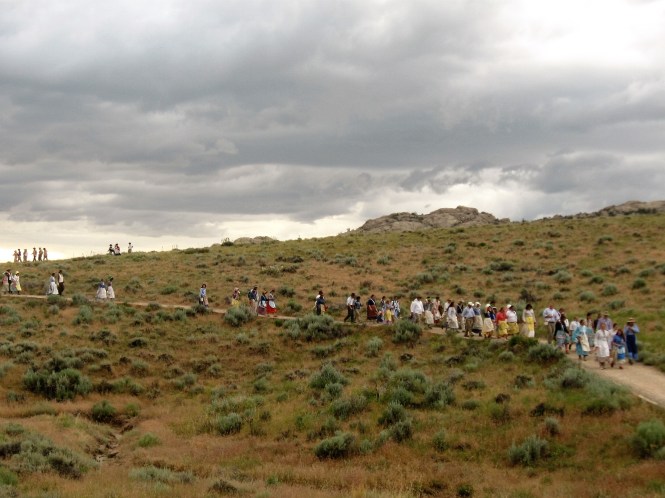
Our teenagers deserve to discover their strength. Our kids are typical: they love their electronics, their games, their music, their cars . . . and they had none of those on trek. No, not even cell phones. (There really isn’t coverage out there, anyway.)
IMG_0995

See any cell phone towers?

All of this means that our teenagers were, overall, soft. (So were most of us adults, to be fair.) While we’ve been trying to prepare these kids since March for this adventure—encouraging them to go walking, and even taking them out ourselves—I think only a handful were fully prepared for the experience.

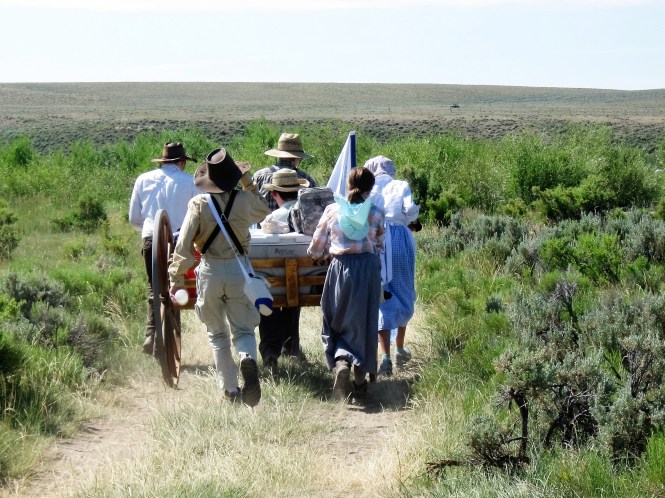
The second day of trek required 10 miles of hiking (later, we learned it was actually 12, but the senior citizen missionaries leading us initially said only 10, so that they kids didn’t lose heart). The terrain was varied and beautiful, but dusty and difficult, especially pulling and pushing a 19th century handcart through the sand.

IMG_1081

(Knowing how much I love epic-looking clouds, God generously provided some for our photos.)

The kids grew tired, despite the water and Powerade and Jolly Ranchers and hoagie sandwiches and bags of Milano cookies. (No, we didn’t eat like pioneers—that’s for sure.)

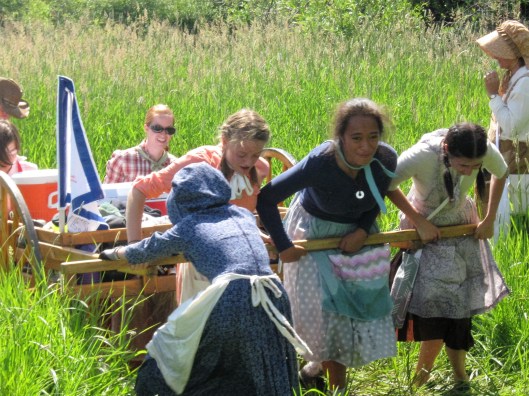
But they persevered. We “Trek Parents” were always by their sides to encourage and help, but we didn’t need to do much because the kids helped each other. They told stories. They made up song lyrics. They cheered when boys tried to sneak off subtly into the bushes to relieve themselves, and returned victorious from watering the shrubs despite threats to sensitive body parts from mosquitoes.

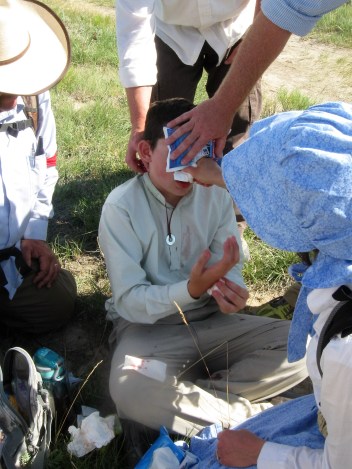
When one of our trek sons developed the most epic nosebleed ever, and the EMT and nurse who accompanied our group of one hundred finally got the bleeding stopped, they recommended that he ride for a time, seeing how pale he was.
IMG_1046

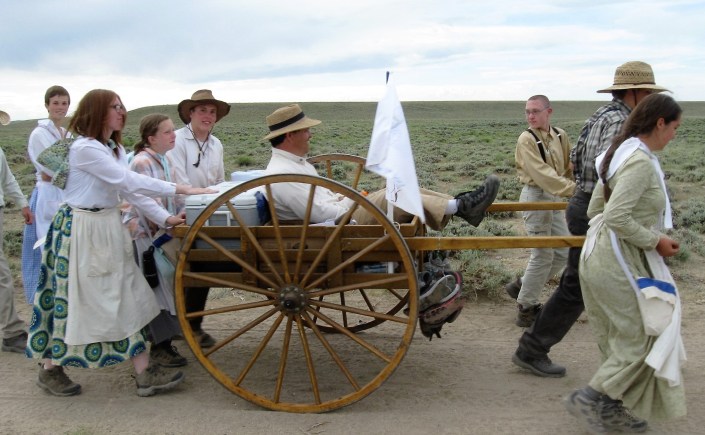
Our kids hastily made room in the handcart, helped in their “brother” get in, then, without any complaint about the added weight, cheerfully pulled him to the river where we crossed, pioneer-like, three times in the rushing water, pulling their brother.
IMG_1050

IMG_1068

Our teens deserve to discover their strength, and their compassion, and their fortitude.
IMG_1070

IMG_1059

Trek isn’t some exercise in futility—walking in enormous circles without running water or bathrooms. (And the porta-potties were few and far between. At one point, I took matters into my own hands by holding up a tarp and letting girls hide in front of me to relieve themselves on the Oregon trail. Quite literally on the trail. That’s why we brought lots of flushable wipes with us.)

IMG_1105

The disparity of porty potties. We taught the men they were allowed to water the bushes. Leave the potties to those of us wrestling with skirts, aprons, and bloomers.

Trek is an exercise in perspective, which our teenagers deserve to understand.

It think few people realize this, but over half a million people used the Oregon/California/Mormon Trail over a span of 25 years—from 1843 to 1869. The trail was so well-used that the original wagon ruts are still quite visible, nearly 150 years after the last wagons used them.

IMG_1120

These are the actual wagon ruts, from 150 years ago, caused by 500,000 pioneers. The distance, astonishing. The vista, immense. The trees and water, non-existent.

Among the 500,000 who trekked west were 60,000 Mormons, fleeing the persecution and mobs of Missouri and Illinois. In fact, they frequently trekked on the other side of the rivers, away from other pioneers who still saw them as targets for persecution and theft. The Mormons figured no one would bother them in the wild west (part of which eventually became Utah), so they took to wagons, and later handcarts, to get there. Most traveled safely, with their mortality rates similar to that of the rest of the country.

IMG_1119

Except for two groups of poor immigrants from England, Sweden, and Denmark. They arrived in America with very little money, had to build handcarts, and got a late start from Iowa City (now Omaha, Nebraska). The Martin handcart company had 665 immigrants, the Willie company around 500. They didn’t leave until August, when they should have been arriving in Salt Lake City, 930 miles away. (You can read more in detail about these companies here.)

Wyoming weather is unpredictable, and 1856 was brutal. In early October, snowstorms hit the beleaguered handcart companies, covering the poorly-dressed and running-out-of-food immigrants with over a foot of snow. It was impossible for them to progress, and they’d been crossing rivers with chunks of ice floating in it. Freezing, without proper clothing or shoes, and surviving on only half a cup of flour a day, the handcart companies were doomed. One group, the Martin Company, eventually took shelter in a cove which protected them from the Wyoming winds, but not the snows.

IMG_0982

Martin’s Cove, Wyoming

It was here that we first took our teenagers, and explained to them that it was sacred and hallowed ground, for not only did the handcart pioneers take shelter there, over 50 died and were buried in unmarked graves. President Gordon B. Hinckley also stated some years ago that the Savior walked there, making it akin to a temple.

Here the Martin Company waited for rescue parties, which Brigham Young had sent from Salt Lake City, over 350 miles away. Sixteen supply wagons and many healthy men headed out immediately, but traveling by wagon on unimproved roads with snows flying meant their progress would also be hampered. (Eventually 250 wagon teams were dispatched.) Many of these rescuers also suffered from hunger, illness, and exposure because they went to help.

When they found the Martin Handcart company, the immigrants were beyond frail, many of them dying, and couldn’t cross another freezing river to get to the cove for shelter. About 15 men, most of them young men and older teens—like those we had brought with us last week—carried the several hundred people across the waist-high river, over and over again, all day long in the bitter cold and snow. Miraculously, all of the young men rescuers survived, although they suffered from the effects of their heroic deeds for the rest of their lives.

IMG_0949

One of three statues commemorating the rescuers who carried pioneers through the icy rivers to the shelter of Martin’s Cove.

This was what our teenagers deserve to see and learn; to recognize their own strength, to see what others had done. Some of our kids had ancestors who were among the immigrants or the rescuers. As they walked the three miles of the cove, they did so in silence. Imagine that—over a hundred teenagers, hiking quietly recognizing the strength and faith of those who had gone before, and the willingness of other teenagers to sacrifice to save others. They deserve to learn reverence.

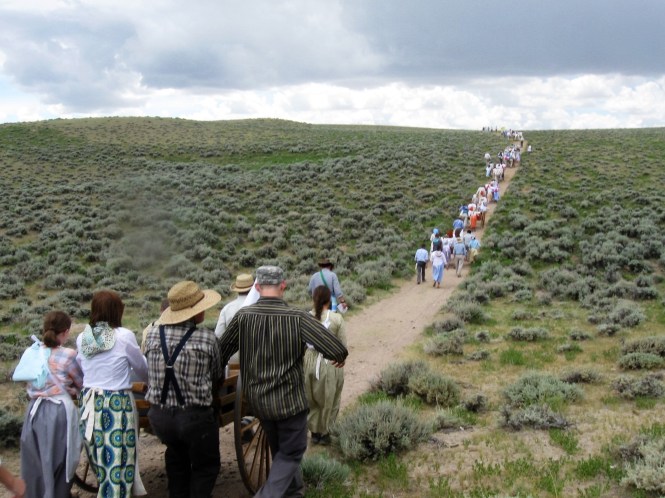
Our teens also deserve to discover they can do hard things. That evening we drove on our buses an hour west to where the Willie handcart company was discovered by the rescuers. What took us only an hour to drive took the rescuers several days to accomplish in snow and wagons. Here we camped, ate far better than the pioneers did (taco salad and pudding cups, anyone?) and spent the next day hiking that 12 miles I mentioned earlier.
IMG_1091


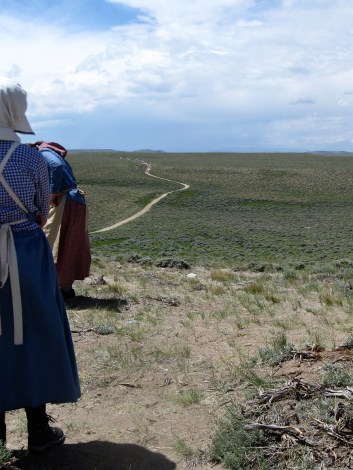
At one point in our trek, all of the men and boys were sent on ahead, recreating the fact that many of the pioneers were women who traveled alone with their children. The men were gone because many had been recruited to join the Mormon Battalion; other men had died along the way, giving their last rations to their wives and children. Still other men went on ahead to prepare the way for their families to follow.
IMG_1121

Preparing for the “Women’s Pull” and watching our men and boys walk away.

IMG_1122

On the other side of the valley, the boys were taught for a few minutes about their responsibilities to their families, God, and community, while on our side the girls were taught about their strength and ability to do hard things.

Then the girls and Mas pushed the handcarts, by ourselves, ¾ of a mile to where the Pas and boys were waiting and watching. They weren’t allowed to come help, but just observe as we struggled through the sand to get the carts up the hill.

IMG_1123.JPG

One of my older (real) sons, who did trek four years ago, said that was the hardest moment—seeing the girls struggle and knowing that he couldn’t help.

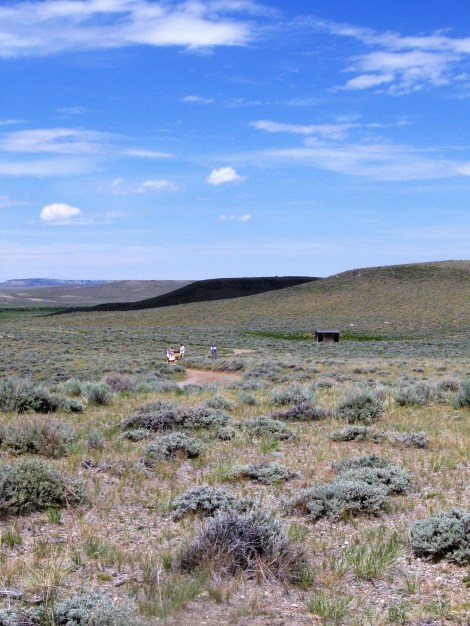
However, another recreation we did was that of a Danish wife whose husband became too ill to continue. He told her to go on without him, but she dragged him into the cart and hauled him herself for two weeks until he improved.

On our trek, we had a Ma and Pa act that out, with us at the top of a hill watching as the small wife half a mile away struggled to heave her very tall husband into the cart, then start pulling it all by herself. Even though it wasn’t “real,” still I couldn’t take any more pictures because I was too teary-eyed, watching my friend try to get her husband up that sandy hill.
IMG_1110.JPG

After a minute, one of our leaders said, “Any of the young men here want to go help?”

They did, four of them, eagerly jogging down the hillside to rush to her aid and help her push and pull her husband to the top of the hill. I have no pictures of it, because it was a sacred moment. None of us need photos to remember that.

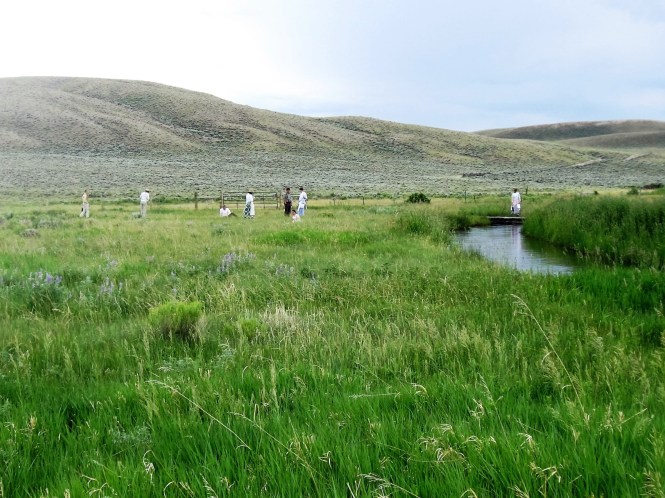
Our teens deserve to discover that there’s nothing more important than family. Ten miles into that hike, our group paused at Willie’s Meadow, where the handcart company of 500 finally had to stop, out of food and facing too deep of snows. The rescuers found them, too, and got them over Rocky Ridge, 16 miles away to where the supply wagons had stopped, unable to go farther. After that ridge, another 13 people died, and after they were buried, two of the men who buried them also died.

It was in the meadow, where the kids were told about the Willie company, that we handed each teenager a letter, written some weeks ago by their parents. One hundred teens then went off on their own to sit in silence and read their letters, and spend a few minutes writing in their journals.

IMG_1152

IMG_1151

All of Dave’s and my trek “kids.”

Again, complete silence. Dave and I quietly took pictures, and felt that even our whispering was too loud as we watched our trek kids, our own two teenagers, and about 90 more read, contemplate, and even meditate in an area of complete peace and tranquility.

That evening our ward group—about 50 of us—sat around a campfire and talked about our impressions of the two days, of what we learned.
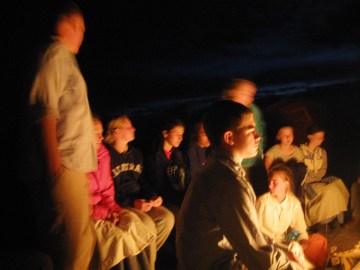
IMG_1171

Teenager after teenager stood up and expressed their thoughts, talked about their love for their families, their ancestors, and those who were there that day helping them to learn.

That night the sky was astonishing—no moon, no light pollution, and no clouds meant that our kids could stare up into a sky crowded with stars and the Milky Way, and feel the universe come down and touch them. Even after such an exhausting and long day, no one wanted to go to their tents just yet. And so Dave and I stood with our eight adopted trek kids, after our “family” prayer and a group hug (which was more of a scrum), and gazed at the heavens which gazed back at us.

Finally, at midnight, we sent them off to bed, reminding them we had camp to take down in the morning, and visit Rock Creek to see where the rescue wagons had been, before the long drive home.

At Rock Creek, where the 15 of the Willie Company had died, we saw their burial area, and sat down on wooden planks for a devotional. That’s when the storm came, an isolated thunder shower, dumping cold rain and even hail upon us as our stake president tried to talk to us about the sacrifices and faith of the pioneers.

IMG_1220

We see the storm coming, and realized that we packed in another vehicle all of our jackets and ponchos. There was nothing we could do but wait to be hit.

We shivered. We froze. And, because it was before our lunch of more sandwiches, grapes, and even soda and more Milano cookies (there’s a Pepperidge Farm factory in our valley–lucky us), we were hungry.

For ten minutes we experienced a tiny fraction what the pioneers did, and it was utterly miserable. One of our leaders said that he had prayed we would have the weather we needed. Apparently, we needed to feel a little bit of discomfort in our very comfortable lives.

After the storm passed, we were able to take shelter in those buses which seemed to be as luxurious as a hotel. (Ok, not quite, but you see where I’m going with this.)

IMG_1203

Even though the school buses were miserable, they were far better and much faster than wagons, or handcarts.

IMG_1246

Exhausted fellow Mas and Pas, trying to sleep.
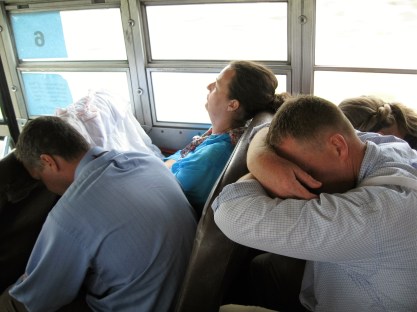
 

IMG_1245

(Wait–this means I’m the only responsible adult awake on the bus?!)

It’s now been a few days since we’ve returned, and I’ve finally got all the laundry washed and put away, the tents swept out, the Dutch ovens reseasoned, and the many supplies we gathered and purchased stowed away. The mosquito bites are healing, and last night I saw all of my trek daughters again, along with several of their mothers.

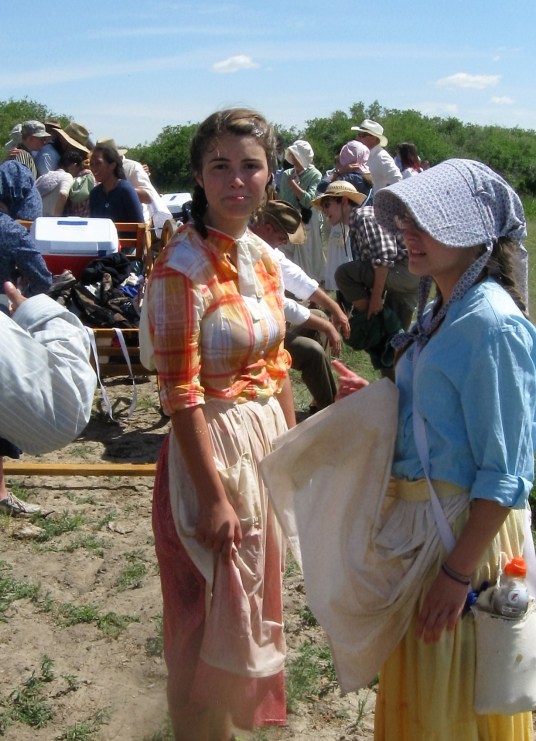
Would they say that trek was “fun”? Parts of it definitely were, especially for my 17-year-old daughter who was the only one who took a bath for three days, because the swift current of the Sweetwater River pulled her under briefly.
IMG_1079

But “fun” wasn’t the point. Over and over the parents of my kids said, “She said it was the best experience of her life,” and “He even broke down as he said how great it was,” and “She said it was a lot harder than she expected, which meant it was even better than we hoped for,” and “It changed him.”

So why did we drag these kids in pioneer gear out to the wilderness and walk them near to death (or so some claimed)?

Because they deserved it. Everyone did.

IMG_1161

(Pa Mercer wore the right boots, but not the right socks, which left him with many blisters. However, riding on the handcart proved more uncomfortable than walking, so his ride lasted about 50 yards. He bailed out when he saw the first major dip in the trail coming, to the relief of our kids.)

IMG_1022

(And I deserve to see my #6 child smile.)

I hate guns, but there’s something I hate even more (A pacifist’s confession)

I hate guns.

They terrify me. They kill, indiscriminately, even in the hands of the most skilled and trained users.

I hate their shape, their noise, and the smell of the cleaning agents.

My neighborhood is filled with gun-lovers. Hunters, cops, concealed-weapon holders—I’m surrounded by them. I wish I knew who stored loaded handguns in their houses, because I wouldn’t let my kids play there. All of that frightens me, to no end.

Many of my extended family are gun-nuts. They own arsenals. They’re gunsmiths. Bullets are stockpiled as plentifully as toilet paper is stock piled in my house.

Even my husband owns guns. I require that they remain dismantled, and stored in various parts of the house, because I hate them.

There are far too many accidental shootings and deaths. I don’t want anyone to come running to my aid, wielding a firearm, because I fear they’d shoot an innocent bystander in my behalf.

I’ve never shot a gun, but all of my kids have. My son is in the military, and two of his brothers intend to follow him. I’ve handled our family guns a couple of times, only by wrapping an old towel around them. I distrust weapons of all kinds.

You may choose to be offended by this, but I also tend to distrust gun enthusiasts. Some strike me as insecure bullies, hiding behind their weapons in a childish display of bravado and strength. Look at me! Look at the size of my caliber! There’s definitely something Freudian, and something cowardly, about those who feel their many guns give them power.

I’m a bit of a pacifist, if you hadn’t noticed. I crave peace.

I’m struck by the calm countenances I see in those who eschew violence: Ghandi, the Dalai Lama, and many others who would rather take a hit rather than deliver one. My father, who taught me to hate guns, was the most peaceful man I ever knew.

Yet, there’s something that terrifies me even more than guns: those who want to disarm my family and neighbors, while still remaining armed themselves

I prefer “The Office’s” version of a Mexican standoff: no guns.

It’s the clichéd Mexican standoff: no one dares to drop their weapon, because it’ll leave them vulnerable. I have to confess, those are the scenes in movies I hate the most. I can’t see any peaceful resolution, and you just know someone’s gonna get hit, probably when they’re walking away.

It’s that hypocrisy that makes me nervous.

It’s the same hypocrisy that I see in the elite of America: those with the money and the power and the influence. Those who make laws and entertainment and products we don’t think we can live without.

Those who are trying, at all costs, to take away from us so that they can have more.

You know who I’m talking about, so I won’t name names, but here’s a brief rundown of what they do:

  • They push for Common Core in the public schools, while sending their children to private schools which don’t follow those standards.
  • They insist on sharing the wealth, but just not theirs, because they still maintain mansions, expensive cars, and designer clothing.
  • They cry about climate change, yet pick up their conservation awards via private jets and gas-guzzling SUVs.
  • They won’t carry guns, but their bodyguards do.
  • They want to disarm America, but not those in their circles of influence.

A hypocrite is the kind of politician who would cut down a redwood tree, then mount the stump and make a speech for conservation. ~Adelai E. Stevensen

It’s the same pattern we’ve seen in history, time and time again. America may not have an aristocracy like there was in the French Revolution, but . . . No, wait. We do. They’re based in Hollywood and Washington, D.C.

How difficult it is to avoid having a special standard for oneself. ~C. S. Lewis

These are very dangerous, very powerful people. For many years I’ve tried to give them the benefit of the doubt. So often I’ve defended those who want more gun restriction and laws, not because I agree with their politics (I don’t, at all) but because I sincerely believe that peace can’t happen when so many options for violence surround us.

I thought the elite of America felt that way as well.

But they duped me.

A hypocrite despises those whom he deceives, but has no respect for himself. He would make a dupe of himself too, if he could. ~William Hazlitt

They’re not interested in peace, for everyone. They’re interested only in control, for themselves. You can’t achieve that control if those below you are afforded any power.

My very peaceful father grew up during WWII, in very violent Nazi Germany. His father, a civilian, went nowhere without his sidearm (contrary to popular memes, Hitler did not disarm all of Germany; only the Jews). My parents, both later citizens of America, frequently commented how naive Americans were, how overly trusting we are of those in power, and how little we understand of the horrors of a totalitarian regime.

“This is what politics is about, right? We help the people discover the threat to their security, then we provide them with a solution. Granted, we create the threat that sends them scurrying to us for help . . .” ~Book 4: The Falcon in the Barn

This is why, no matter how much I personally hate guns, I reluctantly, begrudgingly, miserably agree that taking away all of the guns out of the hands of the public will be more disastrous than the bouts of violence we have now.

“Politicians care only about two kinds of people: those who bring them wealth and power, and those who threaten to take it away.” ~Book 3: The Mansions of Idumea

politicians and power

To the elite of America, I promise that this lowly, inconsequential, middle-aged mother of nine who will never willingly touch a firearm will, once again, support your calls for increased gun legislation and even disarmament, on one condition:

Put down your guns first.

But we all know that’s not going to happen.

Now, if you’ll excuse me, I’ll do what I usually do during a scene of a Mexican standoff: run to my bedroom and hide in the closet until it’s all over.

I’ll likely be there for a very long time.

(~Book 5, Safety Assured Leaving East of Medicetti, is now available at Amazon and Smashwords and here)

Are you going to let the latest tragedy make you harder, or softer?

It’s happened yet again. Another horrific event/accident/terrorism incident, and in the comments of the articles and in social media we see blaming of the victim: If only they’d watched their child better, or If only they hadn’t been at that place at that time, or If only they’d been more careful, less stupid.

If only they’d been better. Like me.

I’ll admit these thoughts have occasionally hurtled through my brain when I’ve read about the latest tragedies, trying to think frantically how I would have avoided it, how I wouldn’t have let such a horrific thing happen to those I love, or to myself.

As if my placing blame on the victim will somehow ensure I’m never such a victim.

But that’s not how it works.

Everyone—even, and especially, the most innocent—can be a victim.

It’s high time we stop piling inappropriate guilt on to those who desperately need our empathy and help.

Admit it—we’ve all done things that we’ve been eternally relieved had no lasting consequences. Perhaps it’s involved our children. I’ll admit that I’ve accidentally left a child at a store/gas station, had a non-swimming child fall into a pool, and also into a lake. (In my case, this was all the same child, and I know the angels have been running full speed to ensure she’s made it to age 17.)

We’ve all had moments of distraction when driving, and nearly caused—or perhaps did cause—an accident. (I’ve been the victim of that.)

We’ve all had moments of pain and distress or anger where we’ve said something inappropriate, or set off a series of events we regret, perhaps for the rest of our lives. (I won’t go into details of when I did that. Let’s just say there’s a list.)

It’s because we’re human, and while the Savior’s statement of “He that is without sin, let him first cast a stone” was meant to humble the Pharisees who wanted to condemn an adulterous woman, I also see this phrase as a comforting reminder: We all screw up. None of us are without sin.

However, that’s not what scares us the most about tragedies. What scares us to our core is that even those utterly innocent of any wrong-doing can suffer in horrific ways.

What shocks us is that we can be very good people, and still have very bad things happen to us. No matter how much we try to blame and shame that, it doesn’t change the truth: all of us can become a victim.

For example, it’s easy to blame lung cancer patients for their misery. “Smoking causes cancer,” is something we all know. But did you know that 10-15% of all lung cancer occurs in people who have never smoked?

Sometimes, bad things just happen.

Or take the story of Michelle Williams, a pregnant mom riding in a car with her family, who was struck and killed, along with two of her children and her unborn baby, by a teenaged drunk driver. What did she do wrong to deserve that tragedy? Nothing.

That’s what really terrifies us: becoming an innocent victim.

And that’s where the real test begins: How do we react when we are innocent victims, or when we see others become victims?

This entire life is one long test: of our attitudes, our criticism, our compassion, our hearts. Every day, every moment, every event large or small, is designed to see what kind of person we’re becoming.

Sometimes, the tragedy strikes us personally. That’s the most heart-ripping moments of our lives. How we respond is the real test.

Michelle Williams, the expecting mom who died, left behind a husband and additional children. How Chris Williams responded to the deaths is nothing less than astonishing: He forgave, that very night, the teenager who killed his family. Interestingly, when Chris Williams was a teenager, a boy darted out in front of his car, and was killed by Chris. He knew what it felt like to be on the other side of the tragedy, helping to cause it. He forgave, because he needed and received forgiveness himself.

But more frequently, we’re bystanders to the tragedy, and with the internet, we’re afforded a gory front-row view to everything that happens in the world.

Perhaps here is the bigger challenge: how do we regard the suffering of others, especially when we’re presented with it every day?

It’s easy to grow cynical. “Oh, another shooting. Well, nothing good happens in a bar at 2 am anyway. Big surprise.”

It’s also easy to say, “They deserved that. What did that family think would happen to them, living in Syria?”

And it’s supremely easy to proclaim, “I’d never let my kids wander off, or be snatched out of my firm grip by a measly old alligator.”

Because it’s so much harder to accept that such a fate could hit us too. We like to cling to the idea that we’re special, we’re above pain. Nothing awful should–or would dare–happen to us.

But hardening ourselves to the suffering of others isn’t the answer. Becoming callous and finger-pointers, especially when we point at the victims, doesn’t save us; it condemns us.

I love these words from an ancient king named Benjamin, in 124 BC:

 “Succor those that stand in need of your succor . . . Perhaps thou shalt say: The man has brought upon himself this misery; therefore I will stay my hand . . . for his punishments are just—

“But I say unto you, O man, whosoever doeth this the same hath great cause to repent . .  For behold, are we not all beggars? Do we not all depend upon the same Being, even God . . .?”

Why don’t we show a charitable heart and attitude to those who suffer? Perhaps we’re afraid of becoming soft, of feeling too much for them, or of being dragged into their misery.

But I think feeling empathy for those who suffer, and even stepping up to help when we can, does far more for us than remaining callous. When we grieve with the victims, we process our own fears, and become more attuned to those around us. We become more Godlike. The ancient prophet Enoch saw God weeping over the children of the world. “Wherefore should not the heavens weep, seeing these shall suffer?”

I remember when the Sandy Hook elementary shootings occurred in 2012, where 20 children were gunned down. When I went to drop off my daughter to school, I saw many parents giving their kids extra hugs as they left, because none of us know when the last time may be the very last time.

That’s the attitude we need to take in the wake of every tragedy: Rather than blaming the victims (and yes, even in the Sandy Hook shooting I saw plenty of fingers pointing at the innocent) we instead need to cherish who and what we still have.

There are many theories and beliefs as to why bad things happen, but perhaps this is the easiest to grasp: To remind us to never take anything or anyone for granted.

With every scene of horror and terror, we can be reminded, daily, of how precious life is. How everyone deserves our love and attention, every day. How we can’t afford to hold on to pettiness, to self-righteousness, to old anger and wounds, because the purpose of this life isn’t to make us harder.

The purpose of this life is to make us soft. 

make us soft

“And you think being soft is a bad thing? Oh, no. Softness is vital. Softness is life. The Creator Himself is soft. No greater compliment could be given to you.”

~Book 5, Safety Assured Leaving East of Medicetti. Now available at Amazon and Smashwords and here

My kids are high school dropouts, and I couldn’t be happier about it

My 17-year-old daughter has been awarded an academic scholarship to the university she’s attending this fall.

But she wasn’t mentioned in the assembly the high school held last week honoring scholarship recipients.

She’s leaving high school with a 3.9 GPA, but she won’t receive any honors.

She quietly walked away from school yesterday, and didn’t even attend graduation (she was working at Little Caesar’s to earn money for housing in September).

Why?

Because she’s not a senior in high school; she’s only a junior. And, like her two older sisters, she’s decided she’s done with the drama and tension of high school life. She’s skipping her senior year and heading straight for college.

Without a high school diploma, without even a GED.

And I love seeing the look of shock on the faces of our friends and neighbors when they hear that I now have five—FIVE—high school dropouts.

“But . . . but . . . they HAVE to have a diploma!”

No, they don’t.

“But . . . but . . . if they don’t graduate, they can’t get into college!”

Not a single university of the four that my kids have applied to has asked for a high school diploma. None of them.

“But . . . but . . .  they need transcripts showing they completed four years of schooling! How do you get around that?”

Easily. Our kids are part home-schooled, part public-schooled. I make transcripts for my children based on what they’ve studied since 9th grade, couple that with the grades they get from their high school courses, and send that to the universities. The admissions offices accept the documents, no questions.

“But . . . but . . . isn’t that illegal?”

Teaching my kids at home? Recording their scores? Nope. And there’s nothing illegal about dropping out of school.

“But . . . but . . . how do colleges accept them?”

Three little letters: ACT.

That test is designed to demonstrate how well a student may succeed in college. Four of my five kids scored in the high 20s and low 30s on their ACTs, and that was good enough for college. One child, who has struggled with some learning disabilities, didn’t score as well, but he’s been accepted to two state schools anyway.

Because college isn’t that hard to get into.

Seriously.

Every state has university systems with “open enrollment.” Essentially it means that if you have a heartbeat and a bank account, you can try a year of college. Having taught at these schools, I realized that this prevailing notion is a good one: maybe someone wasn’t top of his class in high school, but maturity, focus, and time works in favor for a lot of people. Just give them a shot at college. If they don’t succeed after a year, they’re put on probation, but most likely drop out on their own to pursue something else.

Several years ago, my oldest daughter scored the magic number on her ACT to be accepted into Brigham Young University in Provo, Utah. She had taken the test early as a 15-year-old, only so that we could gauge where her homeschooling had taken her.

I stared in shock at her score, then was surprised even more when she said, “Can’t I just go to college now? What’s the point of doing more high school?”

I had no answer for her except, “I guess you could go early . . .” She started her freshman year of college when she should have been at her senior year of high school.

My second daughter, not to be outdone by her sister in anything ever, also took the ACT early, and to her delight scored one point higher. She was attending our local high school part-time, and when her guidance counselor brought her in to choose courses for the next year, she told her, “I’m not coming back; I’m heading to college instead.”

The guidance counselor called me that day. “I don’t think that’s a good idea for your daughter to skip her final year. Most kids aren’t mature enough to move away to college at 17. Most kids really struggle.”

I answered, “Most kids aren’t my kids. I evaluate each individually, and my daughter is ready to leave, just as her older sister, who has a 4.0 at BYU right now.”

Where are my two daughters now? My oldest is completing her master’s degree in archaeology. She’s been published a few times, was the head TA for anthropology for many years, directing 20+ TAs who taught freshman anthropology, and is completing her thesis, despite having a toddler at home and another baby on the way.

my kids are high school dropouts

As my oldest daughter, Madison, received announcements of high school graduations, complete with dramatic photos, we decided to do our own photo shoot of her dropping out. (She’s holding a root beer bottle, by the way). Four years later she graduated as valedictorian of her class at BYU-Provo. Now she’s married, a mom, and finishing her master’s thesis. Not bad for a “dropout.”


My second daughter earned her associates’ degree with a 3.95, went on an LDS mission to Edmonton, Canada for eighteen months, and now is finishing her first year at BYU’s very competitive nursing program. She hopes to become a labor-and-delivery nurse, and eventually a certified midwife.

I think they were mature enough to leave high school, just as their little sister is.

Now, if you’ve done the math you’ll see I said FIVE high school dropouts, and I’ve mentioned only three so far.

I have two sons who also dropped out, but they went through their senior years. Almost.

My oldest son, who has learning disabilities and struggled like his dad to learn to read and write, took schooling slower and finished his high school courses with a 3.8 GPA. Seeing him earn As in English astonished me. Then he quit school, without a diploma.

Then he went to the oil fields of North Dakota.

Then he went on a LDS mission to Pittsburgh, PA for two years.

Then he went into the army reserves and trained in petroleum testing, where he was honored for earning the highest scores. IMG_5690

And now he’s going to college. He’s starting later than most freshmen, but with a wealth of maturity and experience behind him, and with eagerness that a lot of college freshmen, who are burned out from high school, don’t possess. 

I’ve had a few acquaintances surprised by this, too.

“But . . . but . . . he’s getting kind of late start, isn’t he?”

No. He’s only 22. I used to teach evening courses at a community college where half of my students were older than me. It’s never too late to start.

“But . . . but . . . students will be younger than him.”

So what? We’ve been programmed by our many years of public schooling to think that everyone should be the same age in the same grade. But once you get to college, you realize that your classes–if you’re lucky–are populated by a microcosm of the world: people of all ages and backgrounds and even countries.

My son’s starting college in a very smart way: with no debt. He knows he’s not getting scholarships like his sisters, but the army’s helping him pay for school, and he’ll eventually leave with money in the bank, not debts to his name. He’s learned from his parents that student loan debt is a killer.

And what about my other son? He dropped out a little bit early. He left before his third trimester of school. 050

Yep, right in the middle of it all, he waved good-bye and walked away.

He figured, what more could he get out of high school in one more trimester? Nothing, really. He wanted to get to serving as a missionary for the LDS church.

While the LDS church wants its missionaries to complete high school and graduate (the minimum age to serve for boys is 18), I pointed out to our local leadership that none of my kids graduated because they are home-schooled, and my son had been 18 since the beginning of the school year.

Our congregational bishop, a teacher at the high school who had my sons in his classes, scratched his head at my argument. Then, knowing me and our family too well, said, “All right. I guess we can submit his papers and see that the church says.”

By April of his senior year, my son was already serving an LDS mission in Oklahoma City, Oklahoma. He missed all the graduation parties, just like his sister has, but he doesn’t care. He’s already moved on to real life.

I have four more children who will also likely make me proud by being high school dropouts. I’m not proud that they “dropped out,” but that they made decisions for themselves as to what they wanted to do with their lives.

My husband and I haven’t told any of them what we expect of them. I have, however, told them I want them to try at least one year of college, just to see if it’s for them. I want them to have that experience of learning from various people—even the liberally-minded, to help challenge and strengthen our conservative beliefs. When they do that year of college, and where, and how, is entirely up to them.

Back to my latest high school dropout. When she came home from high school for the last time, I asked her, “Any regrets? I heard your friends saying how much they’ll miss you next year, how they wished you’d stay.”

GEDSC DIGITAL CAMERA

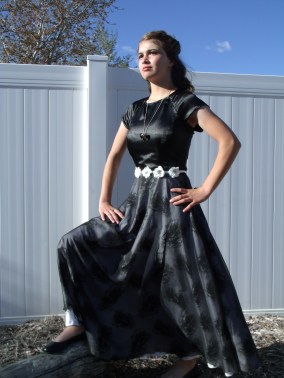
All of my kids do things differently, like making a prom dress skirt out of storm trooper fabric.

Oh, if you could have seen her eyes rolling. Like planets falling out of orbit.

“No!” she declared. “I am done! Let’s get on to real life!” Then she pulled out her tablet, with yet another recipe on it, and headed to the kitchen where she’s been experimenting with meals she can make after a day of college classes.

She’s moving on when she’s ready to, not when some random bureaucrat declares her “mature enough.”

She, like my other children, is making choices for her life, based upon her needs.

I love having a house of rebels.

“Let’s hope there are still a few rebellious ‘teenaged’ souls out there,” Mahrree whispered to Perrin.

“Besides us, I mean.”  

~Book 2, Soldier at the Door

(Book 5 is published and available! Get Safety Assured Leaving East of Medicetti at Amazon, Smashwords, or here on “Start reading the books!“)

Getting rid of things is not getting rid of people

Anyone else get paralyzed by decluttering?

By staring at that old, ratty thing that you’ve had in a box for years, but can’t throw away or donate because of memories, guilt, or because you’d hauled it around for 28 years and it seems ludicrous to finally dump it now?

On the other hand, I look around my house and think, “If that were lost in a fire, would I try to replace it?” The only things I’d want to preserve, aside from my family, are our photos.

Everything else? Nah, they can go.

So why can’t I just chuck them now?

My kids will have to, in a few years. I should save them the hassle.

When my parents started to decline about six years ago, we began the first of many moves, putting them progressively into more intensive care, and also smaller rooms. The first time my siblings and I walked through our old house, which could have served as a backdrop for “That 70’s Show,” I was a little weepy.

Until I took a good look at the green shag carpet, which had been there since my parents bought the house in 1978.

(Not my parents’ old house, but could have been.)

Hideous.

The longer I looked at items my parents no longer needed in their new residence, the more I found myself wanting to chuck them. We preserved photos, journals, my dad’s paintings, and a few books. But everything else?

Within an hour we were tossing the majority into a dumpster. And we couldn’t do it fast enough. Who really needs Tupperware that’s forty years old?

We had to go through the process three more times, as they moved again, and finally as they passed. Each time we took home fewer items, until when my dad died all I wanted were his scriptures. My siblings took a few items, and the rest we donated. It filled the back seat of a car.

As I looked around his room, I realized that he lived quite well with very little.

The entire tiny house movement is based on this: the fewer items we own, the freer we are to live. The less house we own, the more money, time, resources, and peace we have.

I’m fascinated by minimalist movements, like Becoming Minimalist , full of advice to getting rid of all of the stuff we accumulate, thinking it will bring us joy.

(From the Becoming Minimalist Facebook page.)

Or Marie Kondo’s konmari approach to keeping only items that “spark joy” and releasing all those things that no longer do. She suggests giving them to find a new home, to bring joy to someone else.

I did that a few years ago with a china set my parents bought me before I was married. I used it exactly twice. Then I sold it, 25 years later, to a family in our neighborhood for $50. I felt simultaneously guilty and relieved; guilty because I thought it was so important that I never used it (and took it with us on a dozen moves), and relieved that someone else could enjoy it.

Probably 1/2 of all I own I wish I could “send on its way,” but guilt holds me back. My husband made this, or my deceased sister bought me that, or my mom used to wear this, or I read this once, thirty years ago.

I need to remember that the love and memories associated with that person or event don’t leave with the item.

They’re just things I’m throwing away, not the people.

High Polish Tatra mountains

Writing Book 5, and forcing characters to leave behind all that they own, made me wonder how I’d face the same situation. I admit, it’s left me mixed. I want to be able to toss it all, but irrationality holds me back.

A friend told me of her parents’ house—true hoarders—and their many packed sheds in their backyard. They’d asked their grandson to pull some weeds so they could open the door again (it’d been that long since they’d been in there), and as the brawny boy leaned against the shed for leverage, the entire thing crashed down. Everything was destroyed.

The boy’s father cheered.

The boy’s grandparents mourned.

Nothing was salvageable, nor could they remember what they had stored in there for many decades (mostly old paint, it turned out). But they resented having to throw it all away anyway.

(Don’t let this be your children’s fate.)

The rest of the family was thrilled when that shed came down. In fact, they had the grandson lean against all of the other sheds, hoping for a similar result. When my friend’s parents finally die, they’ll need at least three dumpsters, she estimates, to unload all of the stuff no one—not even her parents—can use.

There’s some strange pride in not letting things go, in holding on to something beyond its usefulness.

In not allowing anyone else to have it.

In not acknowledging that you never needed it in the first place.

Some psychiatrists suggest it’s a mental illness, or maybe conditioning from grandparents who endured The Depression nearly one hundred years ago. I remember well the “get more attitude” of the 1980s, where acquiring stuff was all the rage, where your value was based upon what you owned. I think a lot of us in my generation still suffer from this early programming.

But there’s simply no good reason to hoard stuff. No one needs 12 hammers, as one elderly man I know possessed (among a great many other things). He said someone might need to borrow one. In the thirty years I knew him, no one ever came looking to borrow a hammer. Or one of his 15 hand saws. Or 20 screwdrivers. He could have given them away long before they became rusty, to someone who truly would have appreciated them. But no.

I have a friend who has an entire bedroom stuffed with bins and boxes, all for Christmas. It takes her a full week to decorate her house, inside and out, and three Christmas trees. She admits it stresses out her family, especially since every surface is covered in something breakable, but every item is wrapped up in memories, she insists.

The memories of her children, however, of their anxious Christmases, may not be so favorable.

Why do we keep old furniture that’s damaged or even moldy, clothes that don’t fit, knick-knacks that went out of fashion years ago, paintings that no longer interest us, and books we’ll never read again?

Stuff our kids will throw out in another generation with alacrity?

For reasons I don’t yet understand, we often choose to remain burdened and laden by all that we own.  I want to empty out my bedroom closet, but that means tossing a stack of yearbooks. All I need to do is scan in the handful of photos I appear in, then throw away the books I have never, ever looked at since I graduated in the 1980s.

I also have several paintings I did in high school, which I’ll never display because they’re pretty poor, but which I can’t bear to give away. I’ve needlessly hauled them around for decades.

Sometimes I wish we could have a random fire, hitting particular items so that I’ll be forced to get rid of them. Moving many times has helped; each time I had to throw away boxes of destroyed stuff I thought I couldn’t live without I was relieved that I had a reason to get rid of them.

I have to admit, I’ve purposely dropped one or two items during a move just so that I didn’t have to find a shelf for them later.

I’m slowly sliding closer to minimalism. Each shelf that gets emptier, each old box that vanishes, each bag I bring to charity lightens my heart and eases my conscience.

By the time our youngest leaves the house in 15 years, we anticipate we’ll be moving into a tiny home, and that should force me to get rid of the last of the crud. I hope that by the time my husband and I die, our kids will need only an hour to clean up what we left behind. 

Doesn’t this just feel so clean, so simple, so serene?

Until then, I’ll try each week to toss out 10 items I don’t need. That’s my goal for the summer, and we’ll see how it goes.

If you happen to be good at separating things from those who gave them to you, tell me how you did it. I’m gonna need some motivation by August!

How to cancel your Mother’s Day Guilt Trip with “Moments of Perfection”

The following was written by my mother,  Yvonne Neufeldt Strebel, in 1984. She delivered this talk in church on Mother’s Day.  I found this speech in my dad’s journal, and reproduced it here, to show that fear of not measuring up as a mom has been around for at least 32 years.

“Mother’s Day”—the very word awakens feeling of appreciation, gratitude, and love, and rightfully so. I am grateful to be a wife and a mother and to have a good family.

Yet Mother’s Day in our home is known as “Guilt Sunday,” the date for my annual guilt trip.

Beautifully rendered Mother’s Day speeches have left me with a depressing feeling of inadequacy. I have often asked myself, “Could it be possible that my family is succeeding in spite of me?”

I do not measure up to the ideal motherhood, the Supermom. I know that, because I have tried to be Supermom and failed. I am not alone in my plight. Actually, I am in very good company. There are other mothers who have expressed the same sentiments concerning Mother’s Day and Supermom. 

Supermom—you know the type. She gets up very early, every single morning. Go, call on her between 5 and 6 a.m. She will greet you with a radiant smile and will be beautifully dressed, perfectly groomed, unhurried—yet lively—although she has been up for hours.

She has exercised, written in her journal, perhaps even composed music or written poetry.

She in now preparing not only a nutritious, but also an appetizing breakfast, which she will serve on an elegantly set table. No lumpy oatmeal or cold cereal for her family.

Supermom never ever loses her temper, and if she is in pain, she hides it. She always sings while doing chores. She loves and supports her family 100%, does her church and community work exceptionally well—better than anybody else—and never tires. Evening meals, always served punctually, are gourmet delights.

At night, when the day is done, Supermom lovingly turns to her husband and with a brilliant smile, accompanied by a demure sigh, says, “Darling, I love all my challenges. I only wish I could have more.”

I identify with Supermom in only three categories:

  1. I am, by my Prussian nature, punctual: dinner is always served on time, or else we eat out.
  2. Church and community work are very important to me. I love both. But I, unlike Supermom, do get exhausted.
  3. Most importantly, I love my husband, children, in-laws, and grandchildren with all my heart and I support them to the very best of my ability. Although my very best could not ever match that of Supermom.

Other than that, I do not qualify. And I had to come to terms with that. (I also had to prepare this talk.)

Does Supermom really exist, or is she the sum total of imaginations of many kind Mother’s Day speakers?

If she exists, could she perhaps step forward and tell me how she does it?

I suspect Supermom is a myth. I am no longer willing to compare myself to a myth.

supermom myth

In the 1984 April General Conference, Elder Marvin J. Ashton pointed out that,

“comparison is another tool of Satan. Many [mothers] seem to put too much pressure on themselves to be a Supermom or Superwoman . . . A good woman is any woman who moves in the right direction.”

The foundation of motherhood is nurturing love. If we keep this in mind, we need not compete in the motherhood Olympics in order to find the perfect mother.

We are all on the road to perfection. Along the way, we gather what I would like to call “moments of perfection.” These are occasions when we do well and achieve, usually in quiet ways. There are no headlines, no fanfares, but Heavenly Father approves.

When my own children were small, they would bring me the most beautiful bouquets of dandelions. It was better than their previous practice of beheading our neighbor’s prized tulips. When I treated these dandelions as a bouquet of roses, then this, in a small way, was a “moment of perfection.”

I made myself a questionnaire befitting my own situation:

  • Do the women I come in contact with know that I am not their critic? That I will not give unsolicited advice?
  • Do they know that I accept them and their uniqueness as I hope they accept mine?
  • In admiring another woman’s accomplishments, can I do so generously and from the heart, without making it awkward by adding, “You’re so gifted! I could never do that. You have all the talent, and I don’t.” If I can be positive, then I can gather another “moment of perfection.”
  • When receiving a compliment, can I thank graciously without belittling myself? “Oh, it’s really nothing, just something I shipped up quickly,” although in reality I have slaved over it for hours by the sweat of my brow.
  • In serving others, do I do so out of a good desire and because it is needed?

These could all be “moments of perfection.”

If I am not motivated by guilt or fear of what others might think or say, then I have created another “moment of perfection.”

When reporting back to my Heavenly Father at night, I may have had a disastrous day, in part caused by my own weaknesses. But when I repent and ask forgiveness, and I can feel the comfort of the spirit, I know that my repentance has been acceptable to the Lord and I express my gratitude to Him. This then is a very good “moment of perfection.”

“Moments of perfection” can be gather by us all, regardless of whether we are parents or not.

In the final analysis, as I understand it, that which is really crucial to my being a good mother can be summarize in three points:

  1. My obedient to the laws and ordinances of the gospel. I need to keep my covenants faithfully. This makes a closeness to Heavenly Father possible, a closeness I desire.
  2. My nurturing love for my family. I need to learn and practice unconditional love.
  3. My integrity toward myself and others, which I must learn to perfect.

With this in mind, I can learn to eliminate fruitless comparison and cancel my guilt trips.

True personal liberation can only be achieved through genuine gospel living. Heavenly Father lives and loves us all, and recognizes our honest efforts.

1969 Yvonne and Trish, 1969 (2)

My mother and me, 1969 (I’m the small one.)

Yvonne Neufeldt Strebel was born in 1927 in Neisse, Prussia, Germany (now Poland). She endured WWII as a child, losing many of her family to the war, then escaped alone as a refugee fleeing from the Soviet army when she was 17 years old in 1944. She eventually met Rudolf Strebel in Munich, and in 1954 they immigrated to America and married, settling in Utah until their deaths. Yvonne passed away in 2014, at the age of 86. She had four children, 23 grandchildren, and many more great-grandchildren.


Book 5 cover reveal coming next week!

By Wednesday I’ll have completed the cover for Book 5: Safety Assured Leaving East of Medicetti! 

Interestingly, I’m using my oldest son on the cover, the one I wrote about earlier  who’s been ill with a strange viral infection for the past week and a half, and now a secondary bacterial infection. After three hospital visits, he’s finally on the mend.

Just a couple of days before he fell ill, we did his preliminary photo shoot. I told him that past experience showed we’d need to do a second shoot, because even though I took fifty shots of him, I’d realize they were all wrong, and we’d have to redo them. And perhaps a third time. (Maybe this is why my family is reluctant to dress up for my book covers?)

Well, after going through his photos, I realized they were pretty good, and I didn’t need to redo them after all. Good thing, because being ill has taken a toll on him, and it’d be a few weeks before he’d be back in shape.  Tig as Peto (First off, he’d have to shave his two weeks’ beard growth, and that would nearly kill him. I purposely took pictures of him right after he got home from the army, so that he’d still be clean shaven. I didn’t need Goatee-Man on the cover, although he pulls off that look pretty well.)


I changed his eye color, turning his dark brown eyes to light gray. (Any ideas who he’s going to be when his editing’s all finished?)

I did the same thing to his brother, who I used on the cover of Book 2: Soldier at the Door. It’s strange how merely changing one’s eye color suddenly changes the whole person. Both of my sons have very dark brown eyes, but not here. They’re no longer my boys, but new characters.

Bubba with blue eyes

(This change to blue eyes still creeps me out.)

While the rest of my family groans quietly before agreeing to be on my covers (they work for cookies, fortunately) my 8-year-old daughter, however, is DYING to be on a cover, so I may have to write a small book, just for her. (Working title: The Life and Times of a 3rd Grade Narcissist.)


Book 5 teaser–Avalanche on a sunny day

Ever have one of those days/weeks/years, where you were hoping for a sunny day, but instead were buried under a ton of freezing cold snow?

Why is it so hard, on those avalanche days, to remember the snow is only a temporary condition? That the financial/medical/emotional/housing crisis that consumes you today will eventually melt away, and you’ll be left in sunshine? At least, eventually.

High Polish Tatra mountains

And there’s no St. Bernard in sight . . .

This is one of those avalanche months for me: our employment isn’t where it needs to be to sustain us, we’ve had some flooding disasters in our basement requiring repairs and replacements (our deductible is so high we’ll have to cover it ourselves), and for the past week my very healthy and active adult son has been in and out of the ER battling a high fever and various infections, and no one can pinpoint the cause, despite the many expensive tests they’ve run. And, because he was just released from active duty in the army and doesn’t have a job yet, he doesn’t currently have health insurance. I was reminded of that fact when I went to pick up his prescription this morning. Bizarrely, a month ago, his younger brother, on an LDS mission in Oklahoma/Texas, came down with viral meningitis and was hospitalized for five days, with daily treatments for another week. (I need an extended warranty on my adult sons; theirs is expiring, I fear.) Pile on top of all that some personal epic failures where I handled some problems poorly this week, and I feel like I’m suffocating.

Sometimes I think part of the reason I’m encountering these avalanches is because I’m so close to finishing Book 5–Safety Assured Leaving East of Medicetti. There are principles and ideals in this book that have weighed heavily on my mind for literally decades, and I didn’t know how to share them until I began this series. Getting this book out feels very important. I’m still plugging along at it, when I find a few minutes here and there, getting all the thousands of remaining details fixed and nailed into place, but without the usual joy I experience when I’m close to releasing a book. I apologize to it each day when I sit down to my laptop that I’m editing with a dull heart.

Which, in a way, I know is stupid; downright stupid! We’ve faced greater challenges before! Years ago we lost a home, had to live with relatives, and were even homeless for a time! We spent four months living in a condemned house! (It was torn down after we moved out; rumor has it someone kicked the foundation and it fell on its own.)

We’ve weathered job losses, financial disasters, car accidents, and emotional distress, and lived to chuckle about it. Sunny days returned!

So why, oh why, is it so hard to remember those sunny days–sunny weeks and even months–on avalanche days? Why do we frequently sit down in despair certain that this time there’ll be no deliverance? That the months and even years it’ll take to come back from this latest disaster will be the ones that finish us off for good?

Why can’t I remember, for example, that less than a year after we lost our house, we were able to purchase a brand new one for an incredibly low price? And when we sold it five years later, the profits wiped out another debt we’d been carrying for years?

IMG_0670

This was my front yard two weeks ago. A week later it was 75 degrees.

Today I’m trying to remember those sunny days, ones that were suddenly so hot and bright that the remaining snows vanished before the day was over, and I found myself breathing easier.

Today I’m trying to remember that while sometimes winter holds on, and on, and on, I can’t ever remember a year when spring and summer didn’t come. They do, eventually. Never as soon as we want them to, but the sunny days do return.

Eventually.

In the meantime, I need to quit my brooding and find a shovel . . .


(By the way– I still have some free magnets and book marks to give away! Just send me your mailing address, and I’ll send you my thanks for your support. If you want last year’s magnets too, let me know in the message below. I have a couple left.)

Go back

Your message has been sent

Warning
Warning
Warning

Warning.