My Year of Living Deliberately

I don’t have enough time. Or money. Or control of my life.
And I’ve realized that’s all my fault.

For quite some time I’ve been living in survival mode. I think we all hit that sometimes, when we’re just holding on, trying to keep lives and spouses and children together, barely squeaking by month-to-month, existing with an underlying anxiousness that at any moment, something may fly off and send the precarious balance of our lives in a tailspin.

I’ve also realized that’s a stupid way to live, and I can actually do something about it.

I’ve realized I can live Deliberately. (Yes, with a capital D.)

Some weeks ago I read these words by Quentin L. Cook, and apostle in The Church of Jesus Christ of Latter-day Saints:

We need to recognize that there is a seriousness of purpose that must undergird our approach to life and all our choices. Distractions and rationalizations limit our progress.

This has become my mantra for 2015.

My life is more than halfway over.
At age 45, I suppose I’ve hit some kind of midlife crisis.
Where I work I see many people in their 60s, 70s, and 80s, and I’ve noticed two different groups.

 One group is always in survival mode, and rationalizing that way of life. “I can’t lose weight. I can’t be better. I’ve always had bad genes. I’m going back to the doctor for another prescription. I need more help. ” They whine, they complain, and they age rapidly.

The second group—and I work directly with several in this group—are living Deliberately. “I’ve given up sugar and soda, and I feel so much better. I’m exercising more now than ever. Yes, I have some aches and pains, but that’s not going to stop me from working today. I’ve got babysitting my great-grandkids today after work.” They smile, they tackle their challenges, and they’re aging hardly at all.

In Falcon in the Barn (yes, it’s still on track to come out in early spring!) Perrin is thrown into a level of depression he’s never before encountered. He no longer acts, but is acted upon. Not too give too much away, he becomes a shadow of the man he used to be, and he hates it.

At some point in editing those chapters, I realized I had fallen into the same slump as Perrin, frustrated with my feeble attempts to reduce our debt, to improve our home, to make some progress in my life. Nothing was happening as I wished, because I was letting our circumstances work on me, instead of the other way around.

I’ve observed that successful people have Deliberateness in their lives, a seriousness of purpose, an attitude of I refuse to be the victim. As Cook said, 

My concern is not only about the big tipping-point decisions but also the middle ground—the workaday world and seemingly ordinary decisions where we spend most of our time. In these areas, we need to emphasize moderation, balance, and especially wisdom. It is important to rise above rationalizations and make the best choices.

So, tired of limping along, I have decided 2015 will be my year of Deliberateness—my year of making every choice one of careful examination, and wasting nothing. I’ve distinctly felt God nudging me in this direction for the past few weeks, and I’ve learned that it’s never a good idea to ignore the promptings from the Almighty. And to hold myself accountable (because accountability is the essence of life) I’m proclaiming my goals here.

First, I’m Deliberately trying to write neater, which may not sound like much, but I haven’t been able to decipher my own penmanship for a decade now. I pulled out a leather journal given to me eight years ago which I never before dared to use, bought myself a mechanical pencil, and have already filled three pages with completely legible writing.
I had no idea I was capable of that.

Second, I’m Deliberately eating better. I have issues with gluten, and at Thanksgiving realized I needed to limit my diet again. It was either my brain, or my bread. Since I’m a bit on the zombie side, I decided BRAINS! I Deliberately chose better foods, tried some vegan dishes, and limited my intake of sweets, all in an effort to improve my health.

Something shocking happened. From Thanksgiving to New Year’s I LOST 8 pounds! The last time I lost weight over the holidays, I had to give birth to a baby. Eating healthier was SO much easier. I’ve discovered that I like cilantro, brown rice, and quinoa. (I even know how to pronounce quinoa properly, too.) At this rate, I might actually become the weight I’m supposed to be by the end of summer.
I had no idea I could do that.

Third, I’m Deliberately reducing my time in frivolousness. That means that although I’m a reading junking, I’m refusing to read every little post, link, or meme on Facebook, and I will no longer waste time on silly quizzes that tell me the color of my wind (I’m suspecting it’s brown).
Before I started writing my book series, I gave up watching TV (never miss it), gave up my magazine subscriptions (never miss those, either) and deleted Scrabble and Free Cell from my computer (the only games I ever played). Suddenly, I had enough time to pursue my real goals. I Deliberately follow only two blogs, and when I go to Pinterest, I’ve vowed it will now be ONLY to find a new vegan recipe.

I’m also now writing a tongue-in-cheek pregnancy and baby care book, and reducing my dawdling on Facebook and Pinterest gives me the time to do that as well.
I didn’t realize such a small change could make such a big difference.

I love how Cook puts this:

Sometimes it feels like we are drowning in frivolous foolishness, nonsensical noise, and continuous contention. When we turn down the volume and examine the substance, there is very little that will assist us in our eternal quest toward righteous goals. One father wisely responds to his children with their numerous requests to participate in these distractions. He simply asks them, “Will this make you a better person?”

I desperately want to be a better person.

So I’m also Deliberately going to bed earlier and Deliberately getting up the first time my alarm blares.

I’m Deliberately scheduling time to write and study, and I’m Deliberately watching my bank account every day. I will Deliberately pay an extra $5 here and there to chip away at the debt that plagues us, and will keep track to prove to myself that every little bit really does help. I may be chipping away at an iceberg with a butter knife, but it’s better than pretending that iceberg isn’t about to engulf me.

Yeah, that’s a big list. I’m going to fail at all of those points at some time or another, but so what? I’ll Deliberately begin again. And again. And again. Because at some point when I was writing about Perrin’s struggles (don’t worry—no spoilers here) I realized that if he could make some changes, certainly I could as well.

Because I’m running out of life.
I’ve got less than half of it left, and I want to be healthy enough to play with my three-year-old’s children when he eventually has them.
I want to be mentally, physically, and spiritually strong enough to help all of my nine children when they need it.
I want to write another dozen books.
I want to work long enough to drag us completely out of debt.
I want to be the one pushing that friend’s wheelchair in thirty-five years, not the one riding in it.
I want to look back on my life with few regrets, and I want to feel that I took charge of my circumstances, and lived a Deliberately full life.

When Perrin woke up, he wanted that morning to be significant, to be the day he was truly a new man. He could no longer allow himself to be consumed by himself. There were too many other people needing him, and he could no longer remain indulgently weak. . . .
What was his goal today? Not to be the kind of man the world wanted, but to be the kind of leader the Creator wanted him to be. 

~Falcon in the Barn

Why didn’t you do anything to stop him?

“Why didn’t you do anything to stop him?”

That’s what people frequently asked my father. He immigrated to America in the 1950s, and had a subtle yet clear German accent.  “Why didn’t you stop Hitler when you noticed he was ruining everything? He completely changed Germany, and you did nothing about it!”

My dad would answer, calmly and rationally (even though some of those who asked were hardly calm or rational in their verbal attacks). “First, I was born in 1931, so I wasn’t too influential in the politics of the 1930s and 1940s. Second, what could we have done?”

That question has weighed heavily on my mind these past few years as I’ve watched facets of our government morph into something I don’t recognize as America anymore.

Now, this is NOT an Obama-is-Hitler post. But the questions asked of my father have been clanking around in my mind for some time now. “Why aren’t we doing something?”

I won’t go into details of what worries me in our government (except to whine that the ironically named Affordable Care Act isn’t affordable, doesn’t care, and is completely an act; and that the impending immigration reform via executive order [read: tyrannical mandate] would infuriate my immigrant parents who jumped through all kinds of hoops to come to America legally).

But I won’t be surprised when, in years from now, our children ask the same question: “Why didn’t you stop him when you noticed he was ruining everything? He completely changed America, and you did nothing about it!”

IMG_3277

Don’t worry; my baby girl wasn’t traumatized for too long.

Now I freely admit that not everything about Obama is bad. No one is wholly evil (even Darth Vader had a few soft spots).

Personally, we have benefited immensely from the Income Based Repayment program for student loan payments, signed into law by Obama in 2009. Without that, we’d be living in a cardboard box right now, while a huge chunk of our income went to pay off our student loans. I’m grateful for this program and pray that it lasts.

My father, too, was grateful for the Autobahn and Volkswagen, initiatives of Hitler to help the common man. And in many ways, Hitler was a man of morality. He never smoked or drank alcohol, and instituted a “Fast day” where citizens fasted for a meal and were encouraged to give the food they didn’t eat to the poor. Hitler increased education, reduced unemployment, rebuilt Germany’s infrastructure, and—contrary to popular belief and internet memes—relaxed Germany’s gun laws so that more citizens could be armed and even purchase guns at younger ages (the Jews, however, he disarmed, unsurprisingly).

In 2004, my dad was asked to speak to the fourth graders at a local school, and he told them that, “Hitler was a very convincing and inspiring speaker, and he could convert many of his listeners to his ideologies.  . . . Depression, unemployment, and poverty were rampant, and he wanted to turn things around.” And he did.

And that’s when Germans decided he wasn’t such a bad chap . . . until things started to shift.

And that’s when it was too late. Germany was becoming a country unrecognizable to its citizens. Within just twelve years, he changed everything, while Germans stared in disbelief wondering what just happened.

I worry that it’s happening here, too. The Constitution was established to keep our borders safe so that citizens could live their lives as their consciences dictated. But we’ve been drifting away from that for some time now, and considering historically that no republic has lasted intact longer than 200 years, I suppose it’s time for us to implode. As Alexis de Tocqueville wrote, “The American Republic will endure until the day Congress discovers that it can bribe the public with the public’s money.”

I’m definitely no politician, primarily because I feel my heart rate increase, along with my blood pressure, when I read what’s changing in our country. How the Constitution is disregarded. How the Supreme Court overreaches. How states’ wishes and votes are overturned by judges not even in their states. And how the president can do just about anything he wishes through an executive order, while Congress bickers and does nothing.

When Ronald Reagan said, “The scariest sentence in the English language is, ‘I’m from the government, and I’m here to help,’” he was prophetic.

It is the duty of the patriot to protect his country from its government.
~Thomas Paine

My father told the fourth graders: “At Hitler’s rallies the masses shouted, ‘Leader, command; we follow you!’ With this shout, Germans surrendered their reasoning power and forgot to think for themselves. Later we found out that actors with loud voices were interspersed in the crowd, and at the right moments they shouted this cry and the crowd repeated it.”

Are we all just going along with the crowd as well? Because a few well-placed voices are shouting that it’s ok to follow blindly, to let Common Core decide our children’s education, or that the wife of the president can declare how many calories my kids eat at lunch?

I believe there are more instances of the abridgment of the freedom of the people by the gradual and silent encroachment of those in power, than by violent and sudden usurpation.
~President James Madison

We have no excuse for doing nothing about the abridgement of freedoms we’re experiencing. Again, from my dad: “How was it that Hitler had such tight control over the whole nation? The answer lies with the Gestapo, or State Secret Police. Midnight visitors might show up and take that person in ‘protective custody,’ and they wound up in a nearby concentration camp. Smart people knew how to keep silent.”

We’re smart people (perhaps) and we don’t have to keep silent. We don’t have a Gestapo (but we do have an IRS, which Tea Party members would be happy to tell you about).

The Constitution is not an instrument for the government to restrain the people; it is an instrument for the people to restrain the government — lest it come to dominate our lives and interests.
~Patrick Henry

But we do have social media, we have forums, we have ways to complain and protest—many more than we had in the 1960s when they really knew how to protest—yet nothing’s improving. Political parties squabble uselessly, and we citizens suffer for it. Those who hold religious and moral values are increasingly persecuted for not embracing behaviors we deem against the will of God. And despite our public protests on social media, we’re losing.

If ever time should come, when vain and aspiring men shall possess the highest seats in Government, our country will stand in need of its experienced patriots to prevent its ruin.
~Samuel Adams

So how do we do prevent our country’s ruin? What would Samuel Adams do? Thomas Jefferson? I’m sincerely asking for ideas.

I also ask this since I can’t ask my father, who’s still alive at age 83, but whose mind is gone because of Alzheimer’s. Back when George Bush declared war on Iraq, Dad wrote a letter to the editor of his local newspaper stating his concerns about the action, and also wrote to the White House. He was proud of the response he received from Washington, and that his letter was published in the paper, but was discouraged that we still went to war. Twice.

Repeatedly he told me as I was growing up that we had to speak up when we thought something wasn’t right in our country. “We didn’t have that possibility in Germany, but we do in America.”

He was so proud to be an American citizen. He served in the Army, always voted, wrote many letters to politicians, and had the phone numbers for Oren Hatch’s office and the White House on his phone list. And he called them!

dad confused

Dad, and his classic, “Oh, brother . . .” look of dismay.

Later, he amended his answer when people asked him why he didn’t do anything about Hitler. “I was a child in WWII, but as an adult I make sure my opinion is heard. I became an American citizen because I love this country and believe in the pursuit of freedom for everyone. What are YOU doing to make sure this country remains free?” 

Strange as this sounds, I’m glad Dad’s awareness and memory is impaired. He’d be dismayed to see how we’ve strayed from the Constitution he dutifully studied. He’d be wringing his hands in worry that history was repeating itself, trusting a man who thought much more of himself than he should, and took upon him much more power than was ever intended.

Most of all, I still hear him saying, “Why didn’t you do anything to stop him?”

America will never be destroyed from the outside. If we falter and lose our freedoms, it will be because we destroyed ourselves.
~Abraham Lincoln

People tend to trust whoever sets themselves up as the authorities, but at some point each person needs to look at what’s claimed and test it. Is the sunset really pink, or is it more of an orange? What do you see?

Did the government deserve her trust? They acted as if they already had it, Mahrree thought cynically. As if they could just take it, not earn it. And no one was questioning that, were they? They collect our trust as easily as they collect our taxes. We wanted them to succeed so we trust them blindly. Foolishly. And they’re using that. If people stop arguing, stop thinking, and are just willing to take—to trust—whatever the authority dishes out, they’ll accept just about anything— 
~The Forest at the Edge of the World (book 1)


The best Christmas idea in years

Normally I don’t pitch products on my website, but this time I’m making an exception, because this is a truly clever idea (one that makes you think, Daggum, why didn’t I come up with this?), and because I was asked to contribute to it.

Santa’s Red Letter is a marvelous service created by my neighbors (Craig’s an uber- talented graphic designer). How cool would it be to receive a customized letter, with a gold signature, from Santa himself?

Yeah, great idea, isn’t it? (You’re saying, Daggum! in your head, aren’t you?)

The best part is, the receivers of these letters won’t know it came from you and will be amazed to receive a lush, gorgeous message from the North Pole complete with their names and even a few personalized details.

Actually, the very best part is that $1 from each letter goes to the Toys for Tots program, so not only can you send a piece of magic for Christmas, but a needy child gets a bit of magic as well.

Toys For Tots

My neighbors and my children’s friends, the Stapleys, teaching their kids to buy presents for others. Seriously, how cute are they?

So why do I care? Because this year the Stapleys tasked me to write up the letters, and I’ll tell you, mentally putting myself in the very ample pants of Santa was quite the experience. I chanted in my head, “I’m a fat old elf, and I’m happy to write to this sweet little girl . . .” or “I’m a jolly old elf pretty ticked off with James in Centerville . . .”

Nice LettersThere are two categories of letters you can choose from. Red Letters are for Nice children and adults, and even groups. We came up with 14 different kinds, for a variety of situations. For example, how fun would it be for a school or church group to receive a letter from Santa thanking them for completing a Secret Santa project?  http://santasredletter.com/collections/red-letters/products/big-hearts.

I also thought about kids who sincerely try to do something good this season, and how delighted they’d be to realize that Santa noticed: http://santasredletter.com/collections/red-letters/products/just-like-jesus.

And if you have a child asking for a hard-to-get item this year (that maybe not even Santa might be able to find)? We came up with a letter for that, too: http://santasredletter.com/collections/red-letters/products/hard-to-find

And then . . .

Naughty LettersAnd then, I had the delicious delight to think about, What if Santa was pretty disappointed with a child or—even better—an adult? We came up with seven Black Letters (cue the ominous music), and yes, as I penned these, I thought about people I knew who deserved a tsk-tsking from Santa. Here’s my favorite:  http://santasredletter.com/collections/black-letter/products/hall-of-shame-letter Seriously, my Hall of Shame letter still makes me chuckle, and surely you know of adults who really deserves to find this in their mailboxes!

There are also letters for kids who have far too many items on their wish lists, kids who have been treading in Naughty territory and need a nudging back to the Nice side, and even congratulatory and surprise letters for adults.

No, I’m not getting any kickbacks from this website, but I do get a kick thinking about kids and adults who’ll have a fun shock from receiving a letter from Santa.
And I get an even larger kick that last year the Stapleys spent well over $200 on Toys for Tots from this project.

This Christmas, let’s make that donation even larger.
So send someone a letter (each is only $11.95). Amaze your friends and family.
Have a blast.
And start having a Merry Christmas!


What if Santa Wrote Back?

The family MUST come first

Contrary to common societal belief, as a wife and mother, I do need to put my family first. That’s why book four—The Falcon in the Barn—is a bit delayed. I’m now hoping for a January 2015 release (and that’s ambitious, too, so I apologize). I understand your frustration; I feel it too. I had planned to have Falcon ready by November but circumstances won’t let me.

Because I have a family that needs me.

Financial constraints have required me to get a part-time job. And another part-time job. One is only for 12 weeks, and requires me to grade papers at home for many hours. The other keeps me out of the house for 20 hours a week. All together, this means that the four or five hours I used to enjoy writing each day has diminished to 30 minutes (if I’m lucky) and usually late at night when I’m wiped out because I had to catch up on taking care of the house, homeschooling my kids, and figuring out why we’re out of milk again.

Writing progress is pretty grim.

On the other hand, I have enough income to keep the electricity and water on, and the car insurance up to date. Never mind that my joy of writing—along with all other hobbies—has to take a back seat for who know how long. But that’s ok, because my life’s not about me; it’s about taking care of my spouse and children.

Virginia Woolf famously wrote 85 years ago that “a woman must have money and a room of her own if she is to write fiction.” If I had plenty of money, I could quit my jobs and write.

But not only do I not have money, I don’t have a room of my own. My computer is perched in the corner of my bedroom, where—just now—my 7-year-old and her friends trudged in to ask for Otter Pops (we supply the neighborhood). Of course I said yes, then skimmed what I had written to find my spot again.

Interruptions define my life, because my life is all about family. I can think of only a handful of times over the years that I actually shut my door and told my family that no one was allowed in for the next half hour. Otherwise, the carpet to my computer has been worn thin, because they know they’ll find me here, either writing, editing, or grading papers. And I will never turn them away. They have to come first. I committed myself to being their support long before I committed myself to writing a book series.

virginia woolf

She wasn’t the happiest of women, committing suicide by drowning when she was 59.

Virginia Woolf didn’t have children (but likely was bi-polar, which some may argue is just as grueling), so she didn’t understand the pull and yank between being me and being mom/wife. I know it’s counter-culture to claim that I need to be mom/wife first. (“What about your needs? What about your development?” goes the familiar crank.) But frankly, I’ve known too many women who put themselves first, and lost everything else that was important. One writer admitted to still pounding on her laptop during the labor of her baby, and was so obsessed that she devoted all her time to her book . . . and none to her marriage, which ended.

It’s popular to say, “Oh, I’ve worked so hard! I need me-time,” but I’ve discovered over the years that “me-time” can be accomplished in about thirty minutes a day, even less if secret chocolate is involved. Some women I’ve known spend hours on themselves/hobbies/pursuits to the benefit of no one, not even themselves.

Oh, I’m not perfect. I’ll confess to fantasies about everyone going away for a week or so, leaving me with a perfectly clean house, full fridge, and absolute silence so I can write nonstop and really get something accomplished. I’m jealous of friends who take vacations without husbands and children, and drool over what I could get done with so much freedom.

But I also know that after an hour of such freedom I’d get fidgety, and would be on my phone to make sure everyone was all right, that clothes were on (we have “free ranging” issues with our toddler), and that they ate something more substantial than Nutella sandwiches again.

Because honestly, I’m not entirely all right without them. Working away from home, while leaving me with desperately needed cash in our bank account, also leaves me with great anxiety that I’m not doing my duty to my family. When I come home, I’m a mixed bag of relief and disappointment; relief that my 14-year-old remembered to change the toddler’s diaper and the living room isn’t too chaotic, and disappointment that my 16-year-old reports that everything was just fine without me.

Until circumstances change, I’ll lurch and strain and struggle to fit in 135 things where there’s space only for 97. I’ll forget a few things (note: I ended up doing the dinner dishes at 11:30pm) and maybe later tonight I’ll squeak in a half hour of rearranging book four, but only after I’ve gone with my husband to an alumni event at the college, and picked some apples with my kids at a neighbor’s, and did some sewing for Halloween costumes (curse the church for having a costume party TWO WEEKS before the actual date!), and run a load of laundry, and finished dinner, and helped my daughter with homework, and my son with homework . . .

So, yes—Falcon’s coming, my friends. But while I so dearly love writing it, I need to love my family more.

Thanks for understanding. (P.S. Took me another two days to actually post this after writing it. Sigh.)

Mahrree sighed and said, “My children have me tied?”

The thought had never occurred to her. True, her life was completely different now. But caring for these little children, who she thought were funny more  often than frustrating, loving more often than loud, was an honor. It said so in The Writings, and she’d chosen to believe it from the moment she knew she was expecting her firstborn. And choosing to believe it had made all the difference in her attitude as a mother. ~Book Two: Solider at the Door

If you don’t want me looking, then don’t go showing.

Once there was an artist who spent a great deal of effort creating a marvelous 3D work of art. The artist carefully selected paints and fabrics and materials, then spent hours combining it all into a masterpiece that the artist happily brought down to a busy city street.

The artist sat back on a bench to see how the work would be received. Soon someone walked by the structure and paused, squinting her eyes as if jealous. To this reaction, the artist smiled in smug satisfaction.

Others walked by completely ignoring the piece, and to that the artist harrumphed, insulted.

Still others came by and stopped, amazed. Some even got closer and said things such as, “Wow, that’s amazing. How’d you do that?”

The artist evaluated those people before deciding how to react to their admiration. Sometimes the artist explained in great detail, or even showed off a bit more of the work, or—if the artist didn’t deem the observer worth the time—would simply shrug them away and watch for more interesting observers.

Occasionally a particular person walked by, and the artist sat up taller, hoping that the work of art would capture that person’s attention. Indeed, the entire project was intended solely in hooking that someone just like that.

However, another group stopped along that busy street, and stared and gawked at the work, to which the artist shrieked and shouted, “What do you think you’re doing? Get away! Get away! Don’t look!” The group, surprised and thinking that the art was there for everyone, sneered and left, but a few glanced back with sniggers and an unwelcomed comment or two.

By now you’re probably wondering, “What the heck is wrong with that artist?” The piece of art was set out deliberately on display for everyone to see, so why did the artist respond in different ways to different people? And why, especially, the insistence that some people do NOT look?

Now, imagine the artist as a woman instead, and the piece of art she created is herself—dressed up, painted up, sexed up. She’s spent hours putting herself together, and then by walking out in public, she puts herself on display.

This is something I’ve never understood, even though I’ve been a woman for 45 years: women want to be looked at, but only by certain people?

–If other women look at the artist-woman, with envy and even a bit of hatred, the artist-woman feels special, even a bit vindicated because she’s become an object that other women wished to aspire to.

–If the artist-woman feels appreciated by those who look at her, she’ll occasionally tell where she purchased that awesome top, or give away her secrets for those lush eyelashes—but only to those she deems worthy.

–And if the right man notices her—watch out. What will occur then will be a displaying ritual that would put a peacock or a sage grouse to shame. The woman-artist will preen and strut and bend over and giggle and toss her hair—usually within seconds—all in an attempt to be “noticed.”

–However, if they’re the wrong kind of man, someone the artist-woman doesn’t find attractive (overweight, too old, too young, too ugly, too short, etc.) and he bothers to look, to comment, to even suggest dinner that night, suddenly she cries foul and even claims sexual harassment.

In any other situation, this rationale would border on psychosis—a split personality: you can stare at me, but he can’t.

The moment the artist-woman stepped out of her home, she put herself on display. And once she does that, she cannot pick and choose whose gazes she’ll welcome, and whose she won’t. It’s prejudice on the part of the woman to try to get the attention of one kind of man, but not the other, and even more duplicitous to press charges against one man for doing the same thing another did, but happened to be sexy enough to get away with it.

(Click on the photo for a link to the article. Sorry about these half-naked girls. They give me the creeps, too.)

Take, for example, the recent situation at the San Diego ComCon, where a number of women (Geeks for CONsent) were upset that people stared at them (you’re in a crazy costume!), took pictures of them (because you’re in a crazy costume!), and even groped (Ok, THAT’S crossing the line, I agree). (Click here to see some more of those costumes, and you’ll see what I’m talking about.)

However, if you’ve even been to one of these conventions, you’ll realize that costumes (cosplay) is a big factor of the event, and people take pictures of each other in admiration of the effort that went into the elaborate outfit, or in hope to recreate the same costume some day, or because they’re shocked that someone would go out in public dressed in Princess Leia’s Jabba the Hut gold bikini set. Again, touching is NOT ok, but really—you’re going to throw a fit because you created a piece of art that people follow around to admire and take pictures of? So why did you put that art on display in the first place?

When you put yourself on display, you can’t control who looks at you, or how, or why. You have the freedom to show off, but you don’t have the freedom to control others’ reactions to you.

That’d be me there, on the left, in the shadow where I couldn’t frighten small children.

Believe it or not, all women are not ogled all the time. Being a frumpy, lumpy middle-aged woman, (I’d have to dress up as Jabba’s female counterpart, Gardulla, if I went to Comic Con) I don’t have this problem at all, so the argument can be made that I really don’t know what I’m talking about.

However, I have beautiful daughters, and as a writer I’m also a people watcher (actually, I’m sort of a Dr. Frankenstein: I stalk people and steal from them physical and personality traits that eventually get pieced together to make up my characters).

What I’ve noticed is this: some females believe that they are being watched—all the time. While this is generally a teenaged trait, even some grown women are still narcissistic enough to believe every man is obsessed with her. Even if a hapless male just glances in their direction, perhaps mistaking them for someone else, or trying to find the quickest route through the store, these females automatically label him a “perv,” while unconsciously still trying to get attention. I’ve observed this behavior enough to realize that 99% of the time, no male was actively looking at the female, but that’s not how the female sees it.

People look at each other all the time. Usually, it means nothing more than, “I don’t want to crash into you,” or “You’re blocking my view of the menu.”

But I’ve observed something else that goes back to my rant last week about feeling guilt: if women feel uncomfortable with others “seeing” them, then they’re likely not dressed appropriately.  At some level, they are self-conscious; otherwise, they wouldn’t be so overly sensitive to others seeing them. (Even Carrie Fisher was very uncomfortable in her Princess Leia gold bikini get-up.)

Here’s something to consider: If you feel uncomfortable in how you’re dressed, and if you think others staring at you because of how you’re dressed, maybe you shouldn’t be dressed that way.

As I wrote last week, often we think we shouldn’t have to feel guilty about things; the same thing happens here. The women’s movement from decades ago convinced us that we should be able to dress as skankily as we want and not suffer from any consequences.

Not so.

The women I know who feel uncomfortable and fear they’re being watched do so because—I suspect–deep down they feel inappropriate. Our bodies are gifts—marvelous creations of our Heavenly Father that He wants us to keep as a treasure: sacred and respected. Think about anything you truly love and admire; usually, you keep those things protected and safeguarded. You don’t go running around showing it off everywhere, because that cheapens it, sets it up to be denigrated by those who don’t appreciate it as much as you do, and also leaves it open to be stolen and abused.

The same thing should go for our bodies. No, I’m not a prude; I have nine children, and enjoy the process of getting them. But I don’t have to show off my assets to prove that I have them, nor do I expose parts of me for . . . honestly, I really don’t know why women show off their bodies to the world at large. I don’t understand why they insist on taking something so personal, so private, so potentially marvelous, and turn it into something average, like turning gold into aluminum.

Now, let me make it perfectly clear that I am not blaming women for the abuse they may suffer by men. There is no free card for allowing rape, or groping, or not accepting “No!” as an answer. Men are solely responsible for their actions. But women—we have to admit, as uncomfortable as it may make us—sometimes, we go advertising. So we can’t claim to be surprised when someone answers those ads.

No matter what your cultural/religious/ethnic upbringing, I believe there is something inborn in every female that wants to protect her body and keep it private and sacred, to be shared with only one chosen person in the right ways and at the right times.

But every time we females shove that instinct down, and instead insist that we can—and even should—flaunt that which should be kept precious, we create a conflict within us.

That conflict is the root of our anger, of our frustration, of our guilt, and of our tears. I’ll go so far as to suggest this anger, which we so often throw at others who leer and whistle and even grope inappropriately, is misplaced anger.

Our anger, really, is with ourselves, because we cheapened ourselves first, and gave the world permission to gawk.

If we don’t want people looking, we shouldn’t go showing.

     Sareen, beaming and bouncing, with her tunic still embarrassingly low, kneeled in front of Shem in obeisance.
     Then he had no choice but to look down at Sareen.
     Mahrree considered the angle and winced in empathy for Shem. Sareen had made sure she planted herself right where she could make the most of her exposed—
    “Oh honestly, Sareen!” Mahrree murmured in exasperation. “Where’s your cloak?”
     Despite the chill in the air, Sareen seemed determined to show Shem exactly what she had to offer. Not surprisingly, several soldiers had converged around Shem to share in the view.
      . . . For the moment, Sareen was happy for the attention that, someday, she’d realize she didn’t really want.   ~Book 2, Soldier at the Door

Don’t judge me=I’m already feeling guilty

Some time ago I came to the realization that whenever someone throws out the “Don’t judge me!” line, it’s because at some level they suspect that they’re in the wrong, but they’re not ready to admit it, and certainly not ready to resolve it, and would rather that everyone STOP REMINDING THEM about it.

It’s called GUILT, and for some reason we often think we shouldn’t have to deal with that emotion.

My most amoral character agrees:

“Man’s greatest weakness! Guilt, regret, feeling bad about behavior . . . It’s a forced condition, you know, shame about a misdeed. A behavior taught to humans that can, and must, be overcome. Ignore it long enough, it dies away as simple as that . . . Humans abuse themselves. With guilt. With regret. It holds them back, makes them feel as if they owe some duty to others, as if there should be some level of behavior all should aspire to. Well, there isn’t! 
~Chairman Nicko Mal, Soldier at the Door

Well, there is!

And my, do we hate it when someone tries to remind us that the purpose of our lives isn’t to indulge ourselves and hope there aren’t any consequences.

I first encountered this very weak logic back in high school in the 1980s, when punk music hit the US. I had a few friends embrace the culture, dyeing their hair black and using a bottle of mousse each morning to make it stand up straight, putting spikes on every inch of clothing, then scowling when people stared at them.

“Don’t judge me!” I never understood that; they purposely put themselves on display, then didn’t expect people to look?

As a senior in high school I became grunge before Kurt Cobain made a name for himself. I wore holey jeans, didn’t bother with make-up, spent only 5 minutes on my hair (and yes, a few boys commented that I needed to “do something with it”—which pronouncement meant they weren’t boys I’d ever be interested in) and I did so for a purpose. I wanted to prove that I didn’t care about my appearance, but wanted to focus only on trying to get a scholarship (since I hadn’t been the best student for the first 11 years of schooling). Yes, people looked at me–this was the height of preppiness; watch “The Cosby Show” to see how I should have been dressing–and I rather enjoyed it. It was also a good test for my vanity; am I still worthy, even though I don’t “look worthy.” I was trying to make a point, and I made it. Judge me! Go ahead!

Social media has given us even more ways to stand up and be judged, or to scream, “Stop judging me!” Today I read Matt Walsh’s blog on why Christian women should hate Fifty Shades of Grey. I’ll state right now that I think the novel is women’s porn, so I agreed completely with his position.

However, the real lesson is in the comments, as it always is; scattered among the remarks of “Thanks for stating what I always suspected about that horrible book,” were phrases such as, “Hey, nothing wrong with reading about a little sex,” or “So what if I like a little excitement in my books?” and, most common among the dissenters: “Don’t judge me based on what I read! How can you be a Christian and be so judgmental?”

Ah-ha . . . someone’s conscious has been pricked, yet again. If they didn’t feel any guilt, they wouldn’t be justifying themselves, and in the huge social media presence of Matt Walsh, no less. There, for thousands of readers to see, they declare their stance yet demand that no one judge them. How very odd.

Weird Al, Mandatory Fun, Word Crimes, Grammarly

I have no doubt a few grammar Nazis wished they could find a similar uniform.

I see pricks of guilt and judgment everywhere on the Internet, and it always tells much more about the responder than what they respond to. For example, Weird Al Yankovic just came out with a brilliant parody about common grammatical errors, and Grammarly interviewed him about it. Again, the great lesson was in the responses to the interview, because poor Al accidentally used the pronoun “that” instead of “who.”

Oh, there’s no group more self-righteous and unforgiving than Grammar Nazis. (I’ve ranted about them here. Grammar snobs put the Pharisees of Christ’s time to shame.) These responders, instead of appreciating the incredible work of Weird Al, which he shares freely on YouTube so that all of us English teachers can kill another five minutes of class time; instead of being grateful that someone with a greater sense of humor has taken up the grammar cause; no, instead of applauding him, Grammar Nazis vilified him:

“People that know me … people that still haven’t figured out” 😦 And he thinks he’s a grammar nerd. <shaking my head>
[As of this is some kind of special club, and he just violated its most sacred rule.]

I, too, was shocked to see that he used that instead of who. 
[Yes, she actually wrote “shocked.”]

Fortunately there was some reason among the rabble:

Alright, everybody caught the “that/who” error. He’s still a satirical genius. Disagreement with that proposition is dissent up with which I shall not put.

Judgment is everywhere on the Internet, and just as we’re quick to not have people point out our faults, we’re even quicker to point them out in others. I think that’s because when we’re feeling guilty, the fastest way to assuage that guilt is to point out how someone is guiltier than us.

For example, I read an article about a woman who recycles clothing from a thrift store, updates it, then donates it back. I was amazed and humbled to realize she’d done over 700 pieces. I can sew (sort of), but it never occurred to me to use that minimal talent in such a generous and creative way.

Again, the lesson was in the comments. There were plenty of judgments which, I suspect, arose out of guilt.

“Look at the photos—she’s just shortening the hems and sleeves. That’s nothing too special.”
[And yet, still likely more than you did.]

“She’s only taking fat clothes and turning them skinny.”
[And what have you done?]

“As a plus-size woman, I take offense that she’s reducing the amount of clothing that would fit me, making it for skinnier girls. They already have plenty of clothes . . .”
[Seriously, she wrote, “I take offense.”]

And on, and on.

What I don’t think people realize is how transparent they are, how they give the world a telling image of themselves through their comments. Invariably, the more defensive people become, the guiltier they demonstrate themselves to be. I find myself cringing at their responses, pitying them that they’d expose themselves so freely and easily, showing the world their self-centeredness and pettiness.

Oh, he’s not getting out. Trust me.

It’s the old crabs in a bucket. If any tries to climb out, the rest drag it down, until eventually the crabs have torn each other into pieces. We envy others who dare to climb higher, feel guilty that we’re not doing likewise, don’t want them looking down at us from above in judgment, so we drag them back down and tear them apart with our criticism.

Now, I realize that what I’m doing here is also criticizing, on the Internet, and demonstrating my own transparency. I’m judging and doing all of the same things I’m nagging about here. I’m not going to rationalize away my post, but I will draw a distinction: our society is very loath to declare something “moral” or “immoral.” You want to see declarations of “Don’t judge me!” fly? Then make a declaration of what’s right or what’s wrong. Oh, they’ll be coming out of the woodwork like termites exposed to sunshine to come after you.

Yet, this is what we must do:  make evaluations—of products, of ideas, of media, of people—in order to recognize the strengths and weaknesses, the logic and fallacies, the truth and errors, and publicly declare what we have recognized.

And then, this is very important, then do NOT be offended at what comes back at us. If we’re going to be brave enough to take a stand, we have to remain brave enough to let people see us standing there.

As a practicing Christian, I believe wholeheartedly in the Judeo-Christian beliefs of accountability to a higher Being, in following the 10 Commandments, in realizing that life isn’t about getting what I want and when I want it, but in serving others first. It’s crucial for me to recognize what elements in society detract me from pursuing my chosen lifestyle, therefore I not only read about but also comment on those elements.

However—and this is a BIG “however”—we must also be honest with ourselves as to WHY we are making these public evaluations, these statements of “this is bad, and this is good.”

  • Are we doing so because we are truly concerned about the direction of our society, and we want to point out the slippery slopes to help our friends and family avoid them?
  • Or are we critical online because it gives us a sense of superiority?
  • Because we displace our guilt when we shame others?
  • Because we’re merely crabs in a bucket, unwilling to let anyone else rise higher?

And when we decide–and it is a decision–that we are “offended,” we also need to be honest as to why.

  • Has someone pricked our conscience?
  • Demonstrated where we’ve strayed from our personal yardstick of acceptable behavior?
  • Were we looking for a reason to hate “X” or shun “Y” and so we’ve chosen to be offended?

Sometimes we swing that word around proudly, as if being “offended” is some kind of virtue.

Personally, I think it’s a weakness. Years ago I heard someone state this philosophy, and I’ve taken it as my own: “You cannot offend me, for I simply refuse to take your criticism, to see your opinion as overriding my own, to give your hurtful words any room in my mind. If I am right with God, then I needn’t worry about where you think I am wrong.”

(Yeah, it’s a lot like, “I’m rubber, you’re glue; whatever you say bounces off of me and sticks to you,” but a bit more eloquent.)

I’m not saying I live this philosophy perfectly—I took a beating from trolls not too long ago that really tested my resolve—but I’ve found that when someone says something that threatens to offend me, it’s usually because they’ve knocked something inside of me that I’ve tried to hide, like C.S. Lewis’s proverbial rats in the attic that we’re shocked to discover, but were always there, hiding despite our attempts to ignore them.

Over the years I’ve learned to not blast those “stupid people!” in online forums, but I instead I retreat to my closet, get on my knees, and ask where I should be doing better.

And I’ve also realized that God’s criticism is much gentler, more instructive, and more uplifting than any arguments I engage in on the Internet.

In the meantime, I appreciate those who state boldly their opinions on issues that concern me. Even if they declare, “There’s really nothing wrong with a little bit of porn,” I’m grateful, because then I know who I need to distance myself from in the future.

Who decides what your children are taught?

Question: Who should be in charge of your child’s education—the school board, or the federal government?

While you chew on that, allow me to introduce you to a concept from classical rhetoric, called the “logical fallacy.” There are dozens of ways in which information is presented to an audience that screws up the logic—either accidentally or purposefully, in order to manipulate—leaving no one the better informed.

The question I posed at the beginning? We call that a “false dilemma.” There are only two options provided, so it’s a trick question.

The answer should be, NEITHER.

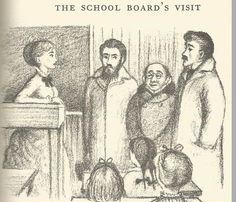
school board visit

When was the last time you heard of a school board visiting an actual classroom?

Who’s responsible for being in charge of your child’s education? It should be YOU!
Years ago, it was. Ever read the “Little House on the Prairie” series? Remember how the school boards came to be?

They were parents of the students, usually over a very limited region, such as a neighborhood or small town, and that board selected the teachers. Not only that, they told the teachers what they wanted their children to learn. If the parents didn’t approve of what the teacher was doing for their children, the teacher was booted out, leaving the parents and the school board to choose someone else more apt to meeting the individual needs of their unique children.

Tragically, we lost that system less than 150 years ago.

Why is that tragic? Because what’s replaced it is so massive and bloated that it cares nothing about your individual child’s needs, but is focused entirely on achieving goals to ensure that this country is producing workers to keep it competitive. Yes, that sounds dismal and even callous, but it’s the truth. No longer are we worried about developing the thought and knowledge of individuals, but in getting those individuals to conform to a group that we can more easily place in order to improve our economic standing. It’s all about money now, not about developing people. (I’ve ranted previously about that here and here.)

And it’s no coincidence that Common Core Curriculum, funded a great deal by Bill Gates, relies the old tried-and-failed assembly line system of education. (We’ve known for over a hundred years that all children can’t be successfully “produced” like a tool, but someone failed to let Gates—the creator of Windows 8—know that.)

Just getting the teenagers to pass the Final Administrative Competency Test—which over the years had been so simplified and leading in its questions that Mahrree often thought a sheep had a fair shot at passing it if only it could hold a quill to mark the ‘yes’ and ‘no’ boxes—was the purpose of education now.
~ Book 4, Falcon in the Barn

I bring all of this up because, once again, Common Core is in the news. As I write this (July 2014) a few states have abandoned it, reclaiming the right to educate their students according to the children’s needs (although state and even local school boards are still too big to be effectual). However, I live in a state notorious for spending very little per child (as if funding=educational excellence, another fallacy no one wants to address) and lately there’s been a spate of letters to the editors, and newspaper articles trying to defend it.

Just today I read one from a new school teacher eager for her first year of teaching, and enthralled with the idea of Common Core. She insisted all children surely can achieve at the same rates and levels, and I shook my head in sympathy. All of her naïve and optimistic enthusiasm would be drained by, I’m guessing, October.

However, I couldn’t help but notice, based on her letter, that she’d been very well indoctrinated by the educational department of her university, and I suspected that a variety of logical fallacies were likely employed to do so.

Mahrree realized some time ago that she was now the only teacher not enamored with the government’s control of education, likely because all of the teachers around her had gone through the Department of Instruction’s very thorough instruction, and were wholly converted to the notion that government knows best.
~Book 4, Falcon in the Barn

Does this come across as harsh?

Not any harsher than what I overheard a few weeks ago. I signed up my grade school children for some afternoon summer camps at the local elementary, and while waiting for them to finish their projects, I overheard one new teacher talking to another, slightly more seasoned. The new teacher said something like this:

“I’m really struggling to get some of these kids into the rubrics. I feel like I’m not representing them correctly. For example, last year I had a handful of kids easily complete tasks, earning them a score of ‘1.’ But then I had others that I had to cajole, bring back on task, then have them correct their work over and over until they finally got it right. [sigh of exasperation from the teacher] Yet on the matrices, they also earned a ‘1.’ But that’s just not fair, in my eyes. They shouldn’t receive that score because of how much work went behind it. [And in my mind I’m thinking, ‘Hey, sounds like they earned that grade more than those who achieved it easily.’ But wait—here comes the kicker:] So how do I force these kids into the right places on the district rubrics?”

Yes, that’s right; where do I shove them on the form? It was clear by his tone and gesturing that he really didn’t want to have to deal with children that didn’t easily complete the tasks, because they were skewing his rubrics, matrices, or whatevers.

But worse than that, his worry was not on meeting the needs of the students, but on meeting the needs of the school district administrators.

Stunned by the rather formulaic and cold manner in which the teachers proceeded to discuss the categorization of children, I didn’t say a word and pretended I didn’t overhear their conversation. (Besides, I’ve learned the hard way when to shut my mouth.) But that discussion hasn’t left my mind.

Why wasn’t the new teacher asking about why some of the kids struggled?
Why wasn’t he worried that many had to be cajoled, and brought back to task over and over?
Doesn’t that signal levels of boredom? Frustration? Is no one worried about that?
And since when did achieving something easily become the benchmark we embrace? There’s a great deal more learned in the struggle, in the revision, in overcoming an obstacle to finally get it right. We’re not celebrating that anymore? Apparently there’s no space on the form for, “Breakthrough Achievement: mastered the 3 times tables, after two long, difficult months. Celebrating all around.”
Oh, but there should be!

Over the years I’ve met several teachers who, having started their careers back in the early 1980s, have abandoned teaching before retirement age because, they told me, “It wasn’t fun anymore.” By that they meant, the joy was gone; they couldn’t read to their students (I remember listening to my teachers reading us novels up to an hour a day; yes, Little House on the Prairie), or develop crafty projects to reinforce lessons, or do messy but interesting science experiments. Greater demands from those furthest away from the actual children have siphoned off the elements of happiness—and learning CAN be a happy thing!—leaving these teachers depressed and worried for their students.

Most of these bright-eyed and optimistic teachers felt certain every student could be coerced into learning, but in a few years they, too, would slump into the same dreariness Mahrree witnessed in older teachers who knew the system didn’t work, but whose only power against it was to leave it. Maybe they, too, at some point remembered the time when parents directed learning, when students asked the questions, and when ideas were discussed, not forced.
~ Book 4, Falcon in the Barn

The worst part is, even after years and years of reforms, our educational system has NOT improved, and we are outpaced by dozens of countries. There are far too many studies to prove it. Google them, and join in the depression.

Then again, that was a generation ago now, and the only class Mahrree knew of that broke all of the lecture-regurgitation rules was her own group full of “special cases:” the students no one wanted because no one could handle them.

Occasionally Mahrree speculated that if she had additional “difficult” students to educate in her own way, that she just might have enough to foment a full rebellion.
~ Book 4, Falcon in the Barn

More and more I’m thinking, that’s not such a bad idea . . . In fact, it may eventually become the only option. And I’m making sure my kids are ready for it.

Just how murky does the water have to be?

“That is some nasty water!”

Those were the first words out of my mouth yesterday as my husband and I, celebrating our 26th wedding anniversary, pushed the canoe out on to the water.

0621141227

Scenic and slimy.

For years we’ve said we wanted to explore the extensive marshy regions in our valley, and finally we were doing it, setting out to see how many birds and critters we could find.
But we were startled at the condition of the water.

“Well,” my husband said, “it is a marsh. And I guess it’s supposed to smell like Shrek’s backyard.”
We soon learned how to paddle without splashing each other—we didn’t want that murky gunk on either of us—and enjoyed gliding past cranes, egrets, and the occasional pelican.

0621141227b

(He hasn’t really changed in 26 years. But I have. That’s why there’s no photo of me.)

Suddenly, we found our paddles sticking, because the filthy water hid the fact that just inches below us was thick mud that smelled like Shrek’s outhouse. Eventually we had to resort to pushing our paddles into the mud to get out of the shallow patches, a few hundred feet across.

Once, after our paddles were sucked nearly out of our hands by the deep mud, I entertained the notion of stepping out of the canoe to push us free, but couldn’t imagine getting any of that mess on me.

“Not quite as romantic as Venice,” my husband commented at one point as he tried to punt us out of particularly sticky area, overgrown with algae.

That’s when the carp started. Apparently the temperatures were right, and love was in the air. Did you know that carp try to spawn on top of the water? Well, we know that now. If we had a bucket, we could have scooped up the giant things, some at least 18 inches long, as hundreds of them further disturbed the shallow muddy water around us.

At the end of an entertaining and tiring hour (canoe seats are not known for their comfort) we headed back to the pier, grateful we never got wet. Even though the channel there was deeper—maybe four feet—that water still wasn’t anything I wanted on my body.

0621141227a

Nice reflection, but take a close look at that water.

Obviously, not everyone felt the same way did. We drifted upon a family—dad, mom, and a girl about 9 years old—floating on large tubes. The dad said to his daughter, “You ready?”
When she cheerfully announced she was, the dad tipped over her tube sending her straight into the muddy, stinky water full of immoral carp.

My husband and I shared the same look: Get that girl a bottle of Clorox!

The girl’s parents nodded to us, as if they were sure they were going to get the “Parent of the Year” award for finding a free swimming area for their daughter.

Interestingly, neither of her parents wanted to join her, even though she claimed the water was nice and warm (tons of bacteria, algae, and biology going crazy will do that to water), and eventually they helped her back onto her tube.

Now, it’s not like we’re opposed to swimming in nature, or think that swimming pools are the only safe way to go. We’ve shocked others by allowing our kids to wade in the rivers in Yellowstone National Park and the Pacific Ocean off the coast of Northern California. Lakes, reservoirs, slow moving rivers–even the mighty Mississippi–have all have bathed our babies, and always first their father. (I usually stand on the bank, with towels.)

GEDSC DIGITAL CAMERA

Seriously, it was 72 degrees outside, Christmas Eve . . . and we were NOT going in?!

The best looks we ever got from strangers, however, was on Christmas Eve in Myrtle Beach, where our kids happily charged into the ocean and declared it warmer than the Yellowstone River. Several families were walking along the shore, but not a single person dared set a toe in. (And sent several disapproving looks at me, which I ignored.) My husband has a habit of diving into any water he can find, and dragging his children along as well, but on one condition: the water must be clear. If he can see the bottom, never mind the season or the temperature—we’re going in.

But not everything is worth submerging ourselves into, even if it looks inviting. For my semi-aquatic husband to say yesterday that he didn’t even want to touch the marshy water (“Next time, we’re heading up the canyon so I can ‘accidentally’ tip us over in a decent river.”) the situation is indeed serious.

After we paddled a sufficient distance away from the family that thought nothing of letting their daughter play in a dreary water world, my husband said to me, “Just how murky does the water have to be before they decide it’s too filthy to toss their child into?”

I’ve been thinking about that ever since, in many different ways. Everything, it seems, is growing murkier, and at some point we have to look at the churning around us and say, “We’re not getting into that.”

For example, the past year I’ve been more and more reluctant to use a family email we established 15 years ago. Back then, the service provided general news–helpful and innocuous. But over the years I’ve noticed it become more salacious, more liberal, and definitely more slanted. Every day there are articles promoting behavior that I teach my children to avoid, biased pieces mocking values I hold dear, and outright distortions of my beliefs and occasionally even my religion.

That water, which we used to freely swim in, is growing filthy.

But the question for me personally is, How murky does it have to get before I finally abandon it? Some days I feel like I’m jogging through Sodom and Gomorrah just to pick up my mail. The fact that the address is linked to so many subscriptions, family, and friends is why we’re hesitant to close it. I know that eventually I’m going to need to, but what will finally be the tipping point that makes me cry out, “Disinfectant for my eyes! Now!”

Already we’ve abandoned radio stations, types of music, certain kinds of video games, the vast majority of TV, movies of certain ratings, and books recommended to us because of the filthiness we didn’t want to wade through. And interestingly, we haven’t missed what we’ve left. We’ve found other places to swim, so to speak. There’s all kinds of marvelous options available to us, if we just make the decision to find them.

So, even as I write this, I realize I need to get out of the waters the moment I see them becoming polluted (and figure out how to transfer everything out of my old email address). But I’ll be the first to admit: sometimes we’re slow to remove ourselves from the slime–even though we know staying clean is a whole lot easier than scrubbing off the filth–maybe because we have a hard time believing that all around us is becoming toxic.

Or maybe it’s become muddy so slowly that we haven’t even noticed, because we’re distracted elsewhere.
For example, take the photo below; I was trying, with my cheap phone’s simple camera, to take a picture of the pelican in flight (that white triangle in the distance). But instead, I ended up with a clear picture of the water around me that reminds me of a cesspool.

0621141252

Yeah, I still don’t know what to call this  . . . this . . .  stuff.

I think I need to be looking more closely, more frequently, at what’s surrounding my family and myself. And keep my feet in the canoe.

Mercy out, mercy in

I was walking down the hall at the community college where I taught business writing to adults returning to college when I heard the words, “I will be merciful to those who show mercy.”

I stopped dead in my tracks, because it was evening and the halls were deserted.

Sometimes God likes to smack me upside the head.
“Well . . . thanks for that insight,” I said quietly to the hall as I continued on my way, perplexed.

Moments later one of my students came jogging around the corner, looking frazzled. During the day he drove a big truck—a giant dump truck in the nearby copper mine. When he had introduced himself to the class at the beginning of the semester, he said he’d spent the last ten years literally driving around in circles, and was ready for something new.

He’d been a good student, but now he stopped before me, breathless. “Mrs. Mercer! I know the paper is due tonight, but I didn’t get it done. Last night my little boy got really sick, so I spent the night with him in the ER because my wife’s pregnant and also sick, and I know I should have taken my work with me to finish . . .”

Somewhere during his panicked explanation, I quit listening, because all I could think of was “mercy.”

Take his school work to the ER and write while he held his sick toddler?

While he explained in graphic detail what ailed his son, I remembered the advice I’d been given when I was a TA in grad school: “Students will give you any kind of excuse to get out of turning in work on time. Don’t fall for it. Now’s the time to teach them that there’s only one definition of ‘on time,’ and anything less deserves to lose points. The real world doesn’t accept ‘late work.’ A real job would fire them for ‘late work.’ Teach them about the real world.”

What stupid advice, I thought.

Before Big Truck Driver could go on, I knew exactly what I had to say. “How’s your son?”

He stopped and stared at me. “Uhh, he was dehydrated and they had to do an IV which he didn’t enjoy, but he’s much better today.”

“And your wife?”

“Better too.”

“So how long do you need to finish your paper?”

“But it’s due tonight!” he reminded me, unnecessarily.

(Ok, maybe it would have cracked my driveway . . .)

“I’ll be grading those papers for days. Get it to me whenever you can.”

He grinned and turned it in to me by the next night. He even drove it over to my house on his way out of the copper mine. (This was before we were in the habit of emailing documents, and I’ll confess—I was disappointed he didn’t show up in his giant CAT.)

Shortly after that incident, others showed mercy to me, and over the dozen years or so since that evening at the community college, I’ve observed this principle I’ve learned to call “Mercy Out, Mercy In.”

Some call it karma, but I’ve discovered the mathematics of it are not a one-for-one relationship. For example, if I were to assign a numeral quality to the mercy I gave to my student, I’d give it a 2.

But when Big Truck Driver handed me his paper that night on my doorstep, the relief and gratitude he exuded was a factor of at least 50.

Something had miraculously multiplied, likes loaves and fishes.

I know, because I’ve felt that same unexplainable math in my life. Someone shows me a touch of mercy, but what I experienced at the receiving end was a much larger measure than what was given. I’ve been granted all sorts of things I like didn’t deserve: time, understanding, forgiveness, forgetfulness, and second chances. And third chances. And fourth chances.

Just recently I was on the end of “mercy in” again. No, I’m not about to give the details of some horrendous experience, because those “share all” blogs make me intensely uncomfortable. But something smaller will illustrate my point.

After spending over a month trying to understand the programs and equipment necessary for recording an audiobook, then recording my first chapter again, and again, and again, I submitted it to my mentoring group.

Rejected.

I confess I shed a few tears, which I rarely do. I had invested four weeks, over thirty hours, sold some personal items to afford the necessary equipment, and suffered through a learning curve that went so steep it toppled on top of me a few times.

I wanted to quit.
But I couldn’t quit.
I was so frustrated, but I so desperately wanted to get it right. The situation seemed hopeless and I felt utterly stupid. How could others succeed while I just couldn’t seem to figure it out?

It’s hard to come back from feeling completely stupid.

Then there was some “mercy in.” One of the reviewers sent me the short message: “But the reading was very good.”

Numerically, that probably cost her a value of 1, and maybe took her all of 15 seconds.

But I felt it a value of 100.

I dried my tears, licked my wounds, spent the next couple of hours experimenting, reconfiguring, rerecording (my fifth time on that same chapter), then submitted again . . .

Almost there.

I fixed a few more items . . .
Submitted yet again . . .

SUCCESS!

All because a mentor handed me a morsel of encouragement, a tiny tender mercy, and it was enough to get me where I needed to be.

I wondered later if that mercy meant so much to me because of what had happened the day before.

I currently teach a freshman composition class, and two of my students turned in their assignments that were  . . . well, completely wrong. One unintentionally plagiarized while the other fell victim to what most college freshmen do: if you’re not sure how to complete the essay, write a book report. (The assignment was an annotated bibliography.)

I had a choice: I could fail them both, saving me from having to grade two more papers, or I could offer some “mercy out.”

The answer was easy. I wrote to each of them, “You’ve misunderstood the assignment, and as it is, you’d earn a failing grade. But I want you to learn this; you’ll need it for the rest of your college career. So how about you take another crack at it, and turn it back in to me in 48 hours? Here’s what you need to do . . .”

That response cost me all of five minutes, maybe a factor of 3, including the extra time I’ll need later to grade their late papers. Marginal. Minimal.

But my students were most grateful (after they were chagrined and panicked). The mercy I extended to them cost me so little, but they received so much more.

Interestingly, the day I finally got approval for my audiobook recording, someone else wrote on my thread where I had requested feedback. This man, who I’ll call Bill, wrote, “I admire your persistence. You have much more than I do. I just can’t seem to get this right either.”

I saw a study once that suggested people born before 1975 will always struggle with technology. Bill was born much earlier than I was, according to his profile picture, and I knew his frustration.

Once again I had a few ways to respond to this: I could have ignored him, or I could have said, “You’re right, Bill. It’s too hard. No one blames you for quitting,” because hey—he’s actually competition for those who may choose between listening to his book versus mine. Why encourage the competition?

But after I had just experienced so much “mercy in,” there was only one response.
I started a new thread, addressed to Bill.
“Don’t give up! Now that I’m so close, I can taste it, and it’s marvelous. You’re so close!”
That cost me maybe a 1.

The moderator of the site jumped in with, “She’s right, Bill. You are very close to success, and I have a friend that can help you.”

When Bill later wrote, “Thanks, all. I think I will give it another shot,” you could feel his hope growing, his frustration lifting, and his joy returning: all results of receiving mercy.

Ready to hit the “smite” button. While this is one of my all time favorite “Far Side” cartoons, I don’t ascribe to the gospel of Gary Larson.

And it cost me so little.

We live in a vindictive society, where three-strikes-you’re-out sounds quite generous compared to the ever increasing no-tolerance policies that leak into everything. That’s why it’s even more important for individuals to give—and receive—mercy. We can’t survive without it.

In other terms, we could consider this repentance and forgiveness, terms which I’ve discovered hold negative connotations in some people’s minds. “Repentance” often creates images of an angry Deity throwing punishments at sinners.

But years ago I heard a much better, and more accurate of repentance: a loving Father with His arm around His child and saying, “Yes, you failed. But you know, failure doesn’t have to be permanent. How about we let you take another crack at this? I’ll even show you what to do . . .”

I think Greg Olsen has a better handle on “mercy out, mercy in.”

I’ll be the first to confess that some days, giving mercy is much easier than others. And those “others” days? They can be brutal–no doubt. There seems to be no mercy left in the world, for anyone.

But over the years I’ve discovered that it doesn’t cost me that much–practically nothing at all–to show mercy: to be kinder, to encourage, to let slide a mistake, to forget a slight, to ignore an insult, to think the best of a person or situation, rather than imagining the worst.

And really, it’s easier. Vindictiveness breeds anger and revenge, and frankly those efforts are exhausting!

It’s simpler to smile, offer mercy, and go on. Then, when you least expect–but need it the most–mercy will come back at you, with more force than you could ever hope for.

Mercy out, mercy in.

Mahrree felt they had been granted so many miracles in such a short time that it seemed as if the tender mercies of the Creator were focused entirely on her family. It didn’t seem fair to be the recipients of so much.

They had suffered some too, but in the balancing of the Creator the miracles always outweighed the tragedies. ~The Mansions of Idumea

Whose children are those?

“[T]he children belong to all of us.”
~Paul Reville, former Massachusetts secretary of education, Common Core enthusiast, and Harvard professor

Mr. Paul Reville.
(And some of the kids that apparently belong to him.)

Mr. Reville (and I’m trying very hard not pronounce his name as “revile” in my head) recently stated the above about who the children of America belong to (read an excellent discussion in Forbes about this here), and as a mother of nine, I’m baffled.

What, exactly, does this mean: my children belong to the country? The government?

So you will now change my toddler’s diapers? Drive my daughter to lacrosse practice? Take my son to his doctor appointments? Why, thank you!

Will you now make their meals, help with their school work, and take them shoe shopping, one of the most horrible experiences a mother and child can endure?

Yes, I’m being facetious; you—whoever this nebulous “you” is that constitutes “all of us”—certainly don’t want the daily grind of parenthood.

So why does Mr. Reville and others claim to have part possession of my children?

This question has weighed on me for years now, and I think I have a few answers.

The short answer is, because they want the capital my child may potentially make.

That’s all it is: money. How much might my child be worth someday. Yes, I realize this sounds crass and simplistic, but I’m afraid it’s true. As a citizen who’s watched the progress of education since I was an education major in college 25 years ago (I gave that up to become a college instructor instead, at the urging of some of my professors), I’ve tracked the changes in theories, especially as they applied to my children.

I’ve come away with one discouraging conclusion: Public education is not about improving the humanity of our citizens; public education is about producing the best workers to make the most money for our country and our leadership. You see, good workers make more money, which brings in higher taxes, which means those with a stake in product development (i.e. Bill Gates, et al.) and government (primarily the federal) make more money.

The children belong to “all of us” because the children are needed to make those in power more powerful.

The End.
Yeah, dismal story.

And while it’s a true story, I refuse to let it be the story my children will be forced into.

Mr. Reville, and Melissa Harris-Perry who also believes that “we have to break through our kind of private idea that kids belong to their parents or kids belong to their families, and recognize that kids belong to their communities,” you’re wrong.

You see, we are faced with an ideological split, here; I believe in God (yes, here it comes—I already see you rolling your eyes, but there are still a few of us God-nuts around, so you better learn to deal with us civilly), and I believe that God has sent my children to my husband and I. And I also believe that He has given us responsibility to raise them.

As a bold proclamation on families states, “Parents have a sacred duty to rear their children in love and righteousness, to provide for their physical and spiritual needs, and to teach them to love and serve one another.”

Ah, there’s a sticky word: responsibility. You see, Mr. Reville, children are not possessions, they are not future capital, and they certainly are not to use for your own means.

They are personalities, ancient and precious, sent here to embark on a most remarkable experience: mortality. The purpose of mortality is to test their will, develop their understanding, and see what choices they will make in the face of trials and temptations.

You happen to be in the exact same situation—you, too, are an old soul trying on a new body and seeing how well you do in this remarkable Test.

But Mr. Revill, you do not own my children. I don’t even own them. They are my stewardship, which is a very different thing than ownership.

Stewardship requires an accounting to be made to Him who gave you responsibility in the first place. Mr. Reville, I fear that the only person you and others with your mindset think you are accountable to are yourselves. That makes you akin to your own god, and I can’t think of a single human that was ever a worthy god.

You may claim that my children belong to you, to the state, but I will not give them up without a fight, I assure you. Already I’m showing these arguments and theories to my children and telling them how “all of us” is trying to control their education and futures.

Yes, everyone, I freely admit it: I’m indoctrinating my children to what I believe is most accurate and correct. I call that “teaching.”

And public education, especially the kind that Mr. Reville is promoting, is also its own brand of indoctrination.

So my friends, we have a battle brewing—one that’s actually been around for thousands of years. Education and who “owns” the children is just its front; the real battle is about who has the power, and how much we’re willing to let happen until we begin to fight back against that power.

“Education is a weapon, whose effect depends on who holds it in his hands, and at whom it is aimed.” ~Joseph Stalin (Yes, the bad guy in the Soviet Union)

Every revolt, every revolution, every call to arms has always been about power. And this time, the battle is beginning in our very homes and schools, by those laying claim to our children, and those of us refusing to let them go.

Lew Rockwell, a politician with whom I don’t always agree (I’m currently a political agnostic: I don’t really believe in any political party) nevertheless makes this excellent point:

“It isn’t a coincidence that governments everywhere want to educate children. Government education, in turn, is supposed to be evidence of the state’s goodness and its concern for our well-being. The real explanation is less flattering. If the government’s propaganda can take root as children grow up, these kids will be no threat to the state apparatus. They’ll fasten the chains to their own ankles.”

No, Mr. Reville; my children do not belong to you. I hope that someday their humanity, knowledge, work ethic, and values will benefit you and their communities, but those benefits will come because their parents were concerned first with raising people who respect God and feel a sense of stewardship to take care of the world and each other. Their purpose in life is to become warm, thoughtful, loving humans, not obedient worker bees. And Mr. Reville, I’m sure that in your old age, you’ll hope you’re surrounded by the former and not the latter.

In the meantime, please leave my children out of whatever schemes you’re devising, because frankly, I have no faith in you or in others that clomp around to the same dull drummer.

Consider these two thoughts  from another celebrated university professor, C. S. Lewis:

Education without values, as useful as it is, seems rather to make man a more clever devil.

Of all tyrannies, a tyranny sincerely exercised for the good of its victims may be the most oppressive.

Parents–hold tight to your children. I used to think I only had to worry about shady characters driving slowly down my street holding out candy to my kids. Now, we have all kinds of folks trying to take possession of something none of us truly own.

     Perrin turned to his wife. “This morning I told you our most precious possessions were safe with Zenos. But they aren’t—”
     “Our babies AREN’T safe?!” Mahrree squealed, twisting absurdly to look behind her as if she could see her children sobbing from miles away.
     “Mahrree, Mahrree,” he chuckled, “I mean, they aren’t our possessions.
       Mahrree breathed deeply and patted her chest to catch her breath.
      “Sorry,” he kissed her on the cheek. “Zenos is fine with them, I’m sure of it.” His face grew solemn. “But it’s been pressing deep into my mind, ever since I called them our possessions. It’s just that . . . Mahrree, we’re told in Command School about the duties of soldiers and citizens. One thing we had to recite was that sending children to school was the citizens’ responsibility to the government.”
      Mahrree blinked at the odd phrase. “Our duty to the government? To hand over our children to their care?”
     “That was one of King Querul the Second’s statements, and the Administrators never abolished it. After all, citizens earn money which is then taxed and given to the government. In a way, the government—and it doesn’t matter whose—sees themselves as owning the people. They don’t serve us,” he whispered harshly, “but instead, we work for them. Without our taxes, they’re nothing. They’re especially interested in the children, because if they’re successful, then so will be the government. Or perhaps I should say ‘wealthy,’ instead of ‘successful,’” he grumbled in annoyance. “It all comes down to riches and power.”

         ~Soldier at the Door, Book 2