Optimism, Gratitude, and Grit can together defeat fear

One of my favorite writings assignments I give my 10th graders is the “Optimism, Gratitude, and Grit” write-up. We’re reading a holocaust memoir, and we talk about the qualities the survivors had in common:
1) the ability to maintain hope and optimism;
2) a feeling of gratitude, no matter the circumstances; and
3) grit and perseverance to never give up.
I then read out loud the chapters in All But My Life detailing the Death March to Volary, Czechoslovakia, and have my students mark the novel with sticky notes whenever they encounter someone demonstrating those traits. Then they type up the lines and label each with what trait it demonstrates.

I tell them later that this was practice for their upcoming research papers, reading a text for specific details.

But I really hope it’s practice for life. They can endure nearly any trial and succeed in nearly any endeavor if they’re hopeful, grateful, and gritty. I have them take online quizzes evaluating their current levels, and explain that each of these traits can be learned and improved.

I love hearing the quiet rustles of paper as they mark another part of the text as I read, love seeing their lists and their labels, and I silently pray, “Let this leak into their brains! They’re going to need it all!”

In many parts of the country, teenagers and college students are becoming fearful snowflakes who melt at the slightest breath of trouble.

Most of my downeast Mainer kids, however, I think are a little tougher. They’re more like snowballs–packed firm and ready to fly.

Some of my students have shrugged at the book, claiming they can’t get into it because they “can’t relate.” I sincerely hope that they never do, but I worry that someday they will, too much.

And it’s then that I pray they’ll remember to always have hope, always be grateful, and never, ever give up. (That’s a much better lesson to remember than how to write a research paper.)
fear and success

Get the Forest at the Edge series here.

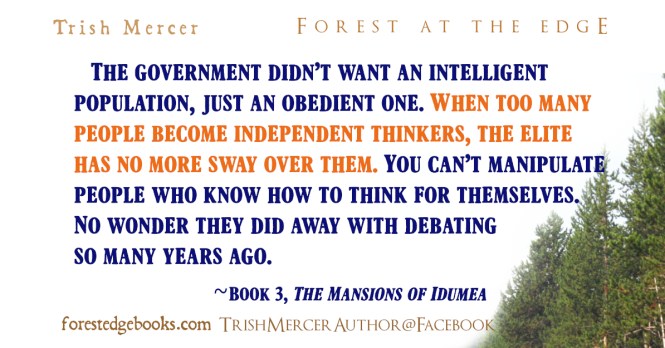
You can’t manipulate the educated, which is why they don’t want us educated

The entire reason for my attending a class as a grad student was to argue with the professor. She was on one side politically, I was on the other. I respected the woman immensely, but daggum, did she know how to push my buttons every week! It was like she was TRYING to make me angry!

Realizing that I was monopolizing each class by pointing out how she was wrong and debating with her for the next hour,  I shut up after the third meeting. Someone else needed to take her on, but strangely no one did.

She pulled me aside after that class and said, “What are you doing to me?! Look at the other students–they’re terrified and complacent. None of them  will ever make a peep. Don’t you realize that I pick subjects I know will rile you up? Come on! Show the rest of the class how it’s done! It’s you and me carrying this class!” Once I realized she was intentionally setting me up, the class was VERY entertaining. I remember thinking, “This is what universities are supposed to be about: an informed debate of ideas.” We rarely came to a consensus, but always realized just how close we were on so many issues.

That was 25 years ago. Ancient history. The world’s not like that anymore, sadly. Debate is stifled and opposing ideas are quashed in the name of “safety” for our fragile feelings. (

I told my college experience to my high school students this week. We’ve been talking about propaganda and logical fallacies, and I presented the quote from the most famous propagandist, Joseph Goebbels:

“If you tell a lie big enough and keep repeating it, people will eventually come to believe it . . . It thus becomes vitally important . . . to repress dissent, for the truth is the mortal enemy of the lie.”

I was pleased to see that my students were intrigued that people could debate issues and still be friends without agreeing. My professor years ago wrote me glowing letters of recommendation when I graduated, even though we disagreed on nearly everything. We respected each other and I am still grateful to her for making me analyze everything I believed.

But today there’s no more debate, no more respect for different ideas, no more desire to discover knowledge for ourselves. If someone disagrees with us, we cut off all discourse and cry “oppression!”

We’ve stopped thinking and asking and debating, which makes us very vulnerable to those who want to do the thinking for us.  In the end, the elite will repress us. It’s happened too many times before.cant manipulate the educated

Get Book 3, The Mansions of Idumea, downloaded for free.


Quit protesting and start doing; it’s not the government’s job but ours

This week in school I taught about the rescuers during the Holocaust and WWII. (We’re reading a Holocaust memoir and I like to give my students historical context.)

We learned about Irena Sendler, who smuggled out 2,500 babies and children from the Warsaw Ghetto, and about Oskar Schindler whose list preserved the lives of 1,200 Jews.

And about Sir Nicholas Winton, who arranged for 669 children to leave Czechoslovakia for new lives in England as the Nazis closed in on Prague.

And about Gail Halvorsen, the Candy Bomber, who started a movement to bring chocolate and gum to the Germans being starved by the Soviets in Berlin in 1948.

Each of these people did something similar: They saw a problem and they INDIVIDUALLY took action. They realized that–all on their own–they could provide relief.

None of them said, “The government really should . . .” because in most of these cases, it was the government CAUSING the problems.

None of them protested or chanted slogans: they went to work instead. The same thing happen in the Civil Rights movement: yes, there were protests, but there were also many individuals taking action on their own to begin with. For example, Rosa Parks set so much in motion by deciding she was no longer going to give up her bus seat.

Also this week my 11-year-old brought home a national publication teaching elementary students about current events. As I helped her answer the questions, she could feel me bristling when I read, “There are many solutions to the problem. First, the government should . . .” My daughter got a lesson she wasn’t expecting: I spouted off for ten minutes on how the government shouldn’t do anything. It was established to keep America safe–and that was ALL it was established to do–so that everyone else could get to the business of solving each others problems.

But it seems we prefer to have someone force what we want for us, instead of doing the work ourselves.

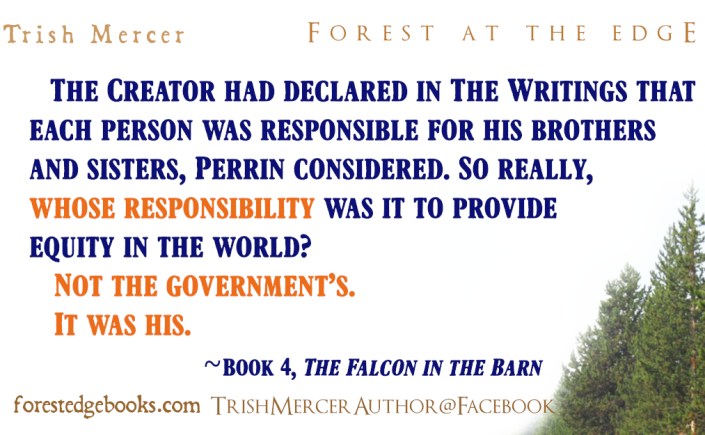
Governments have NEVER solved problems; only individuals have. So what suffering can you alleviate, what wrong can you right, and what work can you do today? Go!

whose responsibility

Get Book 4 and the rest of the series here.

The purpose of politics: not what we, the people, think.

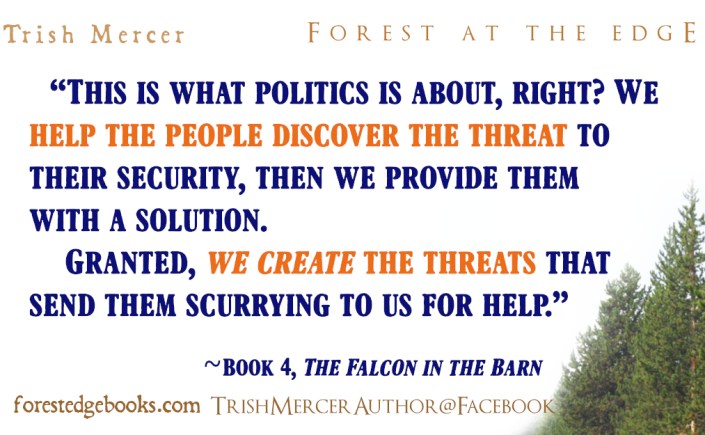
Ideally, our elected politicians solve the problems WE, THE PEOPLE assign them.

Ideally, politicians are OUR employees, working for OUR communities’ greater good.

Invariably, politicians forget that when they get a little power, and will do whatever serves their futures, not ours. There’s no wound they won’t reopen, no minor issue they won’t distort, and no real problem they won’t ignore to ensure their personal success. 

We need the return of true statesmen, and the departure of politicians. As James Freeman Clark once wrote: “The difference between a politician and a statesman is that a politician thinks about the next election while the statesman think about the next generation.”

politics makes threats

Get Book 4: The Falcon in the Barn, here. (And the rest of the series here.)

“We have learned by sad experience that it is the nature and disposition of almost all [people], as soon as they get a little authority, as they suppose, they will immediately begin to exercise unrighteous dominion.” Doctrine and Covenants 121: 39

You already have the power to balance your corner of the world

With so many in the US calling for “fairness” and for the government to ensure (enforce?) that fairness, we have forgotten that creating equity and caring for the poor is already within our power.

We each can balance the world correctly. In fact, we’re the only ones who can. There’s nothing stopping me or you. Change has always been grassroots. It never works from the top down. If we wait for someone to force us to do what they think is right, then we’ve agreed to a dictatorship.

Then it’s all over, for everyone.

corner of the world fair

Download the entire “Forest at the Edge” book series for less than $4 here.

It’s always been individuals who fixed the world; it’s never been a government

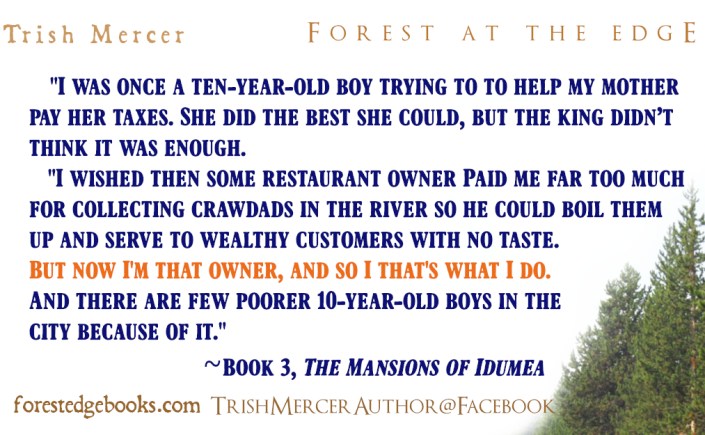
I know of many generous people who quietly go about doing great things for their neighbors. They donate money, they create opportunities, they sacrifice their time, talents, and everything they’ve been blessed with to help others through rough patches, to get job training, to give them a boost up to self-sufficiency.

And they do it anonymously. They choose to live well below their means so that those means can lift those around them. 

I know about these generous people only because they’ve helped us, or because a mutual friend revealed to me the lengths of their care for those around them.

I stand in awe of them, because no one told them or forced them to do it. And that’s why it works. Only individuals can care for each other properly; governments have never got it right.crawdads taxes and help


Download the full series for less than $4 here.

Socialism and the greed of citizens: what happens when they want more?

The biggest problem with socialism that no one seems to be addressing is the insatiability of people who believe they deserve freebies–free income, housing, food, health care, education, etc. The problem is greed knows no bounds. Those who espouse “free everything” are underestimating the selfishness of millions.

And then what happens when the freebies run out, which they always will?

buying loyalty

Download the entire “Forest at the Edge” book series for less than $4 here.

When we stop thinking for ourselves, we’ll be far easier to conquer

Almost every day I want to leave social media, frustrated with the snarl of words and growls of dissension I see every day. But I can’t; I shouldn’t. I need to know what’s happening, how people are reacting, and what new monster is looming on the horizon needing to be addressed.

As much as I’d love to hide in the corner of my closet (and the house I’m in currently has no closets, so that would be quite a feat) I need to know each day what’s going on. It’s the only hope I have to keep my family safe, because the monsters will come, if I notice them or not.people stop thinking


A student is raising a hand: brace yourself!

Students raising their hands during class? I used to think that was a good thing . . . for the first week of teaching. Since then I’ve discovered that what they say will be as relevant as dandruff shampoo is to Medusa.

We may be in the middle of comparing propaganda during WWII to modern day examples, or breaking down Katharine’s speech at the end of “Taming of the Shrew” when the hand shoots into the air as if some amazing insight has just hit a teenager.

But no.

“Mrs. Mercer! I just saw the Coke truck go by the window. That means it’s refilling the machines and I REALLY need a Mt. Dew to make it through the rest of the day. Can I PLEASE go get a Mt. Dew?”

The kid just finished chugging his Dunkin coffee. The last thing he needs is more caffeine. And if he falls asleep in class without his Mt. Dew, is that really such a bad thing?

Occasionally a student will have something interesting to share. Otherwise . . .

“Can I get my phone? I REALLY need to text my mom. It’s SUPER important! Like, I need to talk to her RIGHT NOW! She’s bringing me Subway for lunch and I want to change my order before she leaves.”

The hope is that their minds are on the topics, but . . .

“Mrs. Mercer, did you know that Joey and me got into a fight back in 5th grade?”
I grit my teeth at Joey and me. “And what does that have to do with identifying archetypes in this novel?”
“Nothing. Just thought you should know. I won the fight, by the way.”

That screeching noise you hear? My trains of thought, derailing a dozen times a day.

Even the sharper kids—ones who usually have something great to write or say—may surprise me with A Random Comment That Initiates Cringing (ARCTIC; these comments leave me cold).

“Mrs. Mercer! What you were saying reminds me—I need to run to the office for something.”
I heave a long, heavy sigh. “And how did my describing Odysseus’s consultation with Circe remind you that you need to run to the office? And for what?”
“I just remembered that I need to talk to guidance about my classes next semester.”
There is no one in guidance who is remotely like the witch Circe. “The next semester which doesn’t start for another two months?”
“Yeah. Can I go right now?”
Perhaps I’m Circe the witch they’re trying to get away from.

Train derailment, crash, explosion . . . I grip my whiteboard marker, the only thing that brings me back to focus as I glare at the student who looks at me oblivious that they’ve just tossed my entire buildup–now a fireball–into a gorge. Through my mind passes the desire to send the student past Scylla, the next monster we’re going to read about.

Image result for scylla in the odyssey

(Cat-scan of my brain when a student interrupts my lesson with an irrelevant comment.)

At that moment I pull out an oldy but a goody–so old they’ve never heard of it. “And what does your need to go to guidance have to do with the cost of tea in China?”

The entire class stares at me, dumbfounded.

See? I can do it to. Albuquerque. Snorkel.

While they, in confusion, try to figure out what I just said, I continue on with the discussion . . . and for my sanity ignore every hand that goes up for the next five minutes.

color of captain's eyesGet Book 1, Forest at the Edge of the World here. Free as a download, $9.25 as a paperback.


Books? Thinking? Are those “lit”?

[“Lit,” by the way, is the trendy way to say “cool,” or “neato, daddio.” Just typing that last one is totally not “lit”.]

These lines are what I hope none of my students will ever say about my class:

books thinking never saw before

These lines are also why I often read out loud to them, because even though they’re 10th graders, a few kids had never finished a novel until they took my class.

I worry that books and thinking are becoming as old-fashioned as typewriters and rotary phones. We rarely hear about either much anymore, and when we do it’s, “Hey, remember when we used to think about problems and read all we could before we made judgments? Or am I just remembering a time that never really existed? And am I using the word ‘lit’ correctly?”

Get Book 1, The Forest at the Edge of the World right here. It’s totally lit. (Maybe?)