Book 6 Cover: Flight of the Wounded Falcon, coming in May!

A few tweaks and edits still need to occur, and the back cover needs some adjusting, but I simply couldn’t wait any longer to show you the cover!

Book 6 front cover

Finding a model stand-in for an older Perrin Shin was, I was sure, going to be difficult. I needed a tall man with whitening hair and a presence.  I mentioned my quest to my oldest daughter, and Madison immediately begin sending me links to professors she’s worked with during her undergrad and graduate school years at Brigham Young University in Provo, Utah. I felt quite awkward “analyzing” these professors for Perrin-like qualities, as if on some kind of bizarre dating ritual. (I apologized in my head to their wives, and to my own husband, as I carefully scrutinized each candidate who had no idea he was part of this evaluation.)

Among the profiles was Dr. David Crandall. In fact, he was the first recommendation that my daughter blurted out. Madison has been his head TA for some years now, and when I saw his picture, I gasped.

Perrin Shin is an Oxford-trained anthropologist?!

I asked Madison what he’d think about standing in as a model, and she said, “He lives among the Himba in Africa every summer. You’re not going to find a more chill man anywhere. I’m sure he’ll do it!”

So I wrote an email, then rewrote it and rewrote it, a lengthy message trying to explain to him the book series, the character, what I hoped he’d be willing to do (dress up, walk around in trees, wrangle little boys), and I sent it off, holding my breath.

My daughter asked to see my email after the fact, and then she sighed. “Mom, he’ll read only the top line and skim the rest. He’s a busy man!”

But I’d already sent it, had oversold it, and my doom was sealed.

Until he responded a couple days later with, “Sure, why not? When?”

Uh . . . ok! I made costumes, I checked calendars for travel (I don’t exactly live near BYU), and found an afternoon he was available.

On the day of the photo shoot I became anxious and nervous, and during the two-hour drive I kept thinking, I’m asking a grown man–a stranger–to dress up so I can take pictures of him. Who does this sort of thing?! I don’t always do well with real live people. But I couldn’t back out now, as my teenage son frequently reminded me in the car when I’d start to hyperventilate again.

My entourage and I met him at the duck pond on BYU campus, where mature trees grow up a hillside. Dr. Crandall smiled amiably—yep, very Perrin-like—and strolled over to greet Madison, his right-hand woman in managing his dozen freshmen courses and teaching assistants. Intimidated by his height and presence, and that I was about to order him to do my bidding, I handed him the shirt I wanted him to wear. He put it on, looked around cheerfully, and said, “Now, what exactly are we doing again?”

I nearly snorted. Madison was right—he hadn’t read my explanations (there had been follow-up emails where I wrote him short stories, and he responded with a short sentence). I was struck by the notion that he didn’t have time to read my emails, but because he appreciated my daughter’s work, he willingly gave up half an hour to help Madison’s mother with whatever she was up to.

Feeling flustered as I always am when I try to tell people what I do (I’m horrible at marketing myself), I gave him the exceptionally condensed version of the Forest at the Edge series, and explained the set-up for the shots we’d be taking.

He nodded benignly and said, “All right, tell me where to walk.” He was so laid-back, so easy-going, I could have led him into Hades and I think he would have merely looked around and said, “Interesting architecture.”

Instead, I did the next worst thing: I released upon him a five-year-old and a two-year-old. Then I said, “Just try to walk with them, while I go far, far away up this hillside and take pictures. Boys, stay with Dr. Crandall,” knowing full well that wasn’t going to happen.

For the next half hour Dr. Crandall gamely tried to keep up with, drag along, or find the two preschoolers as they wandered off, got distracted, or got excited. [When you read the book, you’ll see how fitting the whole scenario was.]
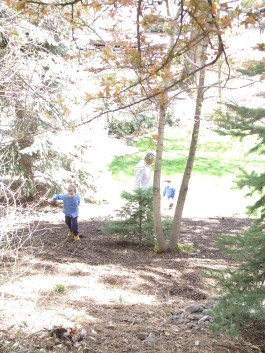
GEDSC DIGITAL CAMERA

“Dr. Crandall, we’re losing one . . .”
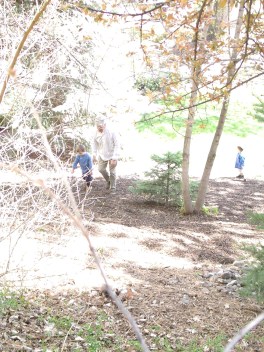
GEDSC DIGITAL CAMERA

“Now we’ve lost the other one . . .”

In the meantime, my son-in-law Austin Pearce and I took photo after photo, hoping that something might work since we’re not experienced action-shot photographers.

Eventually, we decided we had enough shots. Dr. Crandall took off the shirt I gave him and said, teasingly, “And a star is born! Good luck with your book.”

“I’ll let you know how it goes,” I said bashfully. “It’s part of a series. Umm, I’ve got a couple of readers. Actually, the series has been downloaded about thirty thousand times, so yeah—you just might become famous!”

See how I’m such a goober with real, live people? This is why I write, so I can hide behind a computer and not face anyone and babble goofily at them. In his field, Dr. Crandall is already famous. (His own book, The Place of Stunted Ironwood Trees is cited in this recent article.)

Once I looked at the pictures on my laptop, none were what I was hoping for. Initially I had hoped to capture profiles or sharp, distant images of Dr. Crandall, nothing too close or detailed, because I want readers to picture the characters as they wish, without cover art over-influencing or taking too much away. But none of those shots had worked.

Slightly discouraged, I remembered that none of my book covers have been what I originally wanted, but have turned out in surprising ways. I began to fiddle with half a dozen photos, when this emerged.

Book 6 front cover

And suddenly, it was perfect. Dr. Crandall gripping the two-year-old’s hand while earnestly watching the steep terrain he was leading him up (does he have perfect hair or what?), the curious/cautious expression on the littlest boy’s face, the other boy working to maintain balance—suddenly it was representative of many aspects of Flight of the Wounded Falcon, metaphorical bits I hadn’t anticipated but were manifesting subtly, and I knew I had my cover. The trees, the background, the angles, the motion—I never would have been able to stage that purposely.

I contacted Dr. Crandall’s secretary recently so that I could send him a thank you gift, and found out that he’s already in Africa again, hanging out with the Himba and a bunch of students for the summer. How chill is that? (Did I use that word “chill” properly? Shows how un-chill I am. Is “un-chill” a word?)

So chill, my friends–Book 6 will be coming soon in May (after a few more tweaks, a few more edits, and a proof or two). I can hardly wait to share it with you.

 

The Internet Civility Award (TICA): Who will you award it to?

The other day something astonishing happened on my Facebook page.
Friend #1 posted his feelings about government spending, and Friend #2 chimed in with an opposing viewpoint.
Friend #1 presented more evidence.
Friend #2 countered and began to escalate.
This is the astonishing part: Friend #1 explained his beliefs, then APOLOGIZED if he stepped on Friend #2’s toes.
Even weirder, Friend #2 responded by saying no apology was necessary and that SHE was sorry for getting emotional.

AND THAT WAS IT. CIVILITY! Kindness! Respect!
They remained friends, and everyone went merrily on.

I, however, messaged both of them and told them I believed they each earned The Internet Civility Award (TICA). Since there wasn’t one yet, I couldn’t give it. But here it is now. (Yes, I just made this up.)

TICA The Internet Civility Award

Copy and paste this on anyone’s social media page to recognize them for kindness and respect.

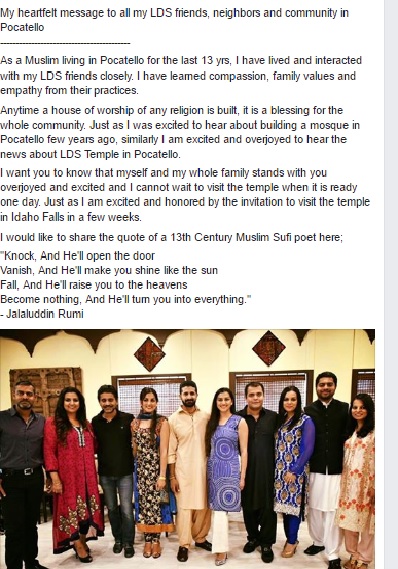
I’ve written about civility before, but lately I’ve been watching for it, and it’s out there. For example, the LDS Church (Mormons) recently announced plans to build a temple in Pocatello, ID, and a Muslim family who lives there posted publicly on Facebook that they were happy for their LDS friends.

Muslims and Mormons

CIVILITY! Kindness! Respect!

In looking for examples of civility to share with my children, we recently became addicted to “The Great British Baking Show,” not because we’re any good at baking, but because we love watching the contestants. It’s a competition, with each week a Star Baker identified, and someone sent home.

The amazing thing is watching these contestants HELP each other, GIVE each other advice, and when one of them wins, they CHEER their fellow competitor. And when someone gets sent home, they WEEP genuine tears for their loss.

Image result for the great british baking show hugging  Image result for the great british baking show hugging

CIVILITY! Kindness! Respect!

I realized the need to point out good behavior to my children during last year’s presidential election. My kids read over my shoulder when I’m on Facebook, looking for movie trailers and videos of screaming goats. My 9-year-old was stunned to see the posts of supposedly “mature” adults she knew, calling candidates names and behaving very uncivilly.

My 4th grader said, “That person’s a GROWN-UP! Why isn’t he acting like one?”

That great question led to a discussion about kindness and respect for all people, if we like them or not. Everyone deserves kindness. Everyone.

She agreed with me that we should unfollow this person, along with a few others, who didn’t demonstrate “grown-up” behavior online.

But I want to reward those who act like mature and civil adults (even if they’re still kids), so I will be awarding TICA  TICA The Internet Civility Awardto those who demonstrate excellent behavior in the face of rudeness, intolerance, and anger, and I’d love for you to join me.
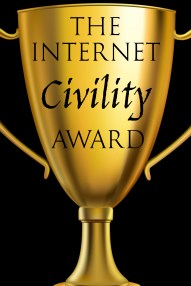

When you see someone approach a conflict with grace and dignity, with kindness and respect, paste this image to them and let the world know that here’s a person who still knows how to behave.

TICA The Internet Civility Award

Maybe if we point out civil behavior more often, more of it might occur.

“That’s the way to respond! With respect like that, you’re already two weeks ahead of everyone else.”

~Book 6, The Flight of the Wounded Falcon, coming May 2017

Don’t kill The Beast! I love “Beauty and the Beast” (even though as a conservative Christian I’ve been told to shun it)

I wasn’t going to see the new “Beauty and the Beast,” although I’d been looking forward to it ever since it was announced two years ago, because of that “gay factor.”

But then I decided to go anyway, because I remembered something: People are not always worth listening to.

So here’s this very conservative Christian’s take on it: I LOVED IT!

Oh, it was bigger than life! Visually gorgeous, with additions to the story that made it so much richer than the 1991 cartoon. The music and the characters all had greater depth, the story deeper meaning, and “those scenes”? Can we say, much ado about nothing?

I’d been betrayed.
Deceived.
Thrown into angst over really nothing.
In fact, I found myself quite liking the “gay” character LeFou. He was never as evil or nasty as some reviewers had suggested, and became the voice of reason toward the end, making some excellent choices. His orientation (which he’s not entirely sure about himself) had no bearing upon his improving character. (And yes, I caught all the verbal references, and I thought they were pertinent and hilarious.)

Indeed, I found myself rather ticked off that I’d ever considered boycotting the movie because of the raging on both sides of the issue. The “This is our first gay character and we’re proud!” was merely PR blustering, because once I saw the movie I was left thinking, “Sheesh. THAT’S gay? Gimme a break.” Then there was the “Oh, horrible Disney! It’s all over and the world will end with this movie!” blustering on the other side which now makes me roll my eyes. (And as for the old argument that the movie promotes bestiality? Those worriers don’t know what bestiality is. Belle clearly is attracted to the beast’s humanity, such as his knowledge of literature.)

All of which had me pondering as I drove home from the movie, “Does something have to be perfect—‘perfect’ according to my very particular standards and sensibilities—in order to be ‘good enough’ for me to enjoy?”

No. Nothing needs to be ‘perfect’ because why in the world should I expect the world to meet my peculiar sense of perfect? Or anyone else’s idea of “perfect”?

Another movie example: I finally saw “Moana,” and I’d heard criticisms of Dwayne ‘The Rock’ Johnson’s singing in “You’re Welcome.” Cringing in worry when he started, I soon relaxed, because you know what? He sang great! Better than me, that’s for sure. (And that’s not hard, either. Is there anything dear Dwayne can’t do?*) (Listen for yourself, and I defy you to not have this earworm stuck in your head for the rest of forever.)

Too many critics, too many snarky folks insisting that this wasn’t perfect in the movie, or that could have been better, kept me from watching “Moana” until this past weekend. And you know what? I LOVED IT! I’m getting the music to add to my walking repertoire.

I find myself scratching my head more and more frequently at the immense criticism flying around about every last little thing, and finding that very little of it is actually deserved. I need to stop listening to people, at least the critical ones. And at times it seems nearly everyone is a critic, for the worst of reasons.

It’s as if we’re finding power and authority in dragging someone else down.
As if we think we’re something special because we can nitpick someone else.
As if we can’t accept something unless it’s our perception of perfect.

Here’s the thing: NO ONE and NOTHING is perfect! (Not even “Rogue One,” which some of my Star Wars crazed children believe IS PERFECT, even though I LOVED IT!)

Ask yourself this: why should my definition of perfect be met by others? Why should I expect writers and actors and politicians and music and entertainment and stores and products and every last little thing in the world pander to what I believe is perfect?

How utterly self-centered and childish.

Here’s the other thing, the more important thing: God doesn’t demand that we’re perfect, either. He loves and appreciates us as we are.

Now, He tells us to strive for perfection, which, according to the scriptures, actually means becoming one with God the Father. Jesus himself didn’t declare himself perfect until after he was resurrected and was one with the Father, which tells me that perfection is impossible in life.

However, perfection is the goal, because it has to be. Nothing less, really, will do. As the great football coach Vince Lombardi said, “We strive for perfection, knowing we’ll never get it, but achieve excellence as we do so.”

Ah, EXCELLENCE! THAT’S the mark! Perfection is impossible; for you, for me, for anything we experience.

But excellence? That’s everywhere! I can create lists of truly excellent movies, music, people, books, art, national parks—and I’d probably never find an end to them.

“Beauty and the Beast” was excellent. So was “Moana,” and “Rogue One.” So are thousands and millions of other things.

Enjoy that excellence! See how someone else did something well, and let it inspire you to try to make something excellent in return. There’s no reason—no decent, good, honest reason whatsoever—to demean and denounce and degrade something minor in something that is excellent.

Because isn’t it wonderful that something can be marvelous, but the minor smudges left by the very human people who created it remain, and still it’s excellent?

So instead of harping upon these flaws, these perceived slights to our overly sensitive sensibilities, forgive them. Accept them. Take heart in them, that excellence abounds despite small failures.

Excellence abounds even in us, despite all of our failures. Maybe we need to be more accepting of ourselves to be more appreciative of the wondrous success of others around us. We’re not competing with them; we’re being inspired by them!

That’s why I’m not listening to the critical voices anymore, because think of the most critical people you know, those who are never satisfied, those who can always find even the smallest imperfection and shine a magnifying spotlight on it. Aren’t those also the most miserable people you know? Aren’t the most self-righteous also the least righteous?Image result for monuments to critics quotes

No one likes the critic. There’s nothing noble in criticism. Never has been. I’m beginning to suspect the most critical people are also those who never attempt to do anything themselves, so that they never are subjected to critics like themselves. Perhaps it’s jealousy that drives them to pick at others, or immense insecurity. Or fear of their own failure.

Criticism doesn’t bring joy. It doesn’t bring improvement. It doesn’t fix anything, either.

But appreciating someone’s efforts does. Identifying and acknowledging their successes. Learning from what they’ve learned. Rejoicing in their excellence, and taking from it that nudge to make something more excellent yourself—there, THERE is joy!

This world and people who make stuff in it are fantastic. Once we quit criticizing every potentially offensive item, we’ll discover what an amazing place we live in.

(And if you can’t, I’ll simply quit listening to you.)

Mahrree’s heart sank to her knees as she watched the three darling girls who she loved so much do their best, their eyes darting over to her as they read their lines, anxious for her approval, and likely fearing her criticism.

They had done their best. Who was Mahrree to point out anything else?

~Book 6, Flight of the Wounded Falcon, coming May 2017

book 6 teaser Critics

(*Totally unrelated to anything here, but an epiphany I had the other day–for those who have read my books, Perrin Shin is about 20% Dwayne Johnson. The other parts of him are Yun-Fat Chow, Colin Firth, Manu Bennett, and my husband, the cute man there in the corner.)Dave smiling

You don’t have to agree with me for us to be friends

I was 19 and terrified to realize that my supervisor for the summer was an openly gay man. It was the late 1980s, and I was from a sheltered community where “such people” were rare. Realizing that me, Molly Mormon, would have to interact with Flamboyant Paul made me think I’d made a mistake in taking that mall job on the east coast.

My suspicions were confirmed when I met my coworkers who immediately jumped in with predictable knocks on my religion when they heard I was from Utah. The fact that I didn’t join in on their drinking party as we unloaded the new freight didn’t help much. I was an easy target. My work environment was initially very uncomfortable, but since it was for only three months, I decided to grit my teeth and bear it.

I frequently noticed Paul watching me, and only much later did I realize that he must have understood what it felt like to be the object of scorn. One afternoon, when the store was quiet and I was dutifully putting away stock while Paul sat at the register with paperwork, he suddenly blurted, “Dogs!”

I looked up, surprised.

“Do you like dogs?” Paul asked.

Confused by the random question, I said, “I grew up with a small, white mutt named Fluffy.”

“Tell me about it.”

“We had him since I was a toddler. When I moved away to college, he’d grown very old and smelly and was going blind. He wandered off shortly after I left. My mom was devastated and my parents searched everywhere, but no one ever saw him again. As if when I left, he knew he should die.”

When I saw how aghast Paul was, I wondered why I’d chosen to relate such a depressing story.

But then Paul burst out with, “That is the SADDEST dog story I’ve ever heard! But I LOVE IT! I love sad dog stories! Ok, I’ve got one—listen to this!” And he went on to relate an even sadder dog story. I have no idea what it was anymore, but I found myself smiling and sniffling at the same time.

I realized Paul had been looking for something to talk about with the quiet, awkward Mormon girl who worked in his store, and finally we connected on dogs.

He told me all about the Great Dane puppy he and his boyfriend were raising, and we spent the whole afternoon talking dogs.

The next day I hesitantly mentioned, “Right now, I have a fish tank.”

Paul clapped his hands and said, “And WE want to get a fish tank! Tell me all about yours!”

For the rest of the summer we chatted every day, and when I left, I hugged Paul with genuine tears in my eyes while Paul sobbed, because we had become friends.

Paul demonstrated that I can still be friends with someone even if I don’t agree with their beliefs or behavior. Our relationship was based on what we had in common, and after three months, that was quite a lot.

About ten years later I was teaching a college writing class where the main project was a 15-page persuasive research paper. I had a very cocky and confident student who I’ll call Doug. I brought articles to class to analyze different points of view, and Doug made it point to quiz me on what leanings I had toward the issues, then launched in to argue against me. While I found him rather boorish, he certainly did liven up the class.

Soon he was meeting with me after class to dig deeper into a certain issue which I suspected was for his paper. He even took notes about my position. Sure enough, when he turned in the project, the little stinker had taken a position the polar opposite of mine. In fact, he argued against me, point-by-point.

When I handed back the papers a few weeks later, cocky Doug appeared worried, for once. He hastily thumbed to the last page, looked at his grade, and gasped.

His peers, who had been reading through his drafts—and warning him, too, about not directly writing against me—leaned over to see his grade. They, too, gasped, and one of them said, because Doug was speechless, “You gave him a 98%? But he argued against you!” (He had a few grammar issues, after all, to warrant losing a few points.)

“I know,” I said, “and marvelously, too. He almost persuaded me to his line of thinking.”

When Doug finally looked up at me, he was grinning. “I thought you’d hate it!”

“I did,” I told him, grinning back. “Because you made such darned good arguments.”

When the semester ended a couple days later, he gave me a quick hug as thanks, and we parted as friends with mutual respect. We didn’t have to agree with each other to appreciate each other.

Over the years I’ve discovered different kinds of people who I appreciate. For example, I’d never become Amish, but I wholly admire the life they live and how they remain mostly untouched by the outside world. I don’t want to convert to Judaism, but I deeply respect their culture, tenacity, and temerity. While I’ll never be a Muslim, I’ve gained greater understanding for them, primarily through chatting with a sweet Muslim family at a university dinner, and discovering how much we had in common.

I have many friends who, while not of my faith, still show support for what we do. On occasion I post pictures and stories about my children who are serving as LDS missionaries, and among those who comment kindly and like the posts are Lutherans, Baptists, and even a “recuperating atheist.” None of them are likely to join my church, but they’re happy to see the experiences of my children, as I am to see the successes of theirs.

We call this kind of appreciation and behavior “civility.” 

And despite what the news and social media would have us believe, it’s still a widely-held virtue, at least among many people I am blessed to associate with.

I have acquaintances who put up with my quirks and ideas without agreeing with them. One friend, who knows I’m trying to go vegetarian, delights in telling me how much meat she consumed that week. It’s friendly teasing, and I barb her back because we know we are safe with each other; we respect each other’s differences.

If I insisted that the only friends I’d have would be those who believed as I do in every last thing, I’d have no friends. I wouldn’t even be married, because there are number of issues on which my husband and I will never agree. Still, we manage around those, as we have for twenty-eight years, roll our eyes at each on occasion, then simply move on to one of many other things wherein we do agree.

No one in my family has precisely the same views on politics, music, literature, food, or education as I do. Yet still I love and appreciate all of them.

Indeed, if we all believed the same about everything, we’d be instantly bored with each other.

We need each other’s differences to challenge us, open us, expand us, and make us take second and third looks at what we thought we knew. We really don’t want homogeneity; we really need variety!

I’ve noticed that people tend to get fixated on rightness and wrongness. It’s been my experience that for a few key issues, usually dealing with life and death and personal agency, there are clear rights and wrongs.

But for the millions of other things we can bicker about, it really doesn’t matter. (I’ve heard people argue vehemently if cookies should be crunchy or chewy, of all stupid things.)*

Many dissimilar approaches can all be “right.” For example, what the “right” dress or music or meal may be for my adult daughters will not be the “right” one for me.

And I think there are times when all of us may be “wrong,” so what does “rightness” matter except to make more enemies in an argument where no winners can exist?

Civility doesn’t worry about who’s right. Civility chooses to exist despite its surroundings.

civility

My gay friend Paul never approached the topic of religion, nor did I approach the nature of his sexuality, except to ask where he found such a gorgeous man who could have been cast as Superman. We avoided the topics we knew might cause a rift, because we wanted to be friends.

Friendships can form even between people who spent an entire semester debating opposites sides, because of mutual respect for the other’s opinions. It’s been nearly 20 years, but I still think fondly of Doug.

I refuse to believe these incidents, or that civility itself, are from a past era, because I still see civility occurring among thoughtful, intelligent people all around me. Civility does not ...mean the mere outward gentleness of speech cultivated for the occasion, but an inborn gentleness and desire to do the opponent good. - Mahatma Gandhi

I see acts of kindness despite idiosyncrasies, and patience with others’ peculiarities. I frequently witness joy in differences. And if you want to be my friend even though I’ve got some strange ideas, I’d love to be friends with you, as long as you promise to keep me on my toes.

Let’s make civility fashionable again.

*Chewy.

“When people govern themselves honestly, there’s little need for mediation. ”
~Book 5, Safety Assured Leaving East of Medicetti

Book 6 Teaser: Marriage can be the scariest endeavor . . .

There’s the story about a young woman saying happily to her parents on her wedding day, “Now I’m at the end of all my worries!”

Her parents glanced at each other said, “True, but she doesn’t know which end.”

That’s not to discourage anyone from marriage, but to point out that there’s no greater adventure, no bigger challenge, and no more rewarding endeavor than figuring out how to leave peaceably with a stranger, and then welcoming more of them, in miniature, into your home.

book-6-teaser-marriage-adventure

Traveling abroad to some remote locale, like climbing Mt. Everest or backpacking through Australia, is generally considered among the greatest adventures, but nothing compares to raising a family at home.

And you don’t even need a passport or a bottomless bank account for this fantastic, exasperating, thrilling, terrifying endeavor.  In fact, not having those, and knowing you can’t escape, only adds to the intensity.

Savor it.

How to stop hating the opposition in 7 short steps

You despise that person (you know the one), and all that they stand for. Their face is on everything and everywhere, and why they’re famous or even admired baffles you to nausea. If they would just die (and everyone else in their little groups) the world would be a better place.

But that’s not going to happen, nor is wishing someone to die a mature attitude that anyone over the age of nine should still possess. Our rhetoric about people and public figures has degenerated to level of grade school recess fights, and it’s time to reverse that. Not just to teach the rising generation how to handle those who they don’t like, but for us adults to have some peace of mind, and some peace in heart.

As I’ve tried to find ways to get along in my mind with those people whose very existence rankle my ire, I’ve devised this list:

  1. Acknowledge that every person—EVERY person—has some good qualities. No one is ever wholly “evil” or “bad,” no matter what the memes say about them.
  2. Find that good quality. Identify it, and not in a sarcastic manner. Recognize that even the “worst” politician, athlete, Hollywood type, or even next-door neighbor has some worthy ability. Maybe they’re very tenacious, or are devoted to their kids, or aren’t fazed by criticism, or have a unique way of looking at the world.
  3. Next, grab hold of that quality, and admire Yes, you heard me right: admire that ability to do whatever, and isolate it in your mind as their redeeming factor.
  4. Do NOT add a “Yes, but,” after that, the words which negate that admirable quality you just identified. There is no room for “Yes, buts.” At least, not at this step.
  5. Now, whenever you see or read something about that person, and you feel your blood pressure rising with rancor, recall that quality, and say to yourself (and here’s where the “Yes, but” comes into play), “Yes, but she seems very skilled in applying eyeliner.” (See, it doesn’t have to be an exceptionally noble trait, but something you can admire.) “Yes, but he genuinely seems to like his current wife,” might be another. Or, if you’ve got nothing else, you could think, “Yes, but I’ve never heard of that person sending rabid gorillas to the international space station.” Repeat this line in your head about the person, over and over if necessary.
  6. And move on. Do NOT continue to read or listen to or watch that person who you so despise. Change the channel, turn off the device, click past them, and find something more settling for your ulcer.
  7. Finally, repeat to yourself: “I do NOT have to get angry about someone. I do not have to spout off in social media, or repost that snarky meme, or comment below the article about why that person should die. I can MOVE ON” (remember step 6?).

7-steps-to-not-hating-the-opposition

Repeat as necessary, and revel in your new-found peace.

You have very little time in life; don’t waste any of it being angry at a public figure who will never care what you think, and will never know.

Go pour some love on someone instead. Valentine’s Day is coming, after all.


Mahrree rarely thought about the twenty-three Administrators who now ruled, and likewise those Administrators thought nothing of her at the northern edge of the world.

~Book 1, The Forest at the Edge of the World

gorillas-and-iss

The chapter may be ending, but the book keeps going

Since last summer, I’ve felt I’ve been dying a slow death. We’re in the long process of moving cross country in June, but not until some major events in our family occur: a granddaughter born, a daughter off to college and back again, a son marrying, another son returning home.

I find myself looking at every day, every activity, and morbidly thinking, “This may be the last time that we ever . . .”

Miserable.

However, God isn’t pleased when I mope, and I’ve discovered Him slipping ideas into my head, such as, “Yes, but you’ve done that so many times, don’t you want to do something new?”

As I get book 6 ready to send out to my beta readers this week (yes, that means it’ll be revised and released in late spring!) I’m realizing that life is a number of chapters, but still all one book. I’ve had many chapters which could be called Childhood, High School, College, Husband and College, Small Children and More College, The Riverton House, The Maryland Year, The Virginia Years, The South Carolina Months, The Idaho Falls Months, The Hyrum House.

I rather expected that The Hyrum House chapter would take another 20 years. The house isn’t my favorite that we’ve owned, but the neighborhood, the views, and the rural location with access to big cities certainly is.

Everything was nearly perfect. Which, naturally, meant that God said, “Time to shake things up a bit.”

That shaking is making everything fall apart. Our family will be scattered, and we’ll be too far away from our adult kids and grandchildren to see them on a regular basis. Since we actually enjoy each other’s company, that’s a bit of a heartache.

That’s when I scowl at this chapter ending and think, “I’m starting to hate this book.”

Because surely the next chapter can’t fix anything, right? We’ve had a few chapters that I really didn’t like, and the photo albums from those years are never touched. I was grateful to slam the book on those pages when they were over.

(By the way, fair warning to my beta readers: there’s a chapter in Book 6 that you will hate. Maybe two. Ok, likely three. Three chapters you will want to slam the book on. But remember–the story’s not over yet.)

But other chapters, I let my mind revisit and enjoy them, but also find something odd happening: I don’t want to necessarily relive them. I was happy for that time, but there’s no going back, thank goodness.

I’ve never understood people who miss high school, even into their older years, wishing vainly they could go back to those glory days. Sure, there were good times, but aren’t there good ones coming, too?

It’s those little thoughts, that prodding from Above, that remind me it’s ok to bring this chapter of my life to a close. God knows that I get restless with stagnancy. That once I’ve worked on a project for a few months or years, I begin to look around for something new. When a job no longer is a challenge, I need a new one. (This book series has been the longest I’ve ever spent on a project, because it continues to challenge me every day.)

While I crave stability, I have to confess to myself, and my husband, that I don’t exactly mind that he changes jobs every few years, that my mind begins to feel claustrophobic in the same place, and while my anxiety disorder causes me to clench in fear at change, that trapped part of my head is screaming, “Lemme out!”

(Brains are messy places.)

It’s when I’ve memorized the street signs, the aisles at the grocery store, how long it takes to get to the pizza place, that I find myself simultaneously thinking, “How nice that I know that so well. That makes me feel secure. Now I’m bored. What’s new?”

So it’s with equal parts of excitement and dread that I watch the last few months of our Hyrum Chapter play out, that I remind myself that it’s still part of my book, that it’s shaped our characters in unforgettable ways, and that we take it with us wherever we go.

And I try to remind myself that the next chapter will also be interesting in unexpected ways, and that I very well may look back years from now upon our new Maine Years chapter, think, “Oh, but that was the best one yet!”

(I just barely looked at the date–which I haven’t done in days–and realized that yesterday was the anniversary of my mom’s death, three years ago. And yet, even her story still continues . . .)

Perrin quietly shut the door behind him and ran his hand along it. As soon as he let go of it, that would be the end—

He felt Mahrree squeeze his other hand, and she reached back and touched the door as well. “I’m sure they have oak where we’re going,” she whispered, and let her hand slide down the door.

And Perrin removed his, clasping it into a fist. He gripped her hand tightly as he whispered in her ear, “Come Mrs. Terryp. Let’s find our new world.”

And neither of them looked back.

~Book 5, Safety Assured Leaving East of Medicetti

Disconnectedness was marvelous! Now, how do I keep it up?

The past few weeks of holidays and visiting family and minor emergencies of illness and injuries and broken-down cars and blizzards has meant that I’ve been much less connected from the world than usual. Without time to edit Book 6 (which I’m actively doing again right now, never fear) I wasn’t on my laptop nearly as much, which meant that when I needed to take a break, or look up a reference, I wasn’t trolling the internet seeing what nonsense has been going on.

And it was . . . marvelous.

Think about it—to not know what irked thousands of people that hour? To miss the tantrums over nothing? To skip seeing who all was offended or marginalized or thought everyone else in the country is too pampered and here’s a thousand reasons why?

Delightful!

For those few weeks of less-connectedness, I was at peace, even though I was fending off massive whirlwinds of worry.

But not worrying about the world and its opinions was . . . heaven.

not-worry-about-the-world-heaven

Now those weeks are over, and now I’m back to hard-core laptopping, and I find myself pulled stupidly back into the discussions, the comments, the articles, the self-righteousness in every corner, and I wonder . . . How do I regain that lovely peace I had so recently?

I know part of my problem: FOMO—Fear Of Missing Out. I’m a recovering news hound, desperate to know everything that’s happening everywhere, because if I don’t know what’s happening, how can I be prepared for what may (and likely may not) happen to my family in the future?

I also have an obsession with reading everything that crosses my way. In the car, I glance at every billboard, every street sign, even graffiti. My eyes have to take it all in. It’s even worse when I’m on social media. Every blasted headline, word, image, comment, etc. I feel compelled to read. I’ve been like this since kindergarten: someone took the time to write it, I need to honor their efforts to read it.

It sounds noble, but it’s utterly absurd.

So I’m sincerely asking: how do you train your mind to hold back the avalanche of too much information, especially when you work on a computer every day? How do you discipline yourself to look to see only if your daughter responded to your message, and not get caught up in a circular debate elsewhere about what constitutes religious persecution?

I don’t have a smart phone, blessedly, otherwise I’d be on overload all the time. We also don’t have cable/dish/TV, but watch only Netflix and Amazon Prime, which gives us a great deal of control over what never gets into our house.

But that blasted laptop, which is my best friend and confidante, is also like a gossipy fishwife, tempting me with news about some frivolous or important issue (don’t know until I’ve read it), or some images of an awesome volcanic eruption (which I need to show my volcano-obsessed son) or something stupid some celebrity said (I don’t know what actress said at whatever award ceremony, nor do I want to; the only celebrity news I ever pay attention to has to deal with Star Wars or Harry Potter alum).

img_2147

Lappy, I both love you and resent you because you enable my worst habits. Fie you. Never leave me!

I’ve narrowed down my problems to Facebook (I don’t understand Twitter, I’m too old to “get” the other social media pages, I limit myself to visiting only 10 posts on Pinterest and go there ONLY if I have a legitimate need, and I have a Google Plus account that I visit maybe once a year, which seems that’s as often as anyone else visits Google Plus) and a couple of news forums (or those pretending to be, like Yahoo).

Oh, but they call to me. And I feel guilty if I don’t know what they’re crying about, or what’s happening with them, as if I’m doing something wrong by not being connected, as if I owe it to the world to join in the melee.

But then I’m annoyed with myself for falling for their inane click-bait titles, or wasting precious time on someone’s ill-thought-out tirade.

So tell me—how do you decrease your involvement in nonsense so that you can be more connected to the real sense of world of home and family and neighborhood instead?

How have you pulled heaven a bit more to earth?

I desperately want that. (And yes, I’m realizing that my posts for 2017 so far have consisted of asking for advice; this may be a new trend since I’m not clever enough to come up with something earth-shattering each week.)

“There’s nothing in this world I want anymore,” Perrin said. “Nothing except to take my family and leave it.”

~Book 4, The Falcon in the Barn

How do you teach your kids—and yourself—responsibility? My successes and failures, resulting in house-elfness.

Parents, I have a question: when do you show mercy and rescue a child, or when do you let them suffer with an unforgettable lesson?

How do you teach responsibility without potentially damaging your child?

That’s a quandary that plagues me nearly every day. I give you Exhibit A, my youngest daughter, age 9. Yesterday she asked blithely, “Where’s my coat?” as she was getting ready to walk to school in 17-degree weather.

That’s not what a mom wants to hear, that a coat’s missing. “Did you hang it up like you’re supposed to?” I asked, with an appropriate amount of nagging inflection.

“No,” she said, a bit indignant. “I brought it home, all wet, from playing in the snow at my friend’s house yesterday. It’s in that . . . bag . . . right . . . there.” Her voice became very quiet as she realized that house elves don’t work here, and that she hadn’t told me that her soaked coat had spent the night growing colder nowhere near the laundry room.

i-am-not-a-house-elf

Because I was on my way out the door to take my college-aged daughter to catch her bus back to school, I hastily threw the coat into the dryer, set the timer for 25 minutes for when my youngest had to leave, and hoped for the best.

I was torn between hoping her coat would be snuggly warm for her brisk walk to school three blocks away (I usually drive her on mornings like this), and hoping it’d still be a bit wet and cold to teach that girl a lesson in responsibility.

And then I spent the next few hours wondering, What would be the best outcome?

How do you know when to rescue a child from their irresponsibility, and when to let them flounder?

Somewhere along the lines I must have done something right with my oldest daughter, Exhibit B. She is so over-the-top responsible that she’s prepared for every contingency. As a freshman in college, she had an emergency food supply while other students were trying to scavenge pizzas from dumpsters at night, and under her bed she stored dozens of bottles of water, “just in case.” And the girl never ran out of toilet paper.

Growing older has only firmed that. On New Year’s Eve last week, she came up with her two little ones so we could go shopping while grandpa babysat. As she brought in a huge overnight bag, she began to apologize. “I know—we’re staying only a few hours, and the drive is only two hours, but what if the snowstorm comes in early? What if we’re stranded here, or in the car?” She had changes of clothes for all of them, extra bottles and formula for her baby, additional cuppies for her toddler, and snacks.

But I said, “This is what moms do: anticipate disasters. Prepare for the worst. Coming to the rescue for your babies is what you’re supposed to do.”

I was pondering this rescuing attitude as I drove with my middle daughter to her bus stop. At what age should the rescuing stop? Or at least be curtailed to allow the child to find solutions themselves?

My daughter mentioned that two of her roommates had gone back to school the night before and each had texted her with the same message: “I forgot my key. When are you coming back?”

I began to scoff sadly, thinking about those poor, freezing college girls assuming that naturally someone else would be responsible enough to unlock their apartment. Someone else would save them from the predicament they chose not to prepare for . . .

Until I spun around in my seat in the van and asked my daughter, “You have your key, right?”

She smiled smugly. “Of course I do.”

Whew. Thank you, Exhibit C. (By the way, her roommates were rescued by an aunt who lived in the area and brought them to her house for the night, since the apartment mangers were out of town.)

Before I could become too prideful that I’d taught this daughter right as well–at least to remember apartment keys–I remembered that she was the one I accidently left at a Target in Roanoke, Virginia when she was six, and has never let me forget it.

(All of her siblings said she was in the van! I swear it! I went right back again to get her! And I found her with a security guard eating popcorn as she sobbed! How often do I have to apologize for being irresponsible and trusting her four older siblings who swore she was in the vehicle?!)

(She’s also the child who nearly drowned in a high mountain lake when she was 7 without me noticing, and also walked into the deep end of a neighbor’s pool when she was 6, also without me noticing. It’s a miracle she’s made it to 18.)

I realized that this child has been conditioned to expect the worst outcome, to know her mother will be too distracted to realize when she’s in trouble, and that she best take care of herself because mom’s too big of a flake to do so.

So maybe that’s a good thing, letting them flounder in deep, cold water, literally and metaphorically? Look how responsible my middle daughter became because I wasn’t.

(Ok, yeah, that’s a pretty lame argument.)

Now I have to admit that my oldest is so responsible likely not because of anything I taught her, but because we moved around so much when she was growing up, and because I leaned upon her and her sister, only two years younger, so much for assistance. My oldest daughters have become responsible out of necessity.

Survival of the most self-reliant.

So back to my youngest; when I picked up her from school in the afternoon (worried that maybe her coat had been wet, was still wet, and it was only 22 degrees outside and walking home would make her deathly ill, even though I “know” cold weather doesn’t cause a cold because my second daughter who’s a very responsible nursing student will remind me of that fact, every mother knows deep down that yes, cold weather causes colds!), she cheerfully said, “Oh, my coat was toasty warm all the way to school. You should put it in the dryer every morning.”

I didn’t know what to do with that.

Instead of being seen as the kind and thoughtful mother who came up with a solution to make sure she wasn’t cold (rescuing), or my daughter thinking that she should be more accountable and at least tell me when something needs drying and hanging up (teaching responsibility), somehow I’ve been assigned a new task in the mornings of making sure Her Highness’s coat has been adequately warmed in the dryer for half an hour (house-elving).

After being a mom for 26 years, I realize I still don’t know what I’m doing.

How irresponsible of me.

I’m open to your suggestions.

What you really need at Christmas

This Christmas, I’m posting my best gift, early:

img_2051

Yes, it’s merely a picture of my husband shoveling the snow this morning. Two days ago he came home from working on the other side of the country. We haven’t seen him since he drove away last summer. (No, I didn’t chase him away. He willingly came back for the holidays, see?)

Over the past six months I’ve gained a deeper appreciation for single parents and the stresses they deal with all by themselves. It seems that each month I had a new little crisis I had to deal with, without another parent to pick up my slack.

But not this week. My sweet hubby got out of bed, looked out the window, and willingly headed out. That means I don’t have to guilt and nag my sons into doing it—Merry Christmas to me!

As he shoveled, I read online about a family whose healthy, college-aged daughter just died unexpectedly in her sleep. About a young husband whose wife and unborn baby recently died in a car accident. About a military family which is facing Christmas without their husband and dad at home, again.

And here I was, taking pictures of my hubby shoveling.

At Christmas we don’t need as much as we think we do. If you’ve got most of, or even all, of your family around you, that’s huge. This year we’ll see everyone except one, but we’ll be able to skype him Christmas afternoon.

But if you don’t have all of your family with you this year, and may never have them again in this lifetime, you most especially need Christmas.

Or, more specifically, He who’s birth we’re trying to celebrate in the middle of the over-scheduled chaos: the Savior.

Bring to Him your heartache. Bring to Him your longing. Bring to Him your anger, and He will give to you the greatest gift that you truly need: Peace of Mind.

Image result for lds jesus

Thank you all for a wonderful year, and may you find and feel that peace that the Savior brings–that lasting peace which tells you that while your life may make no sense right now, it will in the end. Just hold on, believe in Him, and no matter your circumstances, every Christmas will somehow be merry.

In a way, Mahrree felt almost cheated, almost dismayed, for feeling such dejection in the world, and had she only known how swiftly all that loneliness and longing would be swept away—

No, she did know. A small part of her had always known that whatever misery she was enduring would be seem but a small moment in retrospect. The Writings had said so, but it was as if her physical brain couldn’t fathom what her spiritual mind already knew. No wonder her feelings were often in so much conflict.

But now, with the limitations of her mortal mind lifted, suddenly everything was easier. She could remember the sadness, but marvelously she no longer felt it. She held the memories, but none of the pain.

No wonder they called it Paradise.

(Teaser from future book 8; don’t worry, book 6 is coming, very soon. And so will be books 7 and 8!)