
I’m staggered to realize it’s been almost a year since I’ve posted! Since last April I’ve moved across the country again (6th time in my life), then moved once more locally while having pneumonia at Christmas, started teaching at a new high school, gained two grandbabies (over a dozen now), and had a host of other events which have made time scream by. I’ve also started writing new books and hope to have one ready to publish next year.
In the meantime, I’VE GOT A REAL AUDIOBOOK on Amazon for you!
I better explain. Yes, I’ve recorded all of my books available at my Youtube channel, and tried many different ways to take that extracted audio and make it a “real” audiobook on Kindle. But I’ve had a <curse word, curse word> of a time getting those files appropriately formatted. (Three years—no success; it’s because I’m a child of the 1970s, and it’s scientifically proven people my age struggle with tech.)
So when Kindle invited me to try the Audible Audio Virtual Voice Studio I decided, “Hey, why not? Their voices can’t be worse than mine.” (No, this is not a paid promotion. When you read this, you’ll see no one would pay me for this.)
Now that I’ve spent a couple of weeks listening to Female Voice #23—whom I have dubbed “Glorinda” for no discernible reason—read aloud all my chapters, I have a few feelings, some quite strong.

Glorinda’s grade: B+
First, because I’m a teacher, I’ve graded her reading of my book. All teachers will understand the struggle of knowing when to give a B+ or an A-.
Glorinda’s hovering at 89%. But does Glorinda deserve an A-? Here’s what I’m dealing with:
Names.
First, when you initially listen to the voice and the inflections, it’s quite exciting. Hey! She’s speaking my words—for free! And doesn’t sound entirely robotic!
And then . . . she starts tackling names.
When you write low fantasy, you make up names, and it would have been easier for Glorinda if I’d named everyone “Jane” or “Elliot.” But I did not, which means that frequently I’d hit “pause” and screech, “Glorinda! That is NOT what I wrote. C’mon!”
And then I had to teach her how to say the words right by inserting the correct pronunciation. The problem is, Glorinda doesn’t know phonics as well as she should.
My main character’s name is Mahrree, which rhymes with “sorry.” But not to Glorinda.
I’ve inserted the following pronunciations trying to get her to say it correctly: MAWree, Maury, Mahhrry, MAHree.
For some reason Glorinda feels the need to speak the “h” like it’s random French or German, resulting in disturbing guttural sound in the middle:
“Ma<HACH>(like she’s clearing her AI throat)—ree”.
Think of AI hacking on a huge furball, then sounding proud about it.
The first time she made that horrific noise in my headphones, I jumped back from my chair and cried, “Glorinda! What the HECK was that?!”
Then, just to test her, I changed the pronunciation to “Whattheheckwasthat,” and she said it flawlessly, proving she could handle difficult names . . . if she really wanted to.
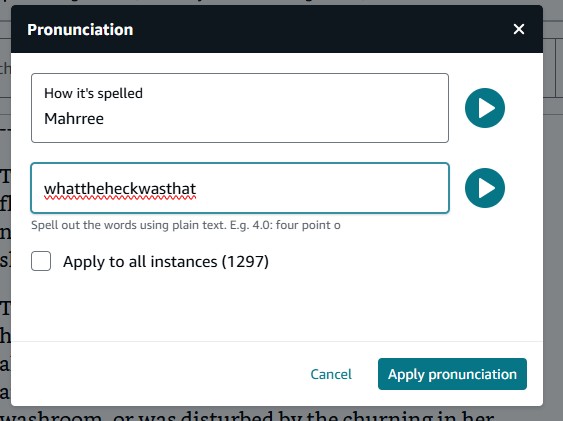
I think she was just messing with me, because I ended up giving her about 10 different phonetic (at least I thought they were obviously phonetic) suggestions.
She finally got the name right about 85% of the time with the spelling of “Mawree,” but sometimes she thinks it’s French and it becomes Marie (with a soft guttural “h” in the middle), or if she thinks the speaker is excited, there’s an abruptly high-pitched REE! at the end of the name. So it’s “maREEEEE!” (Yes, that many “ee’s” and even the “!”)
That’s when I pat my laptop and soothe, “Calm down, Glorinda. It’s ok. Shhh . . .”

And then there’s Mahrree’s mother’s name: Hycymum. I immediately knew this would give us both fits. When it first popped up in the text, I actually groaned out loud.
Suggestion to the programmers: there needs to be a way to tell Voice #23, and all the voices, what syllable to emphasize. I tried capitalizing it to draw attention to it: HYsimum. But Glorinda would read, in a very loud voice, “HIGHSEE mum?”
Yes, there’d often be a question sound at the end, as if saying, “Human woman, what the freak with this name? Are you serious?!” pitched even higher.
After about another eight iterations of the spelling, we mutually agreed this would be the best we could generate: Highsimum. See, Glorinda can read the spelling of “high,” but has no imagination for the rest.
Again, 85% of the time, it’s ok. The other times the name is suddenly rushed, or the end of it is weirdly a question, and sometimes I think Glorinda just wishes I’d named her Martha.
Well, I’m sorry, Glorinda. “Martha” is not a name in my world, so just learn to read!
And then there was the name of the land: Idumea.
Now I realize this is a historical name, albeit obscure, but for my purposes I wanted a slightly different pronunciation.
Oh no, you don’t, says Glorinda. In fact, she creates her own pronunciation was really emphasizes the DOOM in it: IDOOM!ia. (Yes, she somehow inserted ! before the last syllable.)
I hate to admit I rather liked that emphasis a little, because this place does mean DOOM! for my characters.
But dang it, Glorinda! No! It’s pronounced I-doo-ME-a.
She disagreed. I’d yell at her, she’d sweetly mispronounce it over and over . . . (I guess I could have stopped pushing the button to hear her . . .).
Again we tried many ways to come to a consensus, and finally she pronounces “Eyedoo-MEEa.”
But she’s so specific about it, even taking a little pause as if to say, “This author wants me to say it like this—hold on, here we go. Ahem. Eyedoo-MEEa,” and I can sense her looking at me through whatever eyes my laptop has and asking, “Did I get it right that time?” in her smarmy little way.
BUT AN UPDATE! Now I’m working on book 2, and when I put in that pronunciation for THIS book, guess what she says now? EEEE “Y” doo mee uh. (And she adds a touch of snark to it, too.)
She’s so totally messing with me now . . . What does it now sound like in Book 1?! I have to go back to see.
Homographs
Names aside—and I had to teach her 12 names to get correctly—Glorinda also struggled with words that are spelled the same way but pronounced differently based on context. It’s like hearing some of my struggling 9th graders read out loud, so I tried to be patient.
Glorinda didn’t know if Perrin was taking a bow, either on stage after a debate (bough), or also grabbing arrows to shoot someone (boe). He took both, for which I had to fix the pronunciations.
Same with lives. Perrin takes some lives, and he also lives. Glorinda has no idea how to tell the difference.
But something she should have known—which is wholly the fault of programmers—is how to pronounce mischievous. No matter how many times I corrected her, she insisted on saying: mis-CHEE-vi-ous. Some mis-chee-vi-ous programmer may have done this on purpose, just to vex people like me.
Or maybe they genuinely don’t know the word is rightly pronounced MIS-chi-vous.
Ah, you mischievous minx, Glorinda . . .
And the speaker is . . .
Another frustration with the poor AI woman is that she would lose the thread of conversations. Kudos for trying to affect male and female intonation. That’s where I give her a solid A . . . for effort. Because she’d get it right about 89% of the time. (See my grading dilemma?).
Writers will often drop tags between speakers to keep the flow of dialogue uninterrupted. But poor Glorinda would start affecting a male tone for the female, and vice versa.
Often as I was listening to the text, I’d be watching a YouTube video (“8 shocking things to make with Dollar Tree wooden boxes!”) and the conversation in my ears would go slightly unhinged. I’d have to hop back to my text (and miss #4) and see what she was trying to do. The conversation made no sense at all, yet she kept going. The conversation below from Book 2, between Little Poe and Mahrree, is unintentionally awkward so far with the inflections. But I think the program is learning . . .
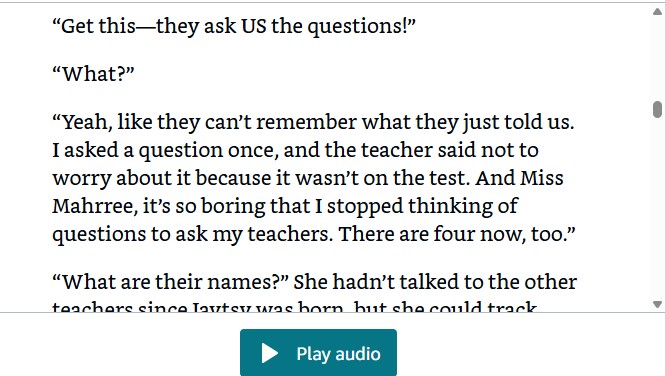
Glorinda reminded me of one of my daughters trying to sew when she was 13, sitting at the sewing machine and not realizing she could take her foot off the pedal. Instead she miserably watched the machine chew and spit out her simple pillow case in a mass of thread and mistakes.
Glorinda also would just kept going, unimpeded, stringing together lines of text, and all I could think was, “Well, that is how it’s written, so I have no idea how to rescue her.”
There are some big positives.
On the plus sides, Glorinda’s voice is very natural sounding, most of the time. (I was tempted to use a British accent, just to add that level of distinction, but worried about how to phonetically spell things in British.)
While exclamation marks might make her squeal at inappropriate moments, instead of sounding stern and angry, and when the text says a character whispers and sometimes Glorinda thinks it should be bordering on a shout, she is far, far better than the robotic voices that have plagued listening to pseudo-audio-books for the past decade.
She is trying, she really is.
Almost real! At times I almost believed she was a real girl, putting some real AI heart into my words, feeling some real AI emotion. Just about 89% of the time.
It was almost enough to ignore that awkward 11% of the time.
As I complained to one of my sons who observed the process about Glorinda’s lack of understanding, I realized that if she improved too much, became too slick and too real, “understood” too much, it would likely feel unsettling, even creepy.
It’s ok that she’s not perfect, because then I can remember this isn’t a real person, but a very good approximation that has just enough randomness to remember Artificial Intelligence will never replace real humans.
At least, I’m praying it never will.
Final grade performance
It’s 89.44%, really close to an A-. Maybe if they fix “mischievous” I’ll bump it up.
But how annoying was it to make?
The process was gloriously easy, compared to my past three failed years of trying to fine tune my own audio to meet exacting specification which I just don’t understand. So good job to Audible and KDP. I took the time to listen to every chapter and found additional little errors I’d not yet fixed. (All are fixed now and republished in every form.)
They even allow you to add pauses of varying lengths, if necessary.
It would have been even more helpful to remove pauses, too. Sometimes Glorinda hesitated for interminable lengths of time before continuing, especially if a sentence breaks off like this–
Then she wouldn’t do the next line for maybe five minutes, when really the next line of text should come immediately after that m-dash.
That’s what the m-dash is for, Glorinda! (And why I’m keeping her at a B+).
So here you go: my first book computer-voice generated book, The Forest at the Edge of the World, read by Glorinda.
If you want to hear MY voice reading, you can go to my YouTube channel (I have no craft videos about Dollar Tree, sorry) and hear my very rough, awkward, rushed attempts, especially in those first many chapters. I became smoother and more comfortable around my third book, so I guess grade wise, I’d give myself an 85%, a solid B.
So for this Book 1, The Forest at the Edge of the World, Glorinda beat me by just that much.
(Also, here’s an updated photo of me from a recent family photo shoot. I realized it’s been over a decade since I put up my photo. In case you ever run into me, you’d never recognize me:)

 Forestedgebooks.com